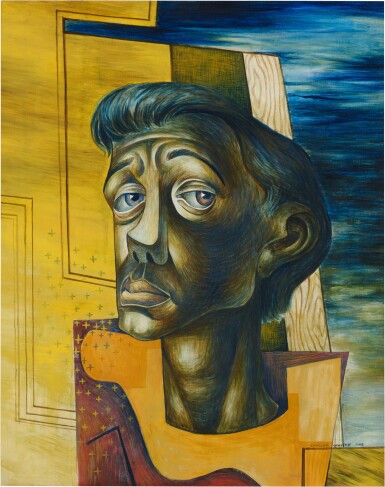
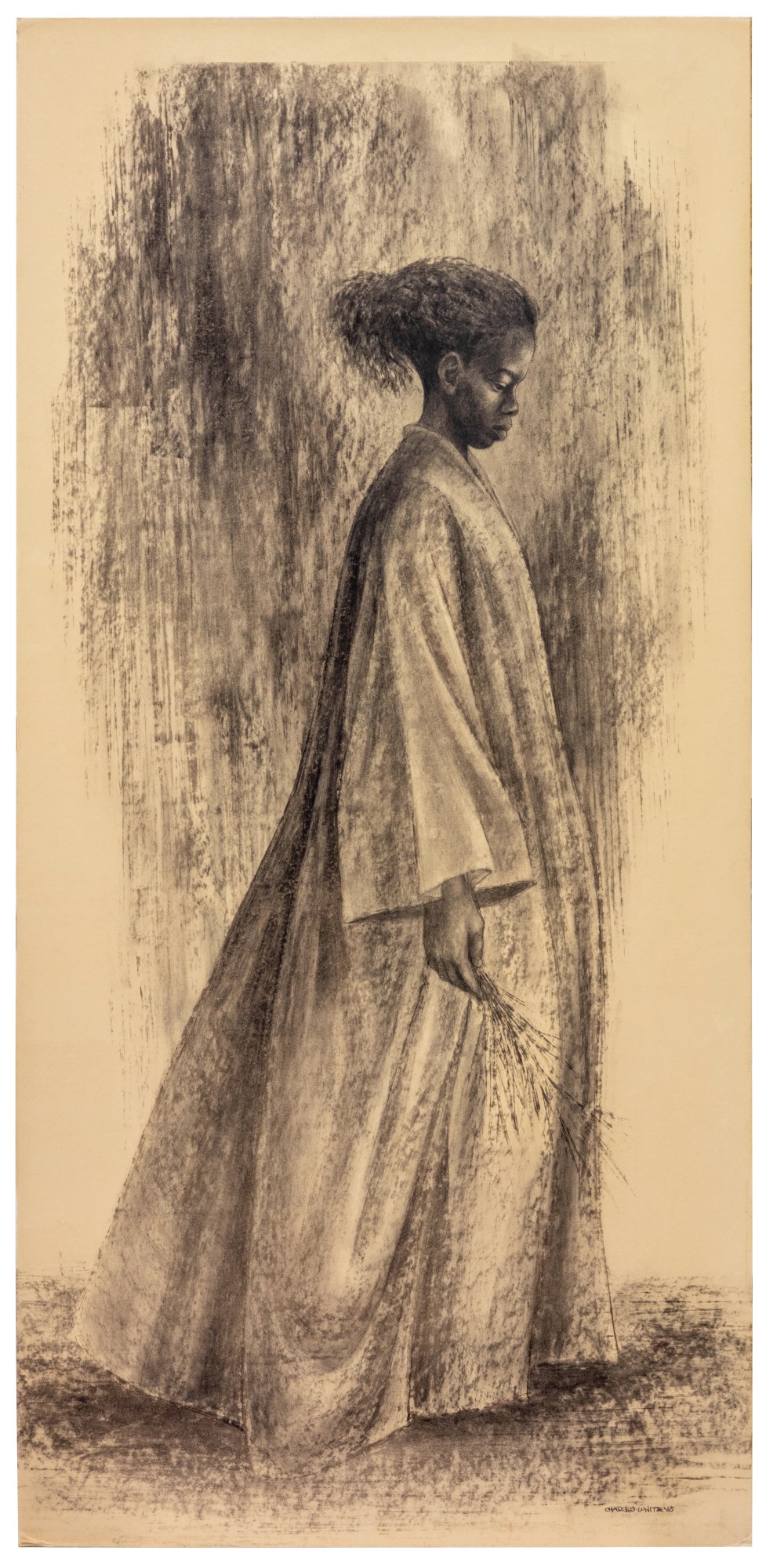
Charles White
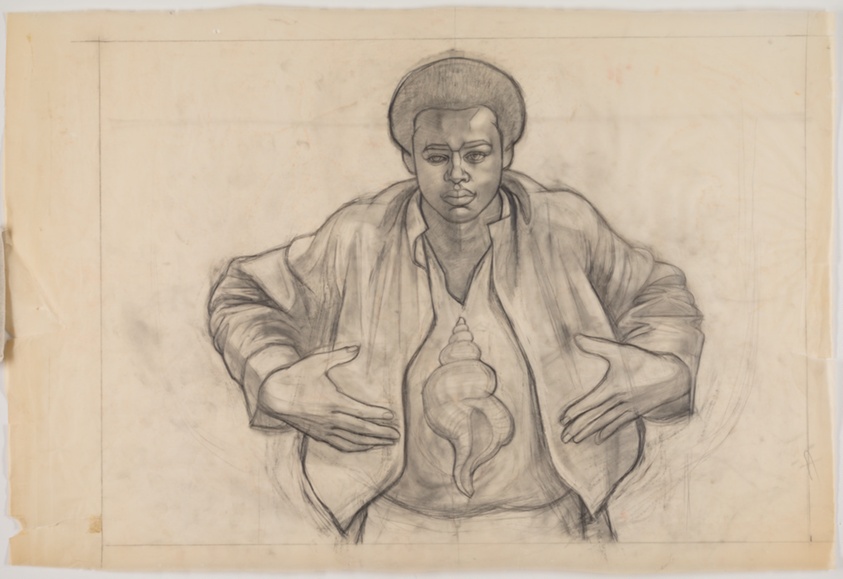
Charles White, Drawing the World Into Dignity
Artist Spotlight · The Collection Editorial
“Art is not a luxury for a people in the struggle. It is as necessary as food.”
Charles White
In 2018, the Art Institute of Chicago and the Museum of Modern Art in New York mounted a landmark joint retrospective of Charles White's work, the first major museum survey of his career in decades. Titled "Charles White: A Retrospective," the exhibition traveled to the Los Angeles County Museum of Art, the city where White had spent the final chapter of his life and career. The response was overwhelming. Critics, scholars, and a new generation of art lovers encountered for the first time, or rediscovered with fresh eyes, an artist of staggering technical command and moral seriousness.
Charles White
Sound of Silence, 1978
The retrospective made undeniable what a devoted circle of collectors and historians had long understood: White is one of the essential American artists of the twentieth century. Charles Wilbert White was born in Chicago in 1918, the son of a steelworker father and a domestic worker mother. His childhood on the South Side placed him at the heart of the Great Migration, surrounded by a community that had traveled north in search of dignity and opportunity. His mother recognized his gifts early and made real sacrifices to nurture them, enrolling him in Saturday art classes at the Art Institute of Chicago when he was still a boy.
That early exposure to a world class collection, combined with the vitality and hardship of Black Chicago life, gave White a subject and a purpose that would sustain him for the next six decades. He was never an artist in search of meaning. Meaning found him first. White's formal training took him through the School of the Art Institute of Chicago, where he studied in the late 1930s, and later brought him into contact with the artists and intellectuals of the Chicago Black Renaissance.
Charles White
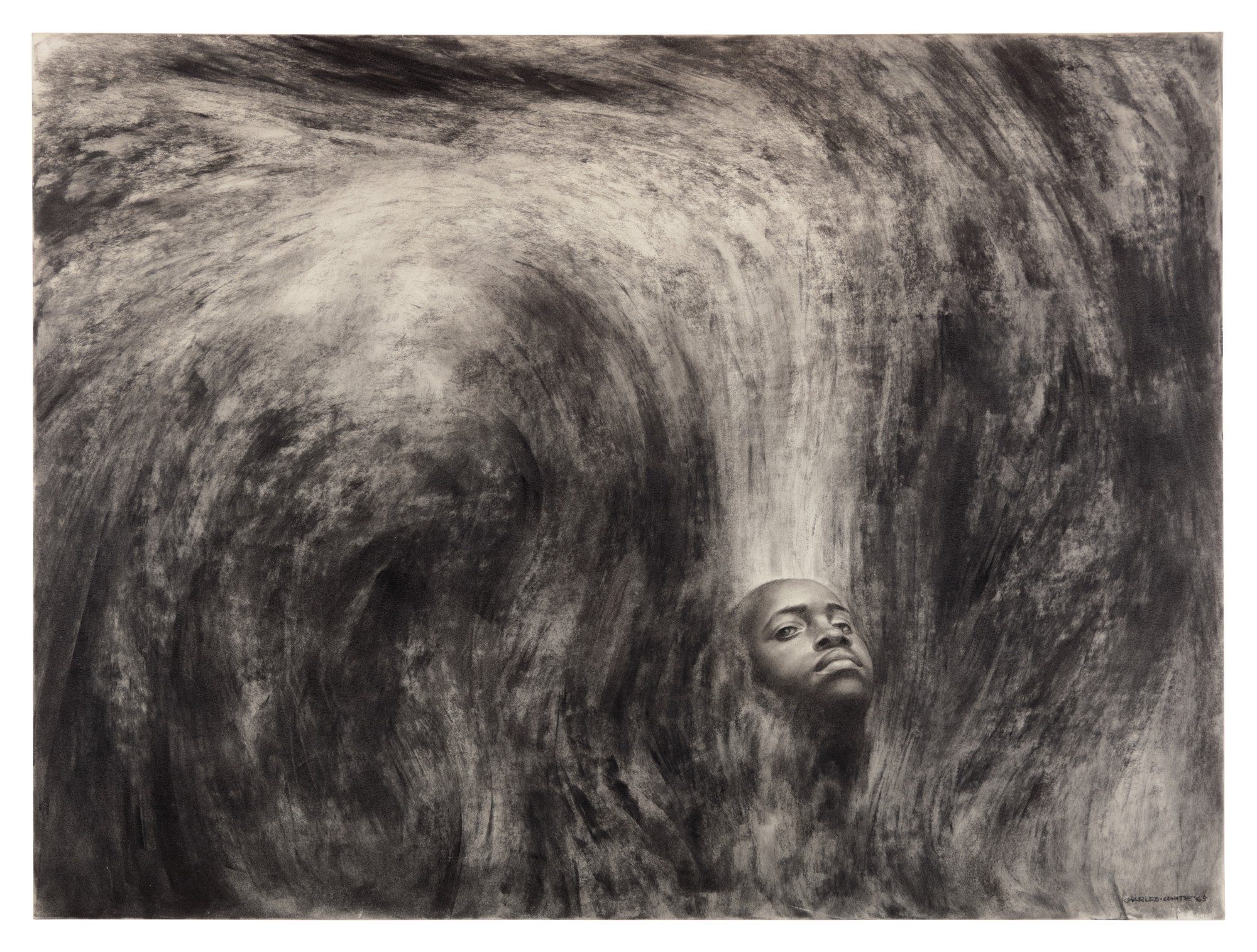
Nobody Knows My Name #2, 1965
He was part of a remarkable cohort that included Margaret Burroughs and the sculptor Marion Perkins, and he moved in circles shaped by the idealism of the New Deal and the urgency of the civil rights struggle. In the early 1940s he relocated to New York, where he studied at the Art Students League and became embedded in the cultural world of Harlem. He also spent time in Mexico studying the muralist tradition, and the influence of Diego Rivera and José Clemente Orozco on his sense of scale and compositional ambition is unmistakable. White absorbed these influences without being consumed by them.
“My art is a drawing of breath, a visual song, in praise of Black people.”
Charles White
What distinguishes White's practice above all else is the medium of drawing itself, elevated by his hand into something monumental. Working in charcoal, conte crayon, Wolff crayon, and ink, he produced images that carry the visual weight of large scale paintings while retaining all the intimacy and immediacy of works made by a single hand touching paper. His figures are heroic in bearing but never idealized to the point of abstraction. They labor, they grieve, they sing, they endure.
Charles White
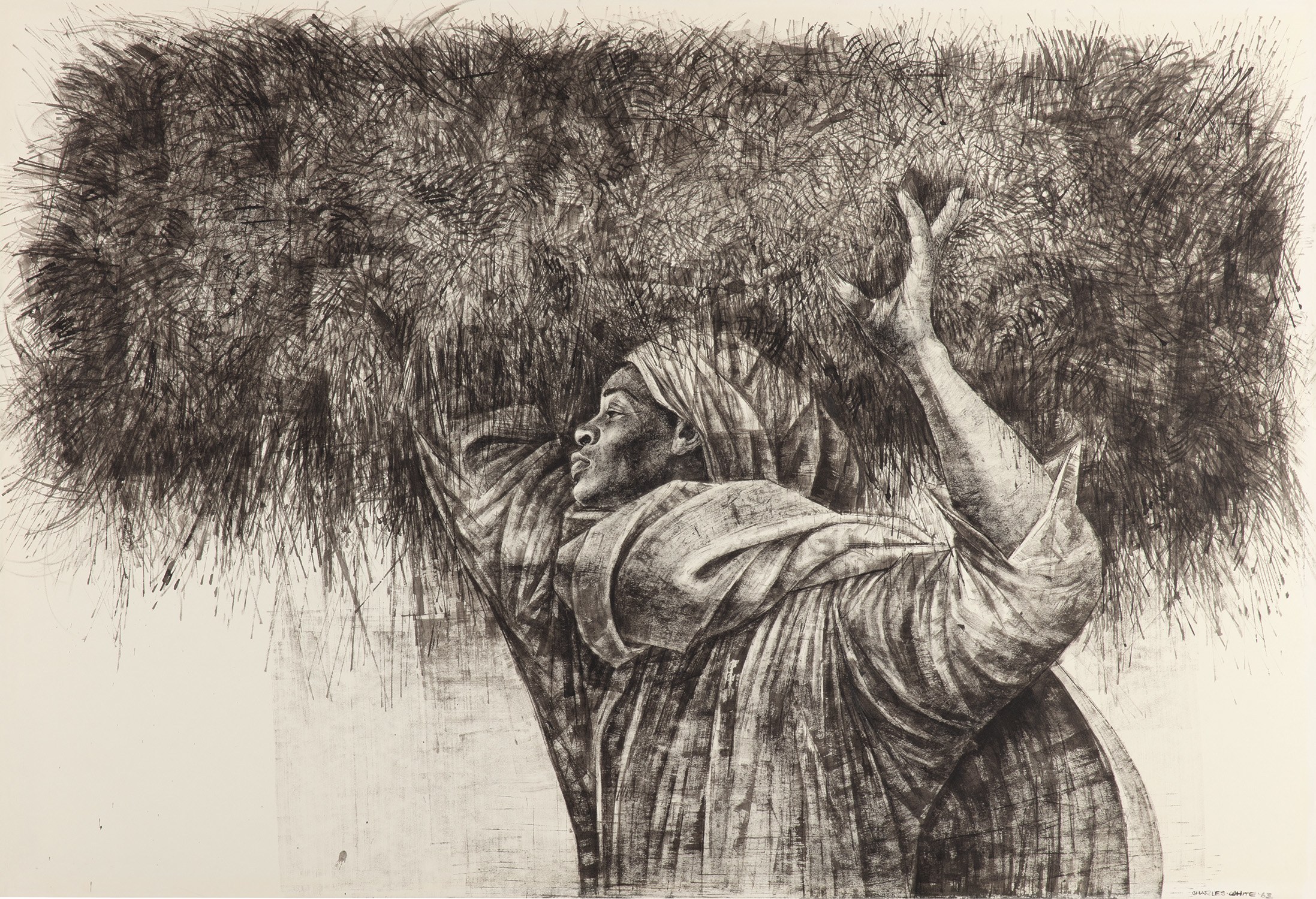
Roots, 1963
Works such as "Nobody Knows My Name No. 2" from 1965 and "To a Dark Girl" demonstrate his ability to render a face or a pair of hands with such precision and empathy that the viewer feels genuinely addressed. His printmaking practice, which produced lithographs of great elegance including "Gideon" from 1951 and the striking color lithograph "Prophet I" from 1975, extended his reach and allowed his imagery to circulate far beyond the walls of galleries. The range of his output across four decades rewards close attention.
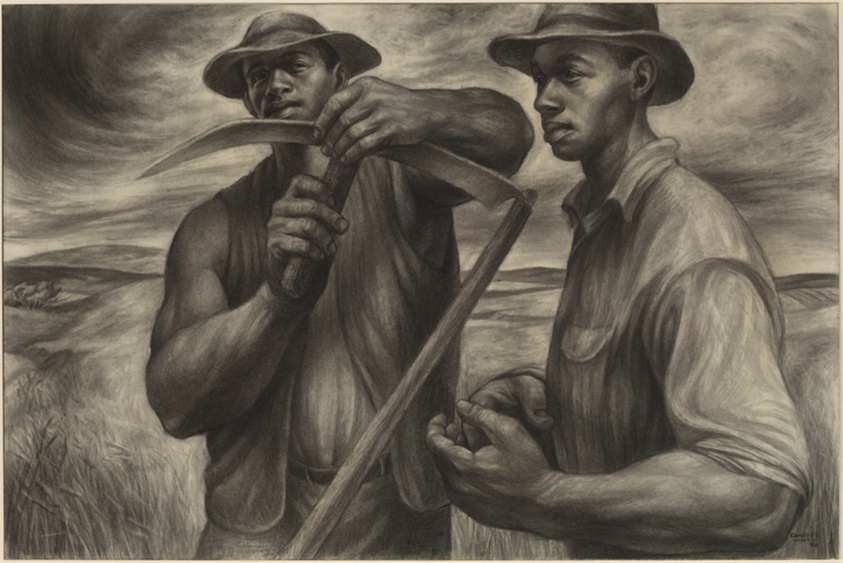
"Roots" from 1963, rendered in ink on board, shows White at his most incantatory, summoning ancestors and memory through a tangle of figures that seems to grow organically from the earth. "Harvest" from 1964 carries that same rootedness into a quieter register, its lithographic blacks warm and rich against tan wove paper. The "Wanted Poster Series" of the late 1960s and early 1970s was among his most politically charged bodies of work, using the visual language of law enforcement documents to frame Black subjects as dignified human beings rather than criminals, a provocation that remains strikingly legible today. Through all these shifts in subject and approach, his line never faltered and his commitment to his community never wavered.
Charles White
Harvest Talk, 1953
For collectors, White represents a rare convergence of historical importance and aesthetic pleasure. His works appear across major institutions including LACMA, the Whitney Museum of American Art, the Art Institute of Chicago, and the Smithsonian American Art Museum, and institutional interest of this depth reliably signals sustained market strength. Works on paper, his most characteristic output, offer a broad range of entry points, from intimate lithographs that reward quiet looking to large scale charcoal drawings that command a room. Collectors who have followed his market closely know that condition and provenance matter enormously with drawings of this technical complexity, and that works with distinguished exhibition histories carry particular value.
The 2018 retrospective brought renewed attention from a generation of collectors drawn to artists whose work addresses the full complexity of American life. To understand White fully is to place him in conversation with artists who shared his commitments and his moment. Elizabeth Catlett, who was briefly his wife and remained a lifelong kindred spirit, pursued a parallel vision of Black life rendered in printmaking and sculpture. Jacob Lawrence's narrative clarity and Romare Bearden's formal inventiveness represent different but related responses to the same historical pressures White navigated throughout his career.
In the longer sweep of art history, White belongs alongside the great draftsmen of the Western tradition, from Käthe Kollwitz to Diego Rivera, artists who understood that drawing from observation and from conscience are not separate activities but one continuous act. White died in Los Angeles in 1979, but his influence has only deepened with time. Artists including Kerry James Marshall, who studied under White at the Otis Art Institute in Los Angeles, have spoken openly about the lessons in craft and conviction they drew from him. Marshall's monumental figurative paintings are in many ways a direct continuation of the tradition White established, proof that great teaching, like great art, compounds across generations.
The 2018 retrospective confirmed what his students and collectors had always known, that White was not a peripheral figure awaiting rediscovery but a central one who had been unjustly overlooked. The corrective has now been made, and his place in the canon is secure. To collect his work is to hold something that belongs, in the best sense, to everyone.
Featured Works