Charles Sheeler
Charles Sheeler, Poet of the American Machine
Artist Spotlight · The Collection Editorial
“I favor a picture which arrives at its destination without the evidence of a harrowing journey.”
Charles Sheeler, artist statement
There is a moment, standing before Charles Sheeler's iconic 1930 painting American Landscape at the Museum of Modern Art in New York, when the industrial and the sublime become indistinguishable. The River Rouge complex near Detroit, rendered with an almost meditative stillness, does not roar or churn. It simply exists, vast and geometric, as though it had always been there, a natural formation as inevitable as a mountain range. That capacity to find beauty, even reverence, in the industrial fabric of American life is what makes Sheeler one of the most original and quietly radical artists the United States has ever produced.
Charles Sheeler
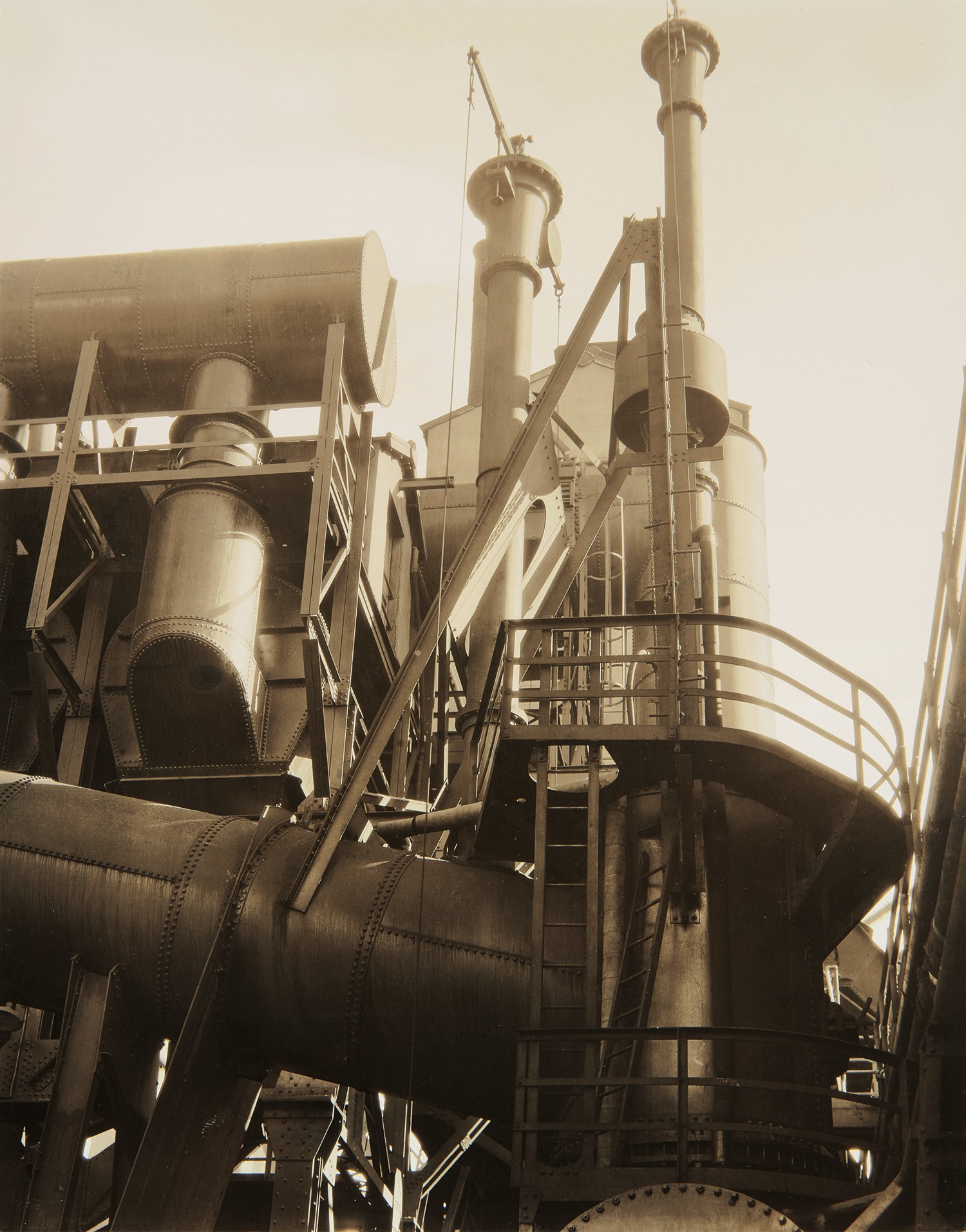
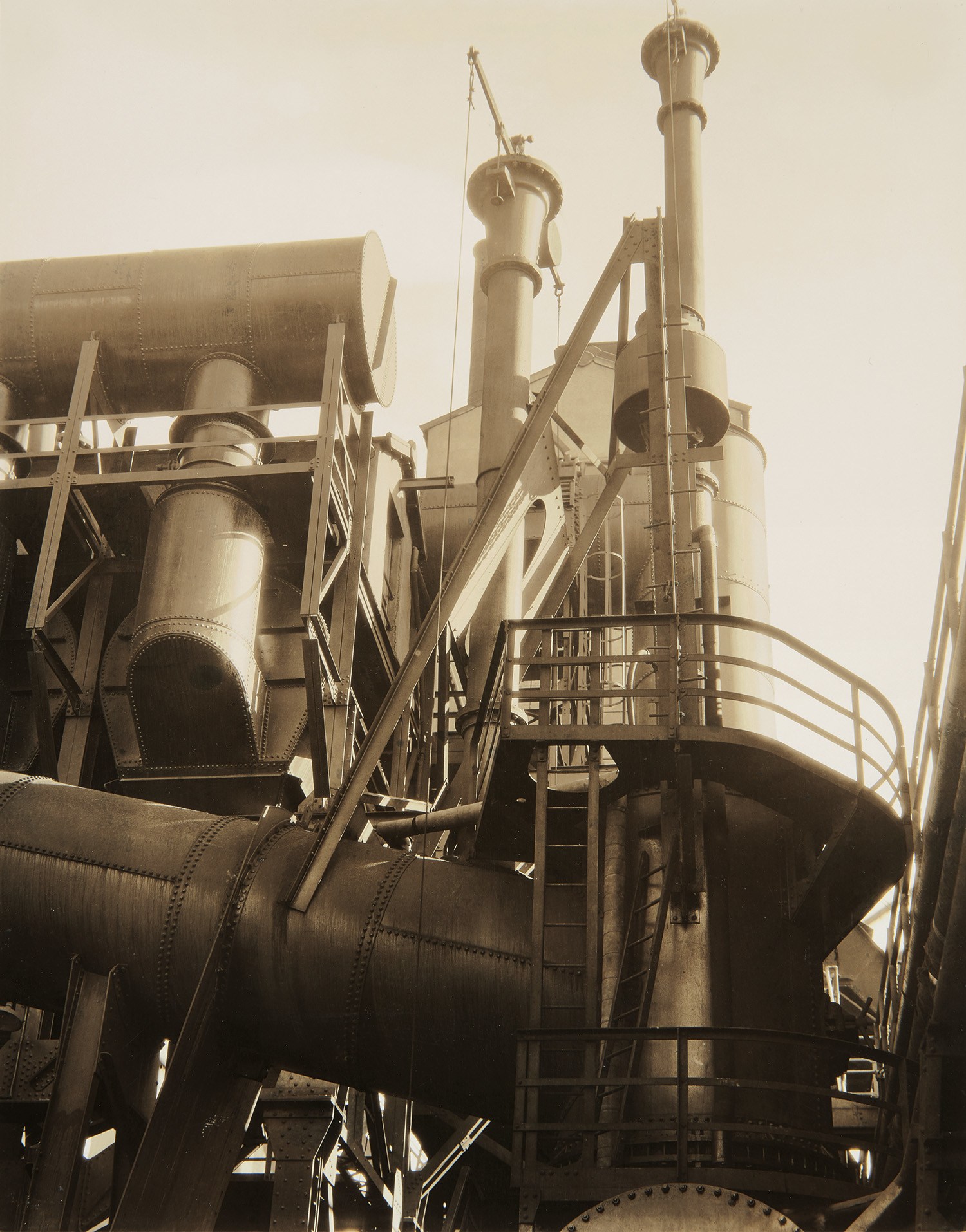
Ford Plant, River Rouge, Bleeder Stacks, Detroit
Charles Sheeler was born in Philadelphia in 1883, into a middle class family that recognized and supported his early artistic inclinations. He studied at the School of Industrial Art in Philadelphia before enrolling at the Pennsylvania Academy of the Fine Arts, where he trained under the realist painter William Merritt Chase. Chase was a formative influence, instilling in Sheeler a rigorous attention to surface, light, and compositional structure. Two trips to Europe in the early years of the twentieth century proved equally decisive.
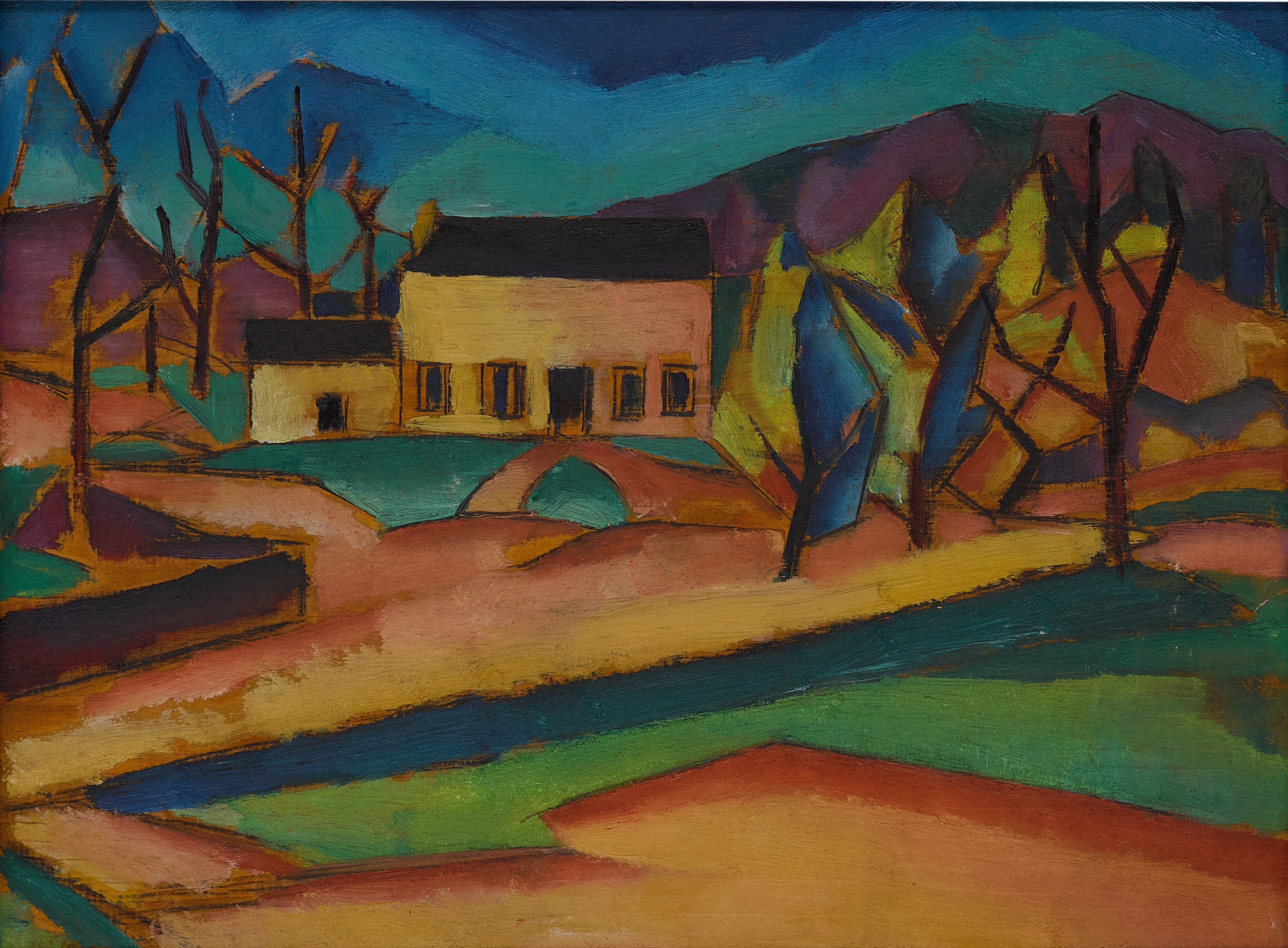
In Paris in 1909, Sheeler encountered the work of Cézanne, Picasso, and the Cubists, and the encounter permanently altered his understanding of form. He returned to Philadelphia not as a convert to European modernism so much as a young artist who had found permission to see the world in a fundamentally new way. Back in the United States, Sheeler began supporting himself as a commercial photographer, a practical necessity that would become one of the most creatively generative decisions of his life. Working in Philadelphia and later in New York, he photographed architecture and domestic interiors with a precision and compositional intelligence that went far beyond the merely functional.
Charles Sheeler
Landscape, 1913
The camera trained his eye in ways that painting alone might not have. By the time he settled in New York around 1919, he was moving in the circles of Alfred Stieglitz and the avant garde, befriending artists like Morton Schamberg and Paul Strand. His paintings from this period, including the celebrated Church Street El of 1920, demonstrate his growing mastery of what would come to be called Precisionism, a distinctly American mode that married the geometric clarity of Cubism to the observed facts of the industrial and urban landscape. Precisionism was never a formal movement with a manifesto or a founding date, but Sheeler became its most eloquent practitioner.
“Photography is nature seen from the eyes outward, painting from the eyes inward.”
Charles Sheeler
Where his contemporaries Charles Demuth and Georgia O'Keeffe occasionally allowed organic softness or emotional heat to enter their geometric compositions, Sheeler maintained a crystalline remove. His surfaces are immaculate, his light sourceless and even, his shadows precise as engineering drawings. This was not coldness but concentration, a form of sustained attention that treats a factory smokestack or a barn facade with the same quality of regard that the Old Masters brought to the human figure. His early work depicting Bucks County barns in Pennsylvania, rooted in the vernacular architecture of rural America, shares the same formal seriousness as his later industrial canvases.
Charles Sheeler
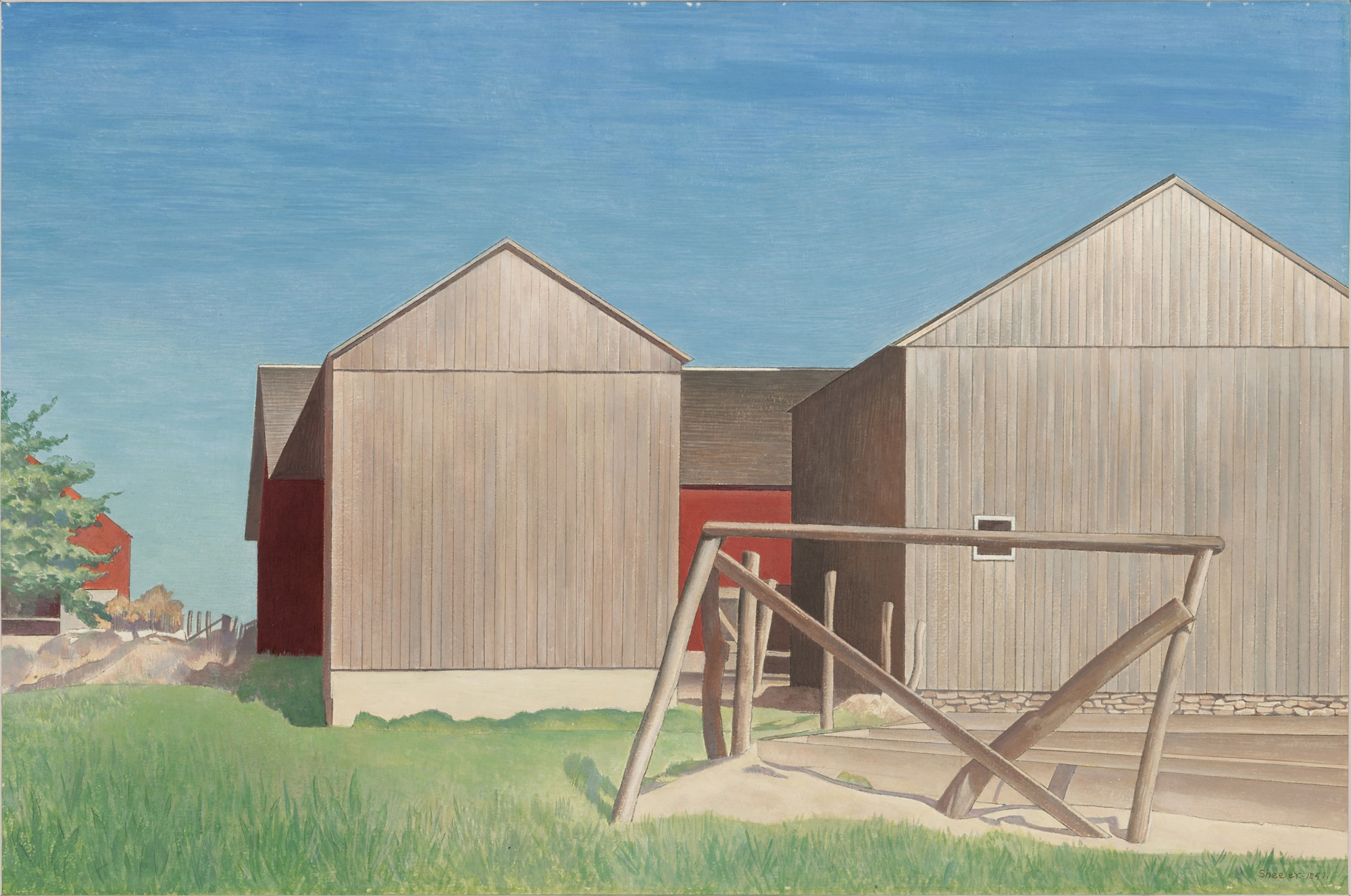
Farm Buildings, Connecticut
Both bodies of work ask the viewer to see structure, to find the geometry latent in the world. Among the works available to collectors through The Collection, the range of Sheeler's practice is richly represented. The gelatin silver print depicting the Ford plant at River Rouge is a document of one of the most consequential photographic commissions of the twentieth century. In 1927, Sheeler spent six weeks photographing the sprawling River Rouge complex, and the resulting images were reproduced widely, helping to shape an entire visual language for American industrial modernity.
The photographs are not advertisements but meditations, finding in conveyors and blast furnaces the same structural grandeur that Sheeler located in New England churches and Pennsylvania farmsteads. The tempera work Farm Buildings, Connecticut reflects his enduring affection for the American vernacular, rendered with a jeweler's patience in a medium that rewards slow looking. Western Industrial from 1955 and California from 1957, both late works, show Sheeler's continued evolution, his forms becoming more abstract and his palette more daring without surrendering his essential clarity of vision. Church Street El, the 1920 oil on canvas, captures a vanished New York with the authority of an artist who understood that the city was itself a kind of architecture, a monument to human ambition and ingenuity.
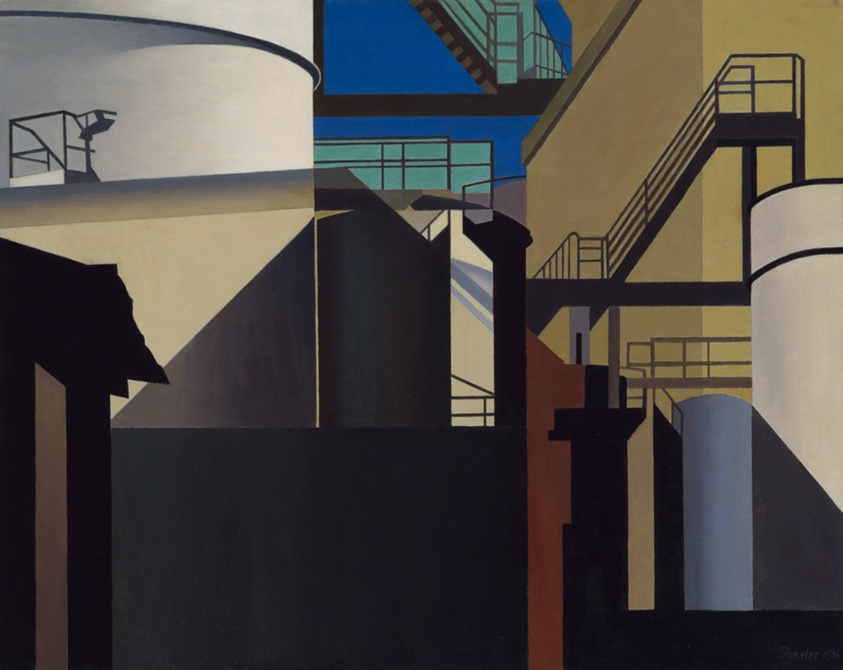
Charles Sheeler
Western Industrial, 1955
For collectors, Sheeler represents one of the most compelling intersections of art historical significance and aesthetic pleasure. His work appears regularly at the major American auction houses, with significant examples at Christie's, Sotheby's, and Bonhams achieving prices that reflect both his canonical status and the relative scarcity of major works on the market. The photographic work, once undervalued relative to the paintings and drawings, has attracted sustained collector interest as the history of American photography has been written and rewritten over recent decades. Works on paper and tempera panels, often more intimate in scale than the large oil canvases, offer a compelling entry point for collectors drawn to Precisionism.
The gelatin silver prints, in particular, occupy a unique position, functioning simultaneously as fine art photography, as historical documents of a transformative industrial era, and as the raw visual material from which Sheeler's painted compositions were often developed. Sheeler's place in the broader narrative of American modernism is both central and, curiously, underappreciated in popular culture relative to his actual influence. He is the quiet giant in a room that often celebrates louder voices. His contemporaries and near contemporaries include Edward Hopper, whose lonely American interiors share Sheeler's interest in the poetry of the ordinary, and Stuart Davis, who brought a more jazz inflected energy to the geometry of American urban life.
Internationally, his work invites comparison to the New Objectivity painters in Germany and to the Purist experiments of Le Corbusier and Amédée Ozenfant in France. Yet Sheeler is irreducibly American, grounded in specific places and specific structures, always insisting that the local and the actual are worthy of the most serious aesthetic attention. Sheeler continued working until a stroke in 1959 curtailed his activity, and he died in Dobbs Ferry, New York, in 1965. The retrospective held at the Whitney Museum of American Art in 1939 and subsequent exhibitions at major institutions across the country confirmed his status as a defining figure of the American century.
Today, with sustained scholarly and curatorial interest in Precisionism and in the broader visual culture of American modernism, his work feels more urgent rather than less. In an era that is renegotiating its relationship to industry, to landscape, and to the visual grammar of national identity, Sheeler's patient, brilliant gaze offers something rare and sustaining: the reminder that beauty is not found but made, through discipline, attention, and an unshakeable faith in the power of form.
Explore books about Charles Sheeler
Charles Sheeler: American Interiors
Gail Stavitsky
Charles Sheeler and the Cult of the Machine
Karen Tsujimoto
Precisionism in America 1915-1941: Reordering Reality
Charles Demuth, Georgia O'Keeffe, and Charles Sheeler
Charles Sheeler: Paintings and Drawings
Andrew Carnduff Ritchie
Charles Sheeler: A Concentration of Works from the Smithsonian American Art Museum
Smithsonian Institution

Charles Sheeler: The Photographs
Theodore E. Stebbins Jr. and Norman Keyes Jr.

Charles Sheeler: American Modernist
Carol Troyen