Charles Méryon
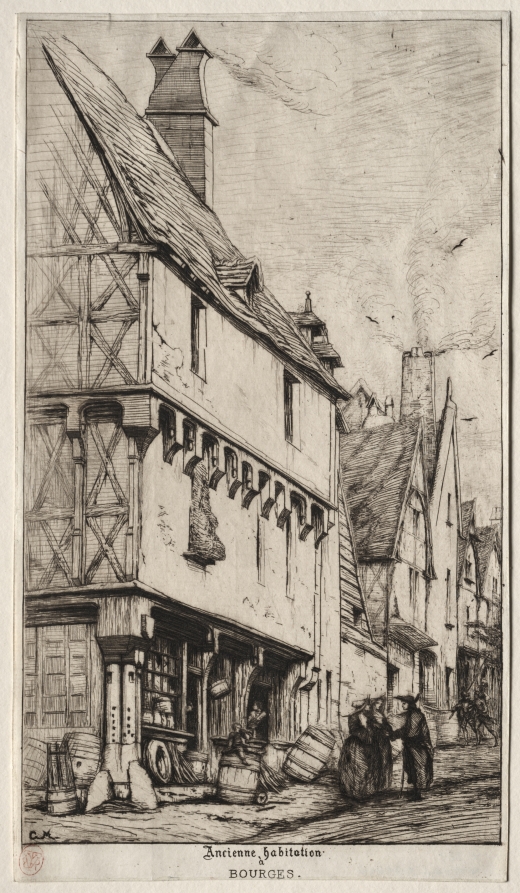
Charles Méryon: Paris Seen Anew
Artist Spotlight · The Collection Editorial
There is a particular quality of light in Charles Méryon's Paris, one that seems to emanate from the stone itself rather than from any sky above. In the permanent collection of the Bibliothèque nationale de France and held in depth by institutions from the Metropolitan Museum of Art in New York to the Art Institute of Chicago, his etchings of mid nineteenth century Paris have experienced a sustained wave of scholarly and collector attention in recent decades. Major print rooms across Europe and North America continue to acquire his work whenever it surfaces, and his presence in the auction market has grown steadily as collectors of old master and nineteenth century prints recognize in him a singular and irreplaceable vision. To encounter a Méryon etching in person is to understand immediately why his reputation endures.
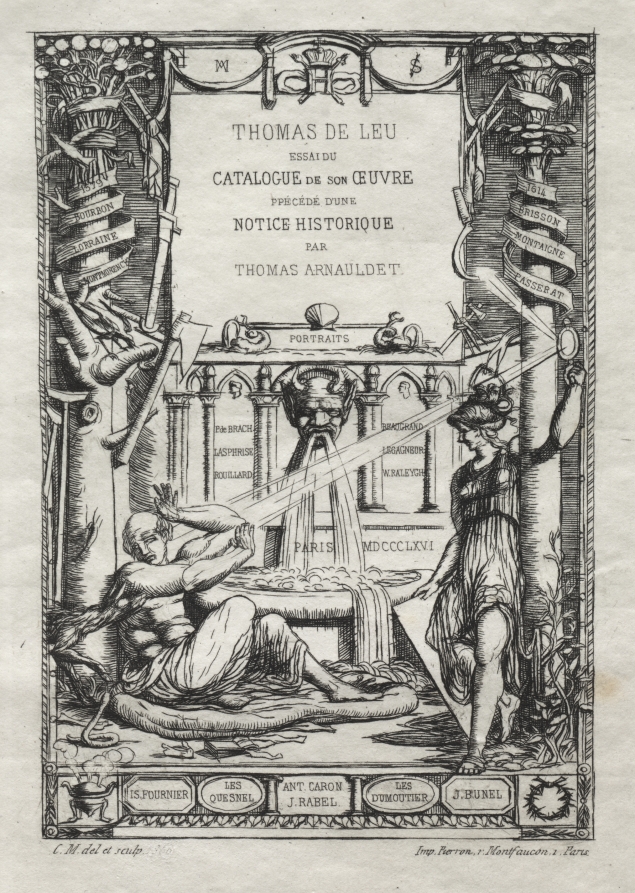
Charles Méryon
Frontispiece for a Catalogue of the Engravings of Thomas de Leu, 1866
Charles Méryon was born in Paris in 1821, the illegitimate son of an English physician named Charles Lewis Méryon and a French dancer named Narcisse Gentil. This unusual dual inheritance, English and French, romantic and analytical, shaped him in ways that would eventually find their fullest expression in his art. He spent his early years in a state of social and emotional instability, and in 1837, seeking structure and perhaps escape, he enrolled in the French Navy. He served for nearly a decade, sailing to the Pacific and to New Zealand, and it was during these years at sea that he first developed a serious interest in drawing and observation.
The discipline required of a naval officer, that habit of precise and sustained looking, would later prove essential to his method as a printmaker. Méryon left the Navy in 1848 and turned his full attention to art. He had hoped to work in color and attempted seriously to pursue painting, but he suffered from a form of color blindness that made this ambition effectively impossible. It was a cruel limitation for a man of his temperament, and yet it pushed him toward etching with a kind of necessity.
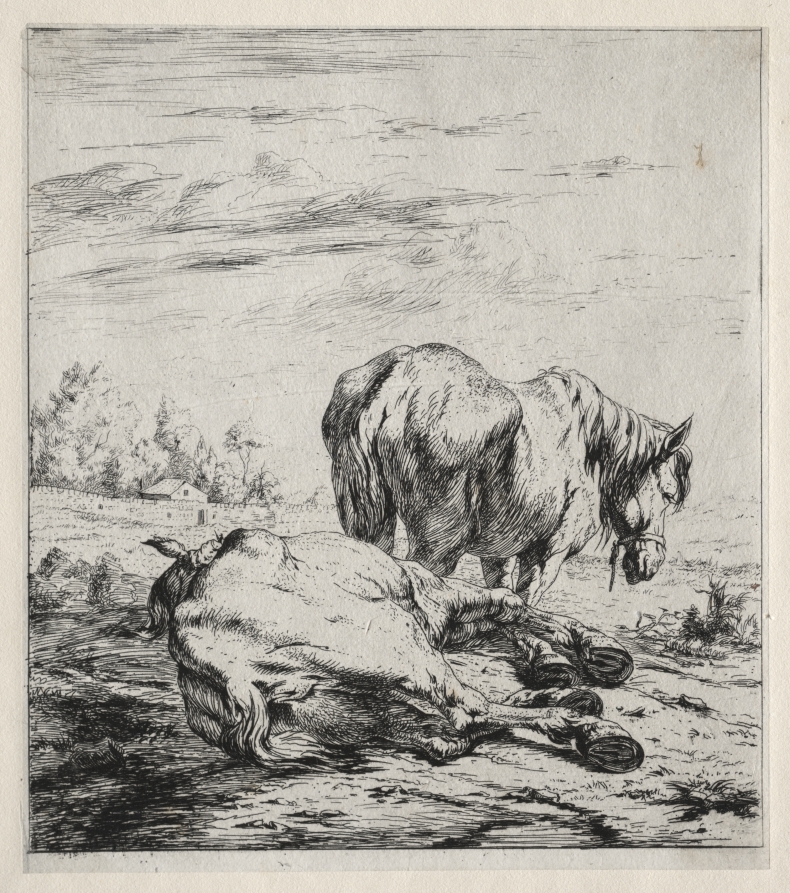
Charles Méryon
The Two Horses, 1850
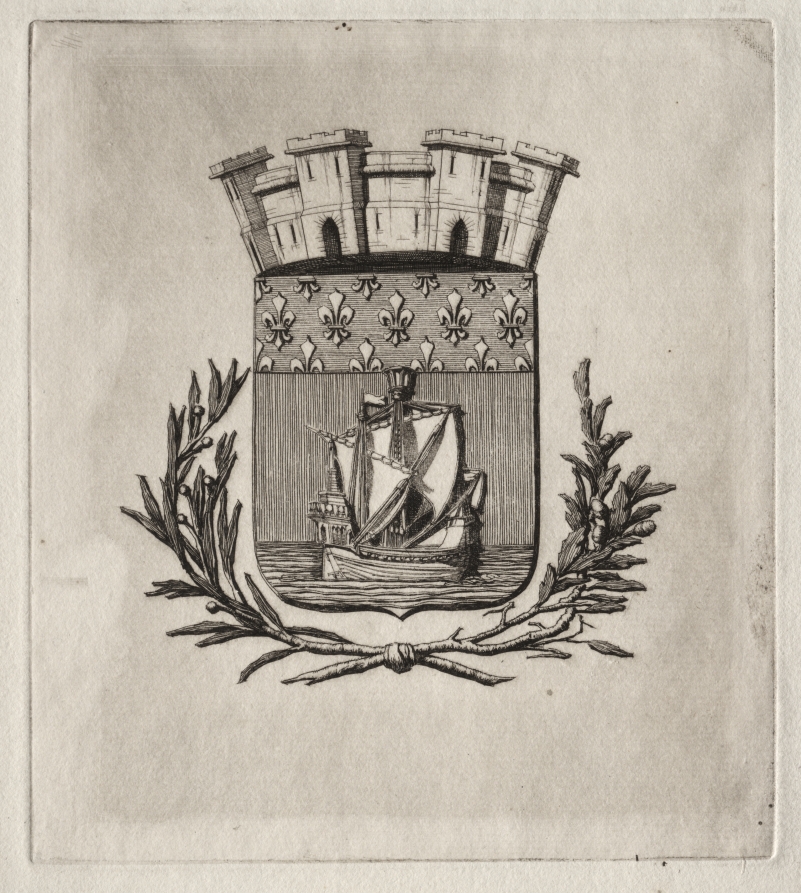
He studied the technique carefully and with great seriousness, looking closely at the work of earlier Dutch masters and at the precise graphic traditions of architectural and topographical printmaking. By the early 1850s he had found his subject and his voice simultaneously, and the result was the great series for which he is now celebrated: the Eaux Fortes sur Paris, his etchings of Paris published between 1852 and 1854. The Eaux Fortes sur Paris stands as one of the genuinely indispensable achievements in the history of printmaking. Works from this series, including The Gallery of Notre Dame, the Old Gate of the Palace of Justice, and the Symbolical Arms of the City of Paris, all dating to 1853 and 1854, reveal an artist working at the absolute frontier of his medium.
Méryon etched with extraordinary fineness and control, rendering the medieval and early modern architecture of the Île de la Cité with a fidelity that is almost documentary in its precision, and yet the cumulative effect of his prints is never merely reportorial. There is atmosphere in them, a sense of accumulated history pressing down on the stone streets, of a city alive with its own memory. This was especially poignant given that Méryon was working precisely as Baron Haussmann's massive reconstruction of Paris was beginning to sweep away the very neighborhoods he was recording. His etchings became, without quite intending to, an act of preservation.
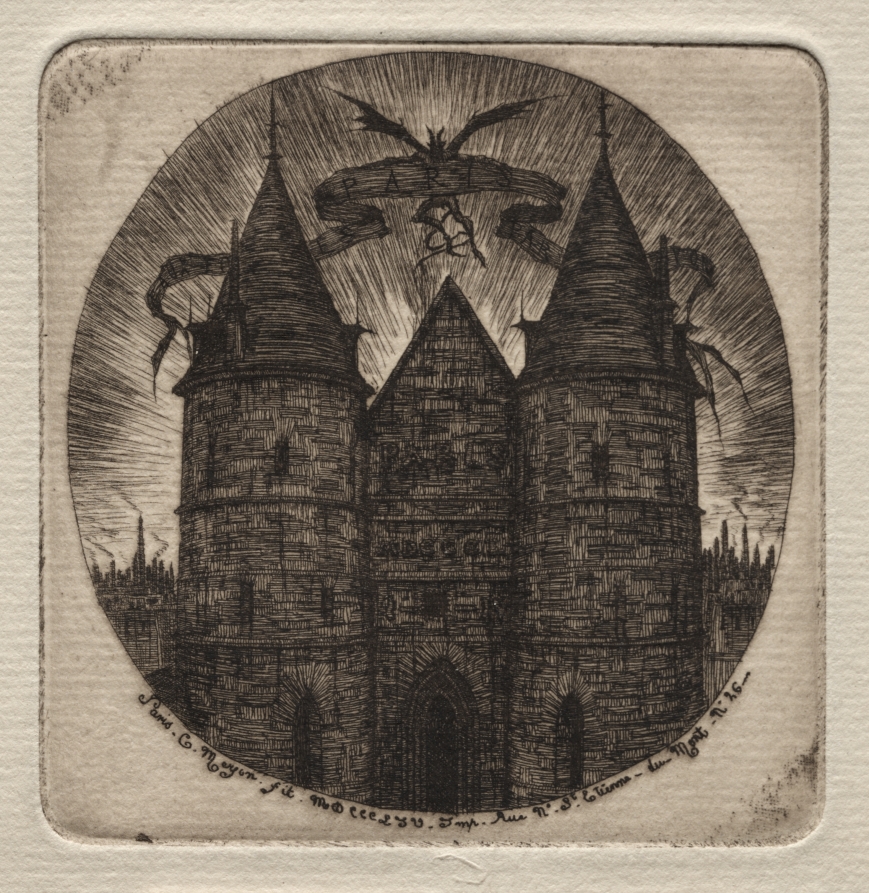
Charles Méryon
Etchings of Paris: Old Gate of the Palace of Justice, 1854
Beyond the Paris series, Méryon produced a body of work that reveals the breadth of his curiosity and his range as a draftsman. His 1850 etching The Two Horses demonstrates his capability with figurative and natural subjects, while the 1853 Map of the Battle of Sinope, rendered in etching and then finished with delicate watercolor washes, shows his ongoing connection to the naval world he had left behind. The 1861 View of Part of the City of Paris, Towards the Close of the 17th Century is a remarkable work that demonstrates his deep engagement with French history, as does the extraordinary 1860 etching depicting the printed work of the Latin author Valerius Maximus being presented to King Louis XI. These are not peripheral works.
They are evidence of an artist with an expansive and genuinely learned imagination. For collectors, Méryon presents an opportunity that is both historically significant and practically accessible compared to many artists of equivalent importance. His prints appear at auction through the major houses including Christie's, Sotheby's, and Swann Galleries, where strong impressions of the Eaux Fortes sur Paris regularly attract serious bidding. The condition of the paper and the quality of the impression are paramount considerations when evaluating a Méryon etching, as he was meticulous about the printing of his own plates and knew precisely what a good impression should look like.
Charles Méryon
Etchings of Paris: The Symbolical Arms of the City of Paris, 1854
Early impressions with rich burr and deep tonal range command the strongest prices. Works like L'Arch du Pont Notre Dame and the Rue des Toiles, Bourges offer collectors entry points into a body of work that rewards long and careful looking. Méryon belongs to a broader tradition of artist printmakers who transformed the etched line into a vehicle for poetic and atmospheric vision. His closest affinities are perhaps with Rembrandt van Rijn, whose handling of light and shadow in etching Méryon studied and admired, and with the great tradition of French architectural and topographical printmaking.
Later artists including James McNeill Whistler, who was himself a towering figure in nineteenth century etching, acknowledged the importance of Méryon's achievement. The poet Charles Baudelaire was among Méryon's admirers and famously attempted to write poems to accompany the Paris etchings, though the collaboration was never completed. That Baudelaire recognized in Méryon a kindred sensibility, a poet of the modern city in a different medium, says a great deal about the depth of his vision. Méryon died in 1868, at the age of forty six, having spent his final years in difficult circumstances and struggling with serious mental illness.
It would be easy to frame his life as a tragedy, but his work refuses that reading. What he left behind is a body of etchings of such refinement, such historical consciousness, and such sustained beauty that they continue to speak across more than a century and a half. Paris has changed almost beyond recognition since he walked its streets with his copper plates and his needles, and yet his vision of the city remains vivid and alive. That is the particular alchemy of the greatest printmakers: they fix a moment so precisely that it becomes, paradoxically, timeless.
Explore books about Charles Méryon
Charles Méryon: A Life
Phillip Dennis Cate
Charles Méryon and His Prints
Loys Delteil

Méryon and the City
Barbara Stern Shapiro
The Complete Etchings of Charles Méryon
Loys Delteil
Charles Méryon: 1821-1868
Campbell Dodgson
Méryon: Etchings and Drypoints
Julia Marciari Alexander