Charles Ephraim Burchfield
Charles Burchfield, America's Visionary Nature Poet
Artist Spotlight · The Collection Editorial
“I feel the same creative excitement working in my garden that I do when painting a picture.”
Charles Burchfield, personal journals
There are artists who paint the world as it appears, and then there are those rare figures who paint the world as it feels. Charles Ephraim Burchfield belonged emphatically to the second category. When the Smithsonian American Art Museum mounted a major survey of his work, curators and visitors alike found themselves arrested by something difficult to name: a trembling aliveness in every leaf, a sound almost audible in every wind bent elm, a spirituality humming beneath the surface of even the most ordinary American afternoon. That quality, at once intensely personal and universally recognizable, is why Burchfield's reputation continues to grow, and why collectors who discover him tend to speak about the experience with genuine reverence.
Charles Ephraim Burchfield
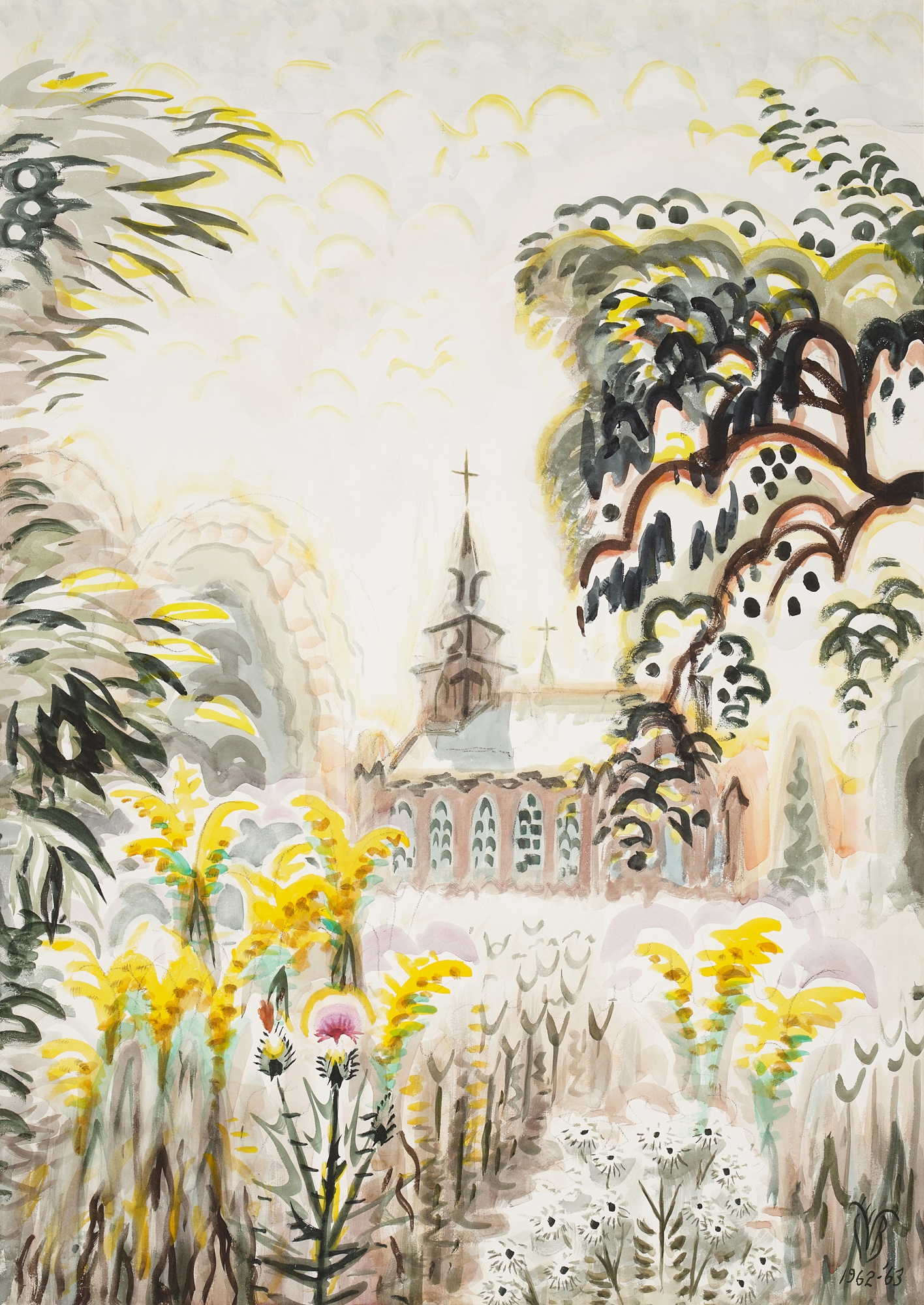
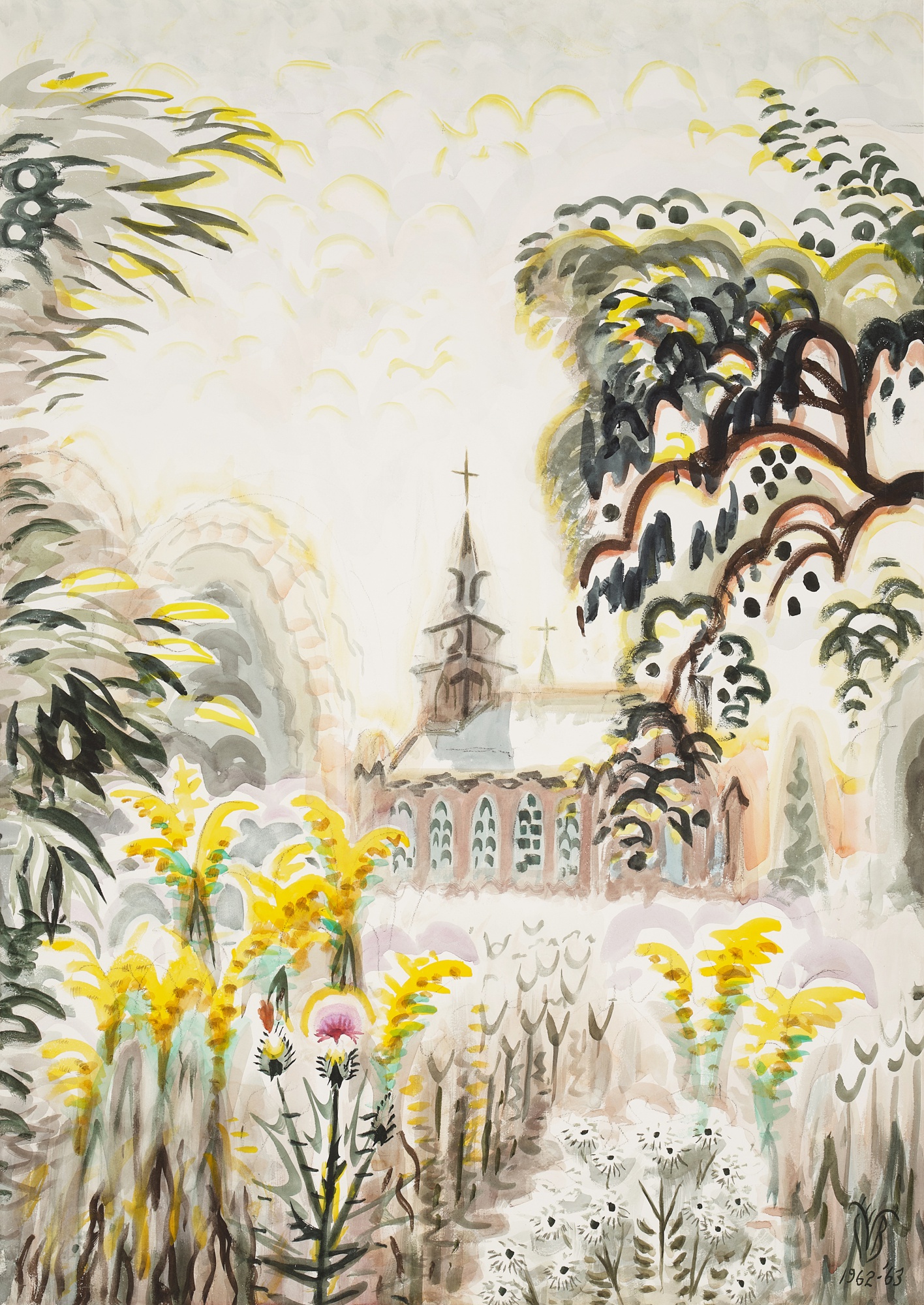
Village Church in August, 1962
Burchfield was born in Ashtabula Harbor, Ohio, in 1893, the fifth of six children. His father died when Charles was just five years old, and the family soon relocated to Salem, Ohio, a small industrial town that would leave permanent marks on his imagination. Salem gave him two things that would define his art forever: the moody, changeable skies of the American Midwest, and the particular melancholy beauty of modest domestic architecture weathering the seasons. He studied at the Cleveland School of Art between 1912 and 1916, where he won a scholarship to the National Academy of Design in New York.
Famously, he lasted only a single day before homesickness drove him back to Ohio. That instinct toward rootedness, toward the specific textures of a known place, was not weakness. It was the very source of his power. His artistic development unfolded in three broadly recognized phases, each as compelling as the last.
Charles Ephraim Burchfield
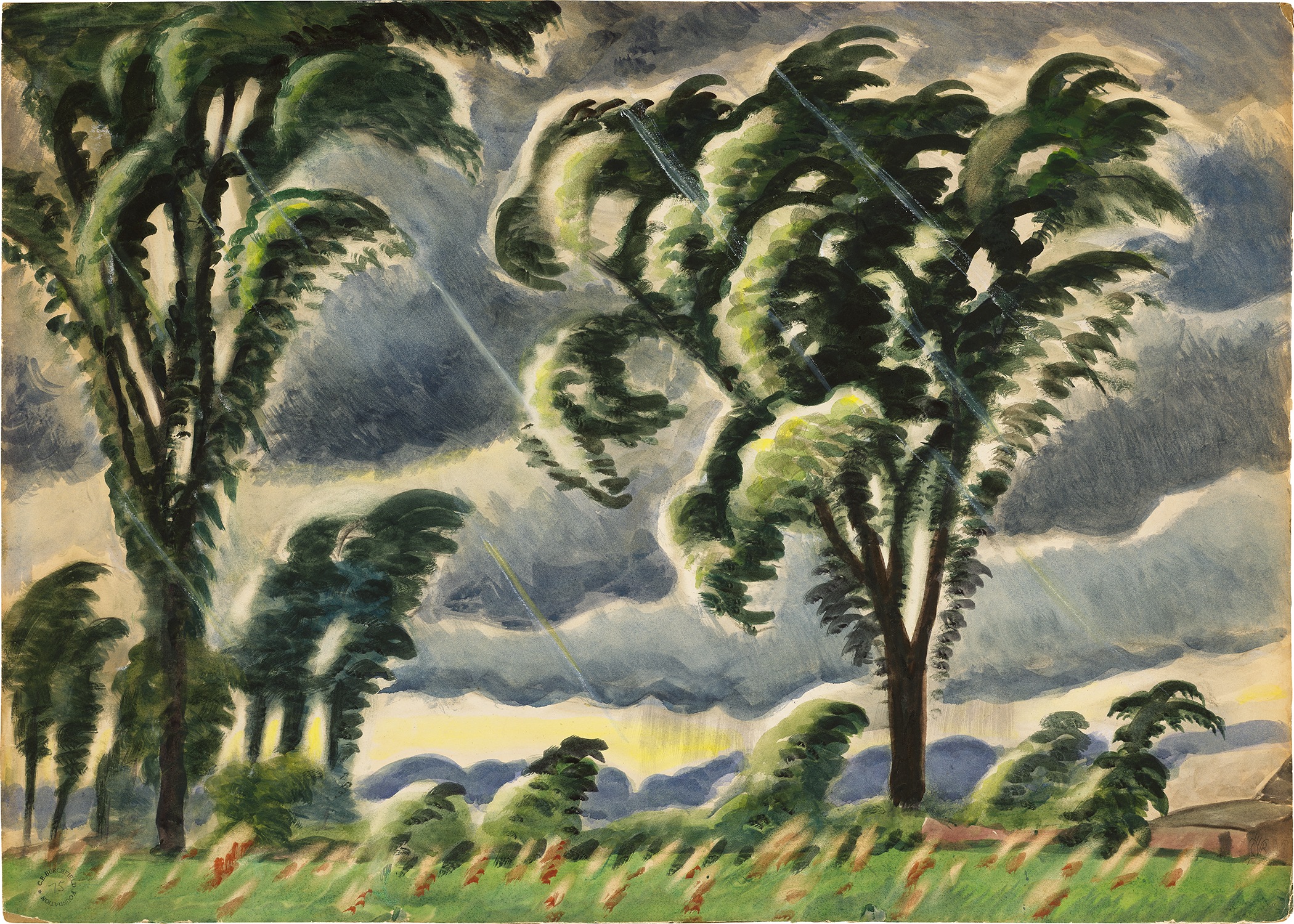
Windblown Elms
The first, sometimes called his fantasy period, produced work of startling visionary intensity between roughly 1916 and 1918. During this time Burchfield developed a personal visual vocabulary he called his "conventions for abstract thoughts," a set of invented symbols to convey emotions like fear, morbidity, and exaltation directly through formal means. Works from this period feel genuinely singular in the history of American art, closer in spirit to certain currents in German Expressionism than to anything happening in New York at the time, though Burchfield arrived at his language in near complete isolation. The second phase, roughly spanning the 1920s through the 1940s, brought him public recognition through what critics labeled Regionalism: careful, affectionate, sometimes wry depictions of small town Main Streets, Gothic Revival houses in rain, factory smoke against pale winter skies.
“All my life I have been haunted by the obsession that to desire a thing or to love a thing intensely is to place yourself in a vulnerable position.”
Charles Burchfield, journals
It was during this period that Edward Hopper, himself a great admirer, wrote presciently that Burchfield was one of the few American painters to have truly captured the mood of the American small town. The third and final phase, which occupied the last two decades of his life, saw Burchfield return to the mystical natural subjects of his youth with even greater ambition, creating large, luminous compositions in which the natural world seemed to throb with almost cosmic energy. The works available through The Collection offer a beautifully representative window into this full arc. "Broken Brick Wall" from 1918 belongs to that electrifying first period, its careful layering of watercolor, pencil, and pastel generating an almost hallucinatory surface tension.
Charles Ephraim Burchfield
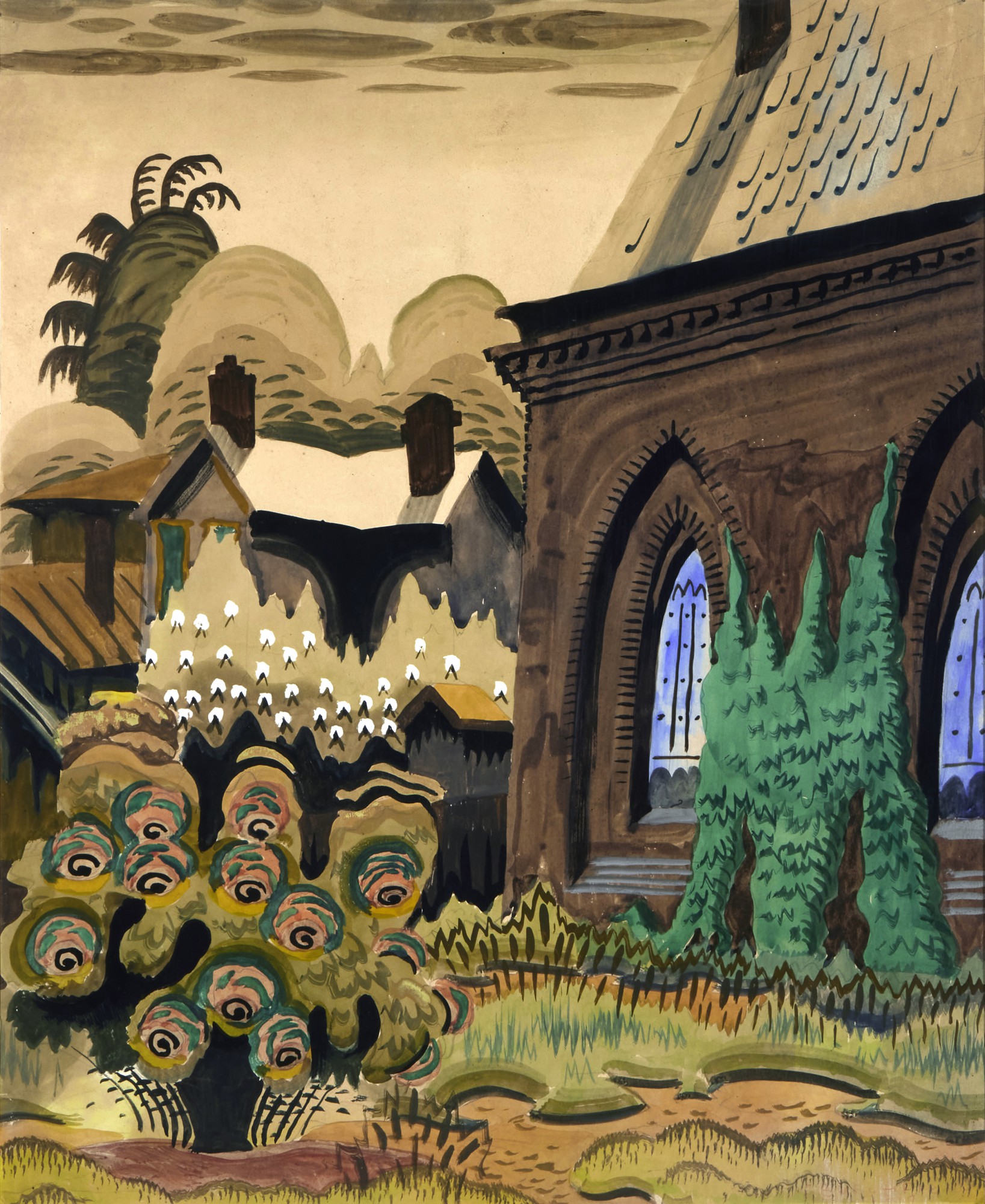
Sunday Morning at Eleven O’Clock
"Hollyhocks" from 1921 captures the transitional warmth of his early regionalist years, the garden flowers rendered with an attentiveness that tips into something approaching devotion. Works like "New Moon in the Woods" (1947) and "Day to Night" (1948) exemplify the luminous late manner, where watercolor and gouache on paperboard become vehicles for depicting natural cycles as genuinely sacred events. "Village Church in August" (1962), one of the most recent works in the group, shows Burchfield at the height of his final period: architecture and nature fused, the August heat practically radiating from the paper. Across all these works, the medium itself is revelatory.
Burchfield chose watercolor as his primary vehicle throughout a long career at a time when the medium was widely considered a lesser cousin to oil, and his sustained, technically brilliant engagement with it helped permanently elevate its status in American art. For collectors, Burchfield presents one of the genuinely rewarding opportunities in the American art market. His works appear regularly at the major auction houses, Christie's, Sotheby's, and Bonhams among them, with strong and consistent results particularly for his late watercolors and his early fantasy period works, which have attracted renewed scholarly and curatorial attention in recent years. Works on paper from the late 1910s and early 1920s carry particular historical significance, while the large scale late compositions command premium prices reflective of their ambition and rarity.
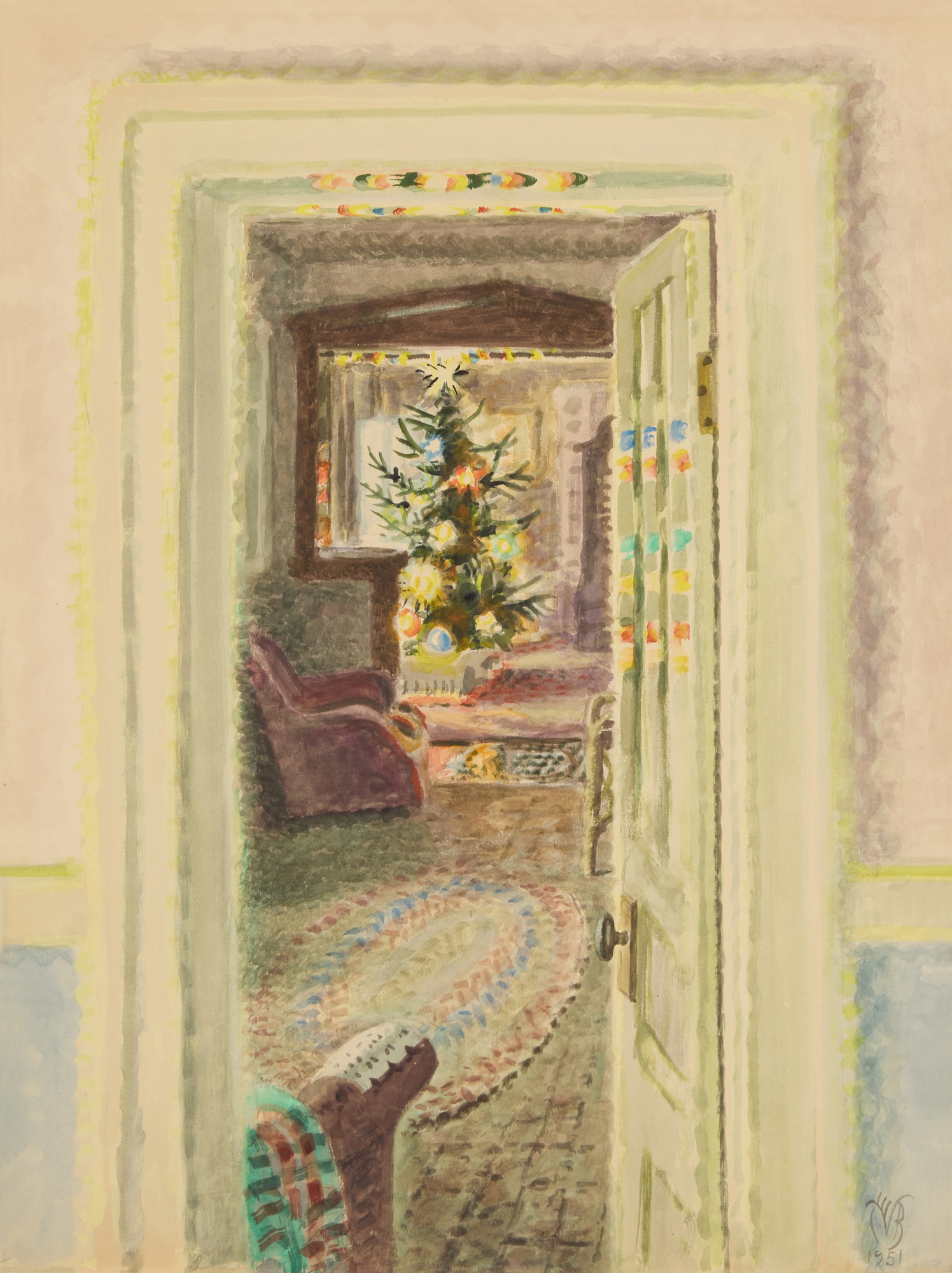
Charles Ephraim Burchfield
Christmas, 1952
What draws the most discerning collectors, beyond the financial rationale, is the sheer intimacy of the work. These are not paintings designed for grand public statements. They are records of a sustained, lifelong conversation between one acutely sensitive man and the natural world around him. Owning a Burchfield means living with that conversation, and collectors who do so consistently report that the works deepen and reveal themselves over years of looking.
Within the broader landscape of American art history, Burchfield occupies a position that is both central and productively strange. He is often grouped with the Regionalists, alongside Grant Wood and Thomas Hart Benton, yet his sensibility is fundamentally more inward and more mystically inclined than either. His closest temperamental kin might be found in the Transcendentalist tradition: his reverence for nature echoes Thoreau, and his insistence on the spiritual charge embedded in ordinary American landscapes connects him to the ambitions of the Hudson River School painters a generation before him. Edward Hopper saw something of himself in Burchfield, and the comparison illuminates both artists: both were deeply American, deeply solitary, deeply concerned with the emotional weight of familiar scenes.
Yet where Hopper's world tends toward an existential silence, Burchfield's vibrates, hums, and sings. Burchfield died in Gardenville, New York, in 1967, having spent the last four decades of his life in the Buffalo region, a landscape he transformed in the collective imagination as completely as Cézanne transformed Provence. The Burchfield Penney Art Center in Buffalo, named in his honor, holds the largest collection of his work in the world and stands as a testament to the depth and durability of his achievement. In a contemporary art world increasingly interested in ecological consciousness, in the animate quality of the nonhuman world, and in art that carries genuine spiritual weight without irony, Burchfield feels not like a figure from the past but like a necessary presence.
His watercolors remind us that the most radical thing an artist can do is pay absolute attention, to a hemlock, a thundercloud, a village church in August heat, and mean it completely.
Explore books about Charles Ephraim Burchfield
Charles Burchfield: His Art and Life
John I. H. Baur
Charles Ephraim Burchfield: Paintings, Watercolors, and Drawings
Neville Rowley
The Paintings of Charles Burchfield: North by Midwest
Andrew Wyeth and others

Charles Burchfield: Marsh Introspection
Nancy Weekly

Charles Burchfield's Journals: The Poetry of Place
Charles Burchfield
Burchfield: America's Visionary Artist
Janice Simon