Charles Burchfield
Charles Burchfield: Nature's Most Passionate American Voice
Artist Spotlight · The Collection Editorial
“I want to paint the very smell of the earth after rain.”
Charles Burchfield, personal journal
There is a moment, standing before a Charles Burchfield watercolor, when the ordinary world becomes something else entirely. The trees hum. The air around a winter rooftop feels electric. A stand of maples in late afternoon light seems to breathe.
Charles Burchfield
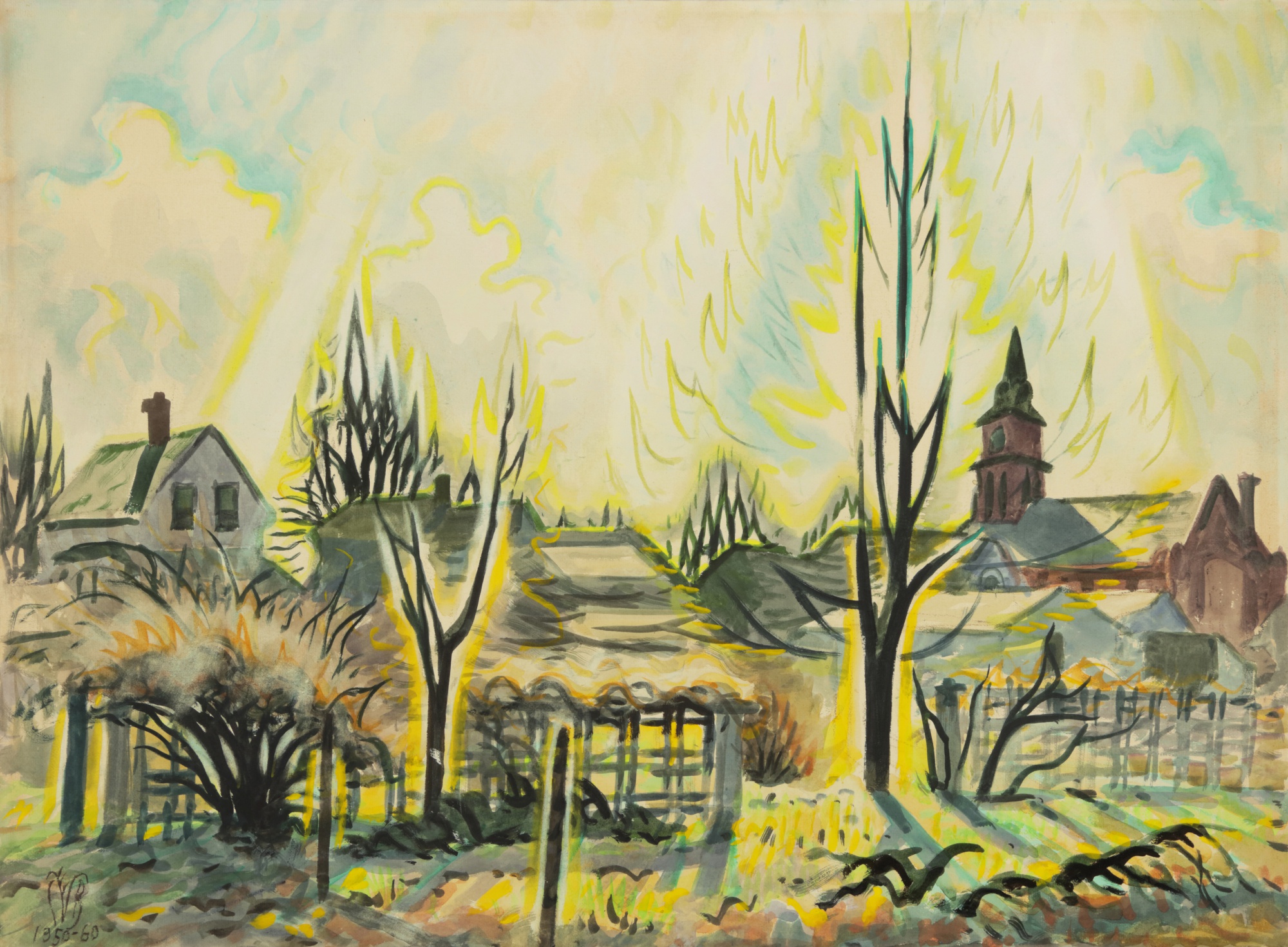
March Sunlight
It is a quality unlike anything else in American art, and it is why curators, scholars, and collectors continue to return to his work with fresh urgency. The Burchfield Penney Art Center in Buffalo, New York, which holds the largest collection of his work in the world, has sustained ongoing scholarly attention to his practice, and major institutions including the Whitney Museum of American Art and the Smithsonian American Art Museum count his paintings among their most significant holdings. In a broader cultural moment when audiences are hungry for art that speaks sincerely about the natural world, Burchfield's vision feels not historical but immediate. Charles Ephraim Burchfield was born in 1893 in Ashtabula Harbor, Ohio, and grew up in Salem, Ohio, a small industrial town whose back streets, sagging porches, and coal smoke winters would become the raw material of some of the most memorable imagery in American painting.
His father died when Charles was five, and his mother raised six children with a combination of practicality and quiet dignity that Burchfield absorbed deeply. From boyhood he kept meticulous nature journals, filling them with observations about birdsong, insect life, the behavior of clouds, and the particular quality of light at different hours and seasons. This habit of sustained, almost devotional attention to the natural world would define his entire practice as an artist. Burchfield studied at the Cleveland School of Art between 1912 and 1916, receiving a classical training in drawing and design that gave his later expressiveness a firm structural foundation.
Charles Burchfield
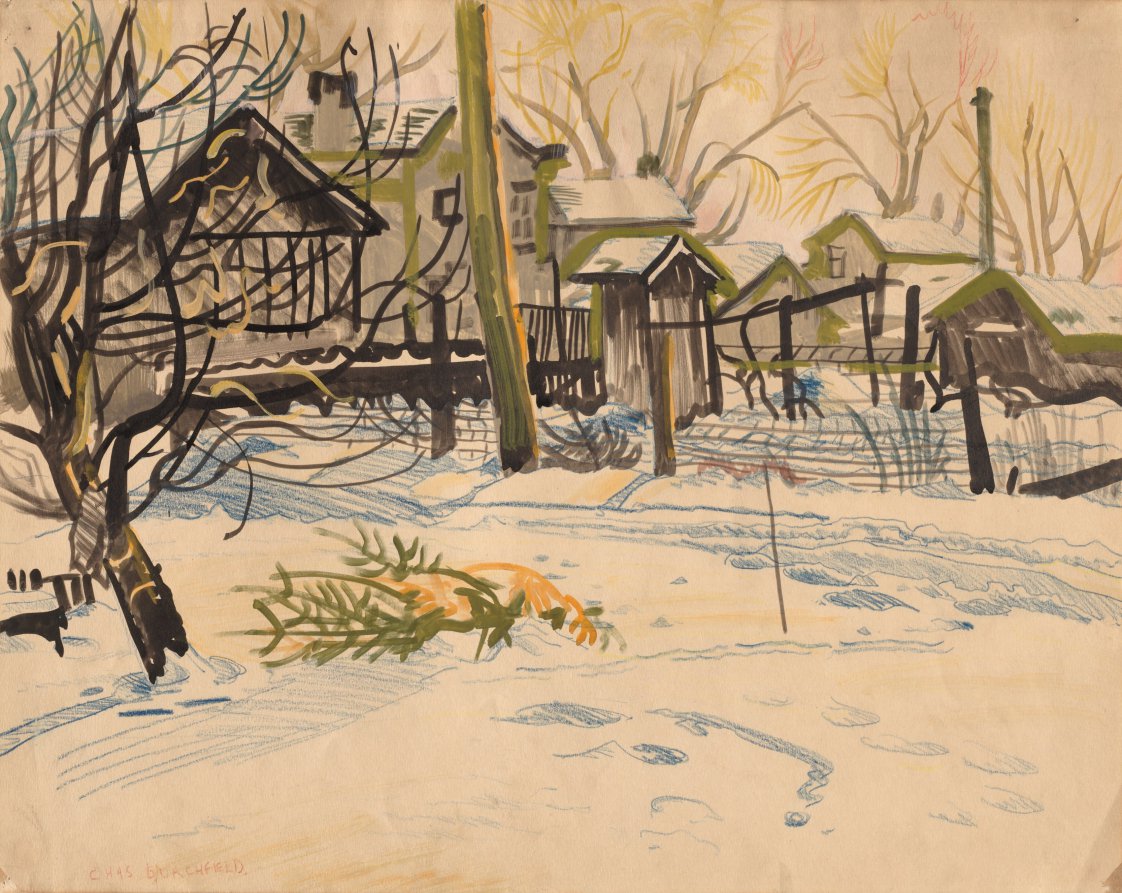
Backyards in Winter (Castoff Christmas Tree), 1917
A scholarship brought him briefly to New York, to the National Academy of Design, but the city overwhelmed him and he returned to Ohio. That retreat proved formative. In 1916 and 1917, working in relative isolation in Salem, he produced a body of watercolors of astonishing originality, a series of visionary panels in which childhood fears, seasonal energies, and the moods of weather were given visual form with a directness that bordered on the hallucinatory. These early works, sometimes called his fantasy period, introduced a visual language entirely his own, with jagged decorative patterns suggesting sound, fear, or ecstasy radiating from otherwise familiar subjects.
“An artist must paint not what he sees but what he feels.”
Charles Burchfield
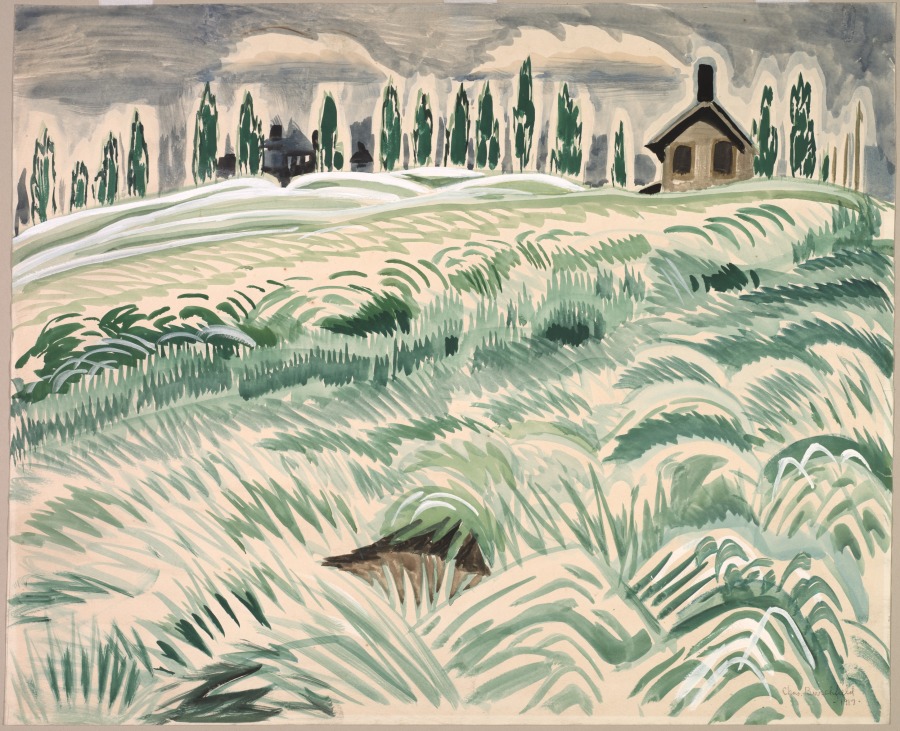
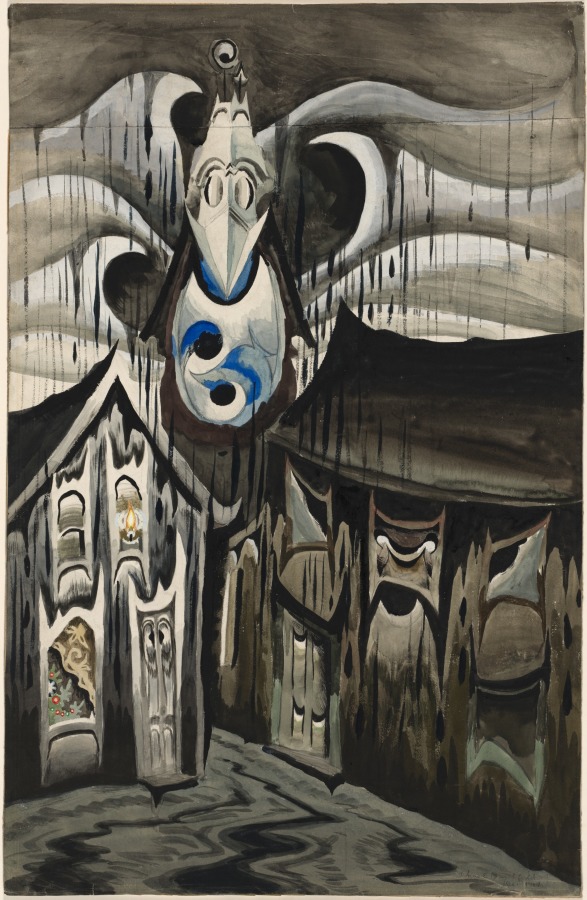
The year 1917 was perhaps the single most concentrated outpouring of his genius. Works from this period, including Church Bells Ringing, Rainy Winter Night, Backyards in Winter, The Sun Through the Trees, and Hillside, show an artist fully in command of an invented vocabulary. In Church Bells Ringing, Rainy Winter Night, the sound of bells is rendered as visible force, rippling across a dark sky above a wet street with an almost synesthetic conviction. Backyards in Winter captures the melancholy poetry of an ordinary Ohio yard after the holidays with a tenderness that elevates the mundane to the mythic.
Charles Burchfield
Hillside, 1917
These are not illustrations of places or seasons. They are records of felt experience, of the way a winter morning actually lives inside the body of someone paying close attention. The mixed media of these works, watercolor combined with gouache, crayon, and black wash, allowed Burchfield to build surfaces of remarkable richness without ever sacrificing the luminosity that is watercolor's essential gift. After serving in the Army and working for some years as a wallpaper designer in Buffalo, Burchfield committed fully to painting by 1929, settling in the Buffalo suburb of Gardenville where he would spend the rest of his life.
His middle period, roughly the 1920s and 1930s, turned toward a more realist engagement with the American scene, producing powerful images of small town architecture, industrial landscapes, and the democratic texture of everyday American life. These paintings brought him national recognition and aligned him, at least superficially, with the Regionalist movement associated with artists such as Edward Hopper and Grant Wood. But Burchfield's temperament was always more mystical than sociological. Even his most straightforwardly observed streetscapes carry an undertow of animism, a sense that the buildings and trees are participants in some larger drama.
Charles Burchfield
Church Bells Ringing, Rainy Winter Night, 1917
In the late 1940s and through the 1950s and 1960s, Burchfield entered what many consider his greatest period, returning to the visionary ambitions of his youth but now with decades of observational discipline behind him. He began revisiting and expanding earlier works, sometimes physically attaching new sections of paper to old compositions to make them monumental in scale. The Butterfly Tree, completed in 1960, exemplifies this late manner: a composition in which the boundary between the organic and the visionary dissolves entirely, and the viewer stands inside a natural world that is simultaneously precise in its botanical observation and radiant with inner meaning. These late works have the quality of summations, as though Burchfield was distilling everything he had learned about seeing into images of concentrated power.
For collectors, Burchfield represents one of the genuinely underappreciated opportunities in American art. His watercolors, even major works on paper from the celebrated 1917 period, have historically sold at prices that reflect a persistent institutional bias toward oil on canvas as the prestige medium. That perception is shifting. Works by Burchfield have appeared with increasing frequency at Christie's, Sotheby's, and Swann Auction Galleries, where strong bidding reflects growing collector awareness of his importance.
The works to seek are the 1916 to 1917 fantasy period sheets, which represent his most original contribution to American modernism, and the large late watercolors of the 1950s and 1960s, which have the physical presence and conceptual ambition of major paintings in any medium. Condition and provenance matter greatly, and the Burchfield Penney Art Center maintains scholarly records that can help authenticate and contextualize works. Within the history of American art, Burchfield occupies a position that is genuinely singular. He shares with Edward Hopper a fascination with American vernacular architecture and the emotional weather of ordinary life, but where Hopper tends toward alienation and silence, Burchfield pulses with animistic energy.
He anticipates the spiritualized naturalism of later American painters, and his nature journals place him in a tradition of visionary natural observation that runs from Thoreau through Georgia O'Keeffe. Yet no other artist quite does what he does. His closest kin may be the German Expressionists, particularly Ernst Ludwig Kirchner and Emil Nolde, but Burchfield arrived at his expressive language independently and applied it to a resolutely American subject matter. Charles Burchfield died in 1967 in Gardenville, leaving behind a body of work that continues to grow in critical and popular esteem with each passing decade.
In an era of ecological anxiety and renewed attention to the more than human world, his art offers something rare and necessary: proof that sustained, loving attention to nature can produce images of genuine spiritual authority. He did not paint landscapes. He painted relationships, between a human consciousness and the living world it inhabits, rendered in the most personal and searching visual language American art has produced. To collect a Burchfield is to bring that quality of attention into your own life, and to participate in one of American art's most enduring acts of seeing.
Explore books about Charles Burchfield
Charles Burchfield: His Art and Life
John I. H. Baur
Charles Burchfield: Catalogue Raisonné of the Paintings
Nancy Weekly and Lee Vedder
Charles Burchfield: An American Vision
Neville Rowley
The Paintings of Charles Burchfield: North by Midwest
Andrew Connors and Nancy Weekly
Charles Burchfield: American Master of the Real
Michael D. Hall
Charles Ephraim Burchfield: Journals and Diaries
Charles Burchfield, edited by Jane Ebihara
Charles Burchfield: The Hirshhorn Museum and Sculpture Garden Collection
Judy Rosenak
Charles Burchfield: An Intimate View
Edith Halpert