Charles Arnoldi
Charles Arnoldi: Where Nature Meets Pure Invention
Artist Spotlight · The Collection Editorial
There is a particular kind of quiet confidence that defines the most enduring figures in American abstraction. Charles Arnoldi, now in his late seventies and still producing work of remarkable vitality, belongs to that rare category of artists whose practice has never stopped evolving. His recent prints and paintings circulating among serious collectors on both coasts confirm what those who have followed his career have long understood: Arnoldi is one of the most genuinely inventive artists to emerge from the Los Angeles scene, and the full scope of his achievement is only now receiving the sustained attention it deserves. Arnoldi was born in 1946 and came of age artistically in Los Angeles during a period when that city was asserting itself as a genuine center of contemporary art.
Charles Arnoldi
Possession, 2009
The Light and Space movement was redefining what paint and surface could do, and a generation of California artists was developing a visual language entirely distinct from the Abstract Expressionist tradition dominating New York. Arnoldi absorbed all of this while finding his own path, one that would take him outdoors, into the physical landscape, and eventually to one of the most distinctive artistic signatures of his generation. The breakthrough that would define his early reputation was also among the most literal gestures in late twentieth century American art. Arnoldi began incorporating actual tree branches into his work, bundling and arranging them into geometric formations and applying paint directly to their surfaces.
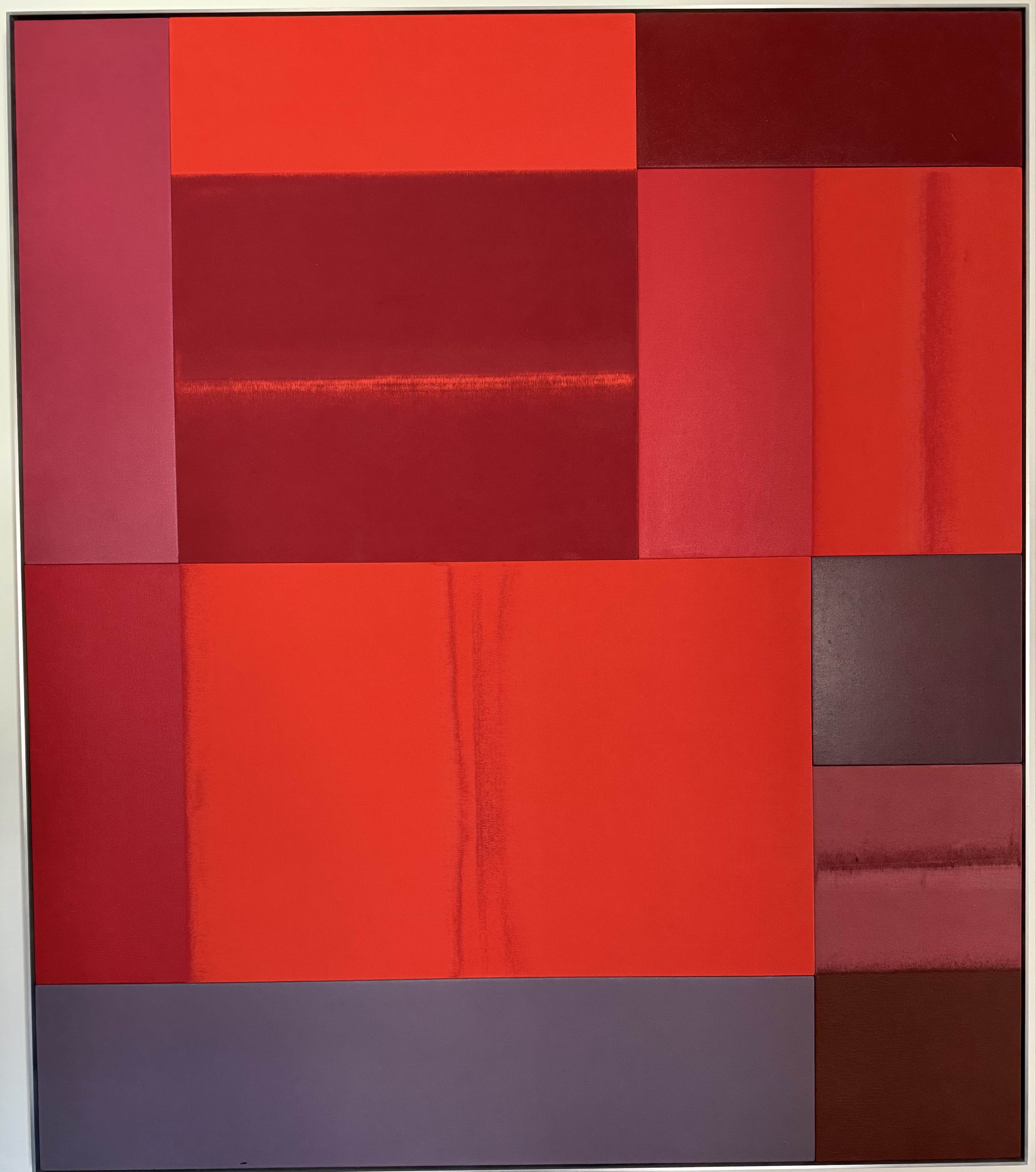
The result was something that defied easy categorization: not quite painting, not quite sculpture, but a charged space between the two where the language of abstraction met the raw fact of natural material. These branch works announced an artist who was thinking seriously about what it means for a surface to have history, weight, and physical presence before a single brushstroke is applied. Looking closely at the four works available here, the range of Arnoldi's practice becomes vivid and immediate. The large red painting is a study in tonal restraint pushed to its emotional limits.
Charles Arnoldi
Cousin, 2001
Composed entirely within the red spectrum, from deep burgundy and maroon through to blazing orange red and soft rose violet, the canvas is organized into a loose grid of rectangular fields. Each panel within the grid carries its own surface quality: some matte and flat, others showing the ghost of gestural marks, a horizontal shimmer in one zone, vertical drips in another. A single band of cool lavender grey anchors the bottom of the composition, functioning almost like a horizon line, grounding what might otherwise feel like pure chromatic sensation. The painting demonstrates how completely Arnoldi understands color as structure, and how much drama can be generated within a single hue when the artist understands surface as a variable.
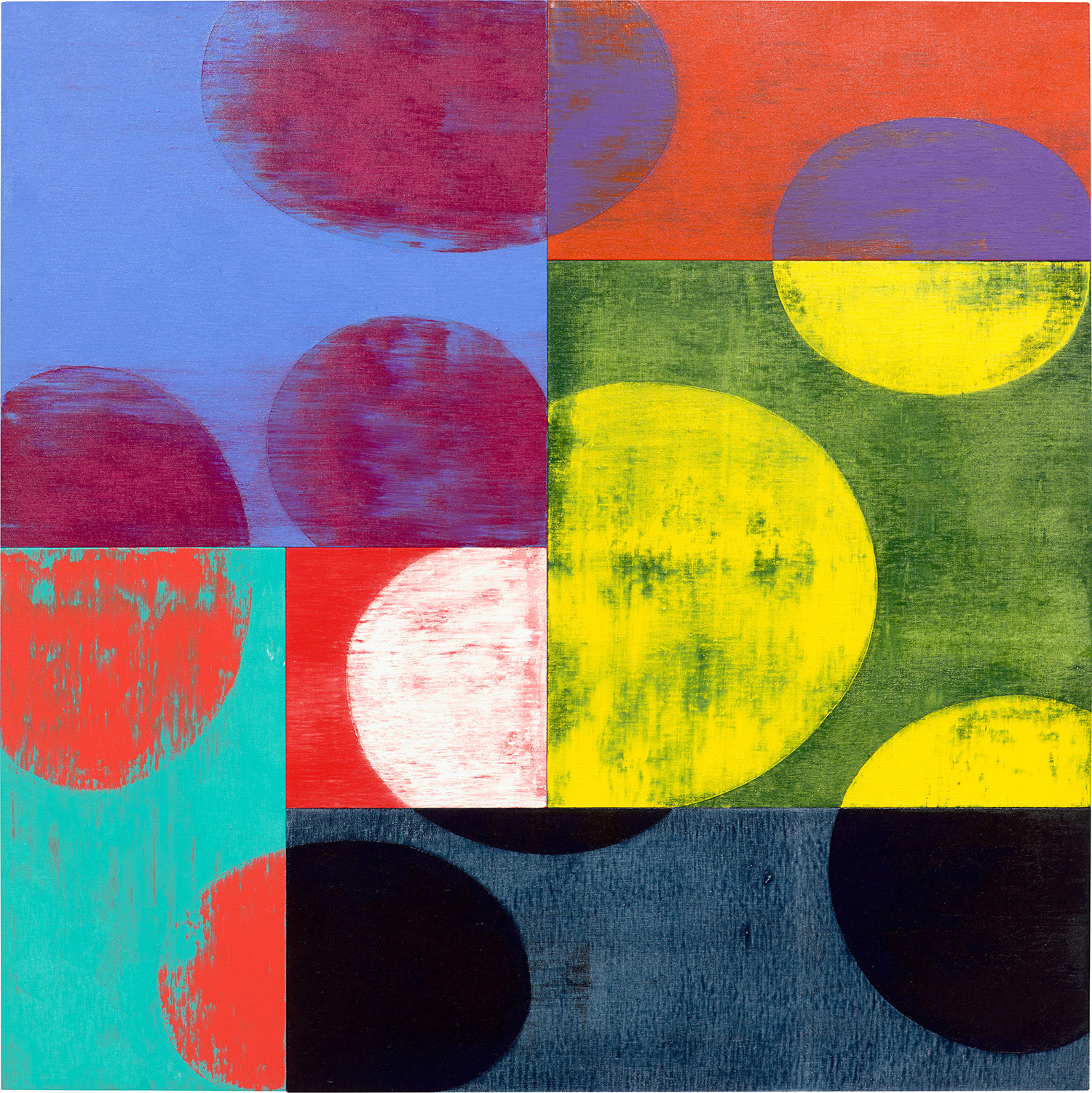
The second painting here, organized as a grid of bold colored panels populated by circles or oval forms, shows a more overtly playful side of his intelligence. Blocks of blue, orange red, green, teal, maroon, and black are set against one another in combinations that feel both systematic and intuitive. Within each panel, a large circular or oval shape is painted in a contrasting tone, some with soft edges, others with the look of worn or overprinted surfaces. The piece has the feeling of a color theory demonstration that has been set free, a conversation between Josef Albers and a street muralist, conducted entirely on Arnoldi's own terms.
Charles Arnoldi
String Theory II, 2016
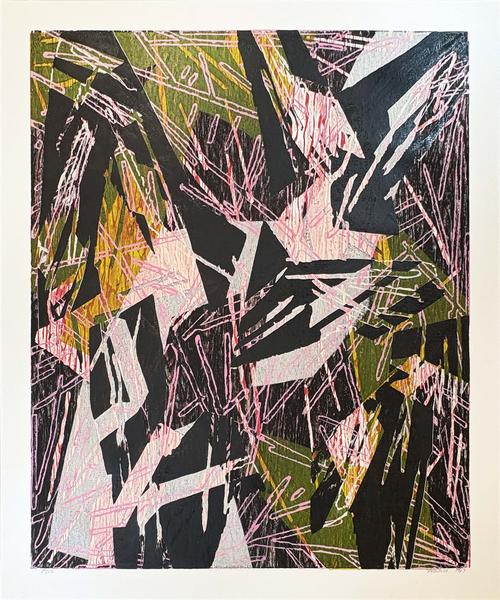
The two works on paper reveal yet another register of his practice. The woodcut, a riot of diagonal marks in green, maroon, orange, and black layered over a pale ground, captures the energy of natural growth in its most raw state. The marks suggest grasses or reeds seen from close range, overlapping and crossing in every direction, the composition threatening to fly apart while remaining somehow unified by the density of the layering. It is a print that rewards patient looking: the longer you spend with it, the more the surface reveals its internal logic.
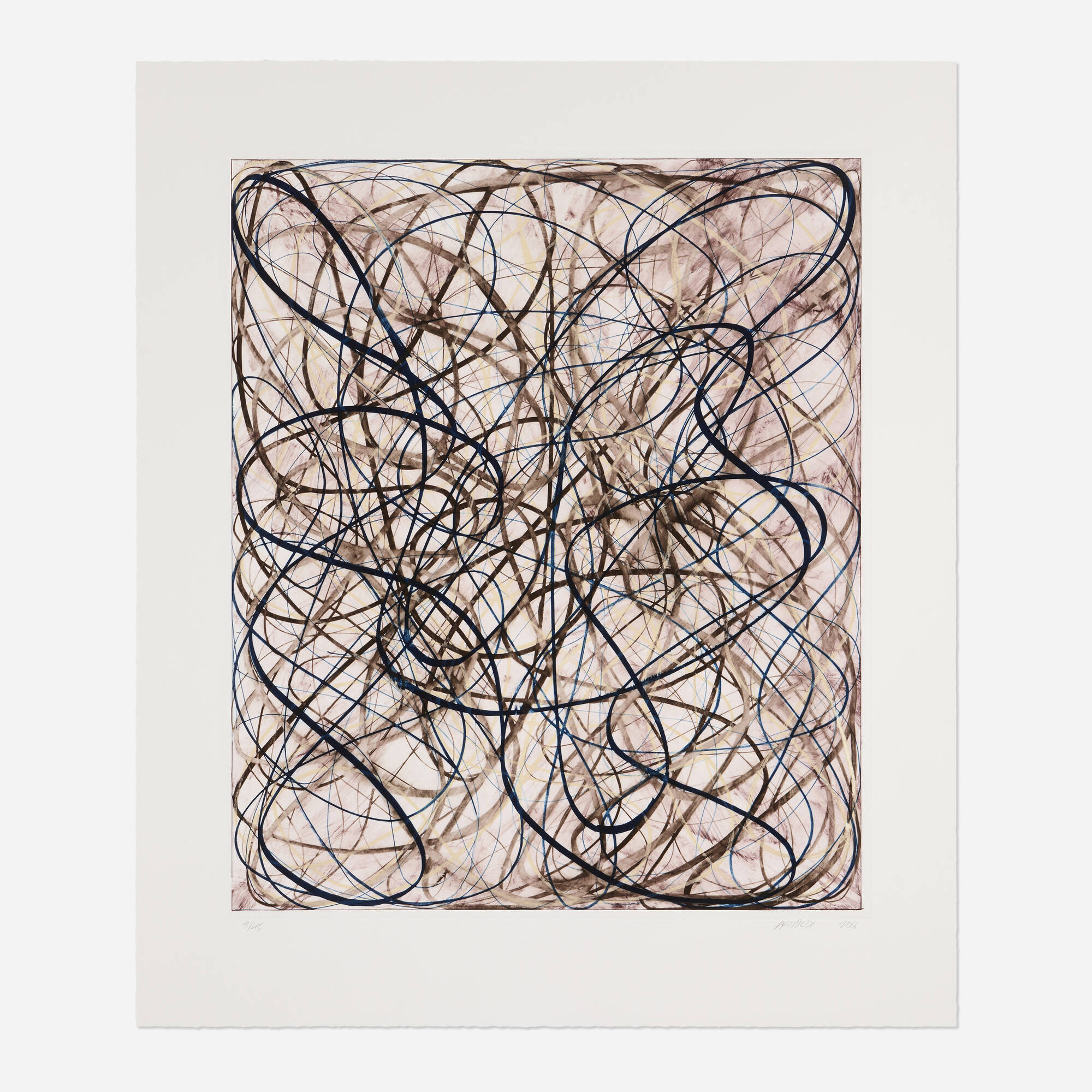
The polymer gravure titled String Theory II from 2016 is among the most technically ambitious works in this grouping. A mass of looping, spiraling lines in deep navy and warm brown fills a cream colored field, the marks building into a dense, kinetic tangle that hovers between drawing and gesture. Thin blue lines weave through the composition like countermelodies, and the overall effect is of movement captured at high speed, a visual record of energy in the process of organizing itself. The technical sophistication here is considerable: the polymer gravure process combined with etching and photo etching produces a layering of mark and tone that no single process could achieve alone.
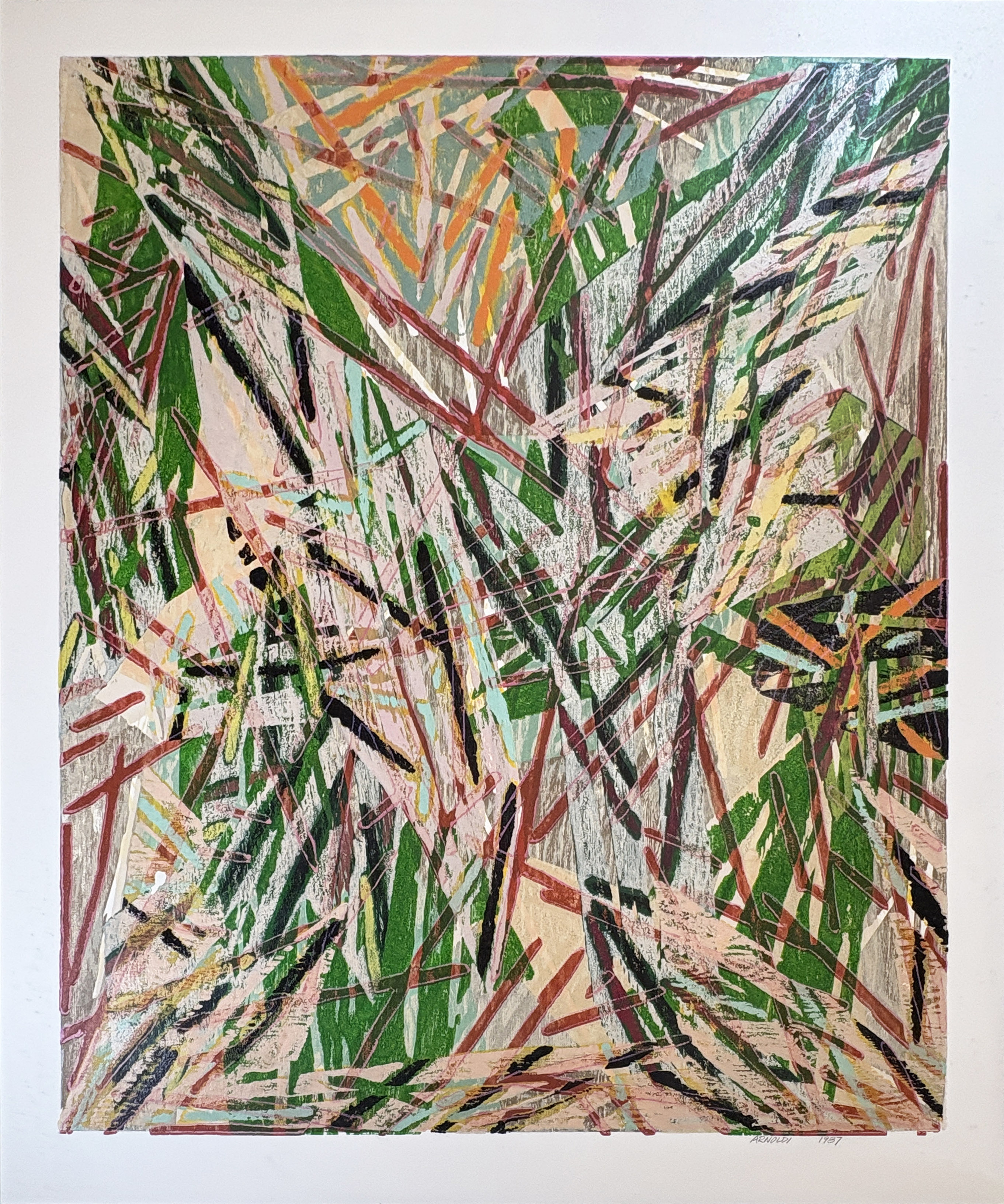
Charles Arnoldi
Untitled, 1987
For collectors, Arnoldi's work offers something genuinely unusual in the contemporary market. His prints represent one of the most accessible entry points into a practice that also includes large scale paintings commanding significant prices at auction. The woodcuts and gravures are not secondary products but fully realized works in their own right, made with the same conceptual seriousness as his paintings. Works on paper from the late 1980s through the 2010s have performed steadily at auction, and as institutional attention to the West Coast art history of that period continues to grow, the demand for his work is likely to increase accordingly.
Arnoldi occupies a specific and important position within the broader narrative of American abstraction. His work shares certain preoccupations with artists like Ed Moses and John McLaughlin in its sustained engagement with surface and structure, while his incorporation of natural material into the picture plane aligns him with a lineage that includes Robert Rauschenberg and even Arte Povera in its insistence that the world outside the studio has a legitimate claim on what happens within it. At the same time, Arnoldi is not easily assimilated into any single movement. His work is too idiosyncratic, too driven by personal inquiry, to function as an illustration of any particular tendency.
What makes Arnoldi matter today, beyond the considerable pleasure his work provides, is the consistency of his curiosity. Across nearly five decades of production, from the branch assemblages that made his name to the technically complex prints of his more recent years, he has remained genuinely interested in the problem he set himself at the beginning: what can a painted surface do that nothing else can do. The answer, as his work makes clear again and again, is more than most of us imagine.
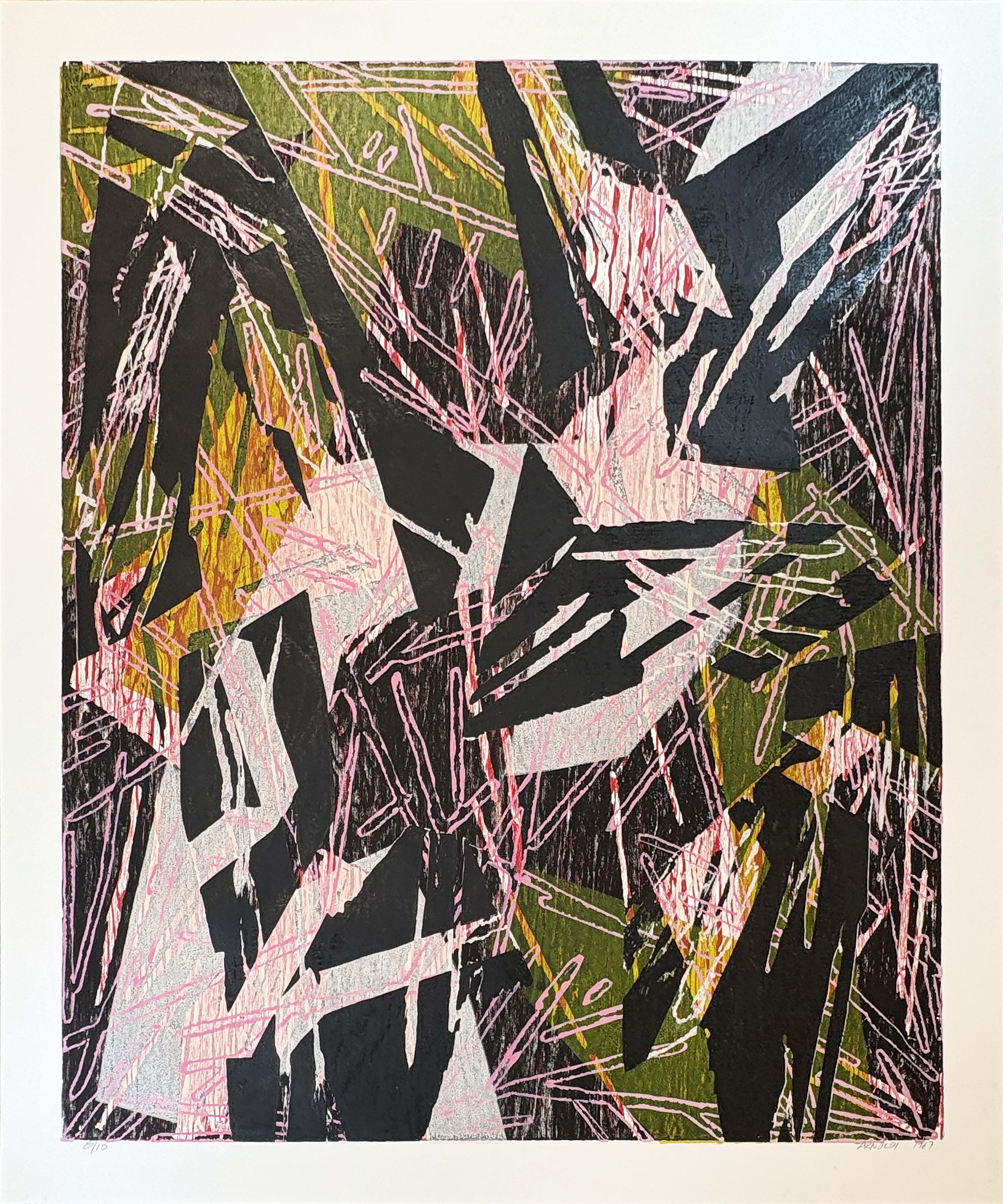
Explore books about Charles Arnoldi
Charles Arnoldi: Works on Paper
Michael Auping
Charles Arnoldi: Paintings and Works on Paper
Peter Frank
Charles Arnoldi: Recent Works
Various
Arnoldi: Collage Works, 1975-1985
Harry Gaugh
Charles Arnoldi: A Retrospective
Susan C. Larsen