Carolee Schneemann
Carolee Schneemann: Body, Vision, Pure Freedom
Artist Spotlight · The Collection Editorial
“I am among those who want to bring the body back into culture, to insist on sensory knowledge.”
Carolee Schneemann, interview with Lenora Champagne, 1981
There are artists who work within the boundaries of their time, and there are artists who redraw the boundaries entirely. Carolee Schneemann belonged emphatically to the second category. When the Solomon R. Guggenheim Museum mounted a comprehensive survey of her practice in 2017, titled "Carolee Schneemann: More Than Meat Joy," the art world was reminded with full force of just how much ground this singular American artist had broken over six decades of relentless, fearless, deeply intelligent work.
Carolee Schneemann
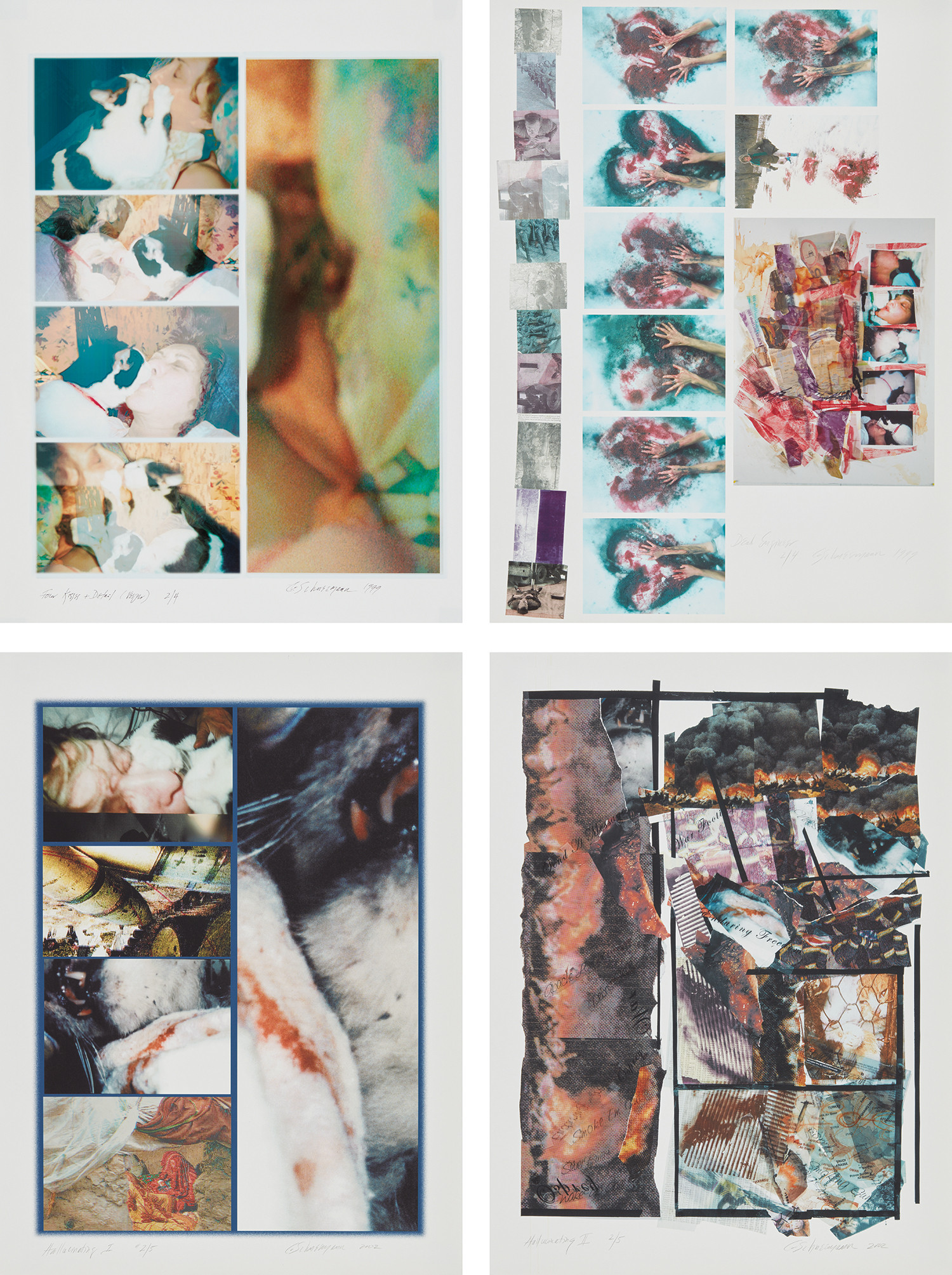
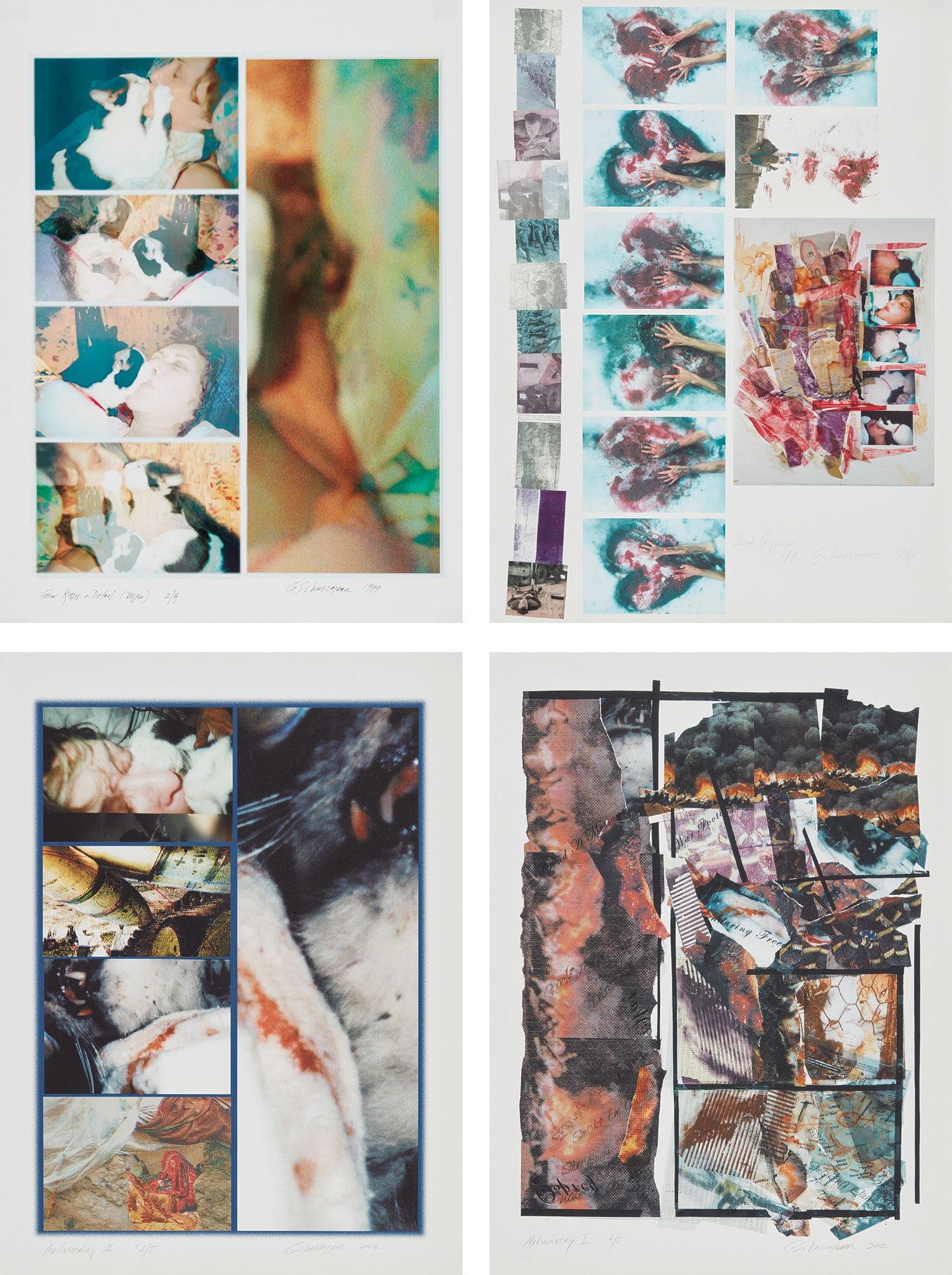
Four Kisses + Detail (Vesper); Dead Engineer-Kosovo; Hallucinatory I; and Hallucinatory II
The exhibition drew crowds who stood before her films, paintings, installations, and prints with something approaching reverence, recognizing in Schneemann a founding matriarch of performance art, feminist theory in practice, and the radical expansion of what art could ask of the human body. Carolee Schneemann was born in Fox Chase, Pennsylvania in 1939, and grew up in a household that was, by her own account, both nurturing and intellectually alive. She studied at the University of Illinois and later at Columbia University, the New School for Social Research, and the Università di Firenze in Italy, absorbing painting, drawing, and art history with a voraciousness that would never leave her. Her early formation was grounded in the history of Western painting, particularly the sensory density of Cézanne and the expressive freedoms of the Abstract Expressionists, though she would come to question the exclusion of women from the heroic mythology surrounding that movement with a directness that was entirely her own.
By the early 1960s Schneemann had settled in New York and was moving fluidly between the downtown painting scene and the emergent Happenings movement centered around figures like Allan Kaprow and Claes Oldenburg. She became involved with Fluxus, that gloriously anarchic international network of artists who dissolved the boundary between art and life, between object and event. Yet Schneemann was never simply a participant in movements; she was always pushing at their edges. Where Fluxus could sometimes feel cool and conceptual, Schneemann insisted on the erotic, the embodied, the mythological.
Carolee Schneemann
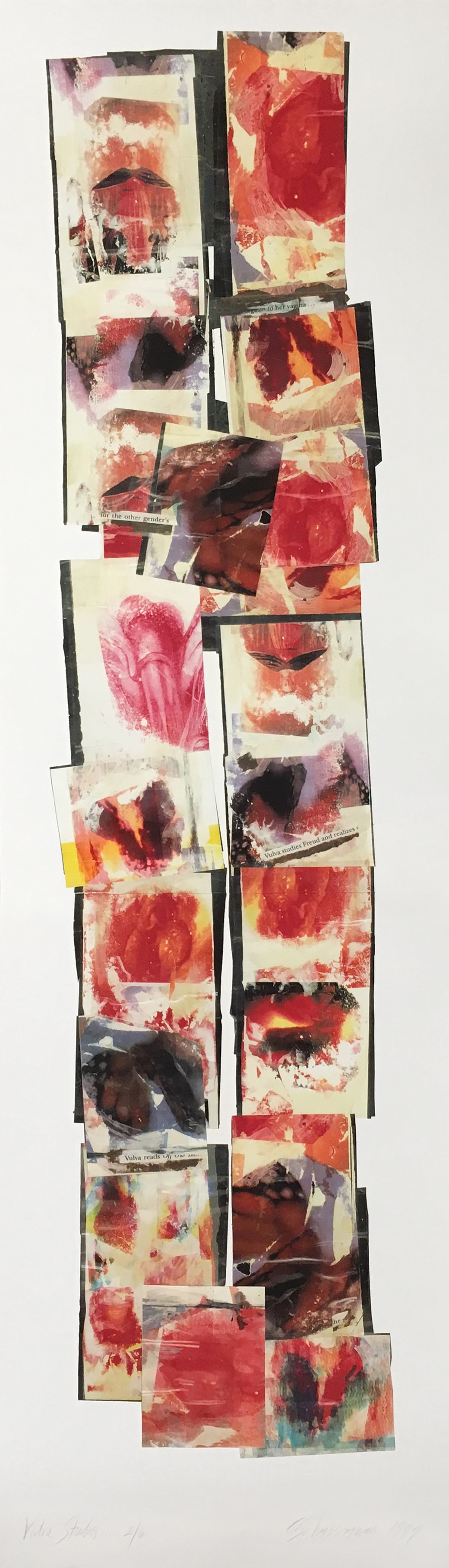
Vulva Studies
Where painting felt static, she animated it. Where performance felt abstract, she made it carnal and political and urgent. The breakthrough work that secured her legendary status came in 1964 with "Meat Joy," a choreographed performance involving raw fish, chickens, sausages, paint, and bodies in various states of undress, staged first in Paris and then in New York. The piece was joyful in the most radical sense: it reclaimed pleasure, mess, and bodily autonomy as legitimate artistic territory.
“In some sense I made a gift of my body to other women: giving our bodies back to ourselves.”
Carolee Schneemann, on Interior Scroll
A decade later, "Interior Scroll" (1975) saw Schneemann stand before an audience and slowly extract a long narrow paper scroll from her vagina, reading aloud from it a text addressing the dismissal of women artists by male filmmakers. It remains one of the most discussed, debated, and reproduced performances in the history of art, not because it was provocative for provocation's sake, but because it was precise, theoretical, and wickedly funny. Schneemann worked extensively as a printmaker and photographer throughout her career, and the works available through The Collection offer collectors a genuinely intimate window into her visual intelligence. "Vulva's School" and related Vulva Studies, which she developed across the 1990s and into the 2000s, extended her feminist iconography into a lexicon of drawn and printed forms that were by turns tender, satirical, and mythologically resonant.
Carolee Schneemann
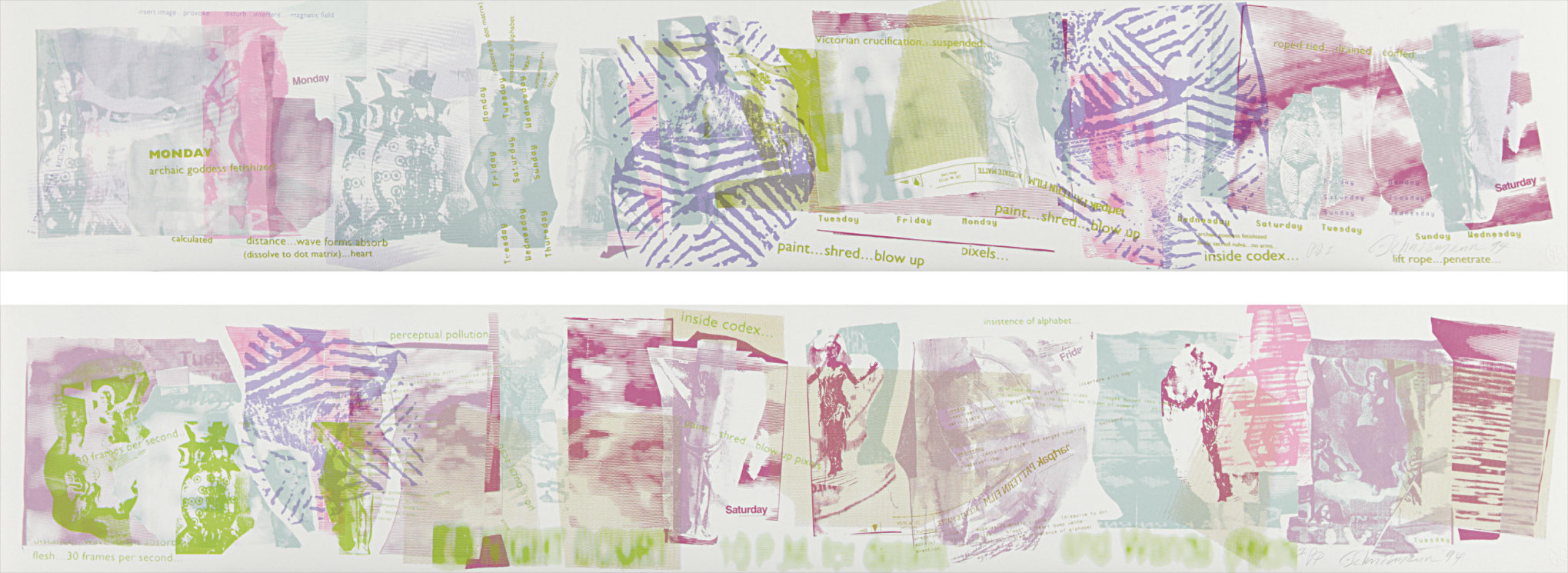
Monday; and Saturday
The prints signed and published through Portland Color represent her working within a careful, craft attentive tradition of fine art printmaking, while the "Monday" and "Saturday" prints published through Mark Patsfall Graphics in Cincinnati, numbered as printers proofs with their distinctive blindstamp, carry the particular intimacy of works that preceded the main edition, chosen and kept close by the artist. Meanwhile the photographic works that reference Kosovo and the series "Four Kisses" and "Hallucinatory" demonstrate the range of her later practice, in which she brought her eye for the charged image to questions of geopolitical violence, memory, and erotic experience simultaneously. These chromogenic and Iris prints have a lush, saturated material presence that rewards close looking. For collectors, Schneemann represents both a historically significant figure and a still developing market proposition.
Her major paintings and installations have entered the collections of institutions including the Museum of Modern Art, the Tate, and the Centre Pompidou, and significant works have appeared at auction through Christie's and Phillips in recent years, with prices reflecting her growing canonical status. But the works on paper and prints remain genuinely accessible relative to her importance, and they carry her ideas with full force. Collectors drawn to the feminist avant garde, to the intersection of performance and visual art, and to works that hold both theoretical weight and genuine visual beauty will find Schneemann consistently rewarding. She is the kind of artist whose work deepens with each return visit.
Understanding Schneemann fully means placing her in conversation with a network of artists who shared her concerns even when their methods diverged. Hannah Wilke, whose body based work and feminist iconography ran parallel to Schneemann's through the 1970s and 1980s, is an obvious point of connection. Yoko Ono, a fellow traveler through Fluxus, shares her interest in instruction, the body, and the dissolution of art world hierarchies. Ana Mendieta brought a similarly mythological and corporeal intensity to performance and photography.
And the legacy of all these artists flows directly into the work of younger practitioners including Kara Walker, Tracey Emin, and a generation of artists for whom the body as both subject and medium is simply given. Schneemann did much of the work that made it given. Carolee Schneemann died in March 2019 at her home in Springtown, New York, surrounded by her books and the accumulated evidence of a life spent in total dedication to the idea that art could tell the truth about experience in ways nothing else could. She left behind a body of work that spans painting, performance, film, video, installation, photography, and printmaking, and that continues to generate scholarship, exhibitions, and passionate collecting.
To own a work by Schneemann is to hold a piece of one of the most consequential artistic practices of the twentieth century, the work of a woman who looked the culture directly in the eye and refused, with extraordinary intelligence and joy, to blink.
Explore books about Carolee Schneemann
Carolee Schneemann: Kinetic Painting
Carolee Schneemann
More Than Meat Joy
Carolee Schneemann
Cézanne, She Was a Great Painter
Carolee Schneemann
Carolee Schneemann: Imaging Her Erotics
Julie Kleinman, David Ward
Carolee Schneemann
Kristine Stiles
Carolee Schneemann: Untitled Film Stills
Various Contributors