Carole A. Feuerman
Carole Feuerman Makes Sculpture Feel Alive
Artist Spotlight · The Collection Editorial
There is a moment, standing before a Carole A. Feuerman sculpture, when the rational mind stutters. The figure before you breathes, or seems to. Water appears to bead and run along a shoulder.
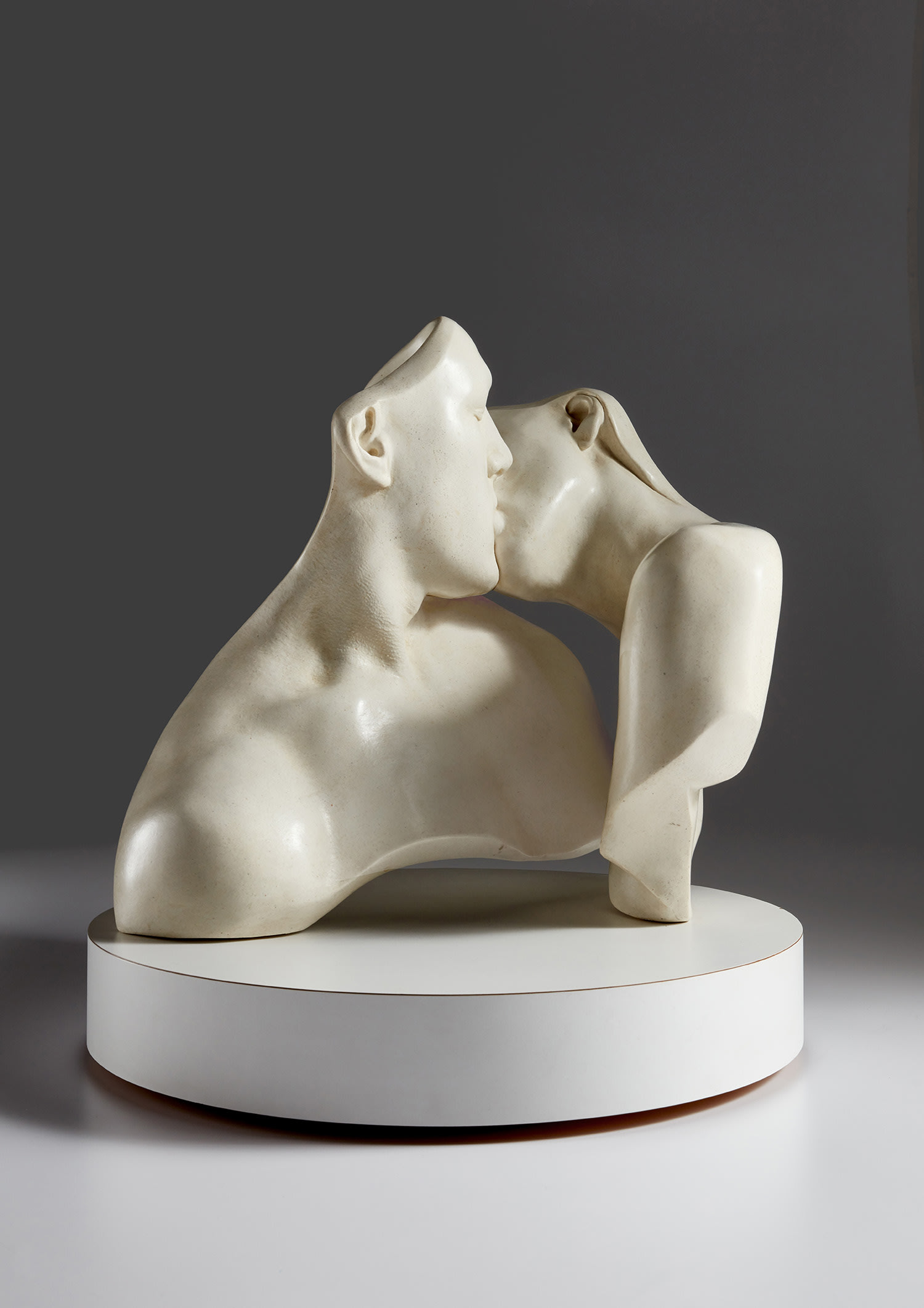
Carole A. Feuerman
Kiss, 1987
A swimmer rests, eyes closed, suspended in a reverie so complete that you find yourself lowering your voice without quite knowing why. This is the quiet miracle that Feuerman has spent five decades perfecting, and it is a miracle that continues to earn her new admirers across continents. Her work has appeared at the Venice Biennale, at the Grounds for Sculpture in New Jersey, and in public installations across Europe and Asia, cementing her reputation as one of the most consequential hyperrealist sculptors working in any medium today. Feuerman was born in 1945 and grew up in the United States during a postwar era defined by both optimism and profound social change.
From early in her development as an artist she was drawn to the human form with an almost scientific intensity, fascinated by the way light moves across skin, the way the body holds tension and release simultaneously. She trained with rigor and seriousness, building a technical foundation that would later allow her to push the boundaries of what resin and bronze could express. Her formative years instilled in her a commitment to craft that sits at the very heart of her practice and distinguishes her work from artists who reach for realism as a concept rather than a lived discipline. The arc of Feuerman's artistic development tracks closely with the emergence of hyperrealism as a serious movement in American art during the 1970s and 1980s.
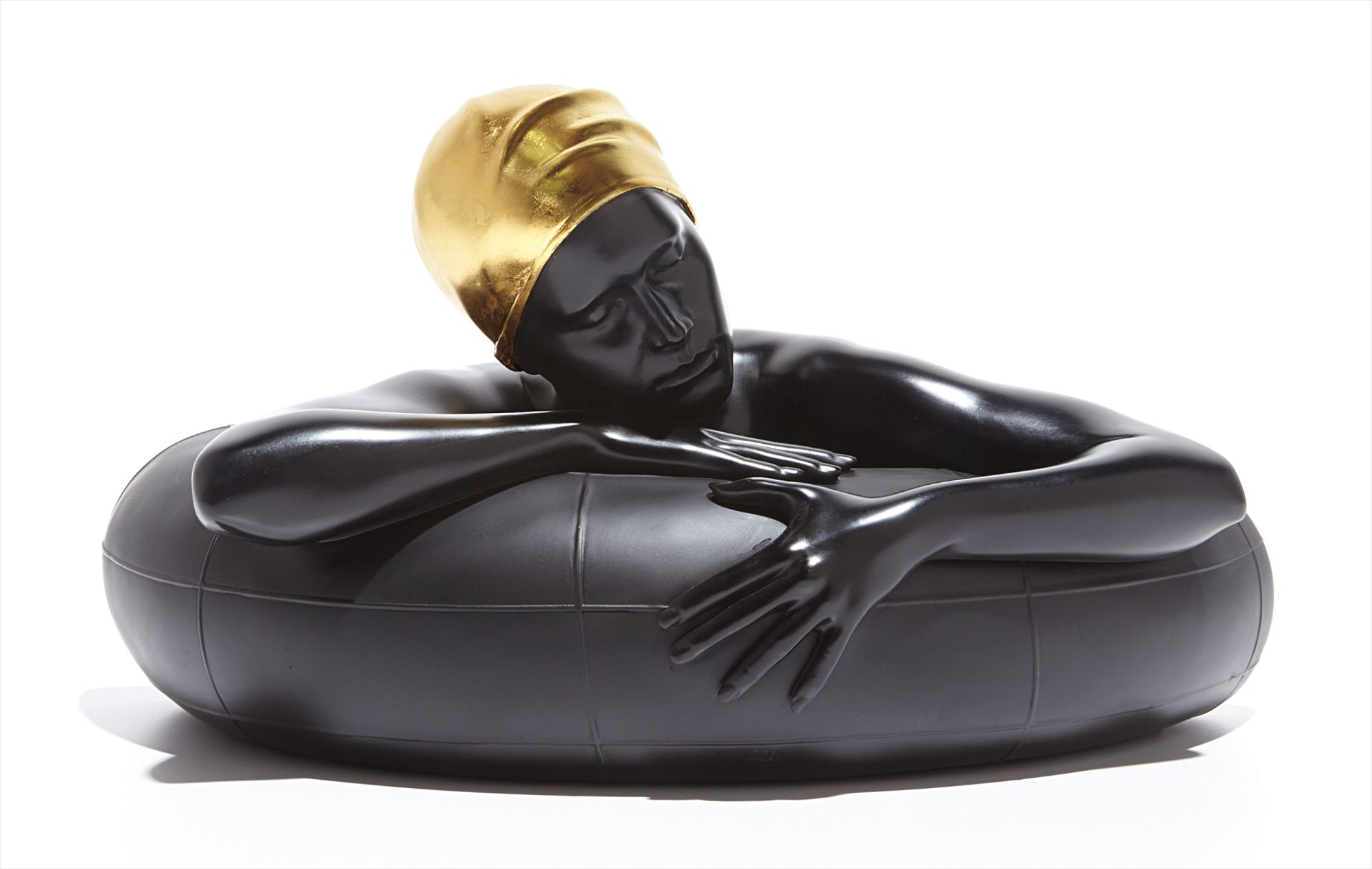
Carole A. Feuerman
Miniature Serena II
While painters like Chuck Close and Richard Estes were redefining photographic fidelity on canvas, Feuerman was asking what that same radical attention to reality might mean in three dimensions. Working in resin, a material that rewards patience and penalizes shortcuts, she developed techniques for capturing the translucency of wet skin, the compression of a bathing cap against a skull, the gentle distortion of features seen through goggles. By the mid 1980s she had found her defining subject: figures associated with water, swimmers and bathers caught in moments of suspension and reflection that carry the weight of something far larger than leisure. Among the works that established her reputation, several stand out as touchstones.
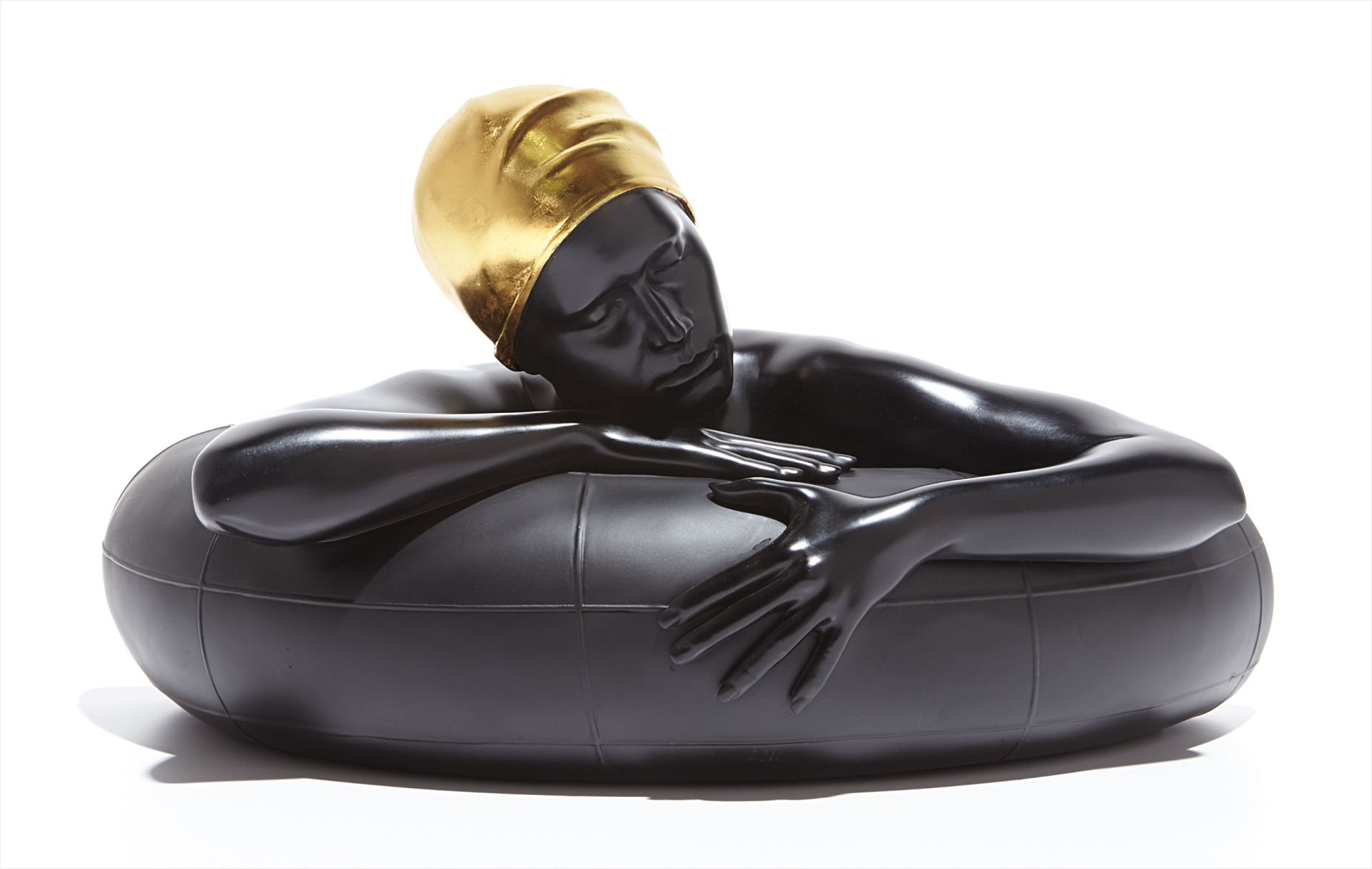
"Sunburn," created in 1983 using oil and mixed media on resin, announced her command of color and surface with startling confidence. The following year, "Beachball" extended that conversation, incorporating a wig to deepen the uncanny presence of the figure and asking viewers to negotiate their own discomfort at the boundary between representation and reality. "Kiss," cast in resin in 1987, remains one of her most emotionally resonant pieces, distilling tenderness into form with the economy of a great poem. Works like "Miniature Serena II," finished with 24k gold leaf, reveal her willingness to layer material luxury onto human intimacy, creating objects that are simultaneously trophies and meditations.
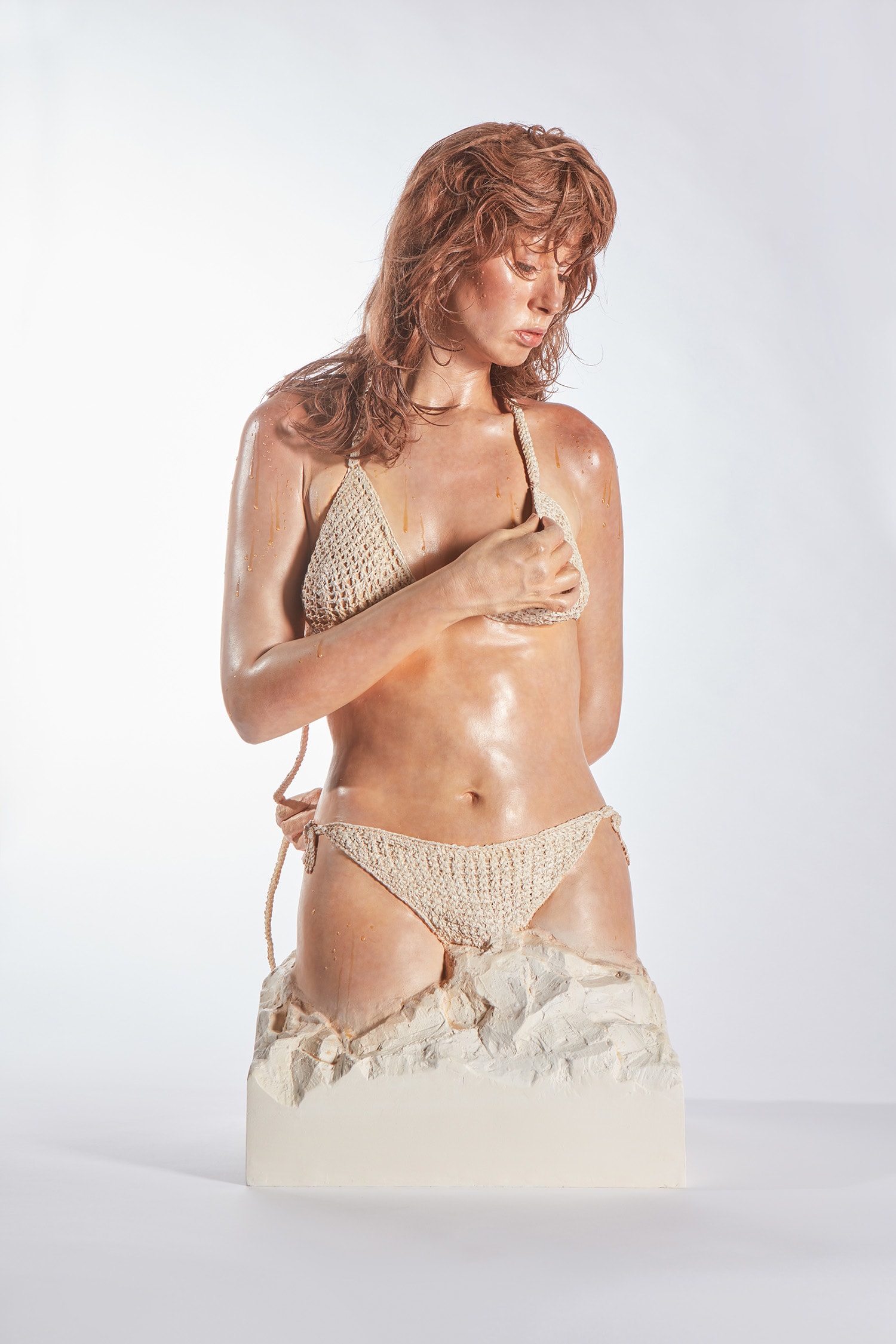
Carole A. Feuerman
Sunburn, 1983
"Reflections" and "Mona Lisa" further demonstrate the range of her imagination, the latter suggesting a playful but serious dialogue with art historical memory. Feuerman is widely regarded as one of the pioneers of hyperrealist sculpture, a designation she shares with a small and distinguished cohort. Her work invites comparison to Duane Hanson, whose fiberglass figures populate everyday American spaces with uncomfortable accuracy, and to John De Andrea, whose painted bronze figures pursue a similar fidelity to flesh. Yet Feuerman's vision is distinctly her own.
Where Hanson favored the workaday and the anonymous, Feuerman gravitates toward beauty in repose, toward figures that feel chosen and luminous. Her swimmers and bathers exist in a private world of sensation, and the viewer is granted access as a kind of honored guest rather than a voyeur. For collectors, Feuerman's work occupies a compelling position in the contemporary market. Her career spans more than four decades of consistent production and international exhibition, which means that works from across her development are available at a range of scale and price points.
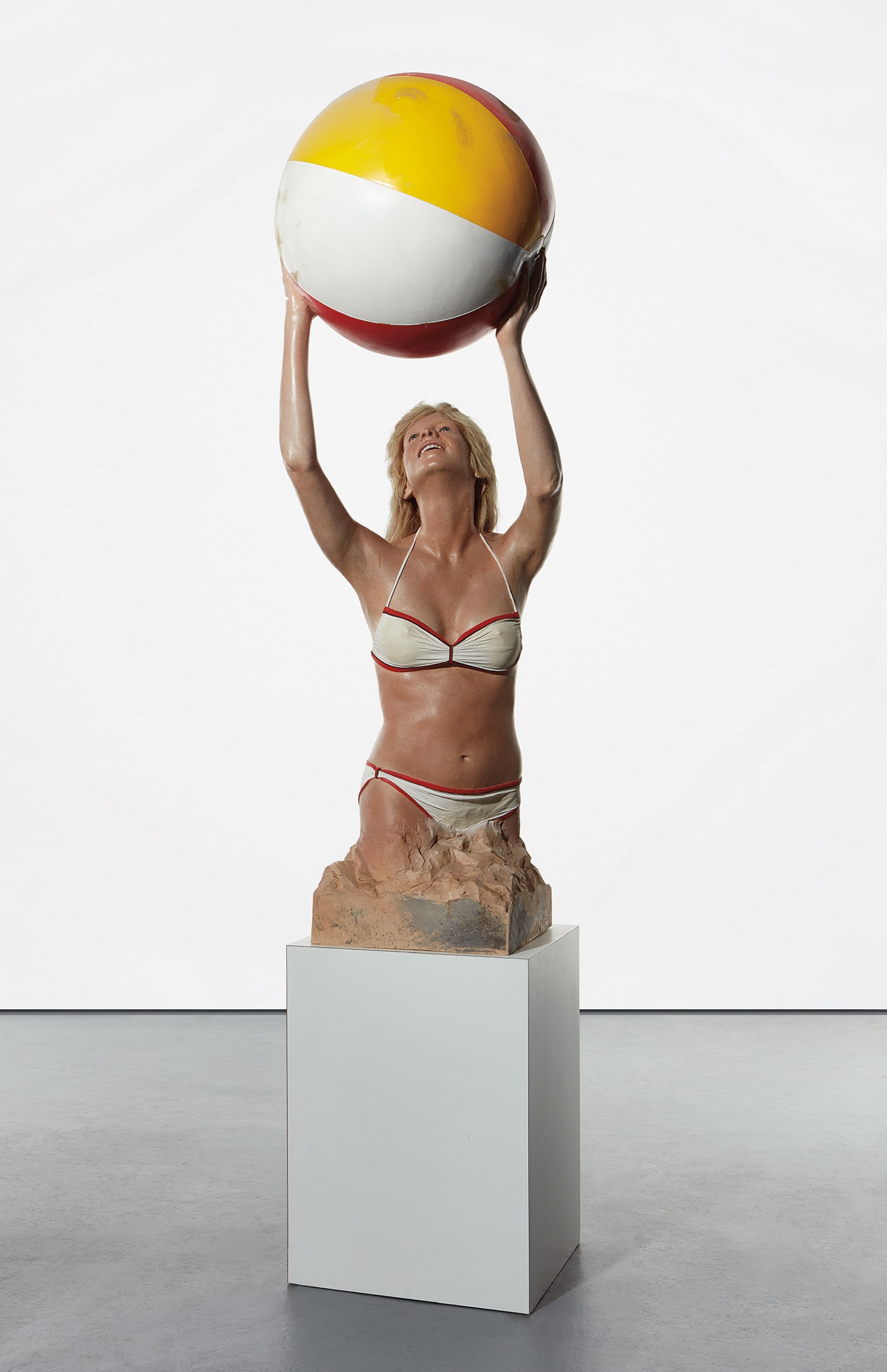
Carole A. Feuerman
Beachball, 1984
Smaller painted resin works offer an accessible entry point without sacrificing the technical mastery that defines her practice. Larger bronzes and resin sculptures command significant attention and represent substantial long term value, particularly as institutional interest in hyperrealism continues to grow. The movement itself has achieved genuine art historical recognition, and Feuerman as one of its earliest and most accomplished practitioners benefits directly from that reappraisal. Collectors drawn to technical excellence, to works that provoke genuine perceptual wonder, and to an artist with a clear and sustained vision will find her practice deeply rewarding.
The broader context for Feuerman's achievement is worth understanding clearly. Hyperrealism in sculpture has always occupied a provocative middle ground, neither the cool conceptualism that dominated critical discourse for much of the late twentieth century nor the expressive abstraction that preceded it. It demands from its audience a willingness to be moved by skill, to take seriously the idea that extraordinary craft is itself a form of meaning making. Feuerman has argued this case not in manifestos but in objects, decade after decade, accumulating a body of work that makes the argument irresistibly.
She has shown at major venues across Europe, Asia, and the Americas, and her pieces are held in distinguished public and private collections around the world. What endures most powerfully about Feuerman's work is its humanity. Her figures are not tricks or provocations. They are presences.
They ask to be regarded with the same attention and care that she brought to their making. In a cultural moment defined by speed, distraction, and the flattening of experience into screens, there is something almost radical about an artist who insists that looking slowly and carefully at a single human form is worth a lifetime of devotion. Carole A. Feuerman has given us figures that stop us in our tracks and return us to ourselves.
That is no small gift, and the art world is still catching up to its full magnitude.