Carlos Rolón
Carlos Rolón Turns Every Surface Into Celebration
Artist Spotlight · The Collection Editorial
When Carlos Rolón installed his dazzling, mosaic laden environments at the 2007 Venice Biennale, the art world took notice of something it had not quite seen before: a sensibility that refused to choose between the street and the salon, between the barbershop and the museum, between Puerto Rican ornamental tradition and the glossy surfaces of contemporary luxury. That appearance on the world stage was not an arrival so much as a confirmation. Rolón, who works professionally under the name Dzine, had already spent years building a practice in Chicago that was as rigorous as it was exuberant, and Venice simply gave the broader conversation a chance to catch up with him. Rolón was born in 1970, and his formation is inseparable from the textures and tensions of Puerto Rican identity in the continental United States.
Carlos Rolón
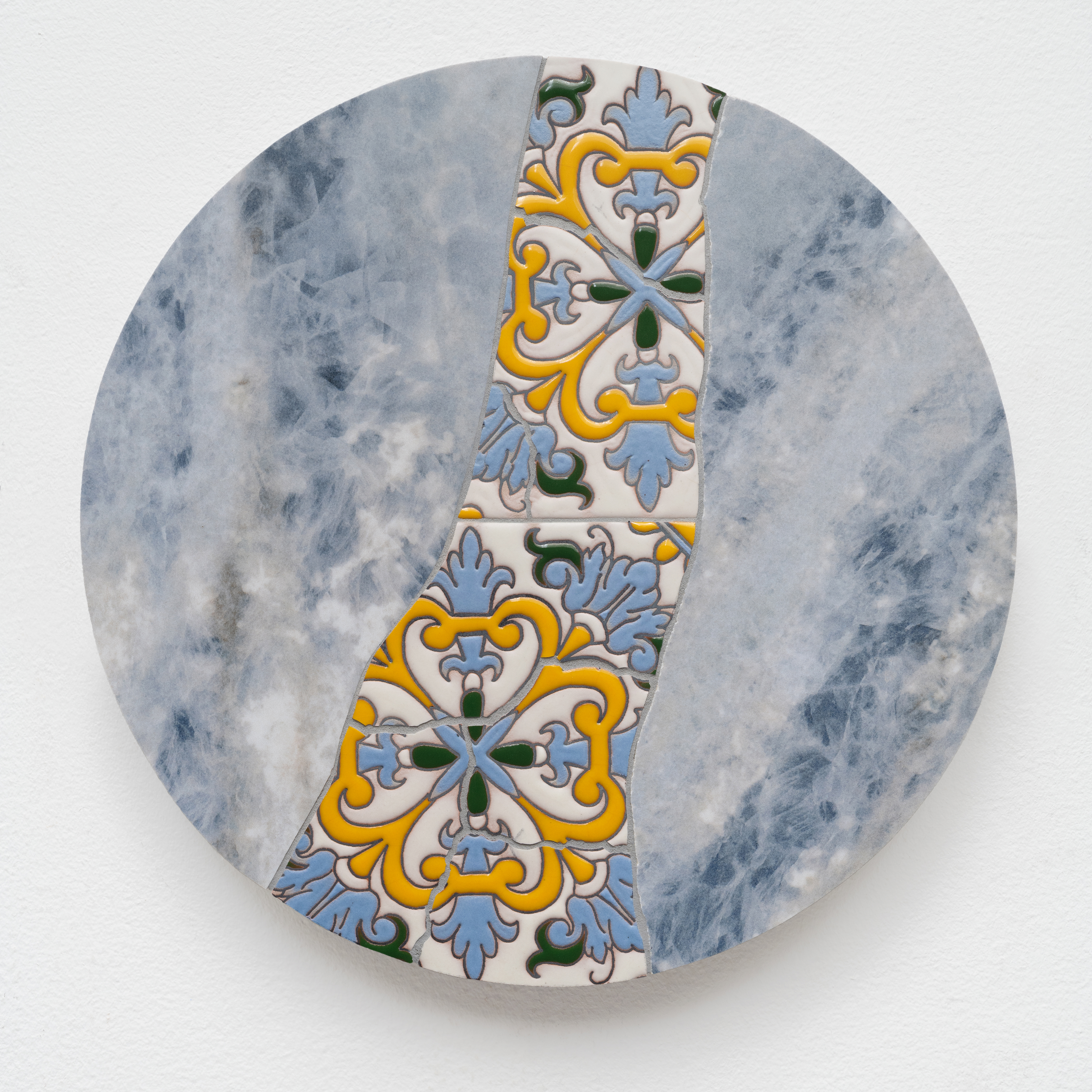
Gibraltar
Growing up with deep roots in that community, he absorbed the visual vocabulary of diasporic culture with the seriousness of someone who understood that decoration is never merely decorative. The ornamental traditions carried across generations, the pride expressed through customized objects, the way a barbershop chair or a lowrider could become a site of genuine aesthetic ambition: all of this became foundational material for an artist who would eventually move between galleries in Miami and New York with equal fluency. Chicago, where he built his early reputation, gave him a community of artists and a city with its own fierce visual culture, and both left permanent marks on his work. The development of his practice followed a trajectory that is easier to trace in retrospect than it was to predict at the time.
Rolón moved through graffiti and street culture as a young artist, and that background gave him an understanding of surface, scale, and public presence that has never left his work. But where many artists who begin in that world either stay within its conventions or flee them entirely, Rolón did something more interesting: he began incorporating the language of fine craft, of decorative arts history, of tile work and mirror and intricate inlay, into an expanded practice that made the luxury object a subject rather than simply an aspiration. He was not celebrating consumerism so much as interrogating the desire that underlies it, and doing so with materials that demanded real skill and real time. The works that define his reputation are objects of considerable physical presence.
Carlos Rolón
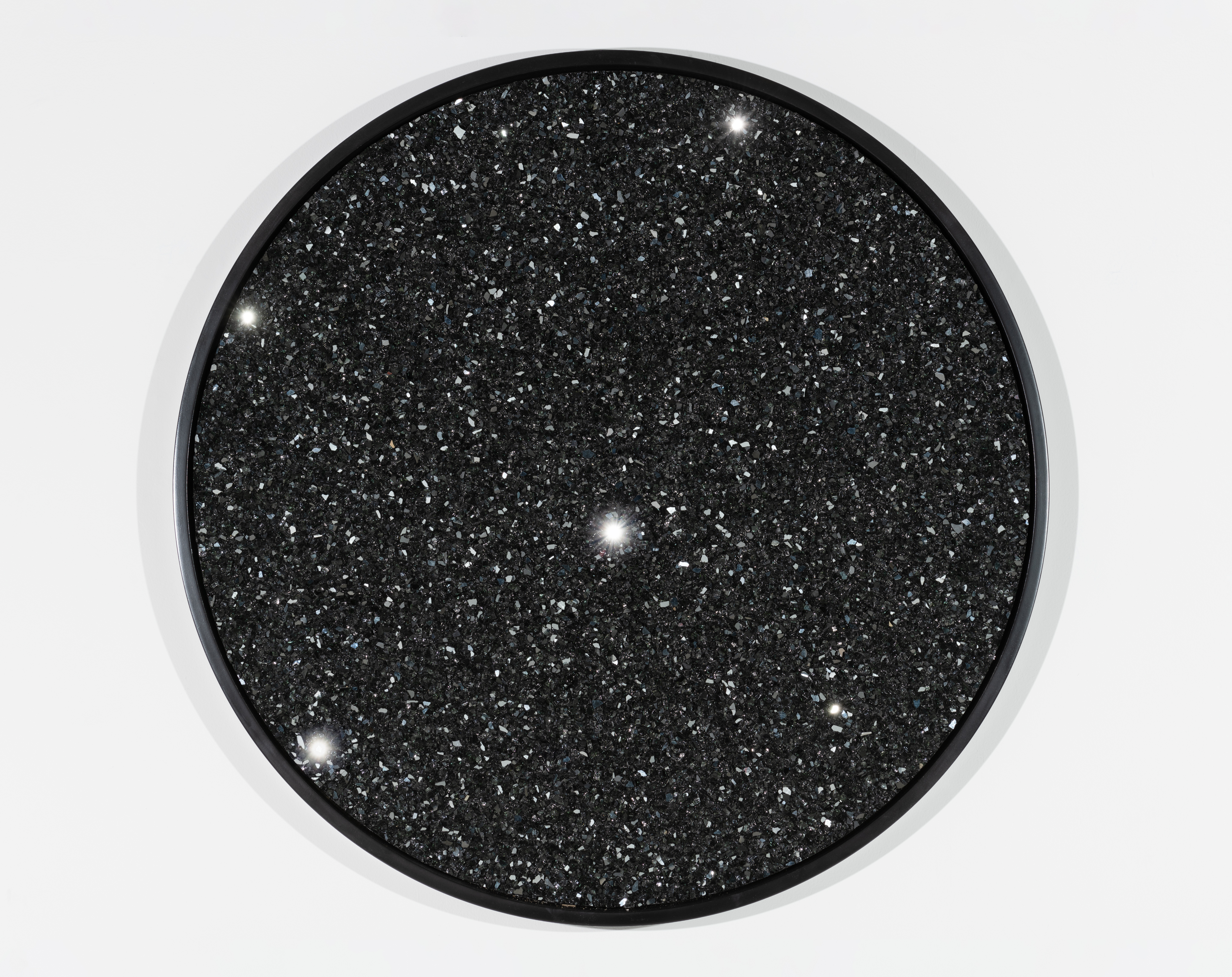
Untitled (Celestial X), 2022
"Gibraltar," composed of repurposed vintage tile, cement tile, marble, and mirror on wedi board, demonstrates how thoroughly Rolón has absorbed the traditions of Mediterranean and Islamic decorative arts while making something entirely his own. The piece rewards sustained looking: the interplay of historic materials with contemporary composition creates a visual rhythm that feels both ancient and urgently present. "Untitled (Celestial X)," completed in 2022 and made from shattered fireglass and silicone on aluminum panel, represents a more recent direction in his thinking. The shattered material carries the memory of violence while the finished surface achieves something luminous and transcendent, a tension that gives the work genuine emotional complexity.
Both pieces demonstrate Rolón's central argument: that beauty is not a retreat from meaning but a vehicle for it. For collectors, Rolón's work occupies a particularly compelling position in the current market. His practice sits at a genuine intersection of craft traditions and contemporary conceptual concerns, which means that the work has appeal across collecting communities that do not always overlap. Collectors drawn to the history of decorative arts find in his surfaces a conversation with centuries of tile making and inlay traditions.
Collectors focused on contemporary identity and diaspora find an artist who treats those themes with nuance and without sentimentality. And collectors who simply respond to objects of exceptional material quality find that Rolón's work rewards the kind of close attention that distinguishes a serious collection from a decorative one. The combination of these appeals gives his work a stability that transcends any single market trend. In the broader context of contemporary art, Rolón's practice invites comparison with artists who have similarly troubled the boundary between fine art and applied craft.
The work resonates with the legacy of artists like Yinka Shonibare, who uses material and ornament to carry postcolonial arguments, and with the surface investigations of Virgil Abloh, who brought a similar fluency with cultural codes to his work across disciplines. Closer to the decorative tradition, Rolón shares territory with artists like Bharti Kher, whose use of ornamental motifs carries multiple layers of cultural meaning. What distinguishes Rolón within this company is his particular combination of street credibility, craft knowledge, and a genuine warmth toward the communities and traditions that formed him. The venues that have shown his work speak to the seriousness with which institutions have engaged his practice.
The Bass Museum of Art in Miami and the New Orleans Museum of Art have both provided contexts in which his installations could reach their full spatial ambition. These are not marginal platforms; they are institutions with real collections and serious curatorial perspectives, and their investment in Rolón's work reflects a consensus that his practice belongs in the company of artists whose contributions will be studied and collected over the long term. What makes Rolón matter today, beyond the beauty of individual works, is the argument his practice makes about the relationship between cultural inheritance and artistic invention. At a moment when conversations about identity in art can sometimes feel more like taxonomy than discovery, Rolón insists on the transformative possibility of making things with great care and deep knowledge.
His surfaces are not illustrations of ideas about diaspora or luxury or craft; they are the ideas themselves, made physical and made available to anyone willing to spend time with them. For collectors who want work that will continue to generate meaning as the cultural conversation shifts and deepens, there are few artists working today with more to offer.