Carlos Mérida
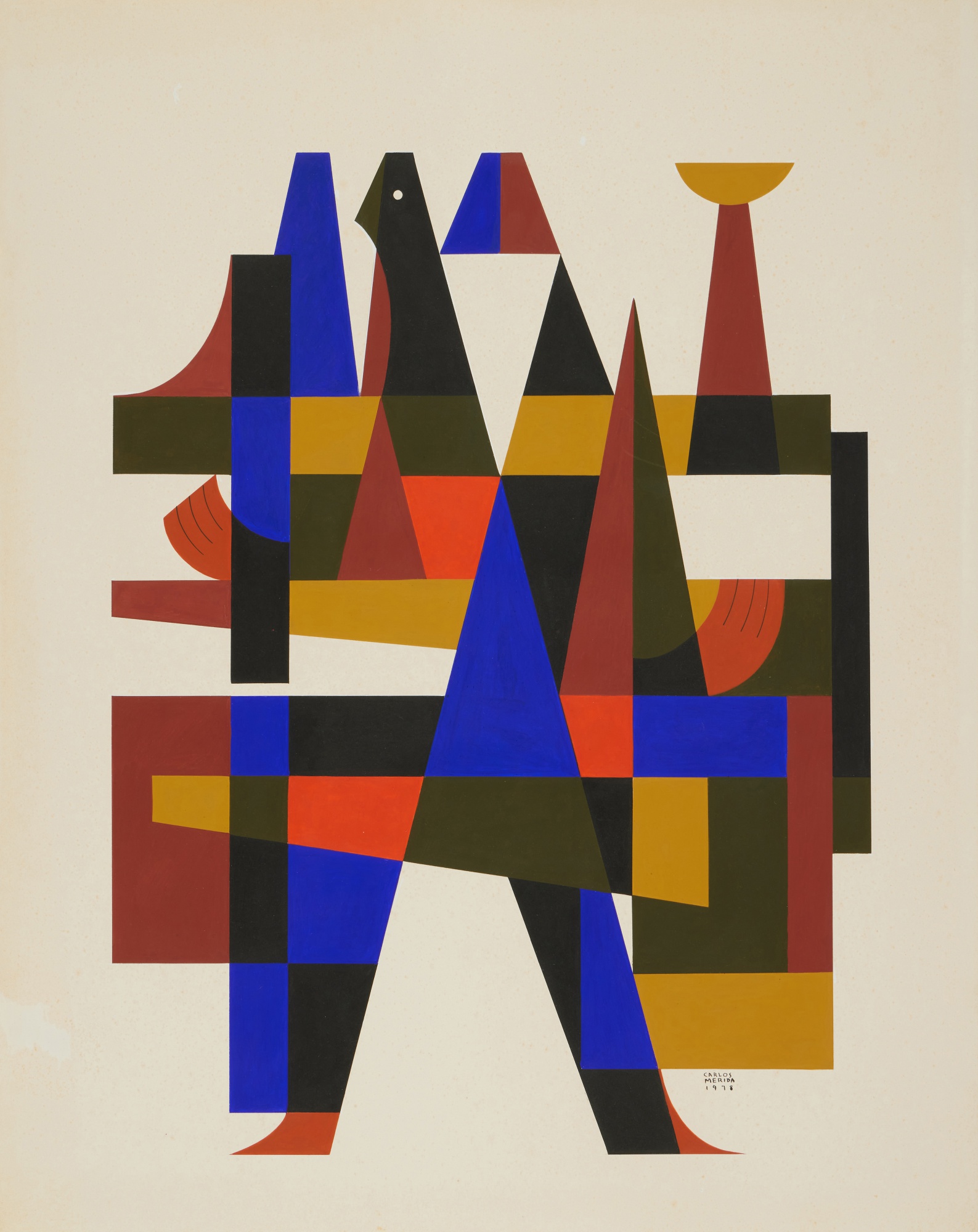
Carlos Mérida, Where Two Worlds Sing
Artist Spotlight · The Collection Editorial
There is a moment in the permanent collection galleries of the Museo de Arte Moderno in Mexico City when visitors stop mid stride. The work before them pulses with color, its geometric forms arranged with a precision that feels almost musical, yet the shapes carry the weight of something ancient, something rooted in the earth of Mesoamerica. The artist responsible for this singular experience is Carlos Mérida, the Guatemalan born, Mexico City adopted master who spent nearly a century building one of the most quietly extraordinary bodies of work in twentieth century art. As institutions across Latin America and the United States continue to reassess the full sweep of modernism beyond its European center of gravity, Mérida's synthesis of pre Columbian spirit and geometric abstraction feels not merely relevant but essential.
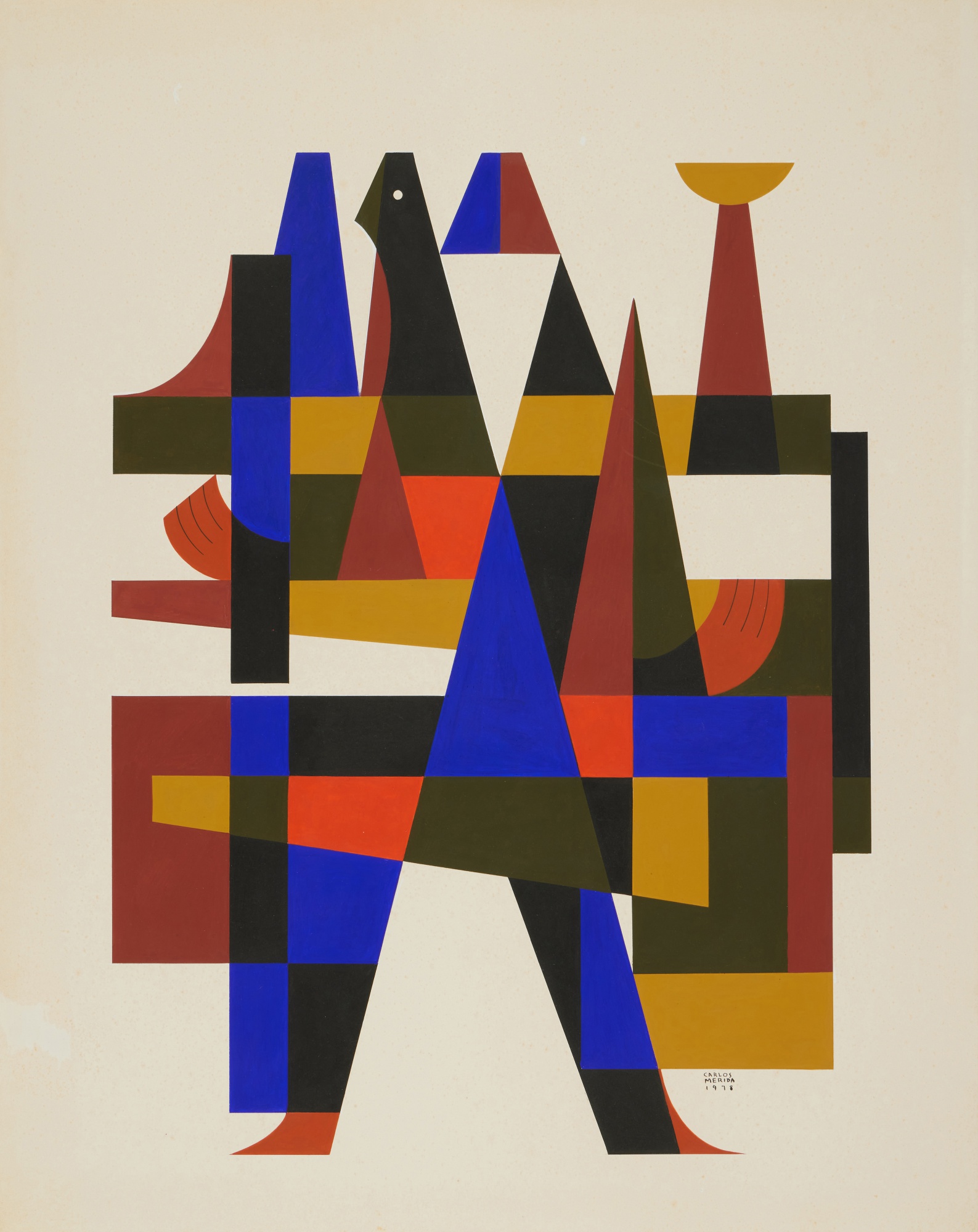
Carlos Mérida
Personaje de pié, 1978
Mérida was born in 1891 in Quetzaltenango, Guatemala, a city of highland grandeur and deep indigenous roots. He came of age within a culture saturated with Maya Quiché tradition, and this inheritance would never leave him, no matter how far his education and ambitions carried him across the Atlantic. As a young man he traveled to Europe, arriving in Paris in the early 1910s to study under the Spanish painter Hermenegildo Anglada Camarasa. In Paris he encountered Cubism, Post Impressionism, and the radical formal experiments that were reshaping the visual language of the West.
He moved in circles that included Amadeo Modigliani and Pablo Picasso, absorbing the lessons of European modernism with an open but discriminating eye. What distinguished Mérida from the beginning was his refusal to become a provincial disciple of any European school. He listened, he learned, and then he looked inward. Returning to the Americas, Mérida settled in Mexico City where he befriended Diego Rivera, José Clemente Orozco, and David Alfaro Siqueiros, the titans of the Mexican muralist movement.
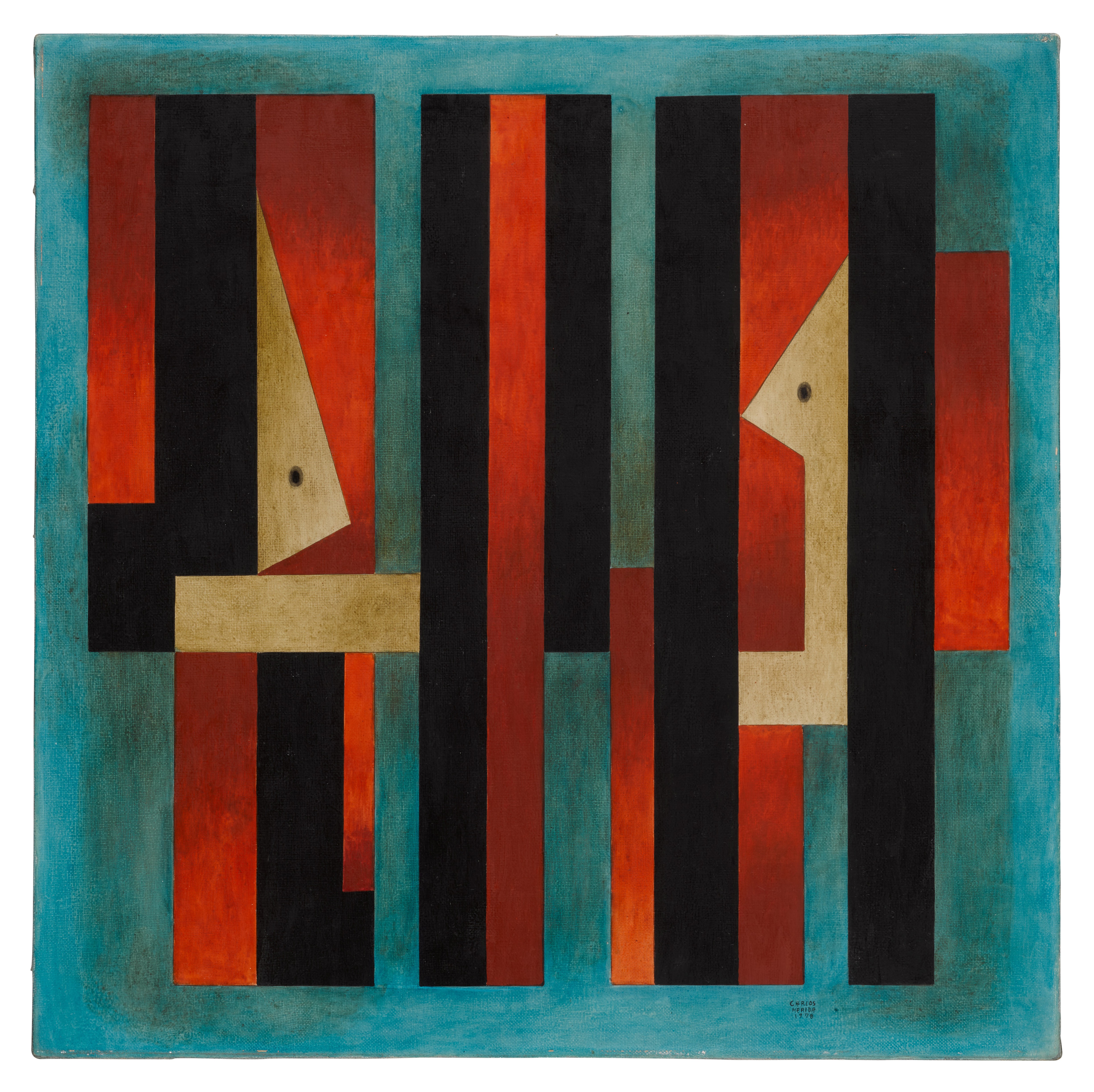
Carlos Mérida
Sortilegio, 1978
He participated in the extraordinary cultural flowering of post revolutionary Mexico, contributing murals to public buildings and engaging with the urgent national project of reimagining Mexican identity through art. Yet Mérida charted his own course. Where the Muralists often turned toward social realism and explicit political narrative, Mérida was drawn toward abstraction, toward the idea that indigenous visual culture already contained within it a sophisticated geometric vocabulary that needed no translation into European figuration to be powerful or universal. This was a visionary position, and it set him apart from his contemporaries in ways that art history is still working to fully appreciate.
The arc of Mérida's artistic development across six decades is remarkable for its consistency of vision and its restless formal invention. Through the 1940s and 1950s he refined his approach to color as structure, creating compositions in which flat planes of saturated hue interlock with the logic of a weaving or a mosaic. His work in this period resonates with the Guatemalan textile traditions he grew up surrounded by, but it also speaks fluently to European Constructivism and the hard edge abstraction that would later define much of North American painting. He completed major architectural commissions in Mexico City, including mosaic murals that brought his abstract vocabulary into dialogue with public space and community life.
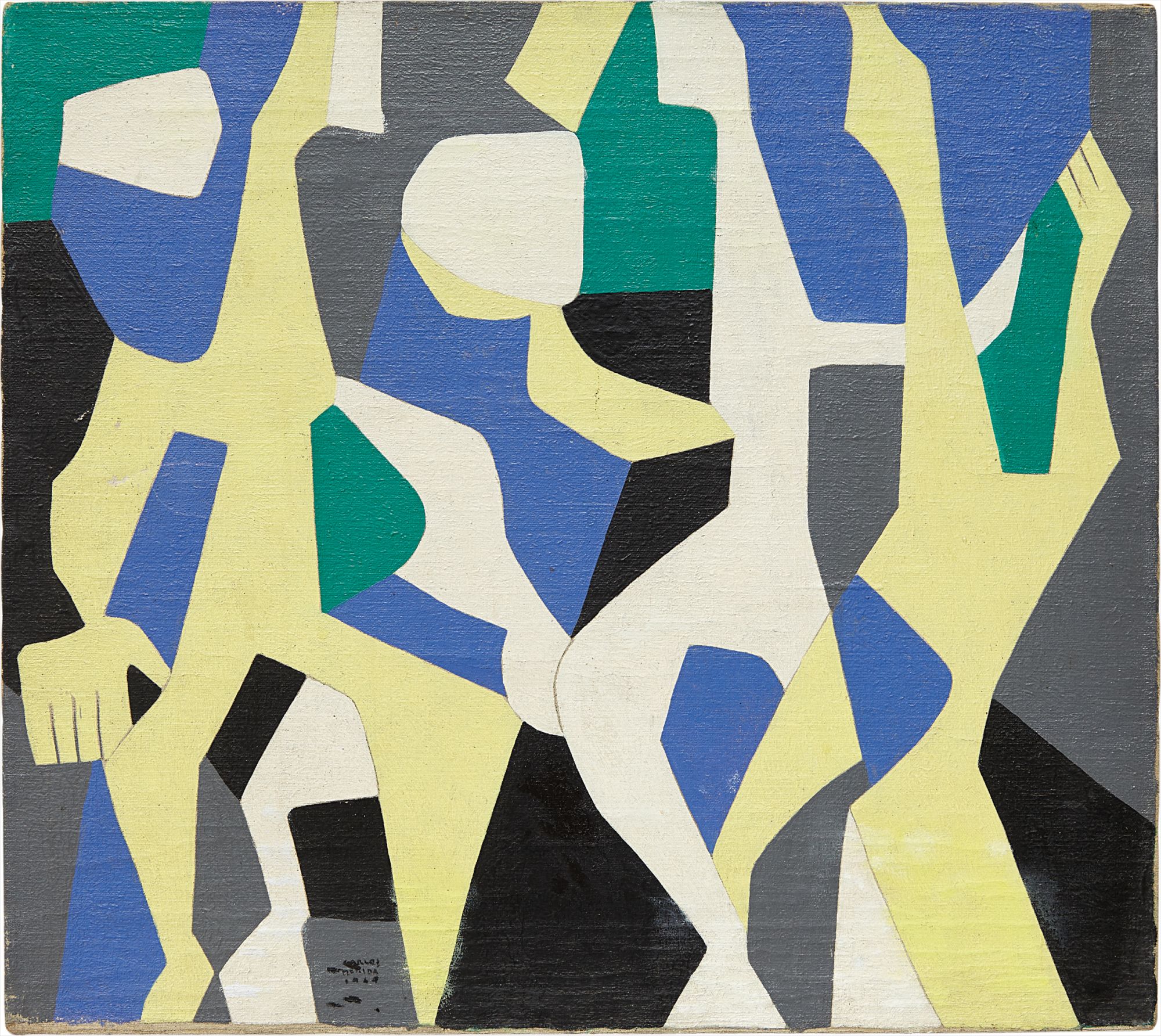
Carlos Mérida
Three Figures
These projects demonstrated that abstraction need not be cold or elitist. In Mérida's hands it was warm, rhythmic, and deeply human. Among the works available through The Collection, several offer exceptional entry points into understanding Mérida's mature practice. "Tepepul el adivino," created in 1972 on casein and polished parchment with petroplastic mounted on panel, exemplifies his extraordinary attention to surface and material.
The choice of parchment as a support invokes the codices of Mesoamerican civilization, while the casein medium gives the work a luminous matte finish that makes color appear to emanate from within. "Los cuatro hitos" from 1968, executed in mixed media on masonite, demonstrates his architectural thinking, the picture plane organized into quadrants that recall both cosmological diagrams and the structural logic of a building facade. "Personaje de pié" and "Sortilegio," both from 1978, show Mérida in the final flowering of his long career, the figure distilled to its most essential geometric presence, color relationships refined to their purest interval. These late works carry the confidence of an artist who has found his language and has nothing left to prove.
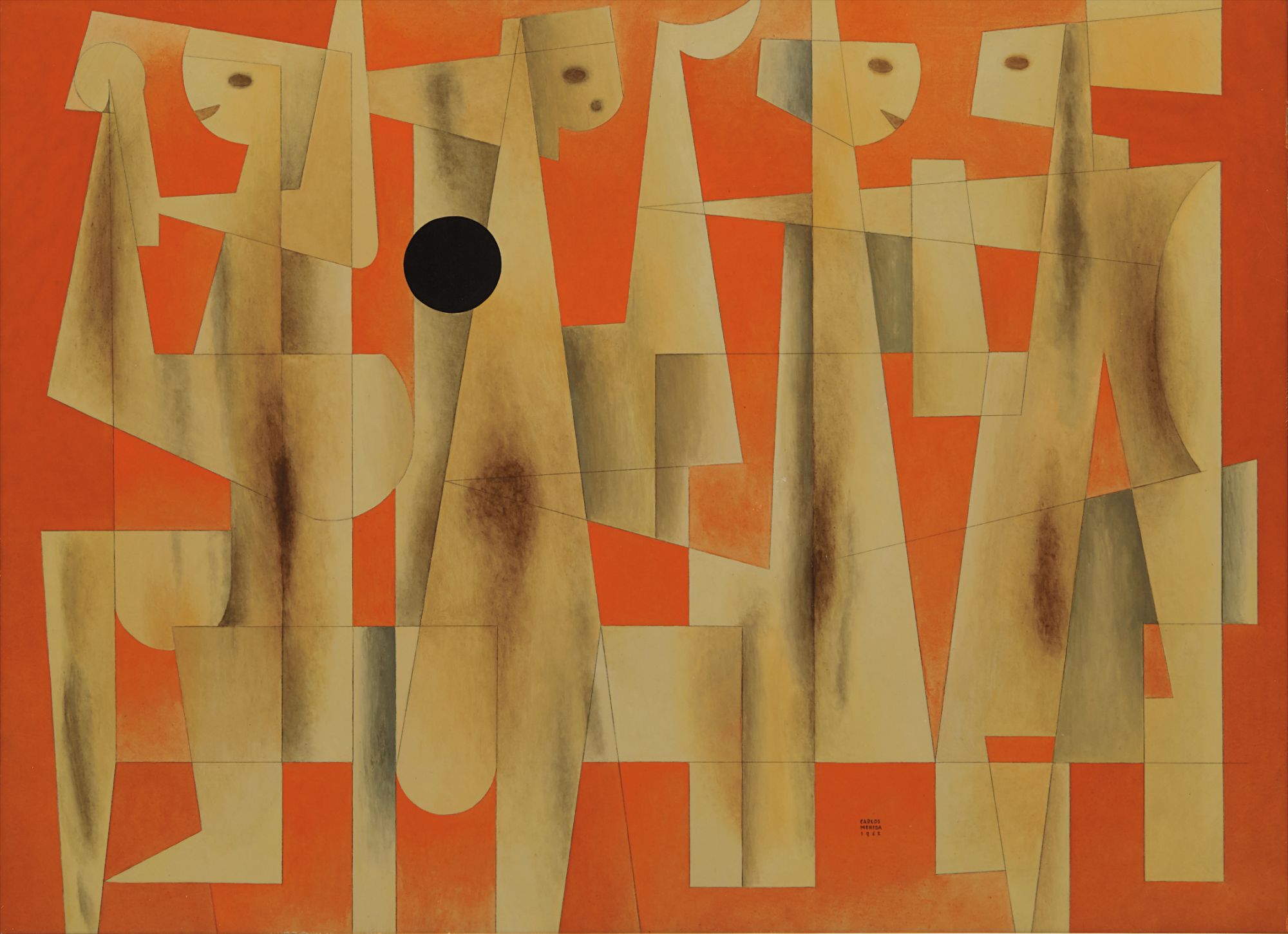
Carlos Mérida
El disco negro
For collectors, Mérida represents one of the genuinely compelling opportunities in the Latin American modern market. His career was long and prolific, and works appear in a range of media including gouache on paper, oil on canvas, casein, and mixed media on panel, offering entry points at various price levels. His position in major institutional collections, including the Phoenix Art Museum and the Museo de Arte Moderno, provides the kind of museum validation that serious collectors rely upon. Works on paper from his mature period, such as gouaches like "Personaje de pié," are particularly sought after for their directness and brilliance of color.
Collectors who have focused on the Mexican modernist school naturally find Mérida a complementary and historically significant addition, while those building collections around geometric abstraction discover in him a figure who arrived at hard edge painting through a completely different cultural path than his North American or European counterparts. Placed within the broader sweep of art history, Mérida occupies a singular position at the intersection of several worlds. He is a natural companion to artists such as Rufino Tamayo, whose own synthesis of Mexican indigenous culture and European modernism brought him international recognition, and to Gunther Gerzso, whose crystalline geometric abstractions similarly drew from pre Columbian architectural and textile sources. In the broader international context, his work invites comparison with Paul Klee's chromatic geometry and with the Uruguayan Constructivist Joaquín Torres García, who famously declared that the South also had its own north.
All of these artists were engaged in the same essential project of building a modernism that was not merely imported from Paris but grown from the ground of their own cultures. Carlos Mérida lived until 1984, working into his tenth decade with undiminished creative energy. His longevity meant that he witnessed the entire arc of twentieth century art, from Cubism through Abstract Expressionism to Minimalism and Conceptualism, and his work absorbed and responded to these movements on its own terms without being subsumed by any of them. The greatest compliment one can pay his achievement is this: to stand before a Mérida is to feel immediately that you are in the presence of a completely original mind.
The colors are his own, the geometry is his own, and the deep cultural memory encoded in every composition belongs to a civilization older than any European art school. That is a rare and wonderful thing, and it is why collectors, scholars, and museum goers who discover him tend to become devoted admirers for life.
Explore books about Carlos Mérida
Carlos Mérida
Laurence P. Hurlburt
Carlos Mérida: The Murals
Francisco Calderón
Mérida: Geometría y Color
Jorge Alberto Manrique
Carlos Mérida: 1891-1984
Mexican Museum of Modern Art
The Art of Carlos Mérida
Daniel Catton Rich