Carl Holsøe
Carl Holsøe: Light Made Tenderly Still
Artist Spotlight · The Collection Editorial
There is a moment, standing before a Carl Holsøe interior at auction, when the room around you seems to hush. It happened most recently at Bruun Rasmussen in Copenhagen, where bidders leaned forward as one of his characteristically luminous domestic scenes exceeded its estimate with the kind of authority that speaks not to fashion but to genuine, enduring desire. Holsøe has been achieving strong results at the major houses including Christie's and Sotheby's for decades now, and the market shows no sign of cooling. Collectors who discover him tend to stay loyal, and it is not difficult to understand why.
Carl Holsøe
Needlework
Carl Vilhelm Holsøe was born in Aarhus, Denmark, in 1863, into a country whose artistic culture was beginning to feel the pull of an inward, contemplative sensibility. He trained at the Royal Danish Academy of Fine Arts in Copenhagen during the 1880s, a period of rich cross pollination between Scandinavian painters and the broader currents of European realism and tonalism. The Academy gave him technical rigor, but it was the friendships he formed there and in the intimate world of Copenhagen's artistic circles that would prove most formative. He traveled, as many Danish painters of his generation did, spending time absorbing the quiet mastery of Dutch Golden Age painting, a tradition whose devotion to domestic space and filtered light would become central to his own vision.
It was through his close friendship with Vilhelm Hammershøi that Holsøe found the artistic kinship most congenial to his temperament. The two men shared an almost philosophical commitment to the interior as subject, though their approaches carry distinct emotional registers. Where Hammershøi tends toward a spare, almost metaphysical stillness, Holsøe brings a warmer, more inhabited quality to his rooms. His spaces feel lived in, breathed in.
Carl Holsøe
By the Window
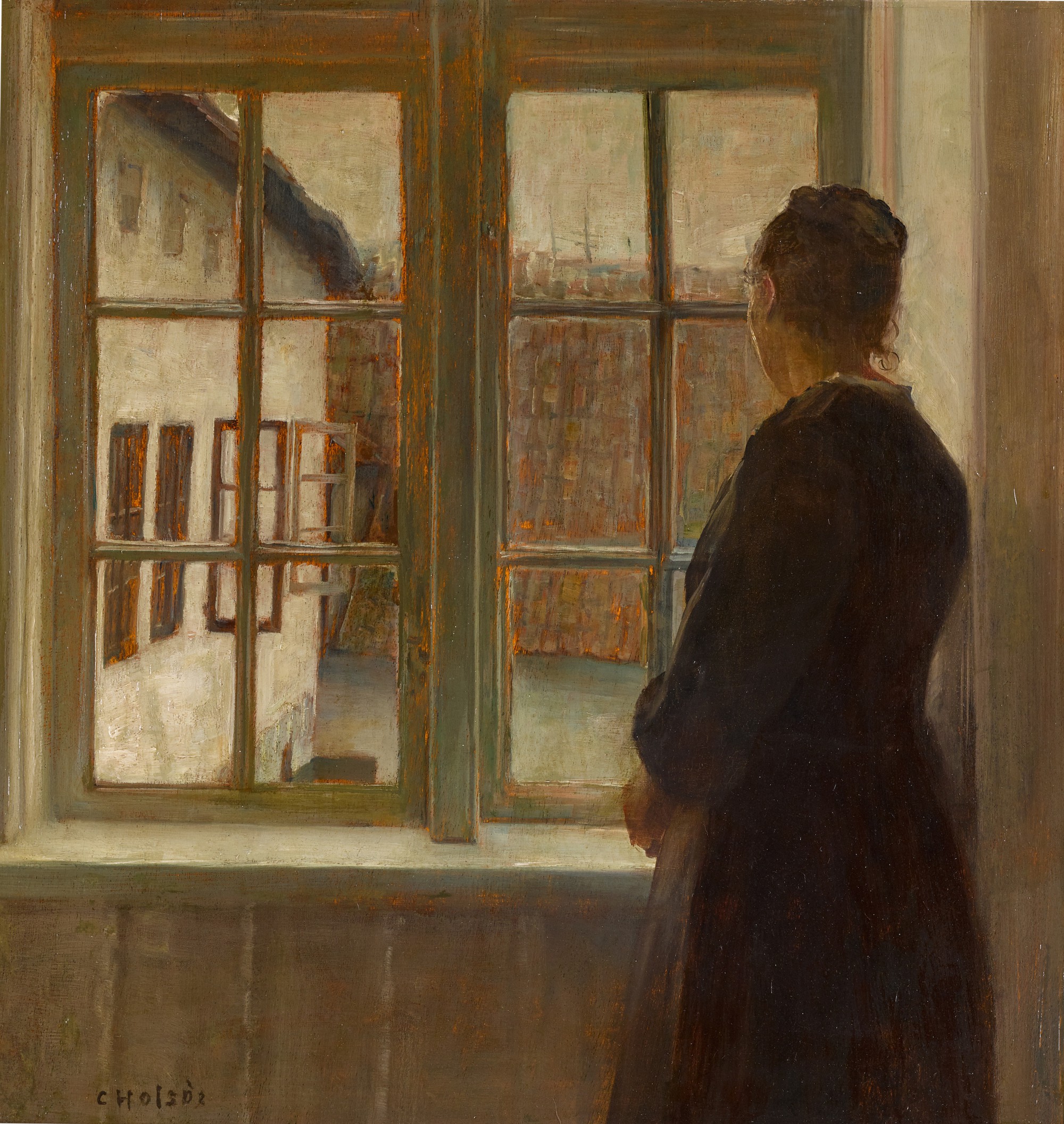
Women sew, read, or pause by windows, and the light that falls across them carries the specific quality of a northern afternoon, cool and yet somehow intimate, as though the world outside has agreed to stay at a respectful distance. Holsøe's artistic development shows a painter who found his subject early and deepened it steadily across a long career stretching to his death in 1935. His breakthrough came through a consistent refinement of tonal harmony, the way he could render the soft gradation between shadow and light on a plastered wall or the sheen of a polished floor without losing the sense of air in the room. He worked primarily in oil on canvas and oil on panel, and his choice of support often shaped the surface quality of the final work.
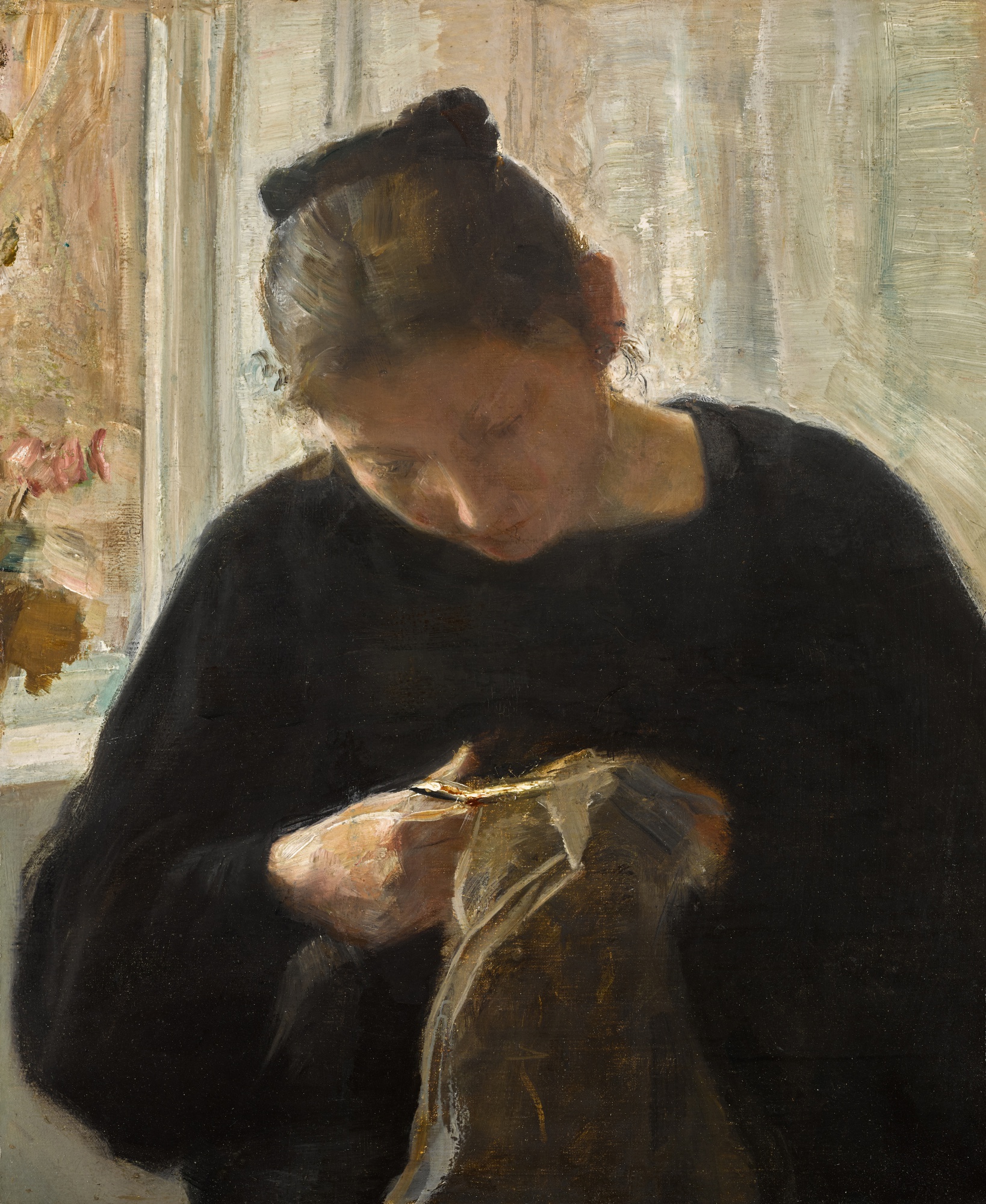
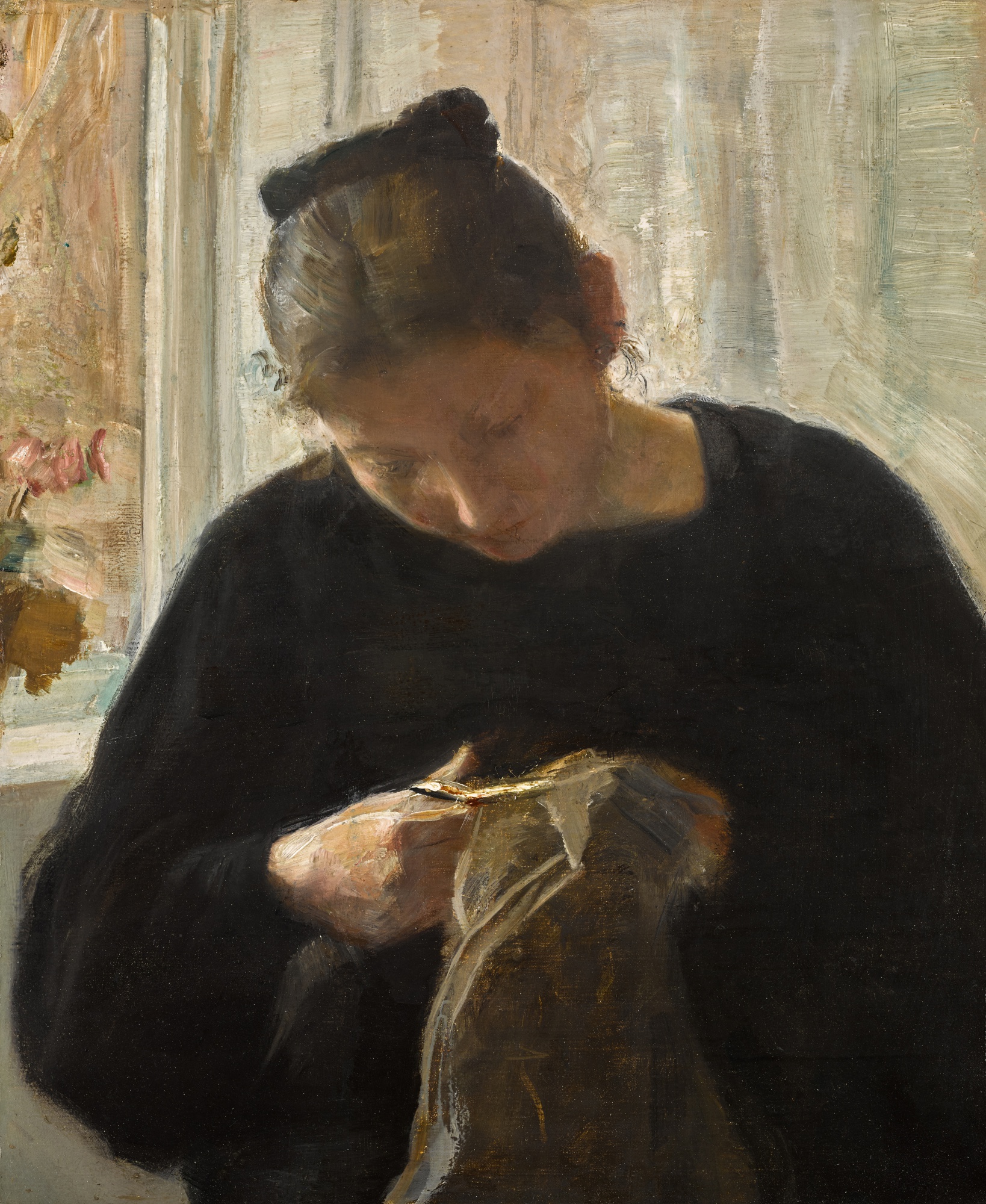
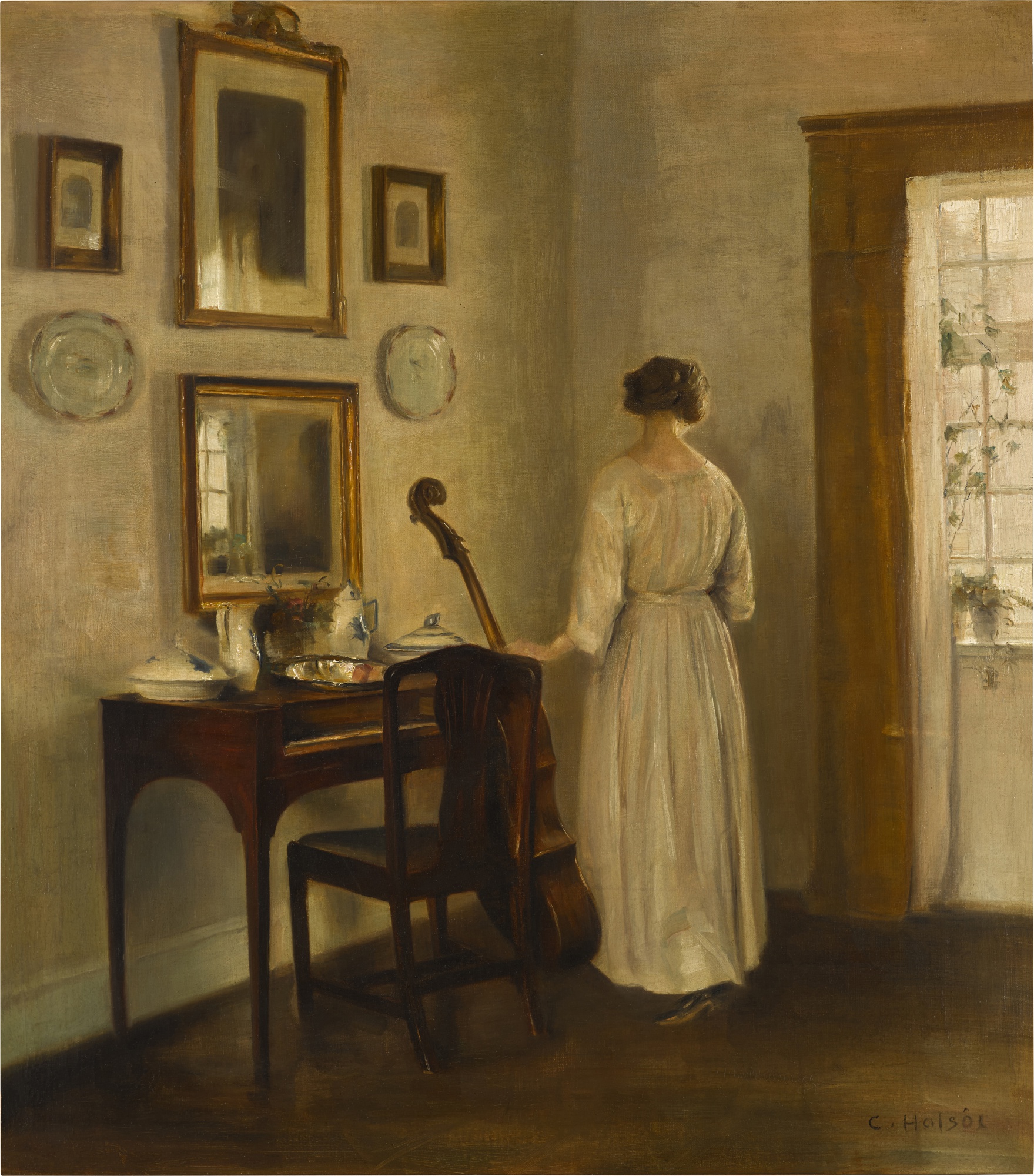
Panels tend to give his scenes a particular luminous density, while canvas allowed him to achieve a broader, more atmospheric diffusion. Works such as By the Window and Girl Seated by a Window show this tonal mastery at its most distilled, with the figure almost absorbed into the ambient glow of the room around her. Among his most celebrated paintings, The Cello stands as something of a landmark in his output, introducing a musical instrument into the domestic interior in a way that adds another layer of sensory suggestion without disrupting the fundamental quiet of the scene. Needlework is another touchstone, a seemingly simple subject elevated by Holsøe's sensitivity to the fall of light across fabric and the particular stillness of a figure absorbed in careful, patient work.
Carl Holsøe
The Cello
In the dining room and Lady Reading in an Interior both demonstrate his gift for composing space, for making the architecture of a room feel like a collaborator in the mood of the painting rather than merely a backdrop. A Candlelit Interior shows a rarer, more dramatically lit register in his work, the warm pool of candlelight creating a sense of sheltered intimacy that feels almost theatrical by contrast with his daylight scenes. For collectors, what makes Holsøe particularly compelling is the combination of aesthetic accessibility and genuine art historical depth. His works invite you in immediately, they do not demand decoding or theoretical scaffolding, but they reward sustained attention with layers of pictorial intelligence.
The condition and provenance of works coming to market matters considerably, and collectors are right to prize examples that retain the delicacy of their tonal surface without restoration that might flatten the very quality that defines him. Works on panel, given their surface stability, have often fared particularly well in terms of preservation. Collectors who have built holdings across his career tend to find that his works speak to one another across a room, creating their own kind of quiet conversation. Placing Holsøe in the broader arc of art history means situating him within a constellation of painters devoted to the poetry of interior light.
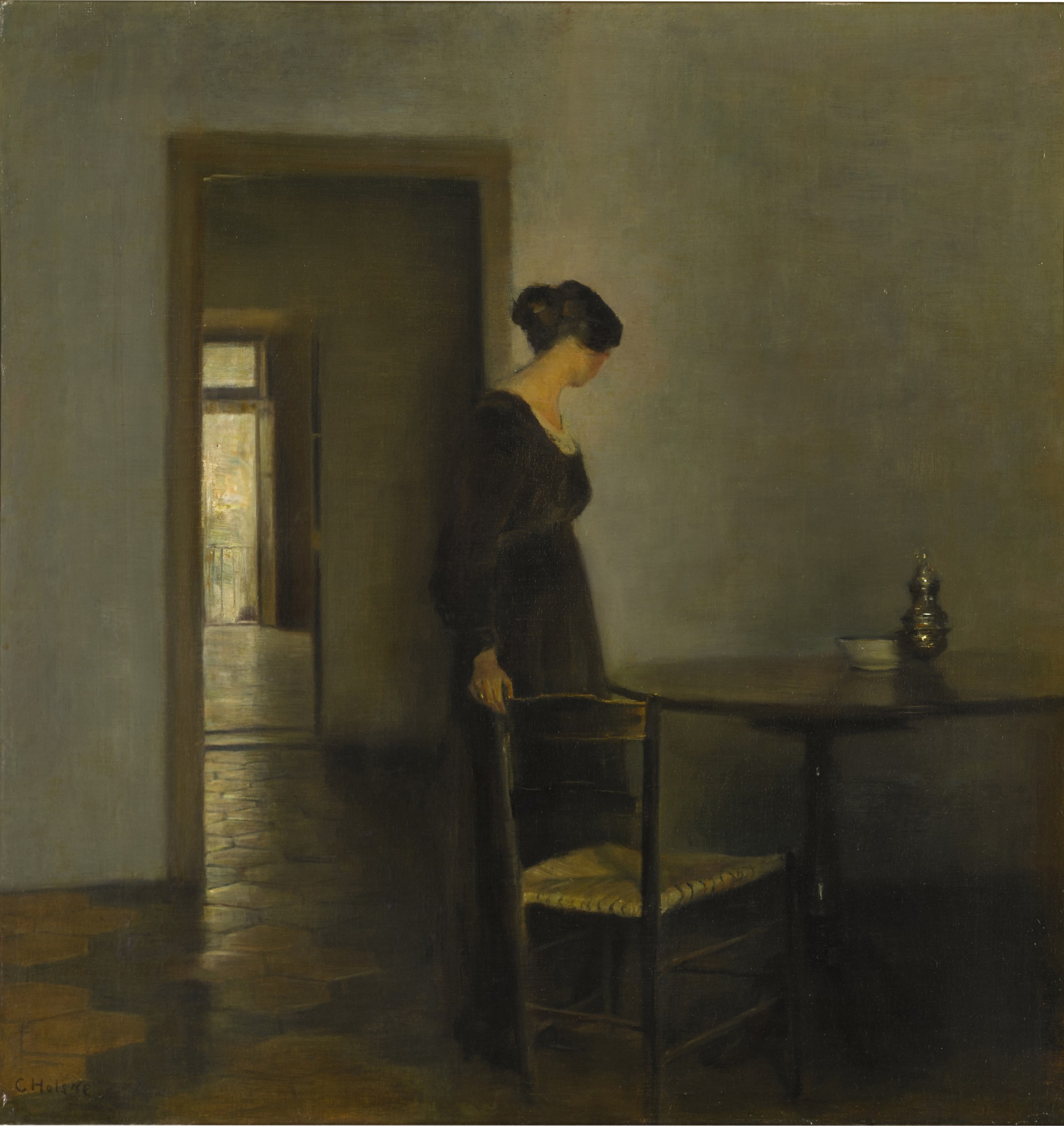
Carl Holsøe
Interior
The Dutch masters, Johannes Vermeer above all, cast a long shadow across his practice, and he shares this inheritance with contemporaries including his friend Hammershøi as well as the Swedish painter Carl Vilhelm Larsson, though Larsson's interiors carry a more decorative, celebratory warmth quite different from Holsøe's meditative tonalism. He also invites comparison with the Belgian painter Fernand Khnopff in his devotion to enclosed, contemplative spaces, and with the broader Intimist tradition that found its French expression in the work of Édouard Vuillard and Pierre Bonnard. Holsøe belongs to all of these lineages while remaining distinctly, unmistakably himself. The legacy of Carl Holsøe is the legacy of a painter who asked a simple question and spent a lifetime deepening his answer: what does it mean to truly see a room, and the life lived quietly within it?
In an era that often prizes spectacle and scale, his work offers something genuinely counter to the noise, not as a retreat from the world but as a patient insistence that the world's most profound textures are found in stillness. Collectors who live with his paintings frequently speak of the way they change across the day as the light in their own rooms shifts, as though Holsøe anticipated the specific quality of light in any home his work might come to inhabit. That is the mark of a painter who understood light not as a technical problem but as the essential medium of human attention itself.