Bernard Frize
Bernard Frize: Painting Remade With Pure Joy
Artist Spotlight · The Collection Editorial
“I am not trying to express something. I am trying to find out what painting can do.”
Bernard Frize, interview with Galerie Perrotin
In the spring of 2022, the Centre Pompidou in Paris reaffirmed what a devoted international following had long understood: Bernard Frize is one of the most intellectually rigorous and visually pleasurable painters working today. His works have occupied walls at MoMA in New York, the Guggenheim, and major European institutions for decades, and the conversation around his practice shows no sign of quieting. If anything, a renewed appetite among collectors for painting that rewards sustained looking has sent fresh enthusiasm toward an artist who has spent fifty years asking what painting can honestly be. Frize was born in Saint Mandé, just outside Paris, in 1954, and came of age in a French art world still working through the aftermath of Conceptualism and the political upheavals of 1968.
Bernard Frize
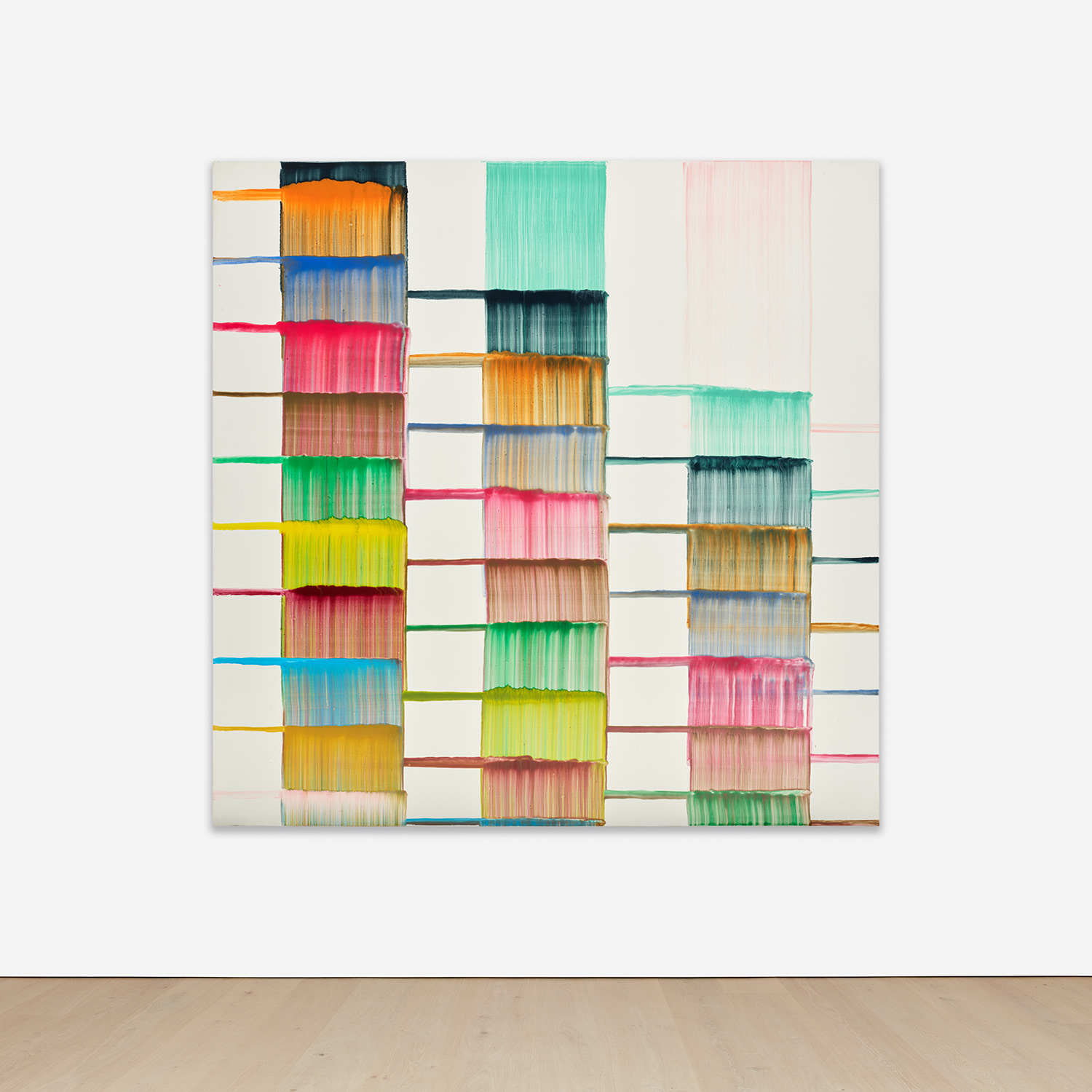
Song, 2008
He studied at the École Nationale Supérieure des Arts Décoratifs in Paris, an institution that prized craft and material understanding alongside conceptual ambition. That formation proved decisive. Frize never abandoned the physical fact of the brush, the canvas, and the paint, but he subjected those facts to a level of systematic inquiry that felt entirely contemporary. He moved between Paris and Berlin over the following decades, absorbing the rigorous critical culture of both cities while maintaining a practice that was, at its core, stubbornly committed to the act of making.
The breakthrough years of the late 1980s and early 1990s established the essential terms of his art. Frize began devising rule based systems to govern how paint would be applied, removing as much as possible the moment to moment decision making that had defined expressionist painting. A gesture would be determined in advance: a brush loaded with a specific color would travel a specific path, and the painting would record that journey with complete fidelity. An early untitled canvas from 1990, available through The Collection and rendered in acrylic and resin, captures this period beautifully.
Bernard Frize
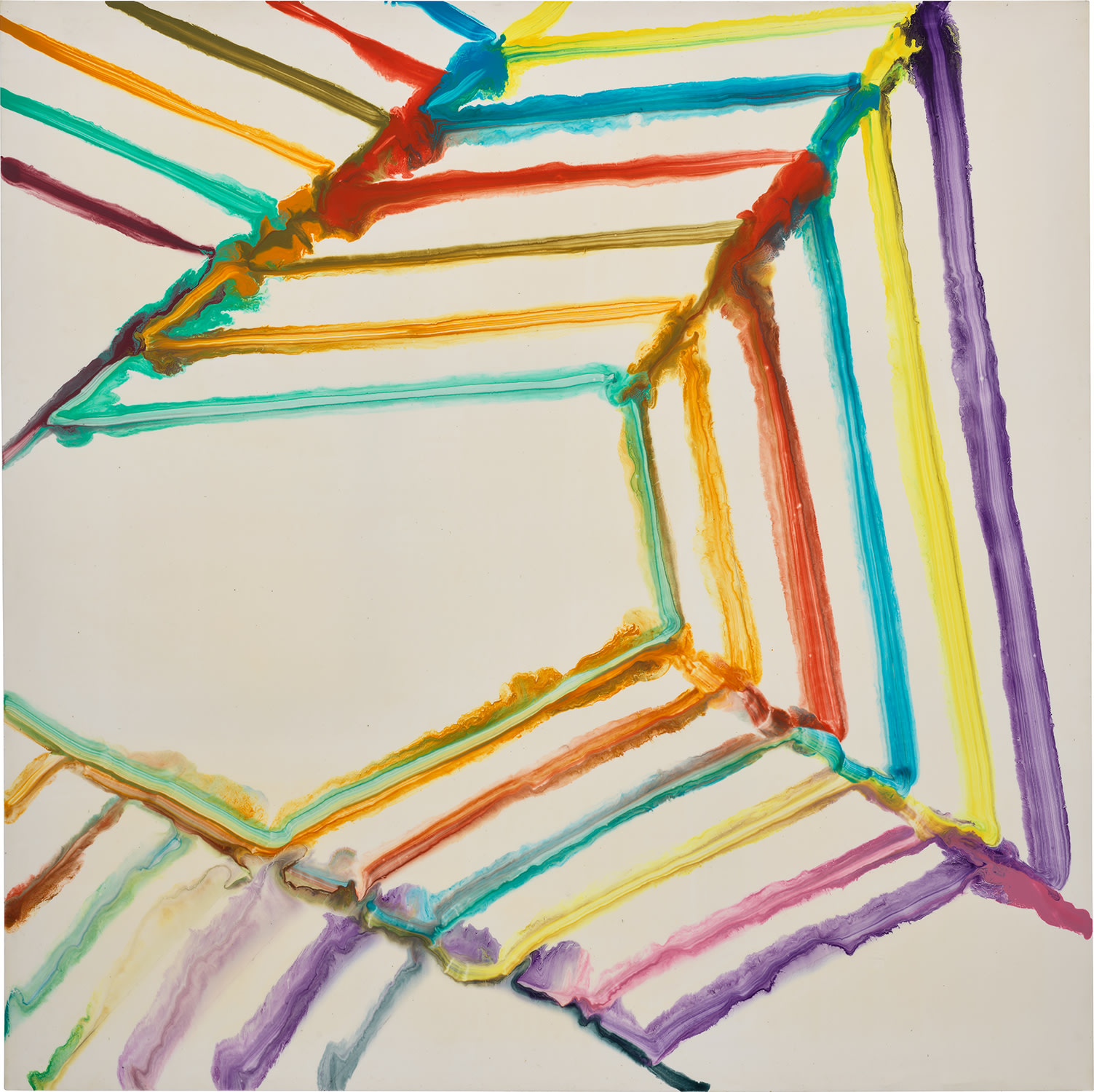
Éventuellement (Eventually), 1998
The surface hums with disciplined energy, the paint tracking its own logic across the canvas without hesitation or revision. These were not cold or mechanical pictures; they were, paradoxically, among the most alive paintings being made anywhere. What distinguishes Frize most sharply from his peers is his embrace of collaboration as a formal principle. Many of his paintings are made with assistants, not as a production convenience but as a structural element of the work.
Multiple people holding brushes simultaneously, moving in choreographed patterns, produce effects that no single hand could achieve. The layered, braided, and interlocking passages of color that result have a quality that might be called impersonal in the best sense: they belong to a system, to a process, to an event, rather than to any individual psychology. This turns the romantic myth of the solitary genius painter gently but firmly on its head, and it does so without sacrificing beauty. Works like Song from 2008 and Riana from 2007 demonstrate how sumptuous the results of this collaborative procedure can be, their surfaces dense with incident, their colors singing against one another in relationships that feel simultaneously calculated and discovered.
Bernard Frize
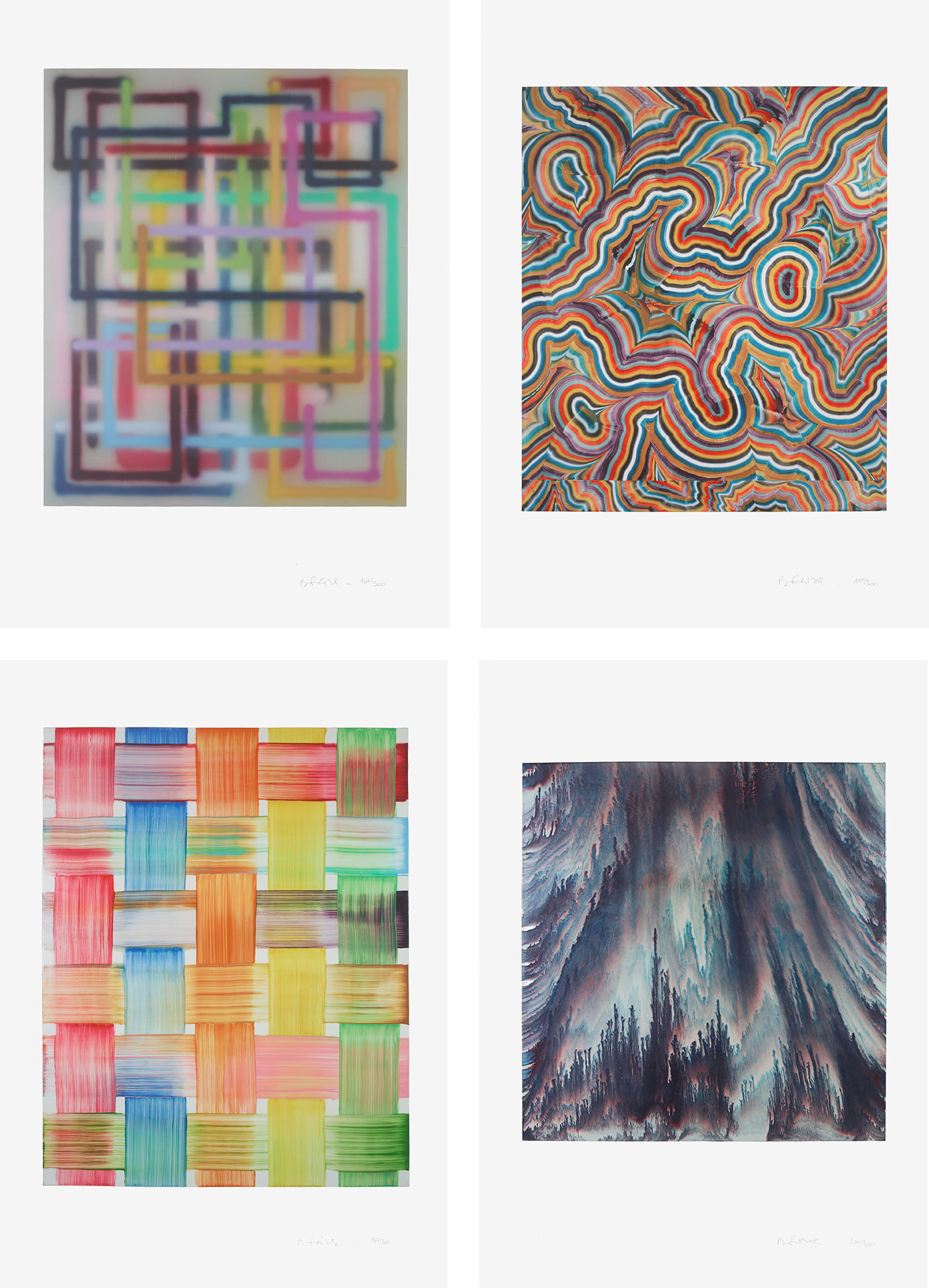
Aimé; Extension 2; Caisse; and Rami
The use of acrylic and resin, a combination that appears across many of Frize's most celebrated canvases, is central to understanding their particular quality of light. Resin gives the surface a luminous depth, a sense that color is emanating from within the canvas rather than sitting on top of it. Verte from 2003 and Blanc from 2006 both exploit this property with great sophistication, the former building a green saturated field of layered incident, the latter exploring what happens when the palette is stripped almost to nothing and form is left to carry the full weight of meaning. Éventuellement (Eventually) from 1998 remains one of the essential works of his middle period, a canvas that repays repeated viewing with new structural revelations each time.
Toky from 2018 and Lark from 2019 confirm that his invention has not slowed: these are paintings made with the confidence of long mastery and the curiosity of someone who still finds the problem genuinely open. For collectors, Frize presents a particularly compelling proposition. His work is represented by Galerie Perrotin, one of the most respected galleries operating internationally, with spaces in Paris, New York, Hong Kong, Seoul, Tokyo, and beyond. That institutional relationship has ensured that his paintings reach serious collections around the world and that their place in art history is actively supported and documented.
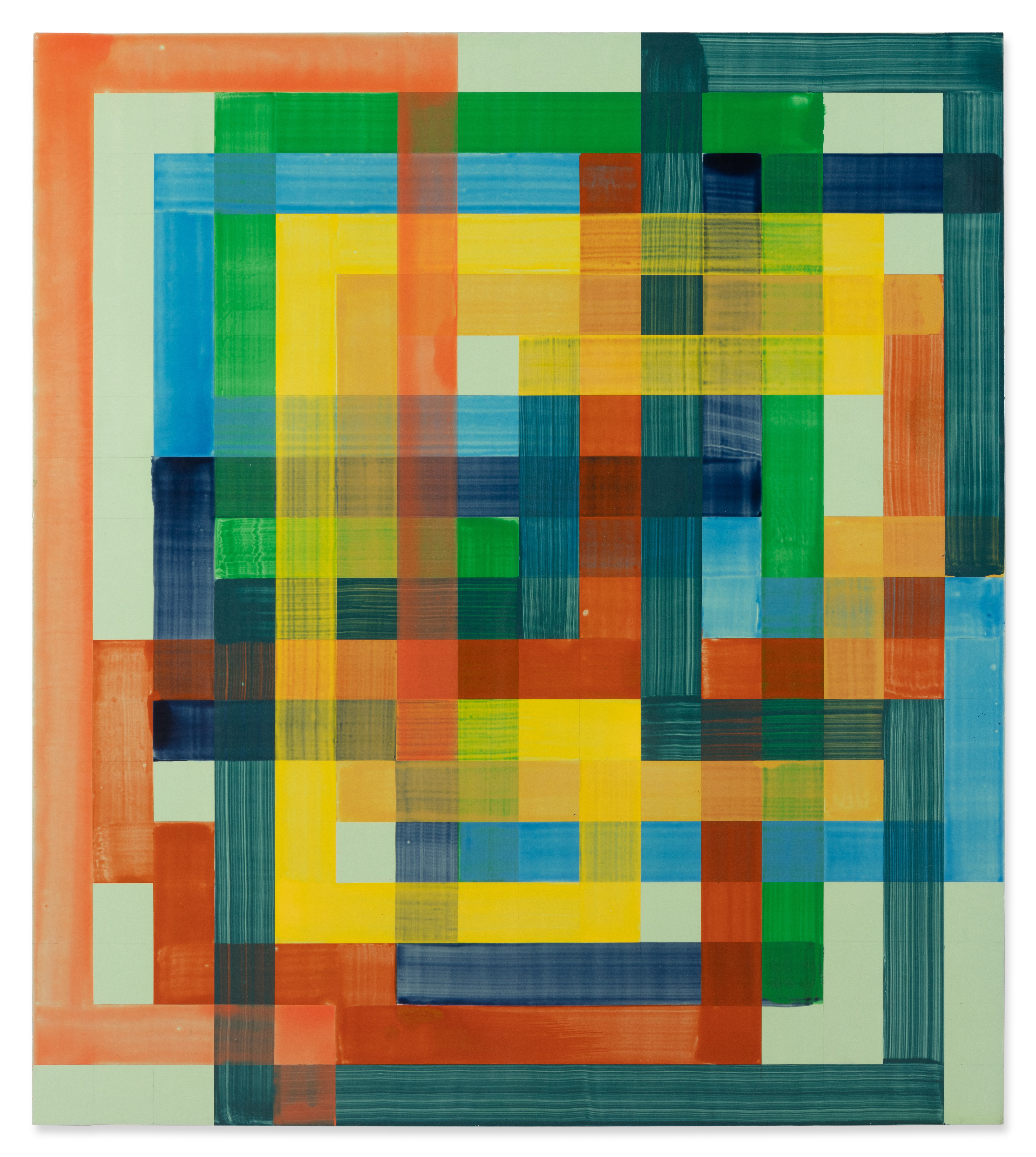
Bernard Frize
Solide
Works on paper and editions published through Perrotin, including the suite comprising Aimé, Extension 2, Caisse, and Rami, offer entry points for collectors at various levels of engagement. These numbered editions, each signed in pencil, carry the conceptual DNA of his larger practice in a more accessible format. On the secondary market, his canvases from the 1990s and 2000s have performed with steady consistency, a reflection of genuine institutional demand rather than speculative enthusiasm. To understand Frize's position in the broader history of abstract painting, it helps to think about the tradition he is both drawing from and departing from.
The American Minimalists, particularly Frank Stella and Robert Ryman, are relevant predecessors: both were interested in what painting is rather than what it depicts, and both used systematic thinking to expose the medium's underlying structure. Closer to Frize in spirit, perhaps, are artists like Niele Toroni and the French Support Surface movement of the 1970s, who interrogated the physical and procedural conditions of painting with comparable rigor. Among his contemporaries, painters such as Günther Förg and Peter Halley have shared his interest in systems and seriality, though Frize's work retains a warmth and a craft based sensuousness that sets it apart. What makes Bernard Frize matter today, in a moment when painting is once again at the center of critical and market attention, is the quality of his intelligence and the honesty of his commitment.
He has never chased trends. He has never pretended that painting is something other than what it is: a physical activity governed by choices, subject to time, and capable, when those choices are made with sufficient rigor and imagination, of producing objects of enduring power. His paintings hang in the greatest collections in the world not because they are fashionable but because they are good in a way that lasts. To live with a Frize is to live with a painting that keeps working, keeps asking its quiet questions, keeps returning color and form to a state of productive uncertainty.
That is a rare and genuinely valuable thing.
Explore books about Bernard Frize
