Bernard Boutet de Monvel
Bernard Boutet de Monvel, Elegance Perfectly Rendered
Artist Spotlight · The Collection Editorial
There is a particular kind of artistic genius that operates at the precise intersection of two worlds, belonging fully to both and yet transforming each by its presence in the other. Bernard Boutet de Monvel inhabited that rare position with extraordinary grace, moving between the rarefied salons of Paris and the gleaming modernism of New York, between aristocratic portraiture and the bold geometric spirit of Art Deco, producing a body of work that feels as alive and covetable today as it did during his lifetime. When major auction houses have brought his paintings to sale in recent decades, rooms have taken notice, and private collectors across Europe and the United States have quietly built significant holdings around his name. His story is one of uncommon talent meeting an equally uncommon moment in history, and the results are simply beautiful.
Bernard Boutet de Monvel
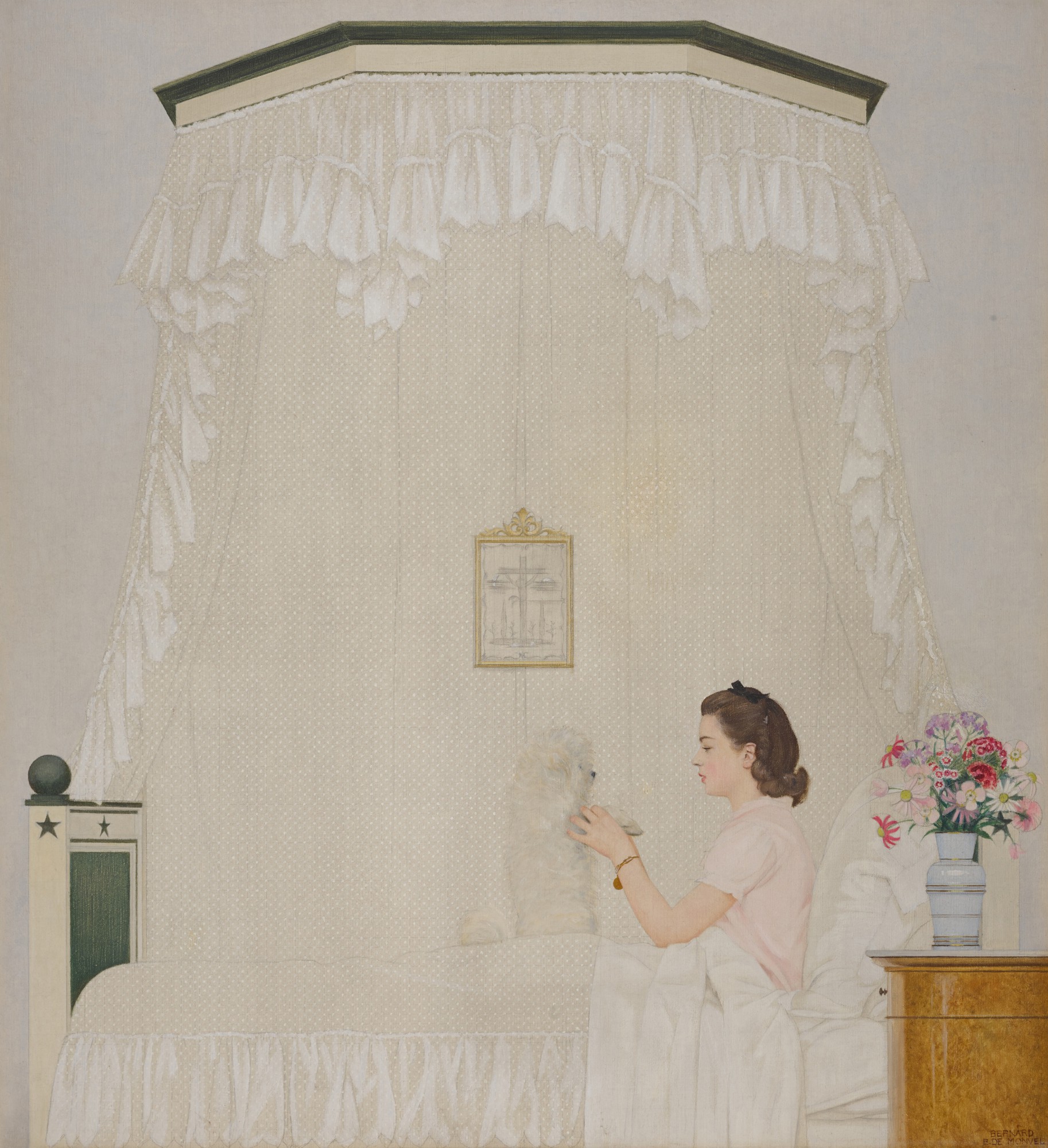
Sylvie et son Chien Champagne
Boutet de Monvel was born in Paris in 1881 into a family already distinguished in the arts. His father, Louis Maurice Boutet de Monvel, was one of the most celebrated illustrators of his generation in France, beloved for his luminous children's books and his refined decorative sensibility. Growing up in that environment, surrounded by draftsmanship, visual storytelling, and the highest standards of craft, shaped Bernard profoundly. He trained at the École des Beaux Arts in Paris and also under the portraitist Léon Bonnat, absorbing rigorous classical foundations that would underpin everything he later did, even when his aesthetic moved decisively toward modernism.
His early career placed him squarely within the world of Parisian fashion illustration and society portraiture, and he became a significant contributor to publications such as La Gazette du Bon Ton, where his elegantly spare line drawings defined a certain vision of chic Parisian femininity in the years surrounding the First World War. That graphic work was formative. It taught him the power of economy, the eloquence of what is left out, the way a clean contour or a simplified silhouette can communicate personality, mood, and status more forcefully than any labored detail. These lessons migrated directly into his painted work, giving his canvases an almost architectural quality that set them apart from his contemporaries.
Bernard Boutet de Monvel
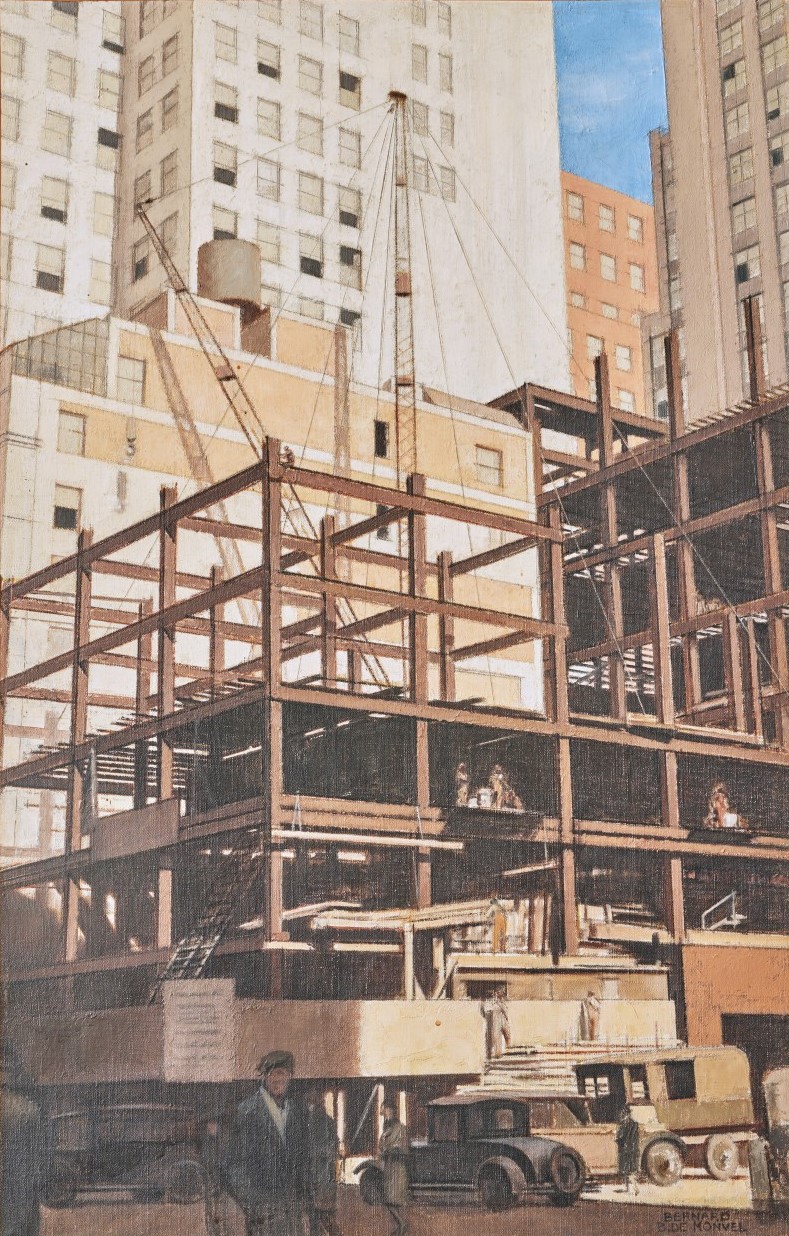
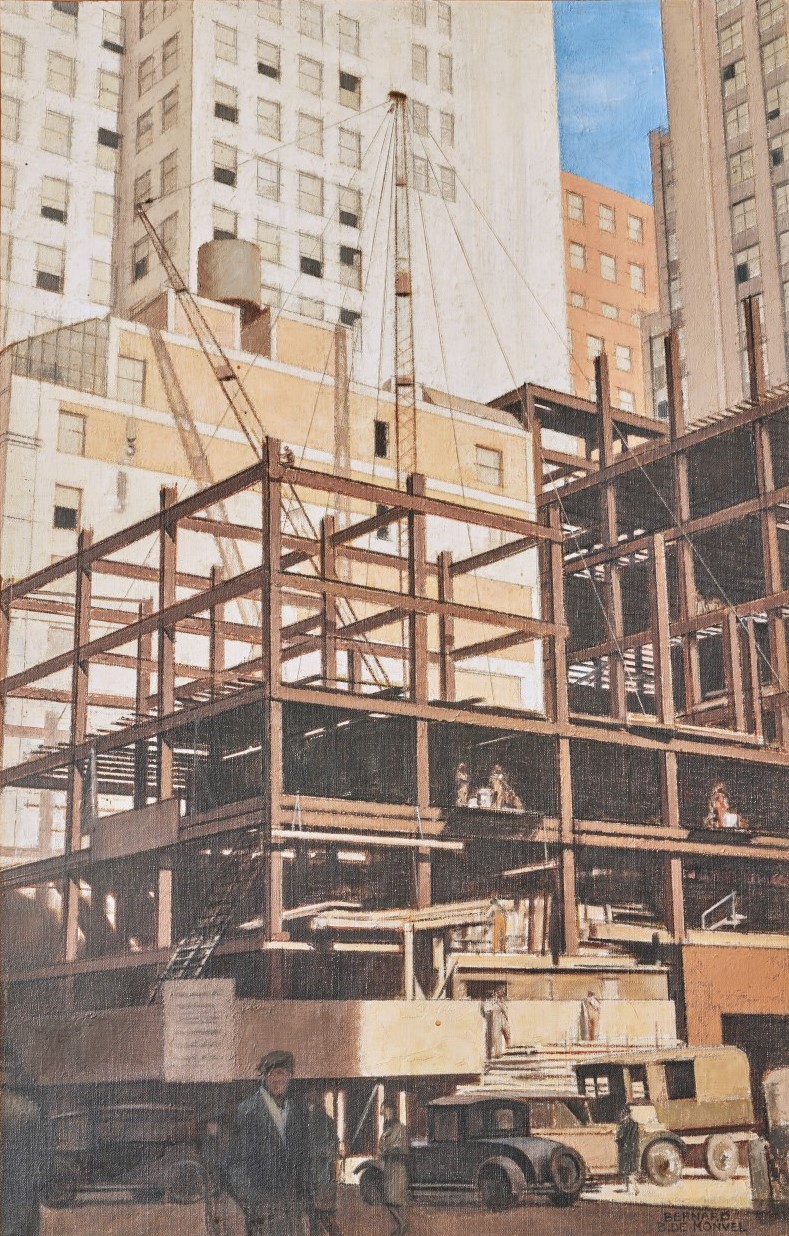
Construction of the Roxy Theater
By the 1920s, Boutet de Monvel had emerged as one of the most sought after portrait painters on both sides of the Atlantic. His style had crystallized into something wholly distinctive: smooth, porcelain surfaces, a palette of refined and sometimes daring elegance, figures rendered with a clarity that owes as much to geometry as to observation. The influence of Art Deco is unmistakable in his mature paintings, and he stands alongside artists such as Tamara de Lempicka and Jean Dupas as one of the defining visual voices of that movement. Yet where de Lempicka favored a certain operatic tension, Boutet de Monvel preferred a cooler, more aristocratic poise.
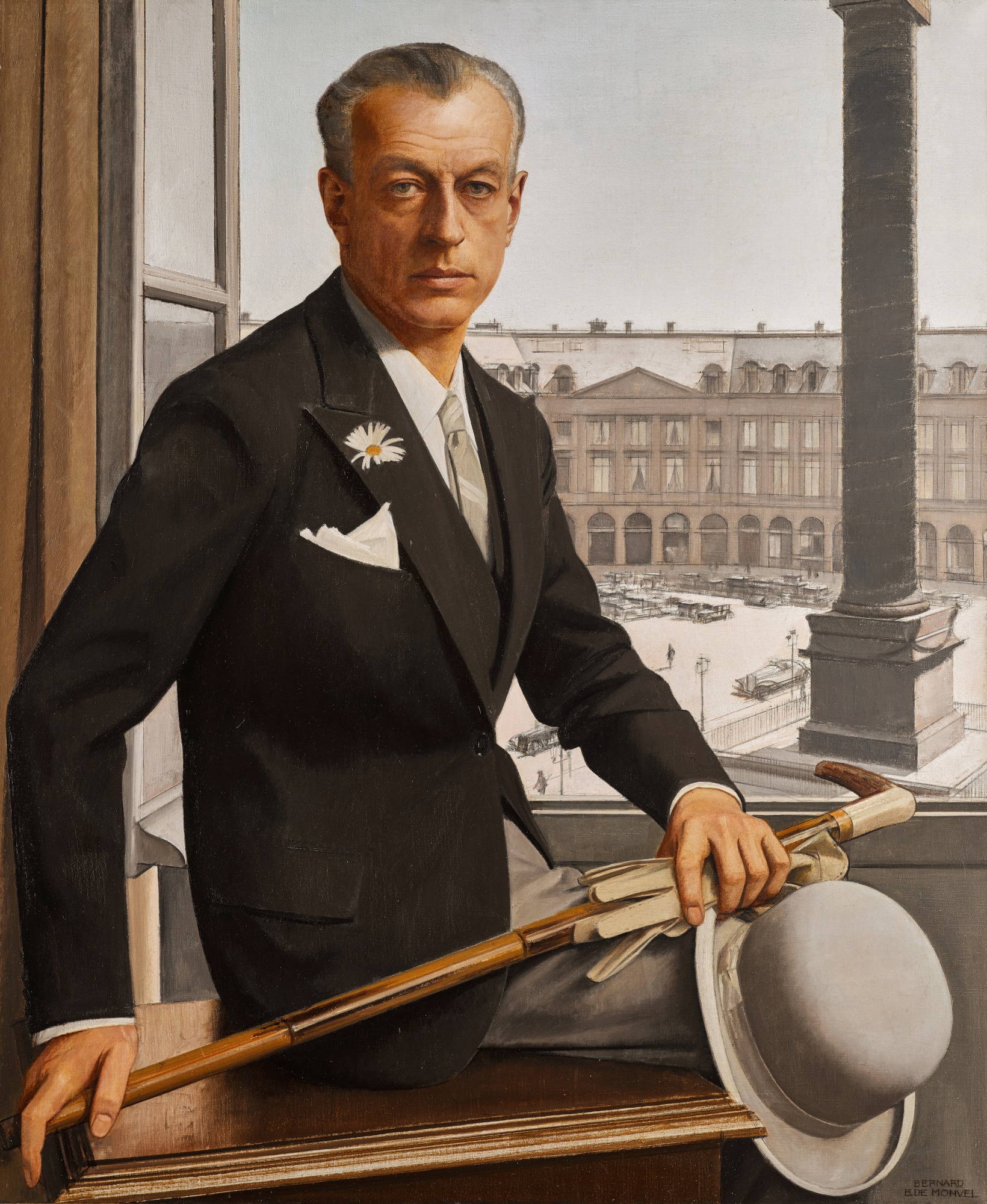
His sitters appear utterly at ease within themselves, which is perhaps the greatest compliment a portraitist can pay. The works available on The Collection offer a compelling survey of his range and ambition. "Autoportrait Place Vendôme" from 1932, executed in oil and charcoal on canvas, is among the most striking self portraits of the interwar period, placing the artist within the grandly ordered geometry of one of Paris's most iconic public spaces and asserting, with quiet confidence, his own place within that world. "Portrait de S.
Bernard Boutet de Monvel
Autoportrait Place Vendôme, 1932
A. le Maharajah d'Indore" reveals the international reach of his reputation: Yeshwant Rao Holkar, the Maharajah of Indore, was one of the most sophisticated art patrons of the twentieth century, and his choice of Boutet de Monvel for portraiture speaks volumes about the painter's standing. "Construction of the Roxy Theater" demonstrates a different side of his talent entirely, turning the raw industrial energy of New York's building boom into a composition of almost symphonic formal power. "Daisies in the Shade" from 1922 and "Sylvie et son Chien Champagne" show his gift for tenderness and intimacy, the way he could soften his precision into something genuinely warm without sacrificing any of his clarity.
Boutet de Monvel spent increasing amounts of time in the United States from the 1920s onward, drawn by commissions from American society families and by the electric energy of New York during its great modernist flourishing. He became a figure of real prominence in American collecting circles, and his portraits of wealthy American patrons are among the finest society paintings produced in that era. His ability to absorb the dynamism of the New World while retaining the refinement of his Parisian formation gave his American period work a particularly compelling dual quality. He was, in the best sense, an artist of the transatlantic world.
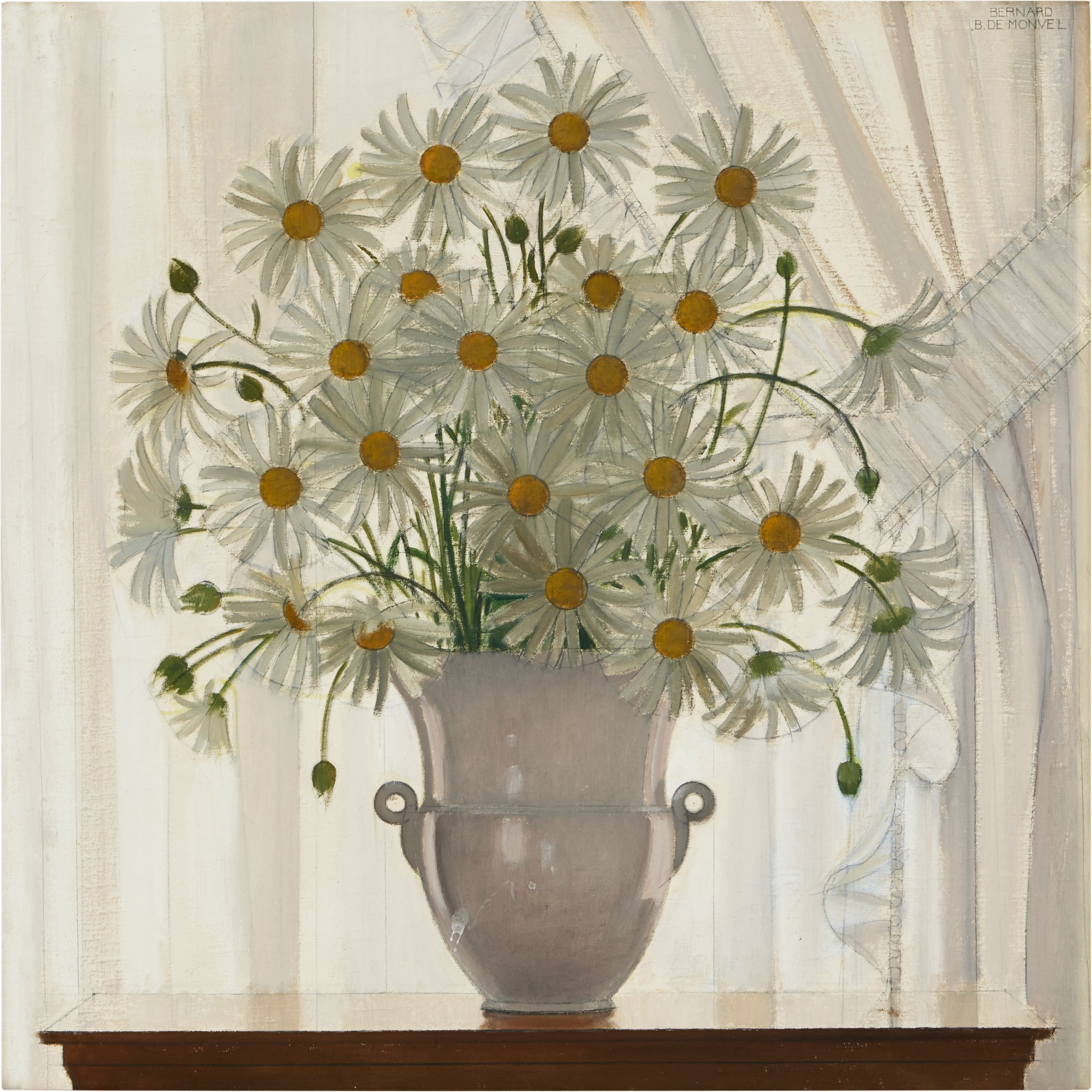
Bernard Boutet de Monvel
Daisies in the Shade, 1922
For collectors today, Boutet de Monvel represents a remarkably strong proposition. His work sits at the heart of one of the most actively collected periods in twentieth century decorative and fine arts, and the Art Deco market has demonstrated consistent depth and resilience. His paintings appear across major auction houses including Christie's and Sotheby's, where strong examples have achieved significant results, and private treaty sales through specialist dealers have also been a notable part of his market. Collectors drawn to figures such as Tamara de Lempicka, Jean Dupas, Kees van Dongen, or the portraiture of Giovanni Boldini will find in Boutet de Monvel an artist of equivalent quality whose work rewards close attention and long ownership.
The combination of impeccable provenance, historical importance, and genuine visual pleasure is a combination that does not grow old. His legacy today is that of an artist who mastered his moment without being consumed by it, who made works so rooted in their time that they have become indispensable to our understanding of it, and yet so beautifully made that they transcend their occasion entirely. Bernard Boutet de Monvel died in 1949 in a plane crash near the Azores, a loss that cut short a career that might have continued to evolve and surprise. What remains is a body of work of extraordinary coherence and distinction, a vision of elegance that still communicates across the decades with undiminished force.