Ben Nicholson
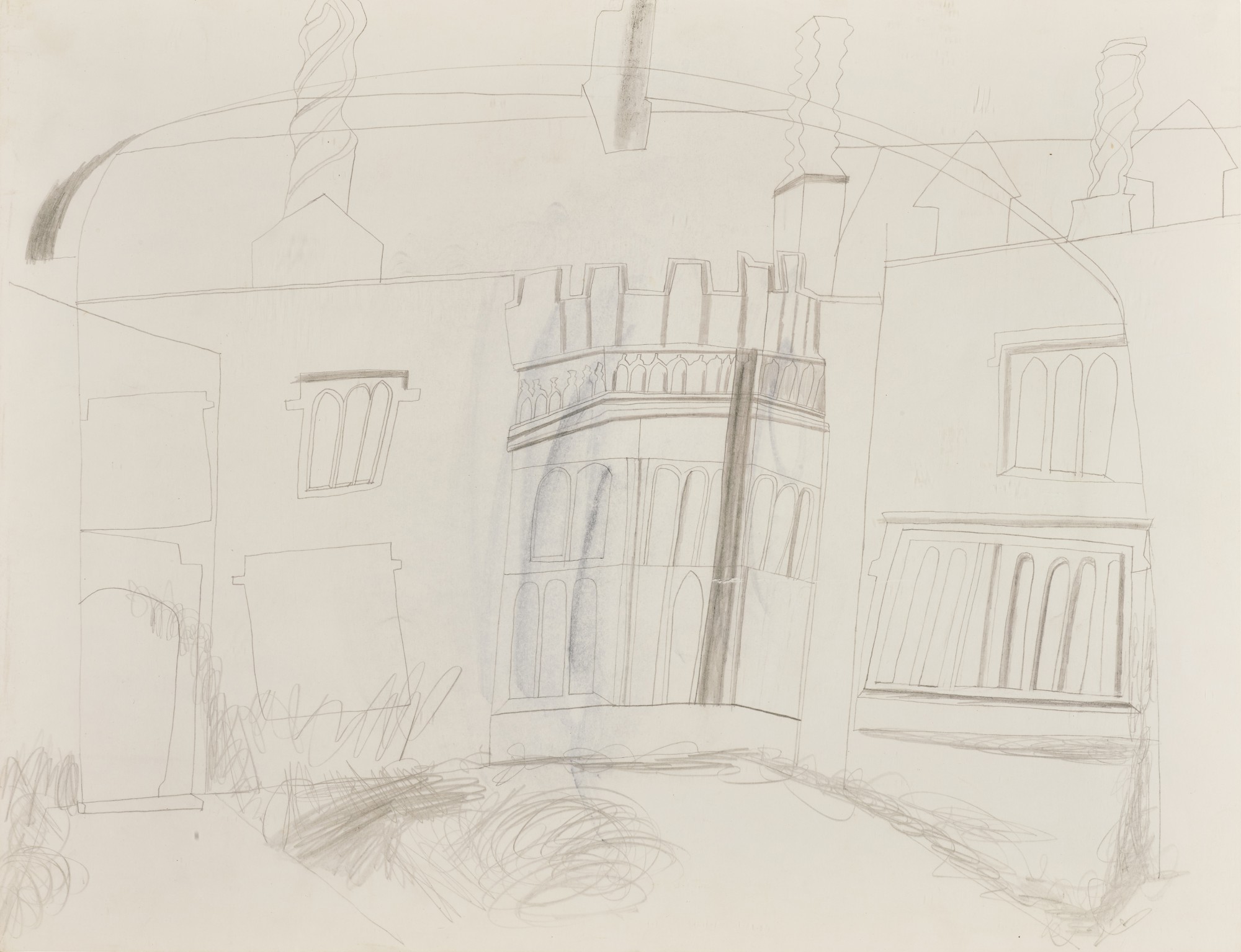
Ben Nicholson: A Master of Pure Vision
Artist Spotlight · The Collection Editorial
“A painting is not a picture of an experience, but is itself an experience.”
Ben Nicholson, notes on his work
In the spring of 2023, Tate Britain drew renewed attention to the quiet radicalism of Ben Nicholson when works from its permanent collection were rehung to foreground the mid century British modernists who reshaped the country's artistic identity. Nicholson's reliefs and paintings occupied a room of their own, and visitors lingered. There is something about his work that rewards stillness, that asks you to slow down and look again, and then once more after that. Decades after his death in 1982, his paintings and prints continue to generate exactly that kind of devotion, among curators, collectors, and anyone who has ever stood in front of one of his white reliefs and felt the world become briefly, beautifully simpler.
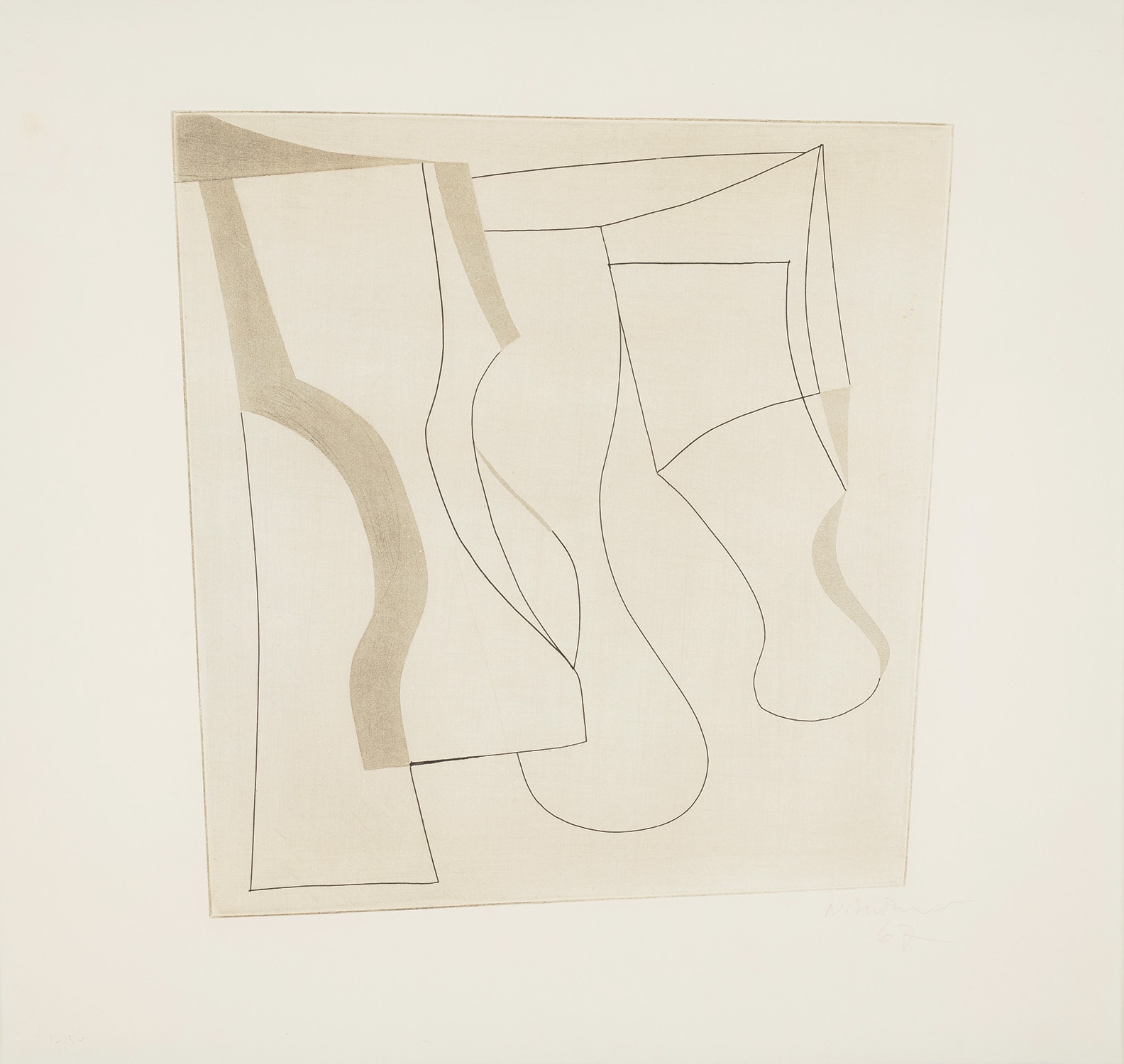
Ben Nicholson
Still Life with Grey
Ben Nicholson was born in Denham, Buckinghamshire in 1894 into a family for which art was simply the atmosphere one breathed. His father, Sir William Nicholson, was one of the most admired painters and printmakers of his generation. His mother, Mabel Pryde, came from an equally distinguished artistic lineage. Growing up in studios and salons, surrounded by the talk of painters, Ben absorbed not just technique but a way of seeing, a belief that the visual world could be distilled into something essential.
He studied briefly at the Slade School of Fine Art in London but was restless there, and a series of travels through Europe and to the United States in the early years of the twentieth century did more to form him than any classroom could. He encountered Cubism in Paris, felt its reorganisation of pictorial space, and never quite recovered from the excitement of it. The 1930s were the decade in which Nicholson found his voice fully and decisively. His visits to the studios of Georges Braque and Pablo Picasso in Paris in 1932 confirmed what he had been moving toward: a painting practice grounded in the tensions between flatness and depth, line and plane, representation and abstraction.
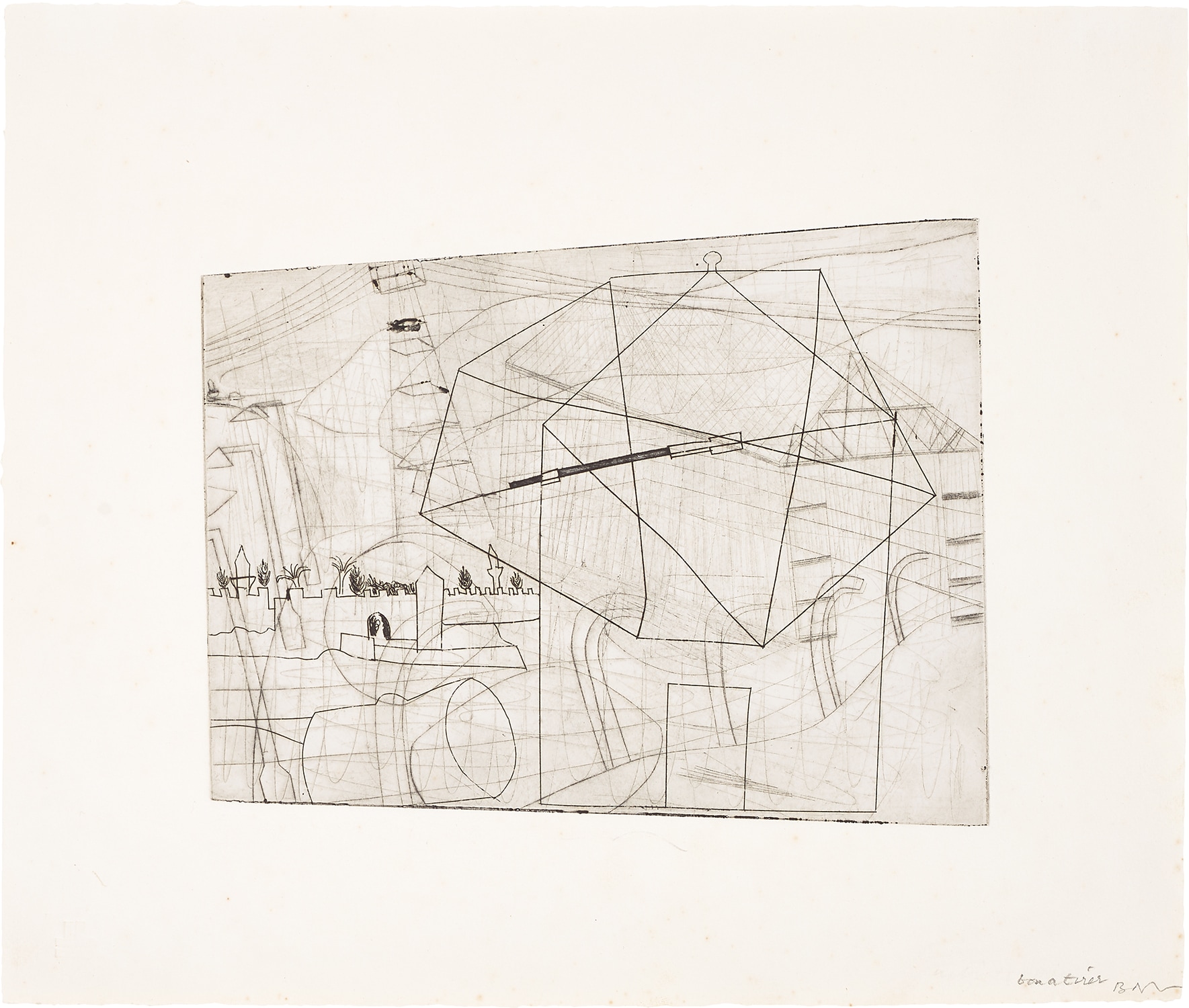
Ben Nicholson
Moonshine (L. 62, C. 53)
His first white relief, created in 1935, is among the most quietly revolutionary objects in British art. Carved from wood and painted a uniform white, it reduced art to its fundamentals: the circle, the rectangle, shadow and light. He was working in parallel with the European avant garde at exactly the moment when that avant garde was at its most ambitious. His friendship with Piet Mondrian, who moved to London in 1938 and became a near neighbour in Hampstead, deepened his commitment to geometric abstraction.
The circle of artists gathered around him in Hampstead during the late 1930s, including Barbara Hepworth, whom he married in 1938, Henry Moore, and the critic Herbert Read, constituted one of the most concentrated moments of modernist ambition in British cultural history. Nicholson's signature works move across a productive tension between the rigorous and the lyrical. His white reliefs are justly celebrated, but his still lifes and landscape paintings reveal a sensibility that was never coldly theoretical. Works such as "Painting 1935" demonstrate how he could hold a Cubist fragmentation of form alongside a genuine tenderness for the objects of everyday life: a mug, a jug, a guitar, a window opening onto a view of the sea.
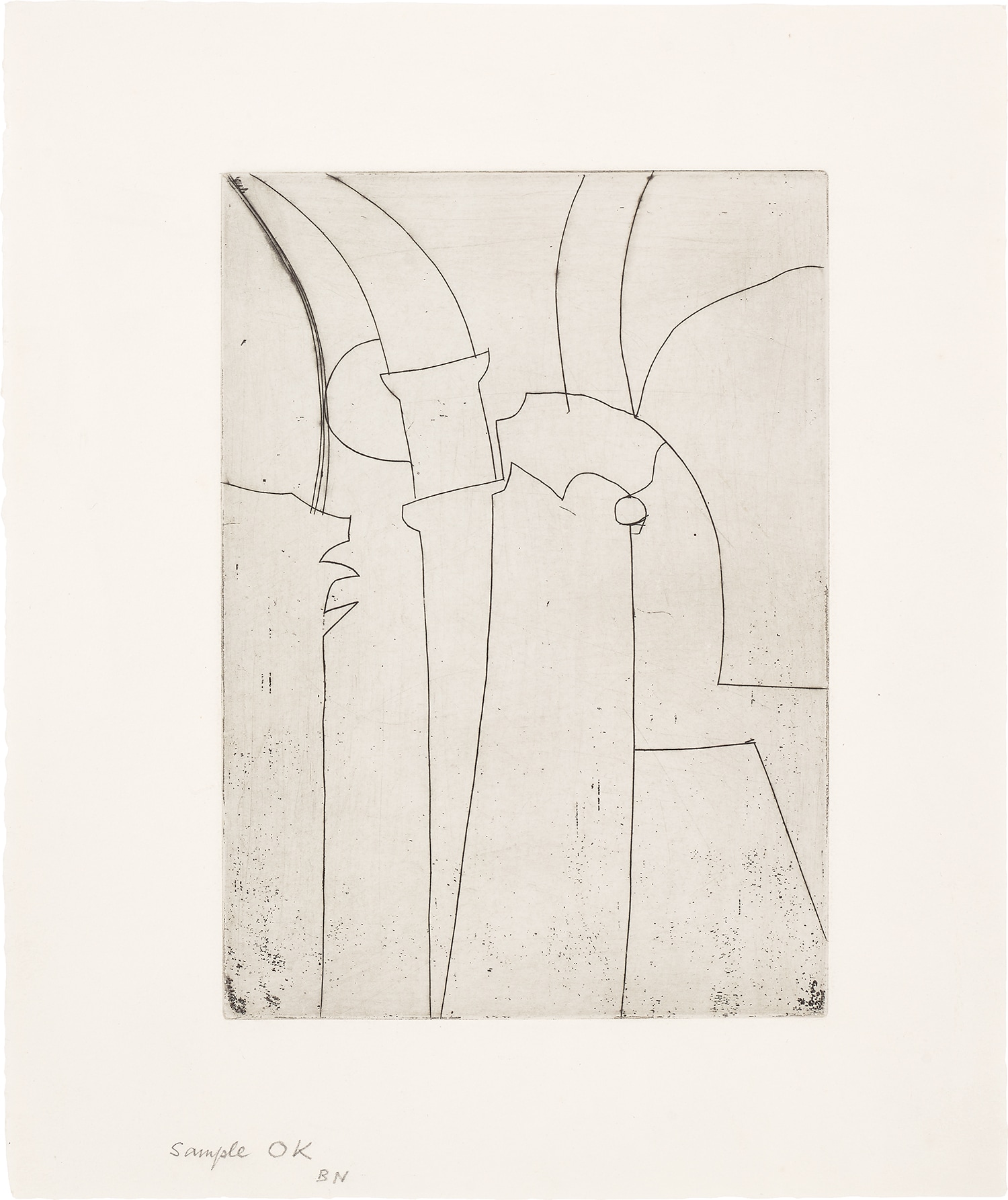
Ben Nicholson
Urbino (L. 26, C. 34)
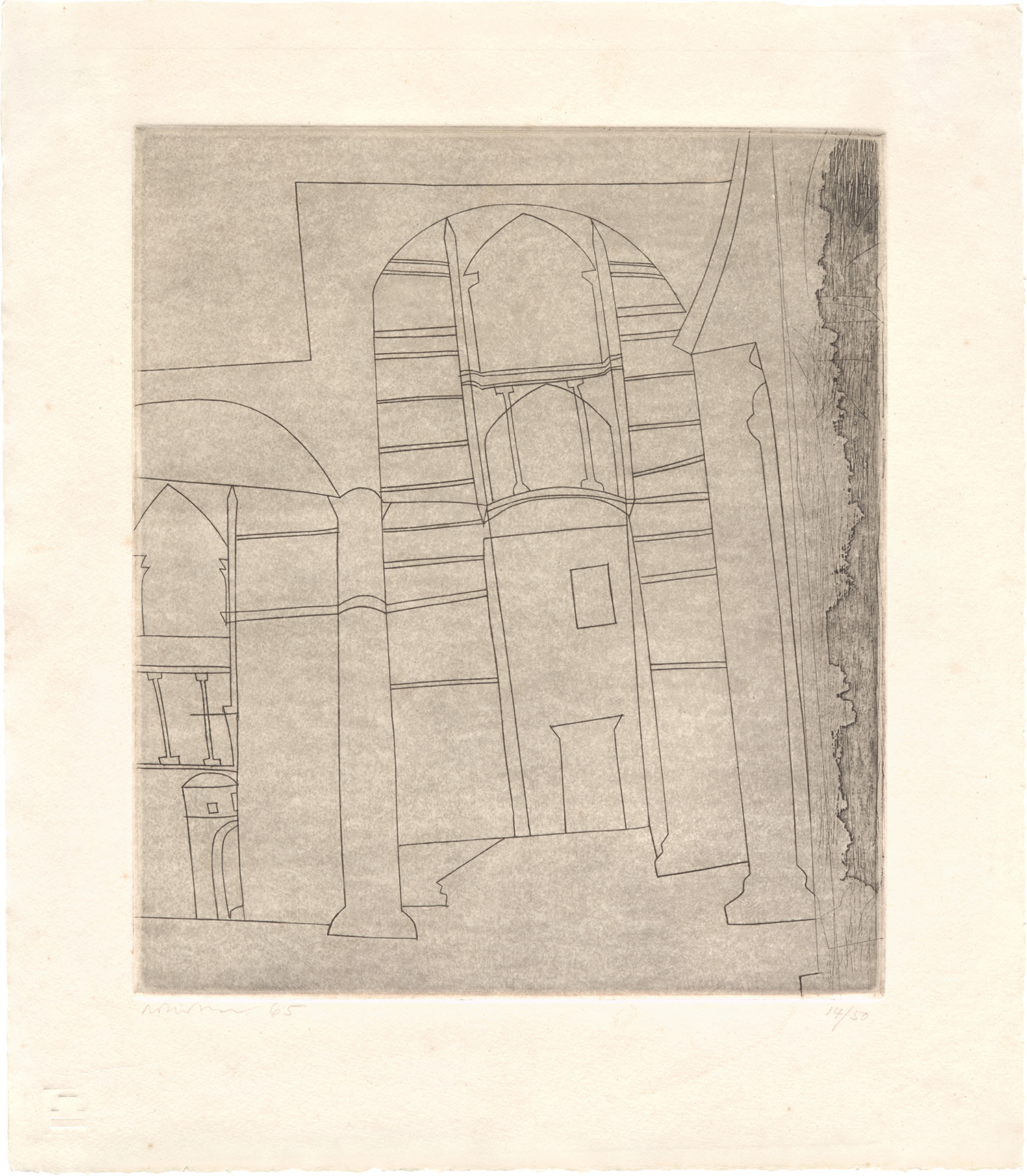
His prints and works on paper, including the etchings and aquatints that feature prominently among the works available on The Collection, show the same intelligence working in miniature. The etching "Urbino" and the atmospheric "Siena" series, for instance, capture the geometry of Italian hill towns with an economy of line that feels like a kind of distillation, as if the artist had looked at the landscape long enough to see only its essential armature. The work "aug 7 54 (aquamarine)" demonstrates his mastery of pencil and gouache, where colour and geometry settle into one another with a natural ease that takes decades of discipline to achieve. For collectors, Nicholson presents a rare combination of art historical significance and aesthetic pleasure.
His works span a wide range of formats, media, and price points, from the major oil paintings that appear at the top end of the international auction market to the prints and works on paper that offer a more accessible entry into his world. The etchings and drypoints are particularly prized for the intimacy they convey: Nicholson at his most direct, working with line alone, finding structure in the landscape or the still life with the confidence of someone who has looked and thought for a very long time. The linocut "Foxy and Frankie" adds another dimension entirely, revealing a wit and lightness that his reputation for rigorous abstraction can sometimes obscure. Auction houses including Christie's and Sotheby's have consistently demonstrated strong demand for his works across categories, and museum acquisitions have continued to affirm his place in the canonical narrative of twentieth century art.
Ben Nicholson
Siena (large version) (L. 22, C. 39)
To understand Nicholson fully, it helps to place him in the company of his peers and his influences. His relationship to Mondrian was one of genuine mutual regard. His work rhymes in interesting ways with that of Paul Klee, whose playful geometry he admired, and with the spare, meditative compositions of Giorgio Morandi, whose still lifes inhabit a similar territory of patient looking. Within British art, he stands as the central figure of a tradition that runs from the Euston Road painters on one side to the St Ives School on the other, the community he joined when he moved to Cornwall during the Second World War.
St Ives became a transformative environment, its light and coastline feeding directly into his work and drawing around him a new generation of artists including Peter Lanyon, Terry Frost, and Patrick Heron, all of whom owe something to the example he set. The legacy of Ben Nicholson is inseparable from the question of what British art actually is, what it looks like when it is most itself and most ambitious. He brought the rigour of the European avant garde into a distinctly English sensibility, one grounded in observation, in place, in the quiet pleasure of a table with objects on it and a view through a window. His work does not shout.
It does not perform. It simply offers itself to be looked at, and it repays that looking with something that is hard to name but easy to recognise as important. For collectors building a serious engagement with the art of the twentieth century, a Nicholson is not merely an acquisition. It is an education in how to look, and a lasting source of genuine delight.
Explore books about Ben Nicholson

Ben Nicholson
Herbert Read
Ben Nicholson: Paintings, Reliefs, Drawings
Jeremy Lewison
Ben Nicholson: A Studio Life
Andrew Causey
Ben Nicholson
Norbert Lynton
The Geometry of Hope: The Life and Work of Ben Nicholson
Juliet Steyn
Ben Nicholson: Drawings from the 1960s and 1970s
Jennifer Mundy

Ben Nicholson and Modernism
Stephen Snoddy