Ayako Rokkaku
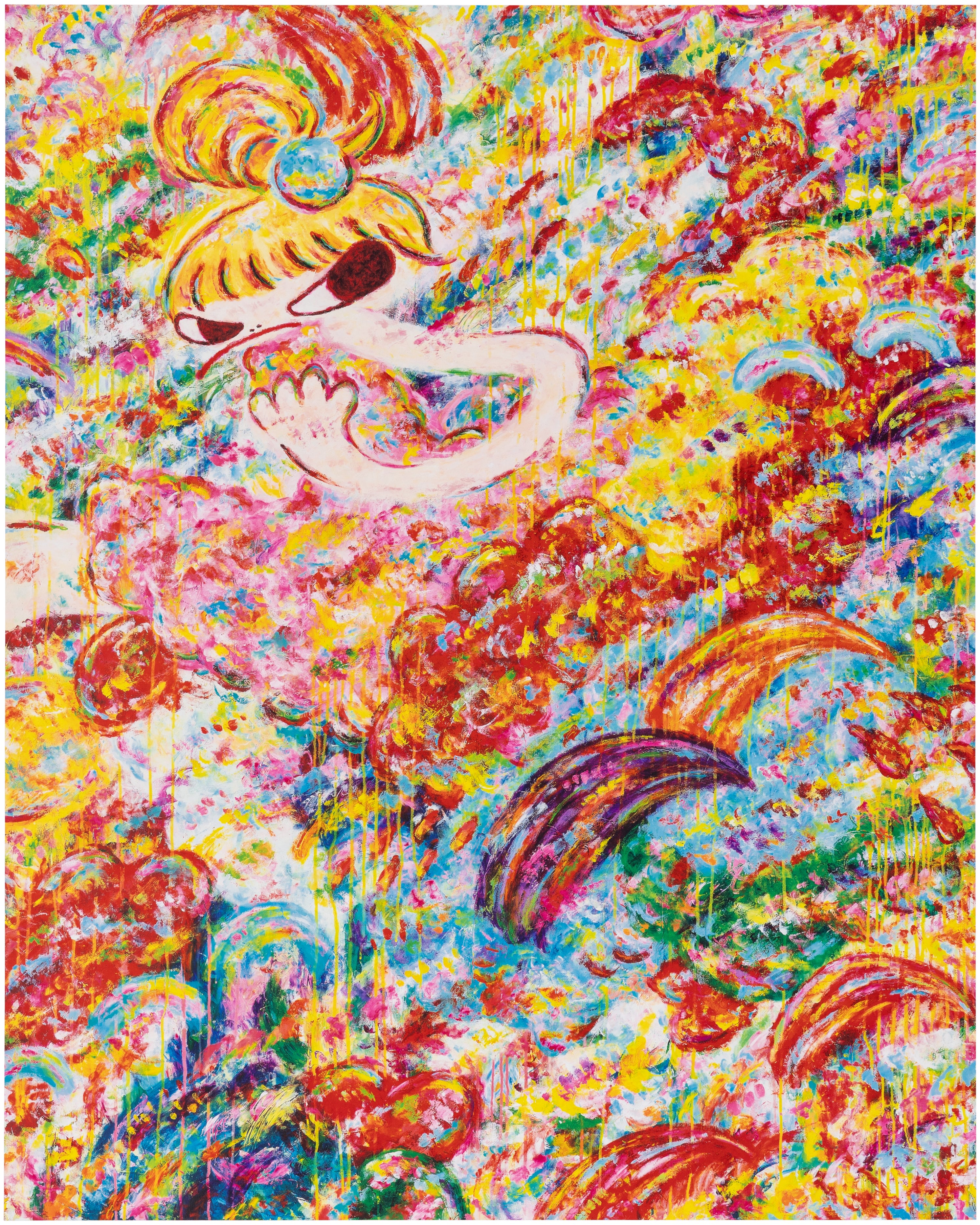
Ayako Rokkaku Paints the World Alive
Artist Spotlight · The Collection Editorial
In the spring of 2023, auction rooms across Europe were watching closely as works by Ayako Rokkaku achieved prices that confirmed what a devoted international collecting community had understood for years: this Japanese artist, who works entirely with her bare hands, is among the most distinctive and emotionally resonant painters of her generation. Her canvases have passed through the rooms at Christie's, Sotheby's, and Phillips with increasing confidence, drawing bidders from Asia, Europe, and North America who are drawn not only to the visual exuberance of her work but to something harder to name, a quality of presence that feels almost tactile even at a distance. Rokkaku has become one of the rare contemporary artists whose market momentum and critical standing have grown in genuine tandem, each reinforcing the other without either feeling forced. Ayako Rokkaku was born in 1982 in Japan and grew up immersed in a culture that holds both rigorous craft traditions and a deep tenderness toward the imaginative and the playful.
Ayako Rokkaku
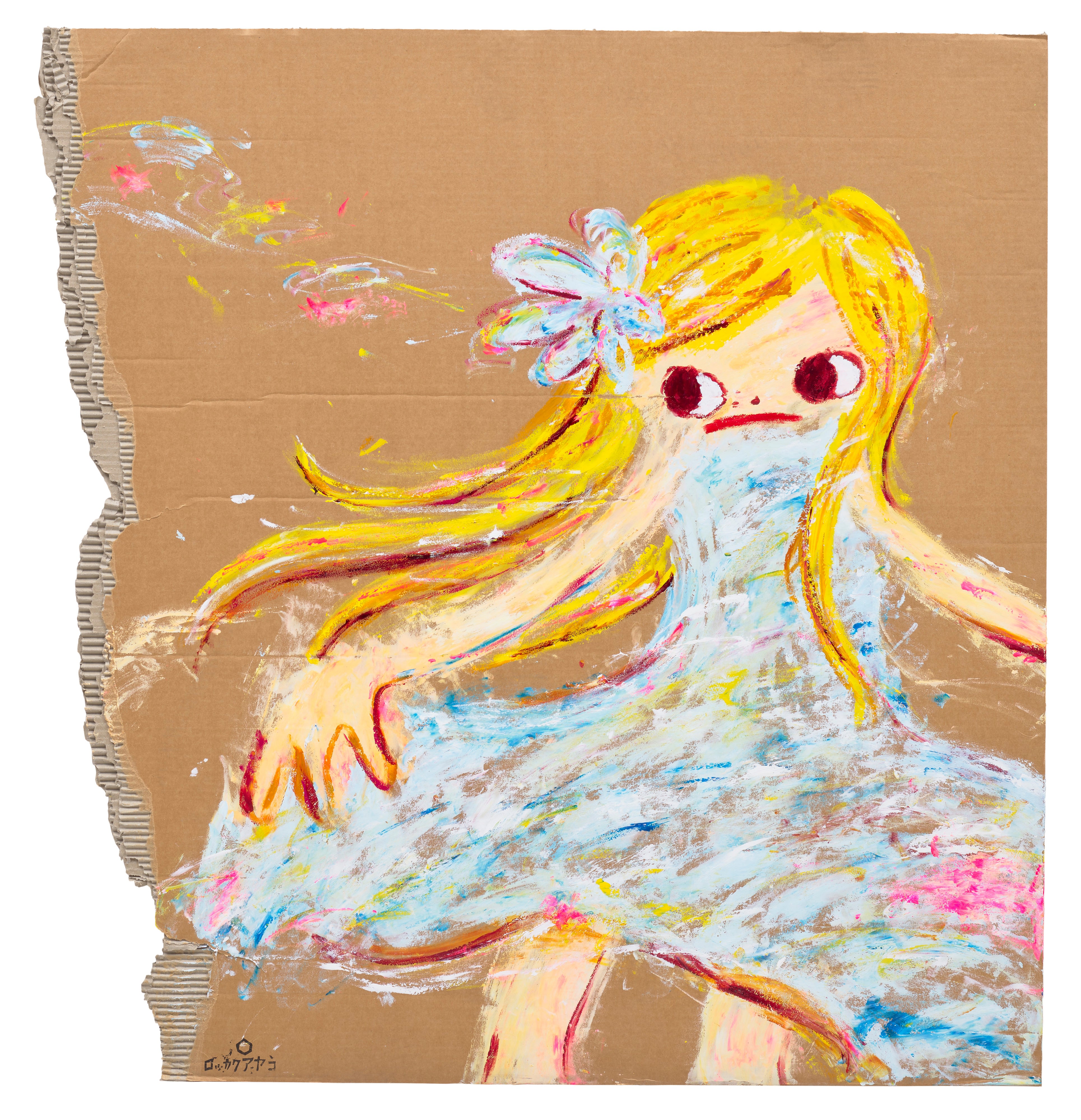
Work, 2007
She came to painting not through the conventional academic route but through an intensely personal impulse, beginning to use her hands directly on the surface as a way of closing the distance between feeling and form. There is something almost prelinguistic about this decision, as though the brush represented a technology she simply did not need, a layer of mediation between her inner world and the world she was building on canvas or cardboard. That instinct, formed early and never abandoned, became the entire foundation of her practice. Her artistic development accelerated significantly when she began showing in the Netherlands in the early 2000s, finding an audience in Europe that responded immediately to her work's combination of raw energy and lyrical delicacy.
The Dutch art scene, with its long tradition of valuing both craft and commerce in the visual arts, offered Rokkaku an environment where large scale, labor intensive painting could find serious institutional and collector attention. She became known for her live painting performances, events in which she works on enormous surfaces in full view of an audience, building up layers of acrylic with her palms and fingers in a process that is as much theatrical as it is artistic. These performances are not demonstrations or spectacles in a reductive sense; they are the work itself happening in real time, and they transformed many first time observers into committed collectors. The signature elements of Rokkaku's paintings are by now recognizable across her entire body of work and yet never feel repetitive.
Ayako Rokkaku
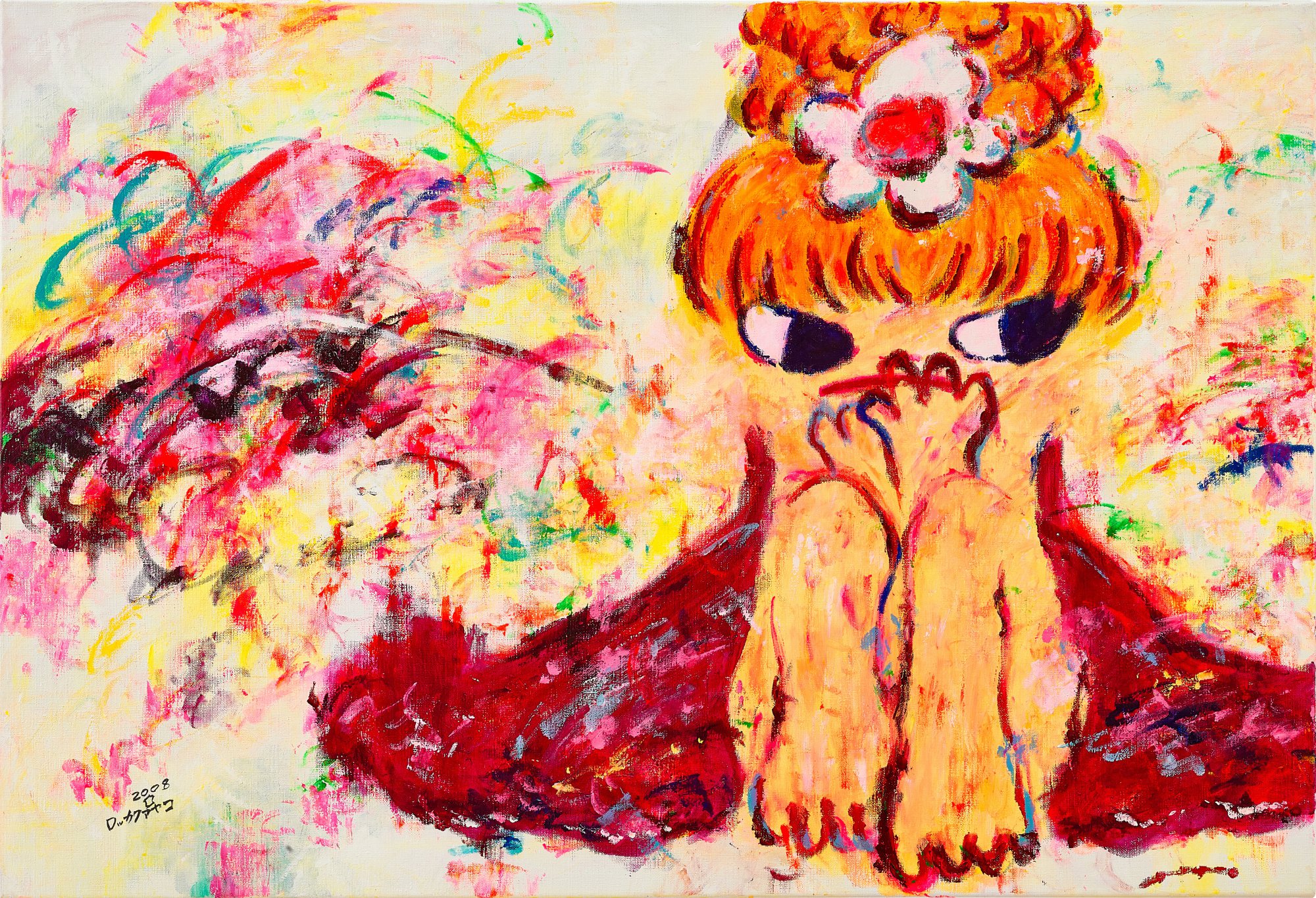
Untitled 無題
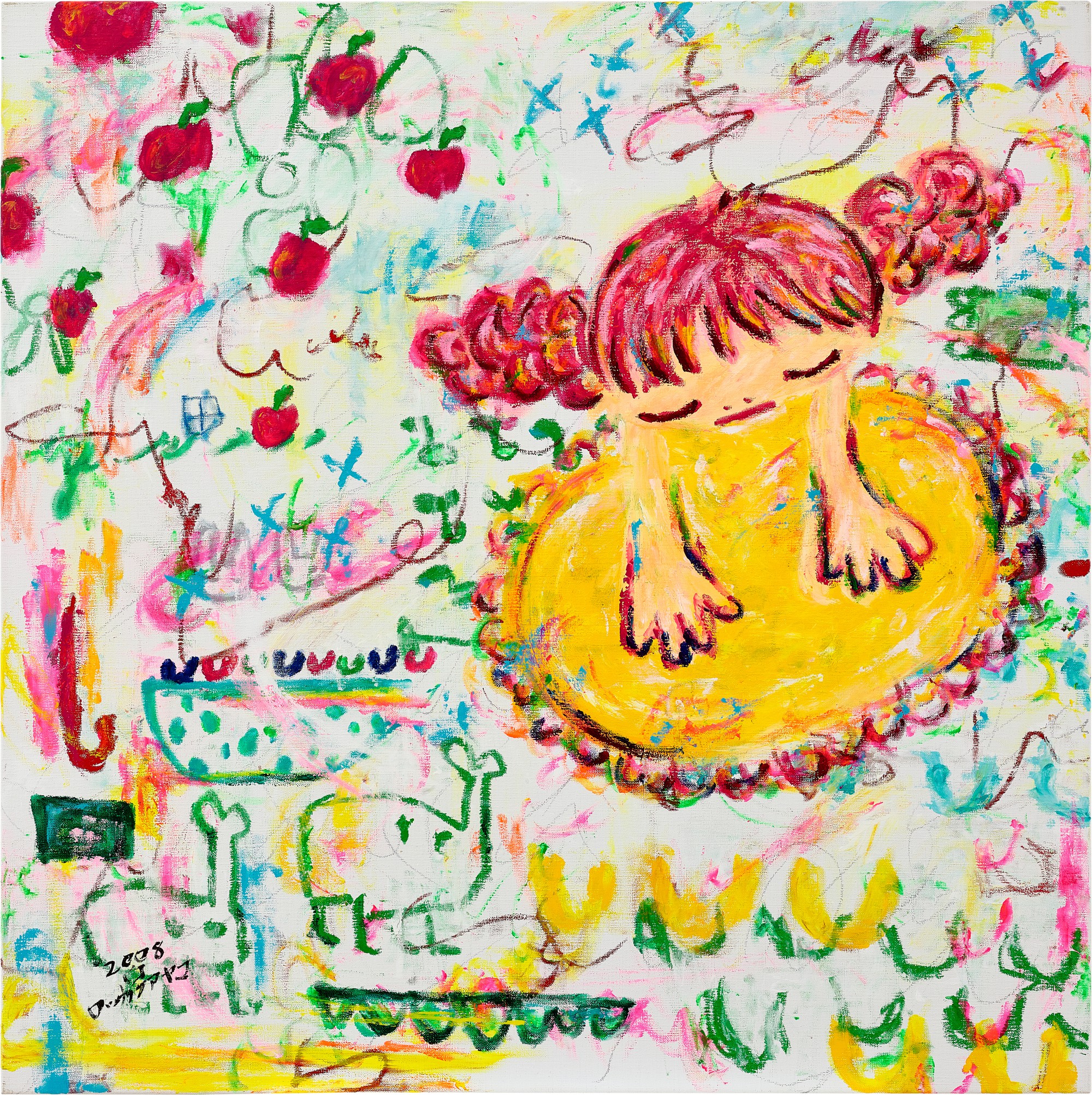
Her figures, often young girls or softly androgynous children, inhabit fields of layered color that seem to exist outside any specific geography or era. The backgrounds are built up through dozens of passes, each hand pressed application adding density and luminosity until the surface has a quality closer to atmosphere than paint. Works such as her untitled acrylics on canvas, her pieces on corrugated cardboard, and her emotionally charged titled works like the piece known as "憤怒" demonstrate the breadth of her material curiosity alongside the consistency of her emotional vocabulary. Cardboard, in particular, has been an important substrate for her, a material whose humble, provisional quality sits in productive tension with the intensity of the color and feeling she brings to it.
For collectors, Rokkaku's work presents a remarkably coherent entry point across a range of formats and price levels. Her editions, including silkscreen prints produced with extraordinary technical care in dozens of colors on fine papers, offer access to her visual world at a more accessible scale, while her original paintings on canvas represent serious long term acquisitions with a track record of strong secondary market performance. The works on cardboard occupy a particularly interesting position, combining the material directness that is central to her practice with a format that feels at once intimate and conceptually charged. Collectors who entered her market in the mid 2000s during her earlier European exhibitions have seen consistent appreciation, and newer collectors coming to her work now are doing so with the benefit of a well established critical and commercial foundation.
Ayako Rokkaku
Untitled 無題
What to look for is emotional immediacy: the works that carry the strongest sense of her physical presence in their surfaces, where the fingerprints are almost visible in the density of the paint, tend to be the ones that hold attention across years of living with them. Rokkaku exists within a broader conversation about gestural and expressionist painting that connects her to artists working across several traditions. Her figuration, with its dreamlike quality and its rootedness in childhood and feminine experience, invites comparison with artists like Yoshitomo Nara, whose tender and sometimes melancholy figures have similarly found a global audience. The physical directness of her process places her in dialogue with artists who have explored the body as a painting instrument, from figures in the postwar European tradition through to contemporaries working in expressive figuration today.
Yet her work resists easy categorization within any single lineage. She draws from Japanese visual culture, from European painting history, and from a genuinely personal and idiosyncratic set of concerns that make her practice feel self generated rather than derived. What makes Rokkaku matter in the current moment is precisely the quality that made her matter from the beginning: an absolute sincerity of expression delivered through a completely individual means. At a time when painting is navigating complex questions about appropriation, digital mediation, and the relationship between art and image culture, her commitment to direct physical contact with the surface feels both timely and quietly radical.
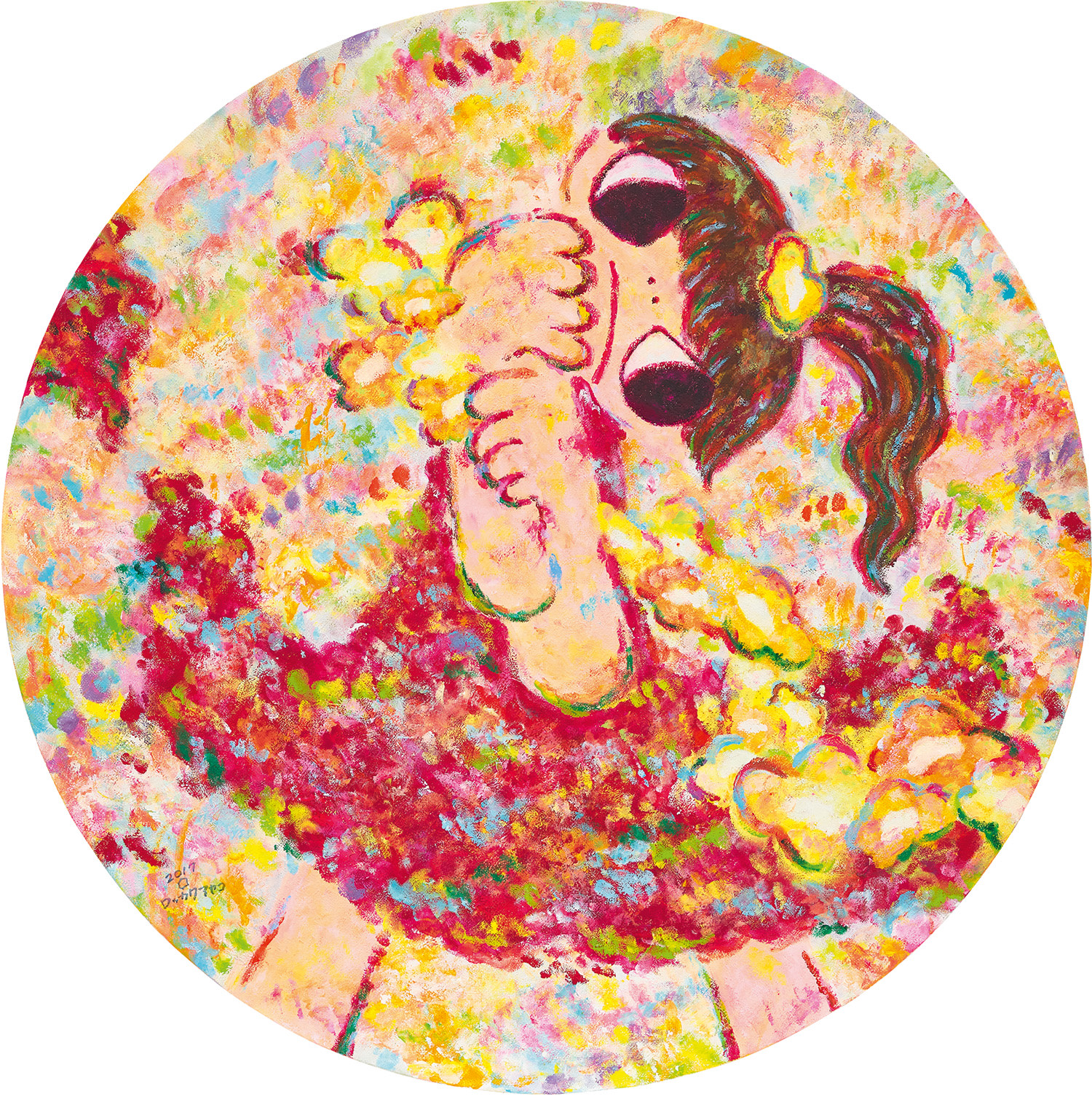
Ayako Rokkaku
diameter 90 cm. (35 3/8 in.), 2017
Her figures carry a tenderness that is not sentimental, a vulnerability that is not weakness. They inhabit their painted worlds with a self possession that seems to reflect something genuine about how Rokkaku sees human experience, particularly the experience of girls and women navigating worlds that are not always designed to receive them gently. That combination of formal originality and emotional depth is what collectors are responding to, and it is what will ensure her work continues to resonate long after the current market moment has moved on.