Auguste Mestral
Light on Stone, History Made Permanent
Artist Spotlight · The Collection Editorial
In the summer of 1851, a small group of photographers fanned out across France carrying unwieldy equipment, glass vessels of chemicals, and a sense of urgent purpose. The French government had charged them with a mission of remarkable foresight: to document the nation's crumbling medieval monuments before restoration or ruin erased them forever. Among those photographers was Auguste Mestral, and the images he brought back from that journey remain among the most quietly extraordinary documents in the history of the medium. More than 170 years later, as institutions and collectors alike have turned with fresh eyes toward the origins of photography, Mestral's work stands as a testament to what the camera could do in the hands of someone who understood both its poetry and its precision.
Auguste Mestral
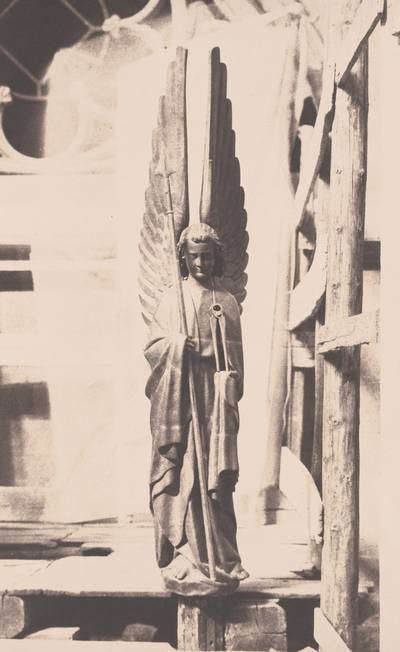
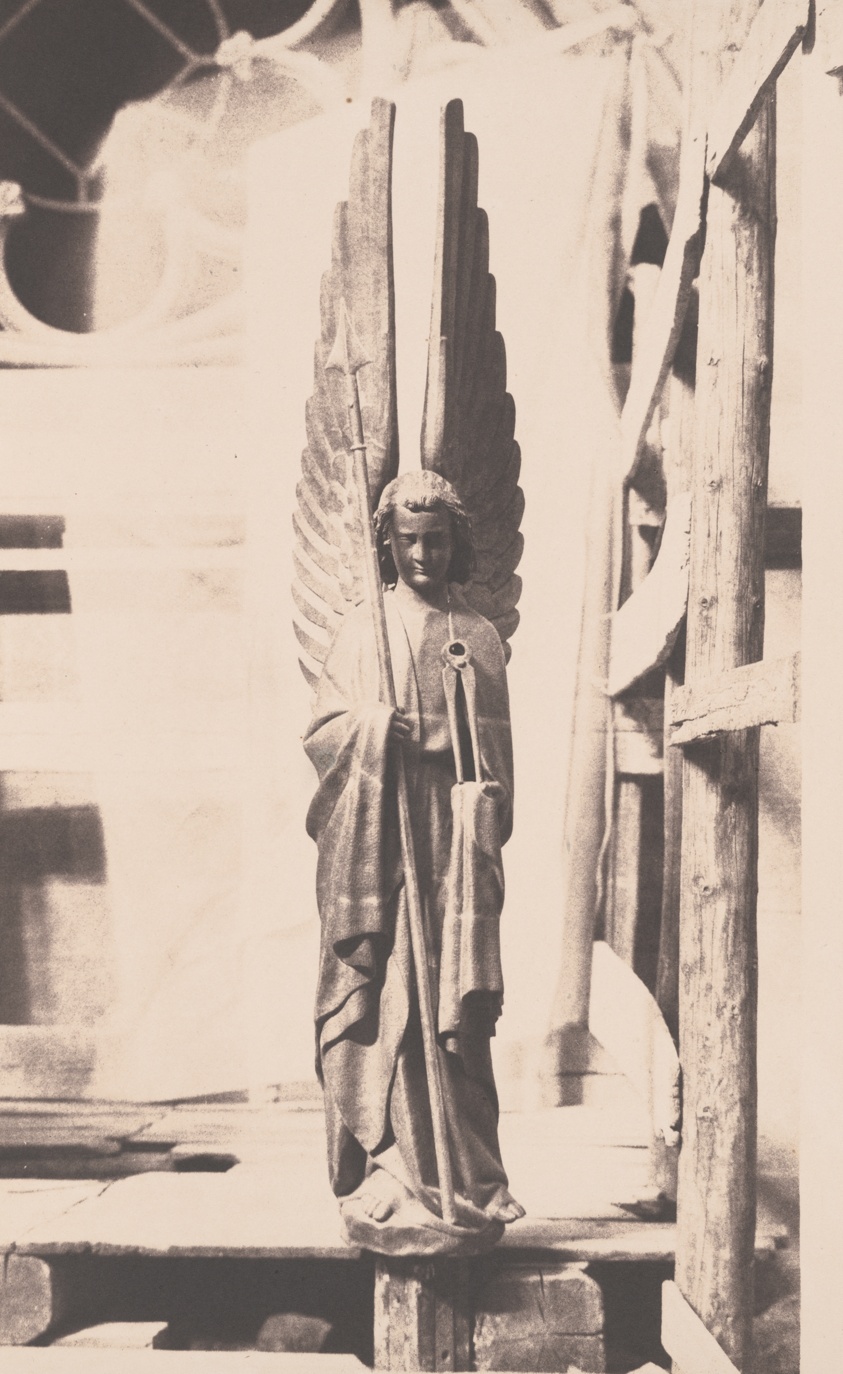
Angel, Sainte-Chapelle, 1853
Mestral was born in France in 1812, at a moment when the technology that would define his life's work did not yet exist. The details of his early years remain sparse, as they do for many figures who worked in the experimental margins of emerging disciplines, but what is clear is that he came of age in an era of extraordinary intellectual ferment. France in the 1830s and 1840s was a place where science and art pressed against each other with productive friction, and photography emerged directly from that collision. Mestral trained as an engineer, a background that would prove formative.
His understanding of optics, chemistry, and structural form gave him an analytical eye that translated with unusual grace into the new medium of the calotype. His early photographic development was shaped by proximity to two figures who rank among the medium's genuine pioneers. His close association with Hippolyte Bayard, one of the inventors of the photographic process and a man whose contributions history has repeatedly undervalued, placed Mestral at the very center of French photographic culture in its foundational years. Later, he worked alongside Gustave Le Gray, the towering figure of nineteenth century French photography whose innovations with the waxed paper negative transformed what was technically possible in the medium.
Auguste Mestral
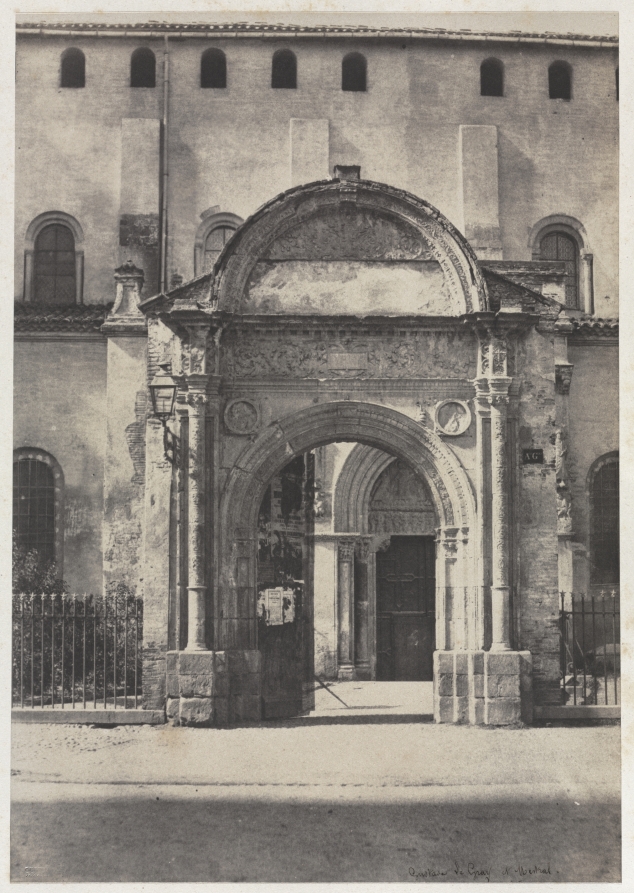
Porte Bachelier, Eglise Saint-Sernin, Toulouse (Haute-Garonne), 1851
To have worked in orbit around both men is to have been educated in the fullest possible sense. Mestral absorbed from Bayard a humanist sensitivity to subject and from Le Gray a technical ambition that pushed against the limits of available tools. The Mission Héliographique of 1851 represents the defining episode of Mestral's career and one of the most significant collective projects in the entire history of photography. The mission was organized under the auspices of the Commission des Monuments Historiques, and the five photographers selected for it, including Édouard Baldus, Henri Le Secq, Hippolyte Bayard, and Mestral himself, were tasked with surveying architectural heritage across different regions of France.
Mestral traveled through the south and southwest of the country, producing salted paper prints from waxed paper negatives with a clarity and compositional intelligence that holds its own against the best work produced by any of his fellow participants. His images of Romanesque and Gothic architecture demonstrate a photographer who understood that stone has its own grammar, its own system of weight and rhythm, and who could make a camera read that grammar with sensitivity. Among his most celebrated works is the image of the Porte Bachelier at the Église Saint Sernin in Toulouse, produced in 1851 as part of the Mission Héliographique. The photograph is a study in the relationship between light and carved stone, the intricate Romanesque ornament of the portal rendered with a tonal richness that the salted paper print process, made from a waxed paper negative, achieves with particular beauty.
Auguste Mestral
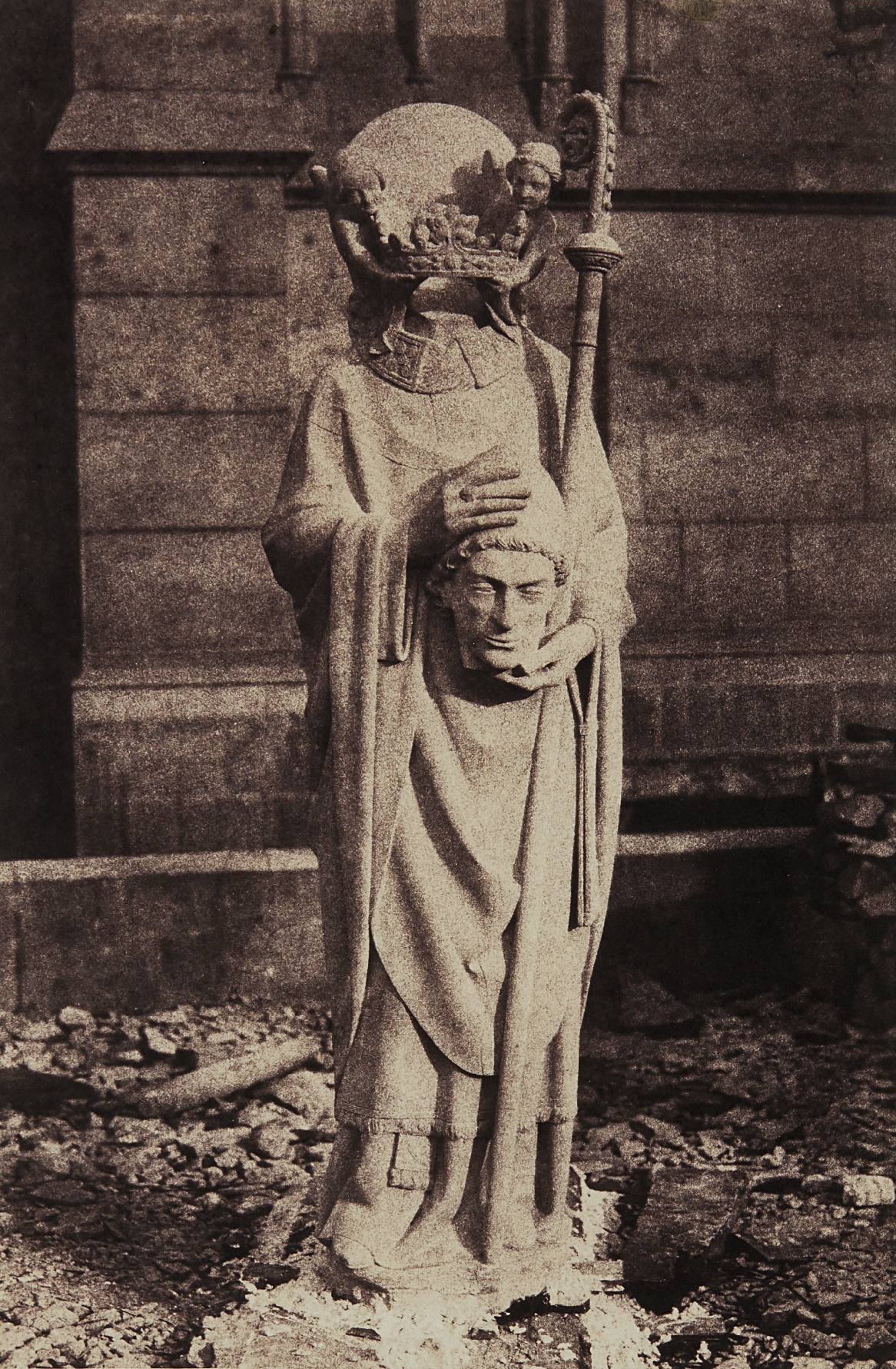
Sculpture of St. Denis, Notre Dame, Paris
There is nothing cold or merely documentary about it. The image has warmth and a kind of patience, as though the photographer understood that a building this old deserved the full attention of the lens. His later work includes a luminous salted paper print of an angel from the Sainte Chapelle, dated 1853, a fragment of Gothic splendor that rewards close looking with its delicate rendering of carved drapery and expression. A further work depicting sculpture at Notre Dame de Paris, inscribed in an unidentified hand on the mount, completes a body of work that reads as a sustained meditation on French sacred architecture and the passage of time.
For collectors, Mestral presents a compelling case that is only growing stronger. The market for nineteenth century French photography has deepened considerably over the past two decades, driven in part by major institutional acquisitions and scholarly reassessments of the Mission Héliographique's participants. Works by Mestral are rare, a consequence of both the fragility of paper negative prints and the relative obscurity into which his name fell compared to more celebrated contemporaries. That rarity is itself significant.
A salted paper print by Mestral is not simply a beautiful object, though it is certainly that. It is also a piece of primary evidence about a pivotal moment in cultural history, when a government first recognized that photography could serve as an instrument of collective memory. Collectors drawn to the intersection of art, history, and the science of seeing will find in Mestral a figure of unusual depth. The artists who surround Mestral in art historical terms form a constellation of the medium's founding generation.
Édouard Baldus, whose architectural photographs from the same period display a comparable grandeur and technical mastery, offers an instructive parallel. Henri Le Secq, another Mission Héliographique participant, shares with Mestral a preference for the meditative and the monumental. Gustave Le Gray, whose influence on Mestral was direct and formative, remains the acknowledged giant of the group, but that proximity elevates rather than diminishes Mestral's standing. To collect Mestral is to collect within one of photography's most important and generative networks, at the moment when the medium first understood what it could be.
Mestral died in 1884, having witnessed photography transform from an experimental curiosity into a global visual language. His own contribution to that transformation was specific and irreplaceable: he helped prove that the camera was not merely a recording device but an instrument capable of interpretation, of finding meaning in the grain of old stone and the play of afternoon light across a carved portal. At a time when questions of heritage, preservation, and the visual documentation of culture feel more urgent than ever, his work speaks with a directness that requires no translation. He was, in the deepest sense, a photographer who understood what was worth keeping.