Auguste Brouet
Auguste Brouet: The Poet of Forgotten Faces
Artist Spotlight · The Collection Editorial
There is a particular kind of pleasure that comes from discovering an artist who worked quietly, with great seriousness, at the edges of fame. Auguste Brouet was never a household name in the way that his contemporaries Toulouse Lautrec or Steinlen became, yet collectors and print scholars who have spent time with his etchings often describe the encounter as a revelation. His work captures the textures of working life in France with a tenderness and technical mastery that feels, even now, startlingly alive. In recent years, as interest in the golden age of French printmaking has deepened among serious collectors, Brouet has emerged as one of the most rewarding figures to rediscover.
Auguste Brouet
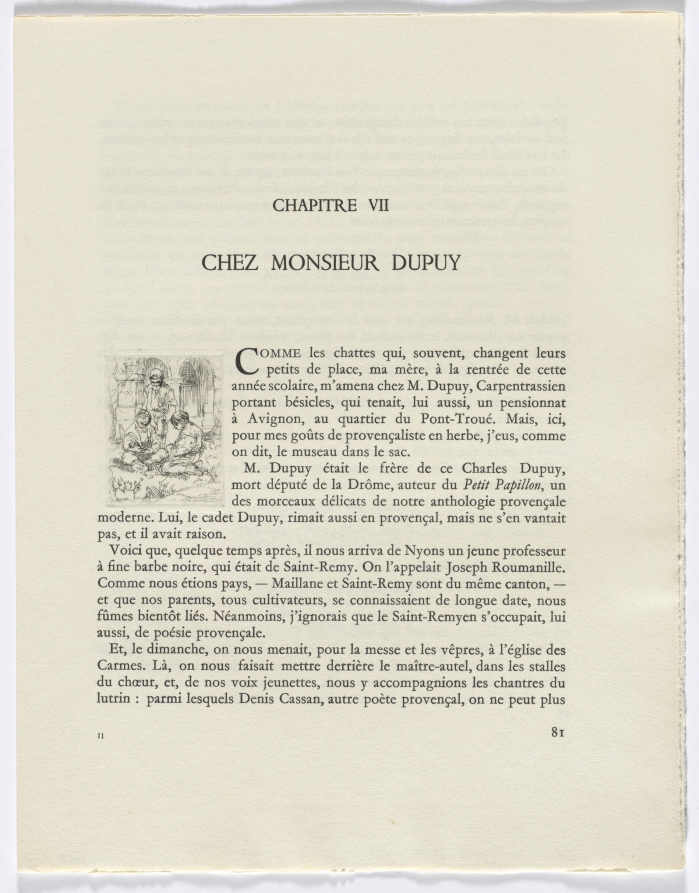
Frédéric Mistral: Mémoires et Recits by Frédéric Mistral: three figures (page 81), 1937
Born in Paris in 1872, Brouet came of age in a city electric with artistic ambition. The capital was a crucible of new movements and ideas, and the printmaking tradition in France was undergoing a profound renaissance, driven by the work of Charles Meryon, Felix Bracquemond, and the broader etching revival that had swept through European studios in the latter half of the nineteenth century. Brouet absorbed these influences with a student's discipline and an original sensibility. He trained rigorously in the technical arts of intaglio printmaking, mastering etching, aquatint, and roulette work with a confidence that would define his mature practice.
What shaped Brouet most deeply was not the salon culture of grand ambition but rather the street. He was a tireless observer of ordinary Parisian life, of the working poor, the street vendors, the circus performers, the drinkers in smoky cafes, and the laborers in industrial landscapes that were transforming France at the turn of the century. His eye was generous rather than satirical, closer in spirit to the sympathetic humanism of Honoré Daumier than to the more cutting social commentary of some of his peers. This warmth, this genuine affection for his subjects, is what gives his prints their lasting emotional weight.
Auguste Brouet
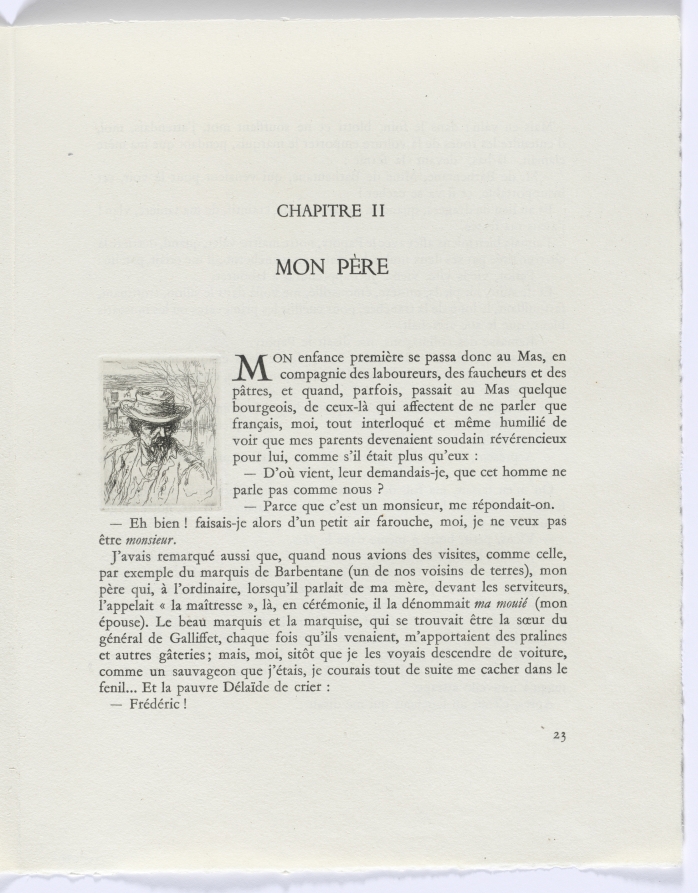
Frédéric Mistral: Mémoires et Recits by Frédéric Mistral: bust of man with hat (page 23), 1937
Brouet's early career produced some of his most celebrated and historically significant work. The 1902 etching, roulette, and aquatint titled At the Creusot Works: The Smokestacks stands as a landmark in his output and in the broader tradition of industrial imagery in French printmaking. Le Creusot was the heart of French heavy industry, home to the great Schneider ironworks, and Brouet's image of its smokestacks rising against the sky is both documentary and poetic. The technical combination of etching with roulette and aquatint allowed him to render the atmospheric grime and grandeur of the industrial landscape with a richness of tone that photographs of the era could not match.
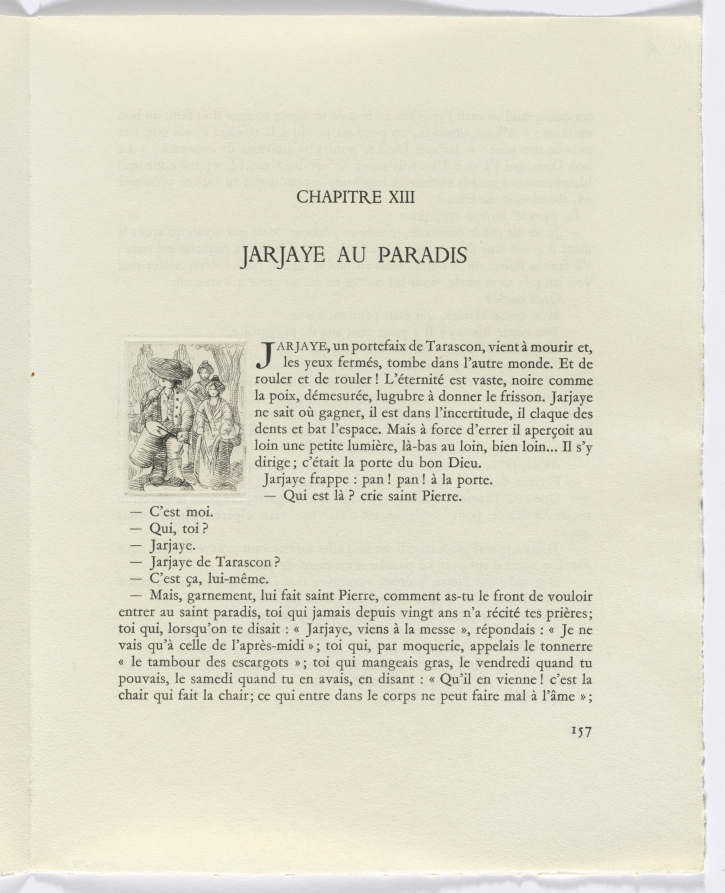
It is a work that places him in an important conversation with artists grappling with modernity and the human cost of industrial progress. His mature period saw him range widely across subject matter while remaining committed to the intimacy of the printed page. The series of etchings he created for Frederic Mistral's Memoires et Recits, completed in 1937 near the end of his life, reveals an artist who had deepened his feeling for light, narrative, and place. Mistral was the great poet of Provence, a Nobel laureate whose literary vision of southern France had captivated readers for generations, and Brouet's illustrations do not merely decorate the text but enter into genuine dialogue with it.
Auguste Brouet
Frédéric Mistral: Mémoires et Recits by Frédéric Mistral: man playing drum (page 157), 1937
The street scenes, the figures at outdoor tables, the pier, the landscapes with rivers and distant city views, all carry a Mediterranean warmth and a sense of remembered experience that elevates the project from illustration to independent artistic statement. The 1925 etching Les Martigues, depicting the picturesque fishing town on the Etang de Berre that had attracted artists including Ziem and Dufy, shows Brouet's mastery of landscape in the service of place and atmosphere. For collectors, Brouet's work offers something rare in the market for early twentieth century prints: consistent quality, strong technical ambition, and relative accessibility compared to better known names. His prints appear at auction and through specialist print dealers with enough regularity to allow meaningful collection building, yet the market has not yet priced his finest work beyond reach.
Serious collectors focus on the industrial subjects and the Mistral illustrations as the twin peaks of his achievement, though his scenes of Parisian street life and his circus and fair subjects also command genuine admiration among print connoisseurs. Condition and the quality of individual impressions matter enormously with Brouet, as they do with all printmakers of his generation, and working with a specialist advisor to assess impression quality and plate state is advisable for new collectors entering this area. In the context of art history, Brouet belongs to a distinguished generation of French printmakers who believed that the etching needle was as serious an instrument of artistic expression as the painter's brush. His closest comparisons are artists like Theophile Alexandre Steinlen, whose compassionate imagery of the Parisian working class shares Brouet's social warmth, and Jean Louis Forain, whose print journalism brought the streets of Paris into sharp satirical focus.
Auguste Brouet
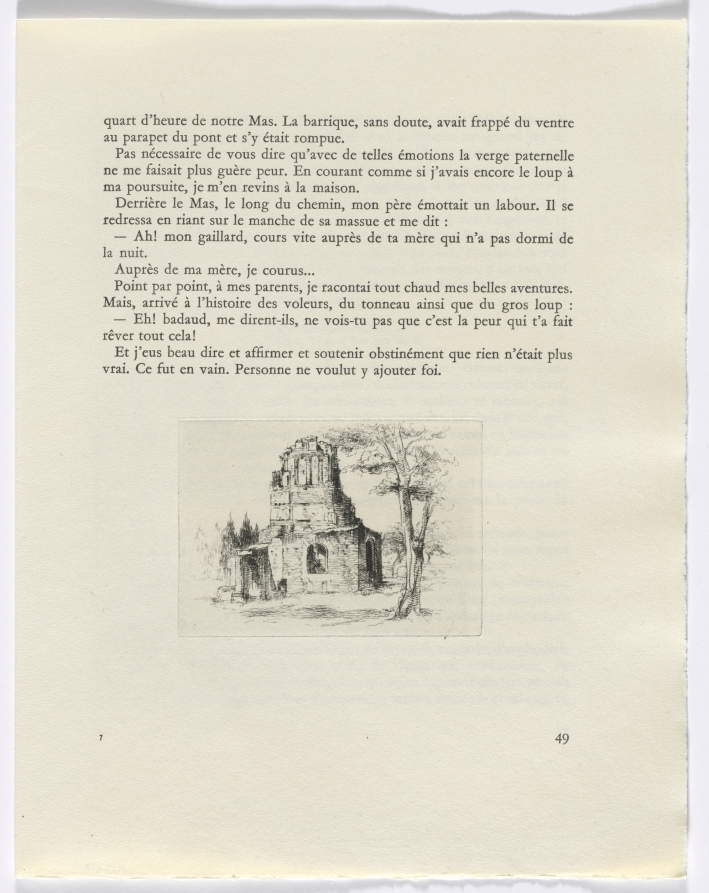
Frédéric Mistral: Mémoires et Recits by Frédéric Mistral: ruin (page 49), 1937
Brouet is also usefully considered alongside the great illustrator tradition that included figures such as Charles Louis Philippe and the printmakers associated with the Societe des Peintres Graveurs Francais. He worked in a moment when the livre d'artiste, the artist's book combining original prints with literary texts, was becoming one of the most prized objects in French culture, and the Mistral project situates him firmly within that distinguished tradition. Auguste Brouet died in 1941, as France endured the occupation and the world he had spent his career depicting was undergoing its most traumatic transformation. His legacy is that of an artist who trusted the ordinary, who found in a smokestack or a street corner or a figure leaning over an outdoor table enough material for a lifetime of meaningful work.
That quiet confidence is increasingly valued in a collecting culture that has grown tired of spectacle and hungry for sincerity. To spend time with a Brouet etching is to be reminded that the most enduring art often comes from the most attentive looking.
Featured Works
Frédéric Mistral: Mémoires et Recits by Frédéric Mistral: three figures (page 81)
1937
Frédéric Mistral: Mémoires et Recits by Frédéric Mistral: bust of man with hat (page 23)
1937
Frédéric Mistral: Mémoires et Recits by Frédéric Mistral: man playing drum (page 157)
1937
Frédéric Mistral: Mémoires et Recits by Frédéric Mistral: ruin (page 49)
1937
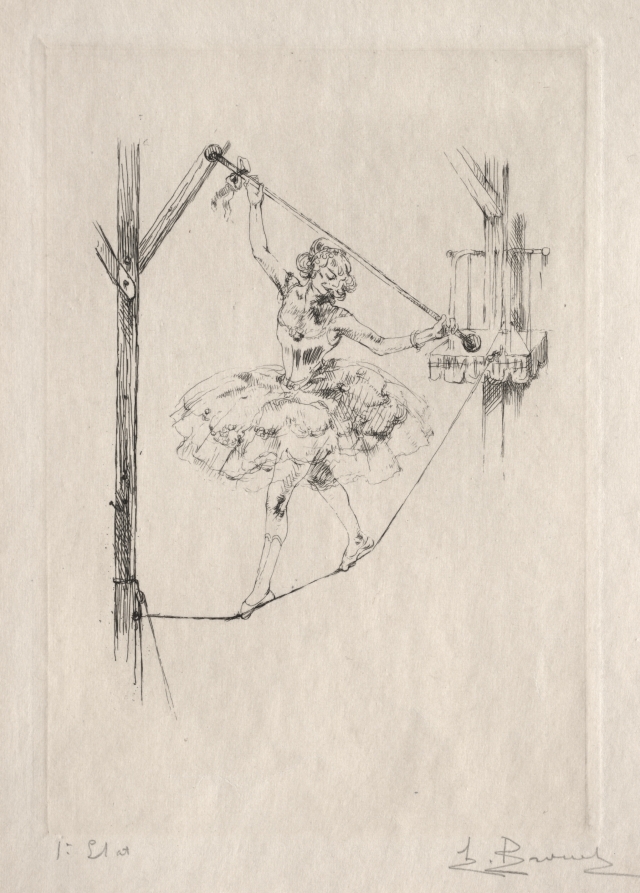
Tightrope Dancer
1902
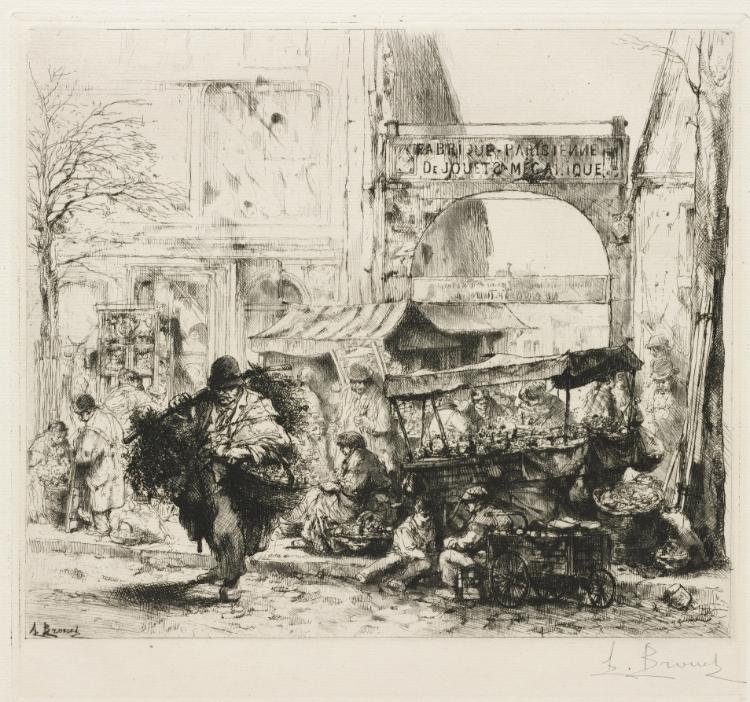
Une Matinee Avenue de Clichy
1925
Explore books about Auguste Brouet