Attributed to Jean-Baptiste Huët
Pastoral Grace, Timeless and Tenderly Observed
Artist Spotlight · The Collection Editorial
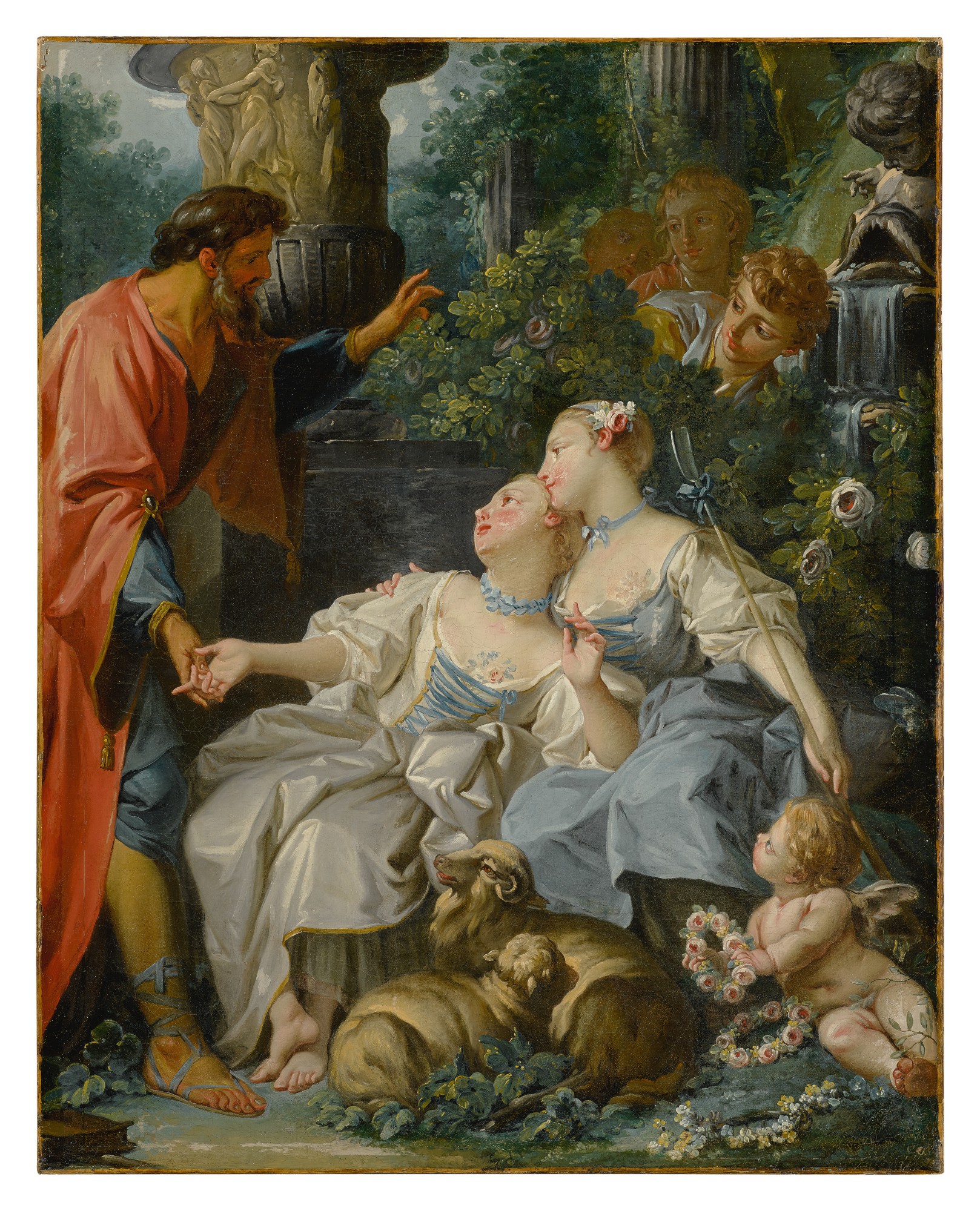
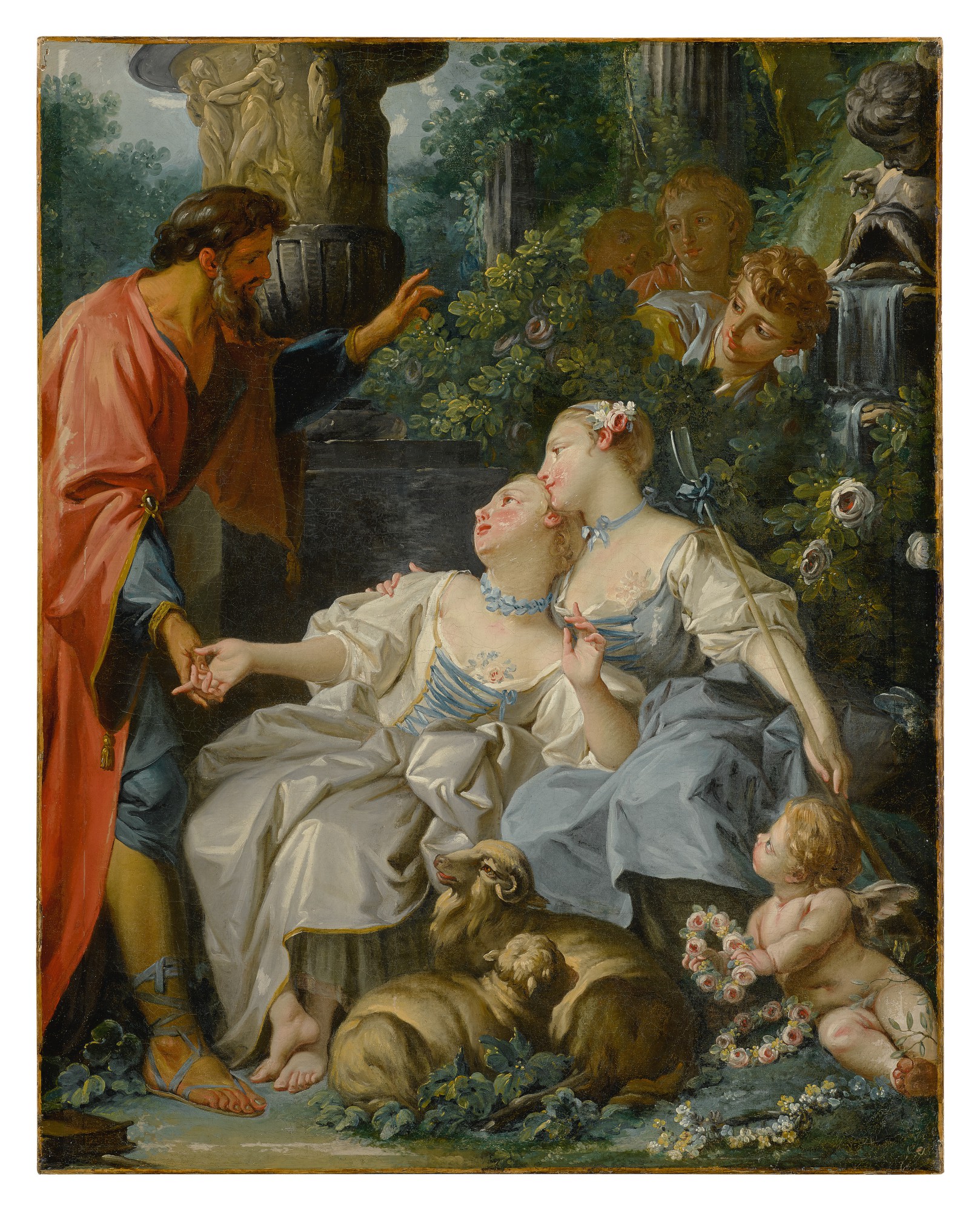
Imagine an afternoon in late eighteenth century Paris, the light falling soft and golden across a garden where two shepherdesses pause in easy conversation with a young shepherd, a playful putto nestled below them and three young men gathered behind, the whole scene suspended in a moment of unhurried, courtly ease. This is the world that Jean Baptiste Huët conjured with such consistent warmth and skill, a world that aristocratic collectors adored and that continues to draw admiring attention from scholars and connoisseurs alike. That a painting of precisely this description survives in fine condition today is a reminder of how durably Huët's vision has traveled across the centuries, losing none of its capacity to charm and to move. Huët was born in Paris in 1745 into a milieu already saturated with artistic ambition.
Attributed to Jean-Baptiste Huët
Two shepherdesses in a garden speaking to a shepherd, a putto below and three young men behind them
His father, Nicolas Huët, was a decorative painter, and the household atmosphere would have been one of craft, observation, and professional seriousness from his earliest years. The decisive influence on his formal training, however, came through Jean Baptiste Leprince, the inventive French painter known for his orientalist fantasies and his mastery of aquatint engraving. Under Leprince, Huët absorbed the technical foundations of both painting and printmaking while developing the sensitivity to outdoor light and animal form that would define his mature practice. Paris in the 1760s was alive with competing artistic energies, and a young painter moving through its studios and salons would have encountered everything from the lingering pleasures of Rococo decoration to the first stirrings of the Neoclassical reform that would eventually reshape European taste entirely.
Huët was admitted to the Académie Royale de Peinture et de Sculpture in 1769, a formal recognition that placed him squarely within the professional mainstream of French art. His reception piece and his subsequent Salon submissions established him as a painter of genuine accomplishment in the genre of pastoral and animal subjects, a specialization that carried real prestige in a culture still deeply attached to idealized visions of rural life. The French aristocracy, its great country estates and hunting parks forming a kind of parallel universe to the intellectual ferment of Paris, provided a natural and enthusiastic audience for his work. Huët understood what these patrons wanted: scenes that flattered their sense of connection to the land while rendering that land as graceful and legible as a well composed poem.
What separates Huët from mere decorative facility is the quality of his observation. His animals, whether sheep grazing in dappled meadows, dogs alert at the edge of a hunt, or cattle resting in afternoon shade, are rendered with a specificity of posture and anatomy that speaks to genuine study. He was not simply repeating a formula but looking, and looking carefully, at the living world around him. His palette tends toward the soft and luminous, favoring creams, warm greens, and the dusty blues of open sky, and his handling of paint has an assurance that never tips into rigidity.
The shepherdesses and their companions in the painting available on The Collection exemplify this balance perfectly: the figures are graceful without being stiff, the garden setting lush without being overgrown, and the narrative moment precisely chosen to suggest conversation, pleasure, and the easy continuity of a sunlit day. Huët also worked extensively as an engraver and textile designer, and his contributions to the renowned Jouy printed cotton manufactory, known as toile de Jouy, brought his pastoral vocabulary into the decorative arts on a significant scale. The pastoral scenes he created for printed fabric reached audiences far beyond the Salon walls, embedding his visual sensibility into the domestic environments of French families across the social spectrum. This breadth of activity reflects a pragmatic and professionally alert intelligence, one that recognized the value of working across media and contexts without ever compromising the underlying quality of observation and design.
His engravings after his own compositions extended his reputation further still, making his images available to collectors who could not acquire painted originals. For collectors approaching Huët today, several qualities recommend careful attention. Works firmly attributed to his hand are distinguished by the characteristic softness of his modeling, the particular care he takes with animal anatomy, and the compositional coherence that comes from a painter who understood the long tradition he was working within and who had fully internalized its lessons. The market for eighteenth century French pastoral painting has shown enduring resilience, with major auction houses in Paris, London, and New York regularly presenting works by artists of this period to enthusiastic international buyers.
Huët occupies a respected position in this market, admired both by specialists in French Rococo and Neoclassical transition and by collectors drawn more generally to the period's characteristic elegance. Works bearing careful scholarly attribution command serious consideration, and the presence of period provenance or exhibition history naturally adds further depth to any assessment. Huët's place within art history is best understood in relation to the great tradition of French animal and pastoral painting that stretches from the work of Oudry and Desportes earlier in the eighteenth century through to the more robust naturalism of the nineteenth. He shares with his contemporaries a commitment to the pleasures of idealized rural life, and his work invites comparison with artists such as François Boucher, whose Rococo sensibility left a lasting mark on French decorative painting, and with Hubert Robert, whose own engagement with garden and landscape subjects illuminates a parallel strand of the period's visual culture.
Huët is perhaps less celebrated than either of those figures today, but specialists regard him with genuine respect, and there is a quiet but steady current of scholarly and market interest in reassessing his contribution. The lasting appeal of Jean Baptiste Huët rests on something simpler and more durable than fashion or historical circumstance. He was a painter who looked at the world with affection, who found in the pastoral scene a vehicle for genuine visual pleasure, and who executed his vision with the kind of technical command that makes a painting a pleasure to live with across decades and generations. In an era of rapid and sometimes disorienting change, both in his own time and in ours, there is something quietly sustaining about an art that insists on the beauty of an afternoon, a garden, and a conversation held in good light.
Collecting Huët is an act of faith in that enduring vision.