Arnaldo Pomodoro
Arnaldo Pomodoro: The World Inside the Sphere
Artist Spotlight · The Collection Editorial
“I have always been interested in the dialectic between order and disorder, between the perfection of the surface and the complexity within.”
Arnaldo Pomodoro
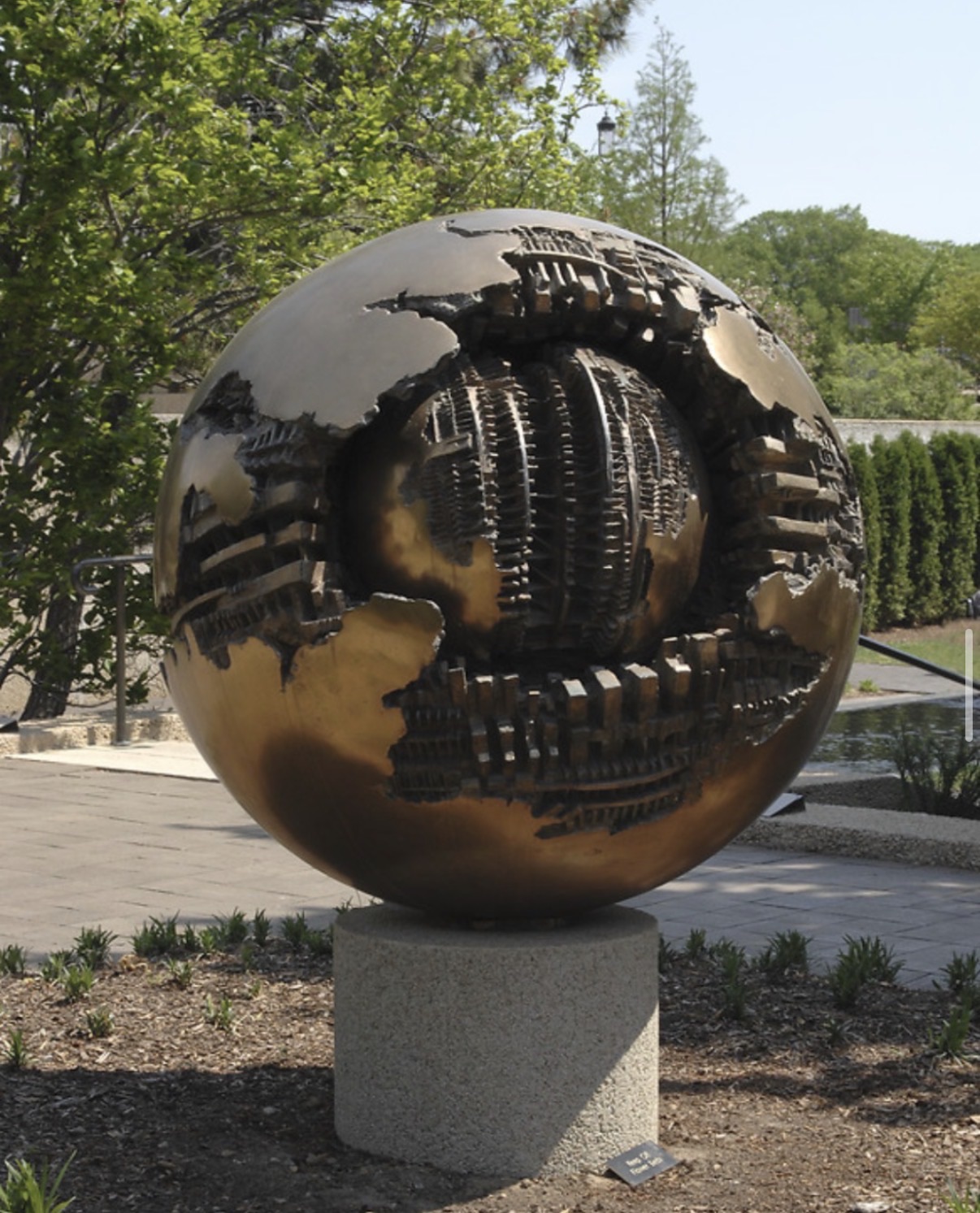
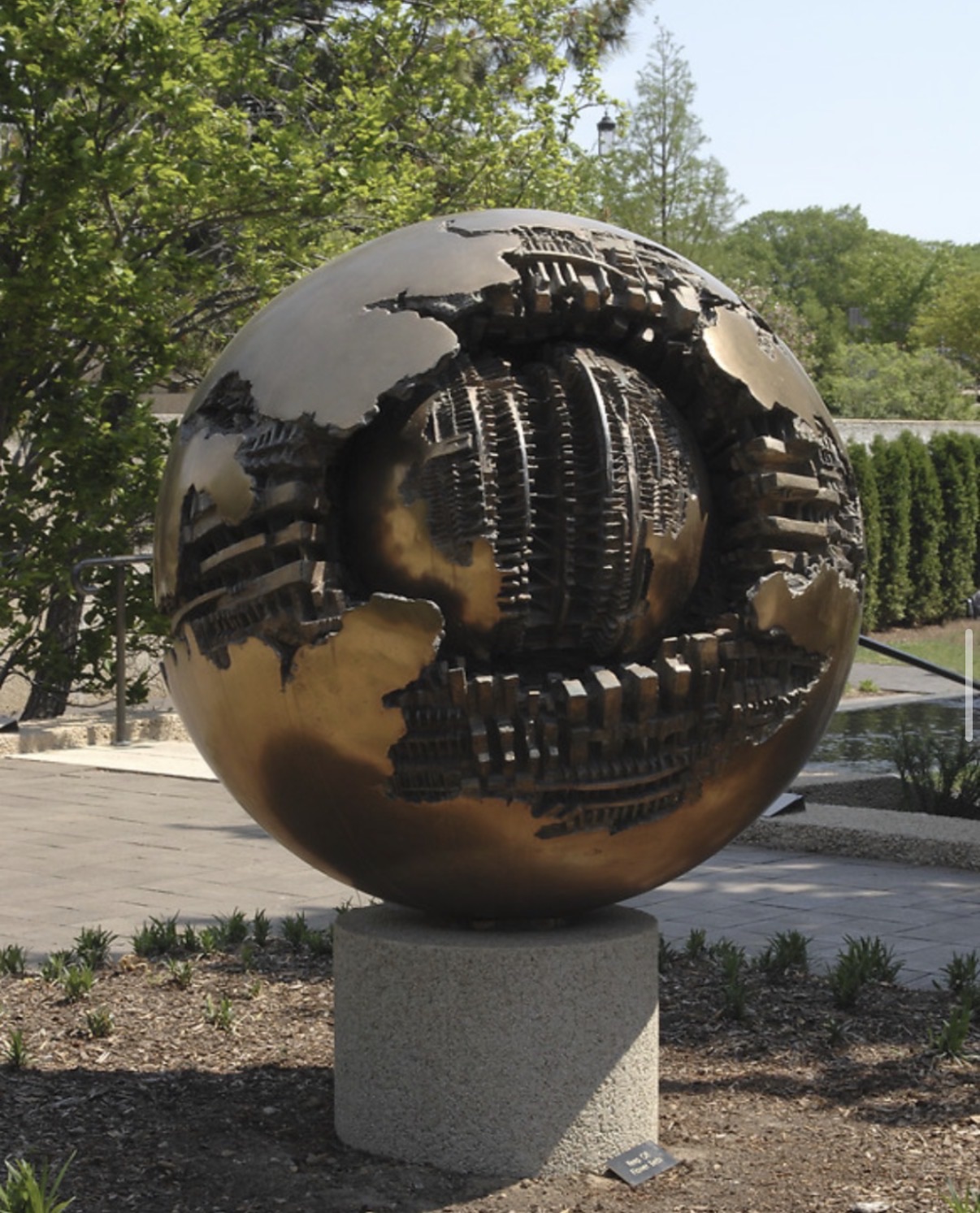
Stand before one of Arnaldo Pomodoro's great bronze spheres and you feel something shift. The outer surface is immaculate, geometric, almost architectural in its precision, but then the eye finds the rupture: a deep gash or crater that opens the form, revealing a dense interior universe of gears, glyphs, and fractured geometries. It is one of the most arresting visual experiences in all of postwar sculpture. That the same fundamental image has captivated audiences at the Vatican Museums, at the United Nations headquarters in New York, and in the courtyards of universities and cultural institutions across four continents is a testament not merely to Pomodoro's technical mastery but to the profound philosophical resonance of his chosen form.
Arnaldo Pomodoro
Sphere No. 6 (Sphere within a Sphere), 1963
Arnaldo Pomodoro was born in 1926 in Morciano di Romagna, a small town in the Emilia Romagna region of northeastern Italy. He grew up in an environment shaped by craft and making: his early training was in jewelry and goldsmithing, disciplines that instilled in him an intimate understanding of metal, surface, and the relationship between ornament and structure. This grounding in the decorative and the functional would prove essential, giving his later monumental bronzes an extraordinary surface intelligence that purely academic sculptural training rarely produces. He moved to Milan in the early 1950s, arriving in a city still reconstructing itself after the war and electric with artistic ambition.
In Milan, Pomodoro found himself at the center of an extraordinary cultural moment. He worked alongside his brother Giò Pomodoro, also a sculptor of considerable distinction, and the two became figures within a circle of artists, writers, and intellectuals that included Lucio Fontana, whose spatial cuts and punctured canvases were redefining what a surface could mean in art. The influence was mutual and generative. Pomodoro was also drawn to the work of Constantin Brancusi, whose belief in the expressive autonomy of pure form shaped an entire generation of sculptors, and the work titled Uccello: a Brancusi, cast in bronze in 1981, stands as both homage and conversation across the decades.
Arnaldo Pomodoro
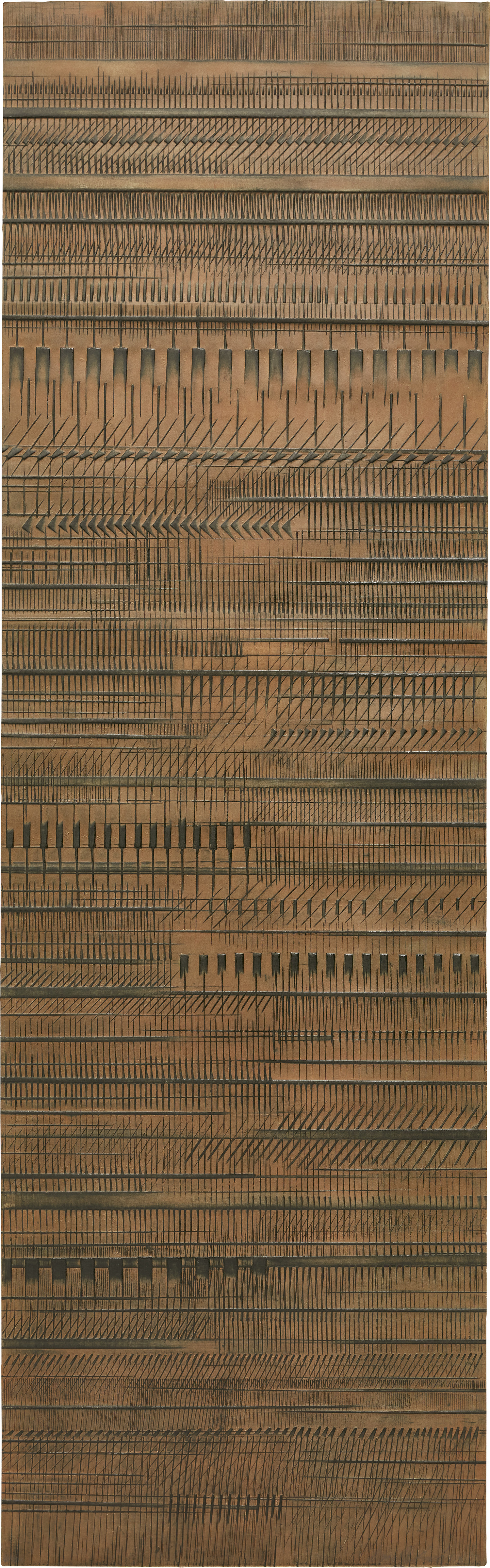
Foglio lungo di Pavia (Long Sheet from Pavia) (A.P. GR52)
The late 1950s saw Pomodoro exhibiting internationally, and works such as Grande Tavola Della Memoria from 1959 demonstrate his early ambition: bronze surfaces inscribed with what appear to be ancient scripts or eroded texts, as though the material itself remembers something the viewer cannot quite decipher. The sphere series, which brought Pomodoro to global recognition, emerged in earnest in the early 1960s. Sphere No. 6 (Sphere within a Sphere) from 1963 is among the earliest and most significant examples of a form he would continue to develop and scale upward across his entire career.
The conceptual proposition is elegant and inexhaustible: the sphere is civilization itself, or the human body, or a planet, or a cosmic ideal, perfect and self contained on the outside while harboring within it all the contradictions, mechanisms, and disorders that sustain it. The tension between the polished exterior and the churning interior is never resolved, and that irresolution is precisely the point. Pomodoro invites the viewer to sit with complexity rather than seek easy consolation. His Disco series from 1981, rendered in bronze, extends the same logic to flat circular forms, treating the disc as a kind of architectural cross section through which hidden systems become visible.
Arnaldo Pomodoro
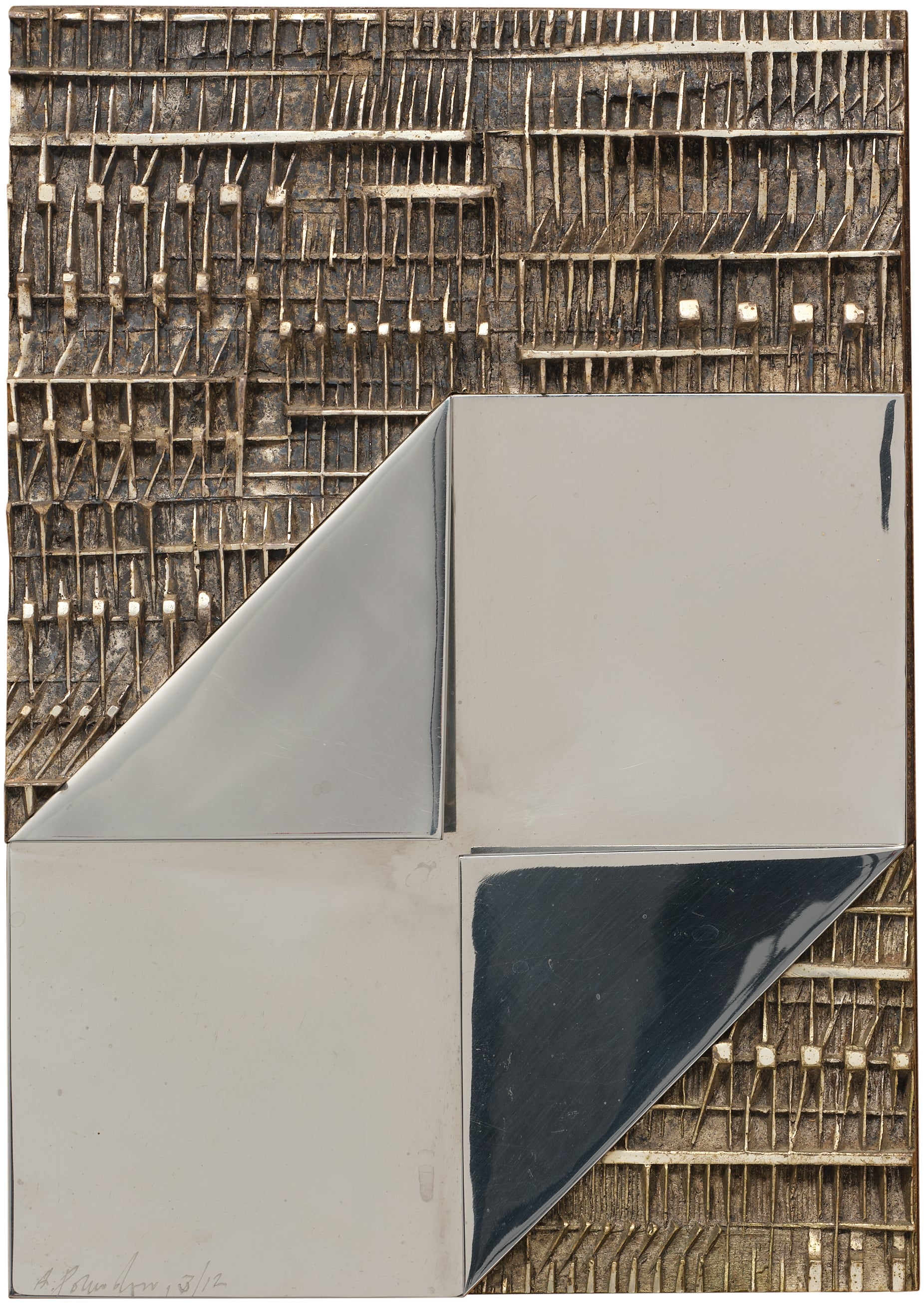
Bozzetto per Tavola quarta, 1974
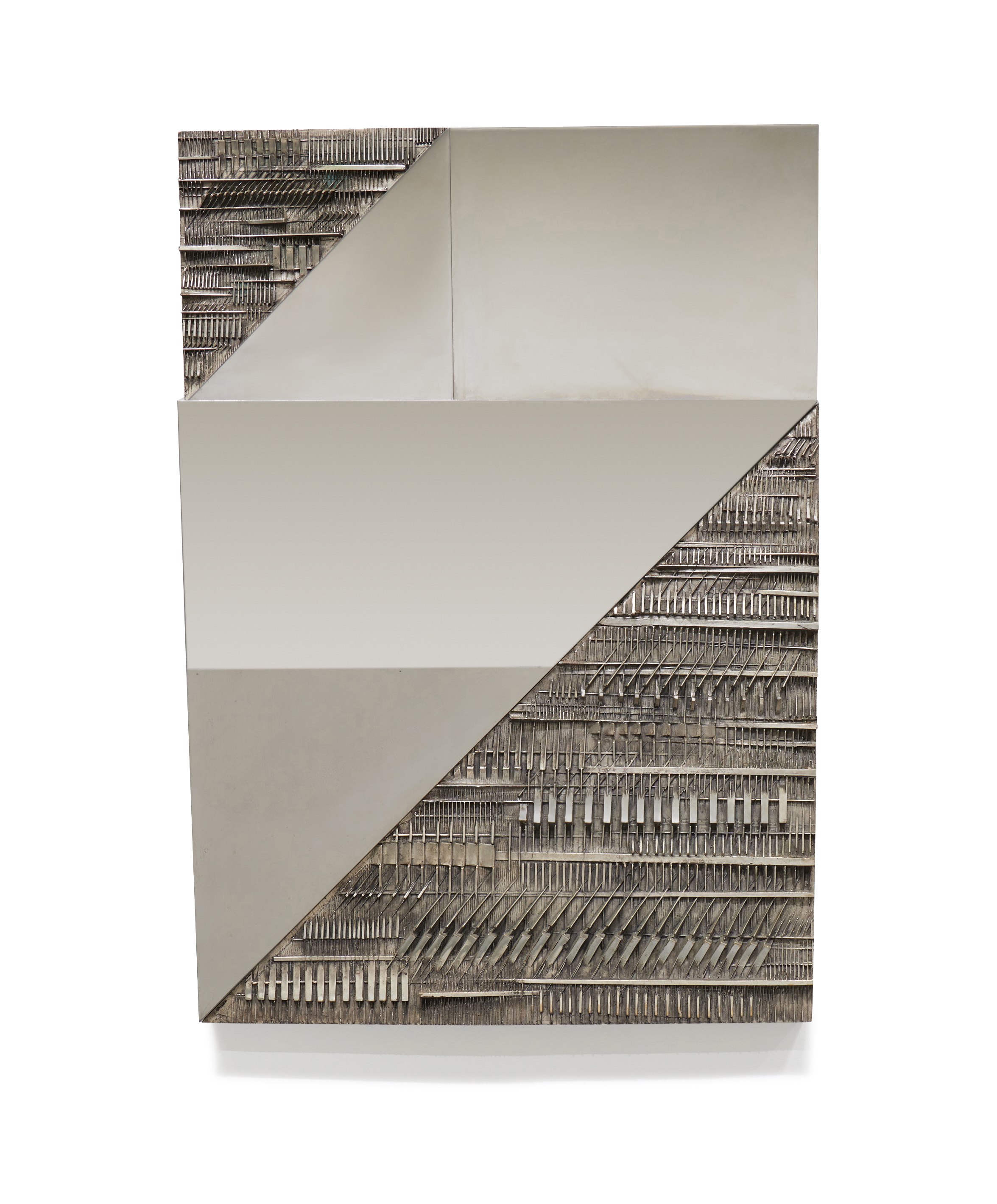
Beyond the spheres and discs, Pomodoro's output reveals an artist of remarkable range. The Immagine trasversale from 1974, worked in steel and bronze with silver patina and mounted on a wood panel, shows his ability to move between sculpture and relief, between object and image. The stele works, including the Stele per Assider, draw on ancient commemorative forms while filling them with the same fragmented internal language. His boxes and multiples, such as the gilded bronze and silver Scatola and the elegant Fermacarte paperweight editions, invite collecting at a more intimate scale and demonstrate that the quality of thought and making Pomodoro brings to his monumental commissions loses nothing in translation to smaller forms.
These objects carry real intellectual weight and have long been treasured by collectors who want something of Pomodoro's world on a desk or shelf as well as in a garden or atrium. For collectors, Pomodoro represents a rare convergence of art historical importance, institutional presence, and genuine beauty. His works appear regularly at the major international auction houses, and his bronzes at all scales have performed consistently well in the secondary market, reflecting sustained global demand from both private collectors and institutions. When approaching the market for his work, condition of the patina is a primary consideration, as Pomodoro's surfaces are the site of meaning as much as form.
Arnaldo Pomodoro
Immagine trasversale, 1974
Works from the 1960s and 1970s carry particular art historical significance, representing the period of his most concentrated innovation, though the quality and ambition of his practice remained high across subsequent decades. The multiples and editions offer a compelling entry point for collectors building a relationship with his work, while the unique bronzes and large reliefs represent serious and rewarding long term acquisitions. Pomodoro's place within the broader landscape of postwar and contemporary sculpture is both distinctive and well secured. He shares with artists such as Eduardo Chillida and Isamu Noguchi a belief in the monumental bronze as a form of public philosophy, a way of placing thought in the world at a scale that invites collective encounter.
Like Fontana, he understood the cut and the rupture as generative rather than destructive. Like Brancusi, he trusted the autonomy of pure geometrical form to carry meaning without narrative assistance. Yet the particular texture of Pomodoro's vision, his fascination with internal complexity, with the gap between appearance and reality, between surface and system, belongs entirely to him and speaks with particular urgency to a contemporary world still grappling with the same tensions he began exploring more than six decades ago. At an age when many artists might rest on legacy, Pomodoro has continued to work, to exhibit, and to engage with the questions his practice has always pursued.
The Fondazione Arnaldo Pomodoro in Milan, dedicated to his work and to the promotion of sculpture more broadly, stands as both archive and living institution, ensuring that his contribution remains active in cultural conversation rather than merely preserved. For anyone who has stood before one of his great spheres and felt that quiet vertigo of looking into a world within a world, the experience is not easily forgotten. It is the mark of an artist who found a form equal to his ideas and gave it to the world with extraordinary generosity.
Explore books about Arnaldo Pomodoro
Arnaldo Pomodoro
Giulio Carlo Argan
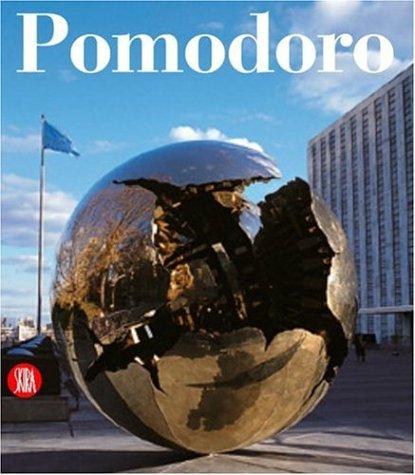
Arnaldo Pomodoro: Katalog der Werke
Francesca Marquet
Arnaldo Pomodoro: Sculptor
Henry Moore
The Sphere of Arnaldo Pomodoro
Pierre Restany
Arnaldo Pomodoro: Bronzes and Sculptures
Flaminio Gualdoni
Pomodoro: Labyrinths and Spaces
Carolyn Christov-Bakargiev