Armand Guillaumin
Guillaumin: The Colorist Who Burned Brightest
Artist Spotlight · The Collection Editorial
There is a particular quality of light in the Creuse valley of central France, a raw, almost electric luminosity that seems to vibrate off the ancient granite gorges and wind bent oak trees. Armand Guillaumin understood this light better than almost any painter of his generation. When the Musée des Impressionnismes Giverny devoted renewed scholarly attention to the artists surrounding the Impressionist core circle, Guillaumin emerged again as a figure whose contribution had been historically undervalued, a painter whose chromatic boldness was not a side note to the movement but one of its most prophetic voices. His canvases, scattered across private collections and now increasingly sought on the secondary market, feel startlingly alive, as though the paint has not entirely dried.
Armand Guillaumin
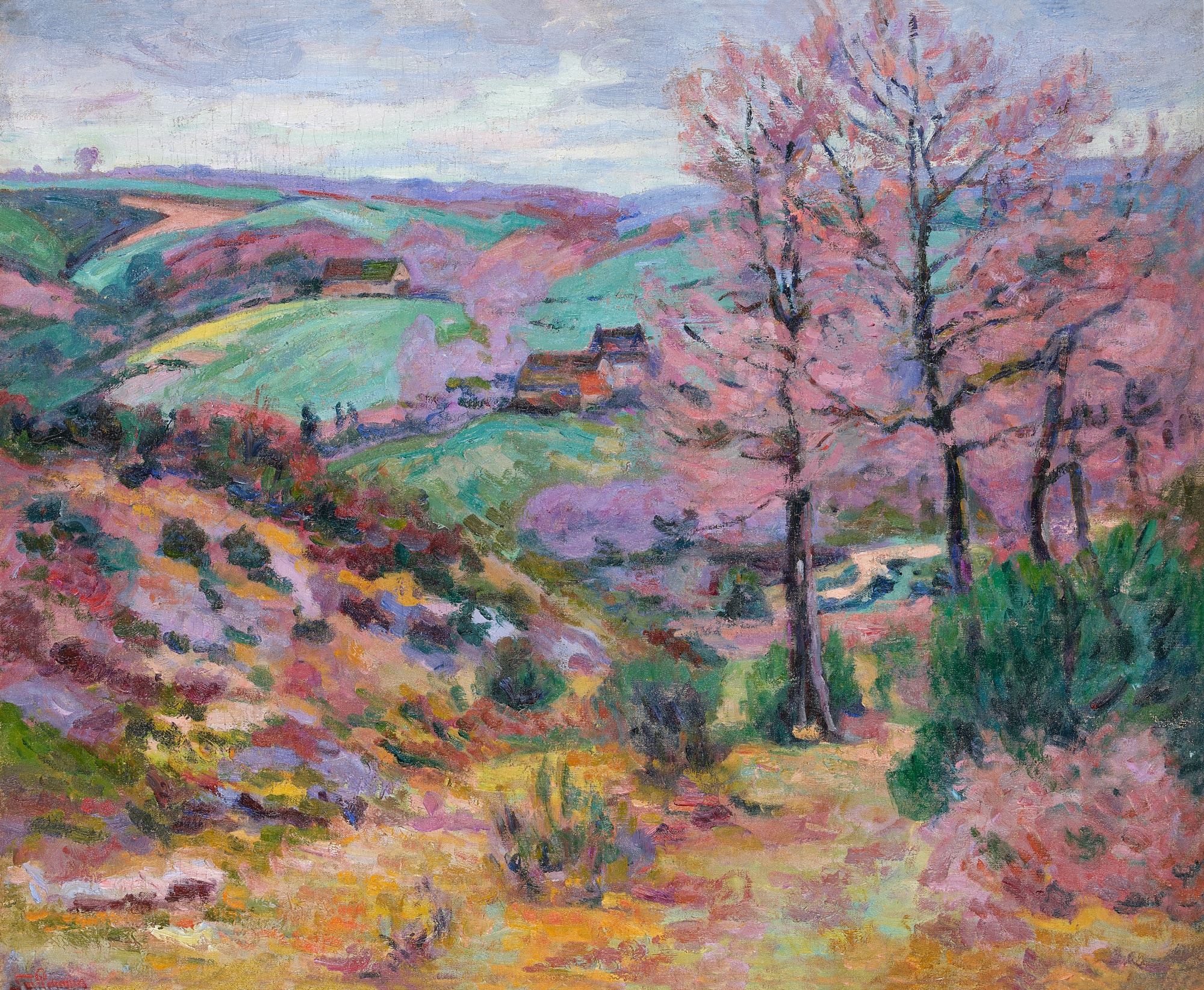
Les Bréjots
Jean Baptiste Armand Guillaumin was born in Paris in 1841, into modest working class circumstances that would define the material conditions of his artistic life for decades. Unlike many of his Impressionist peers, he had no wealthy family to subsidize his ambitions. He studied briefly at the École Municipale de Dessin and later attended the Académie Suisse, the famously unstructured studio on the Île de la Cité where artists paid a small fee to draw from live models without formal instruction. It was here, in the early 1860s, that he encountered Paul Cézanne and Camille Pissarro, friendships that would prove foundational.
The Académie Suisse was less a school than a crucible, and Guillaumin was forged in it alongside two of the most consequential painters in Western art history. To support himself while painting, Guillaumin worked for years as an employee of the Paris municipal transit authority, laboring at night on the city's road network so that his days could remain, at least partially, devoted to art. This grueling arrangement lasted into his forties. Pissarro, who admired him deeply, corresponded with collectors and dealers on Guillaumin's behalf, and the two men shared not only aesthetic affinities but a sincere mutual respect.
Armand Guillaumin
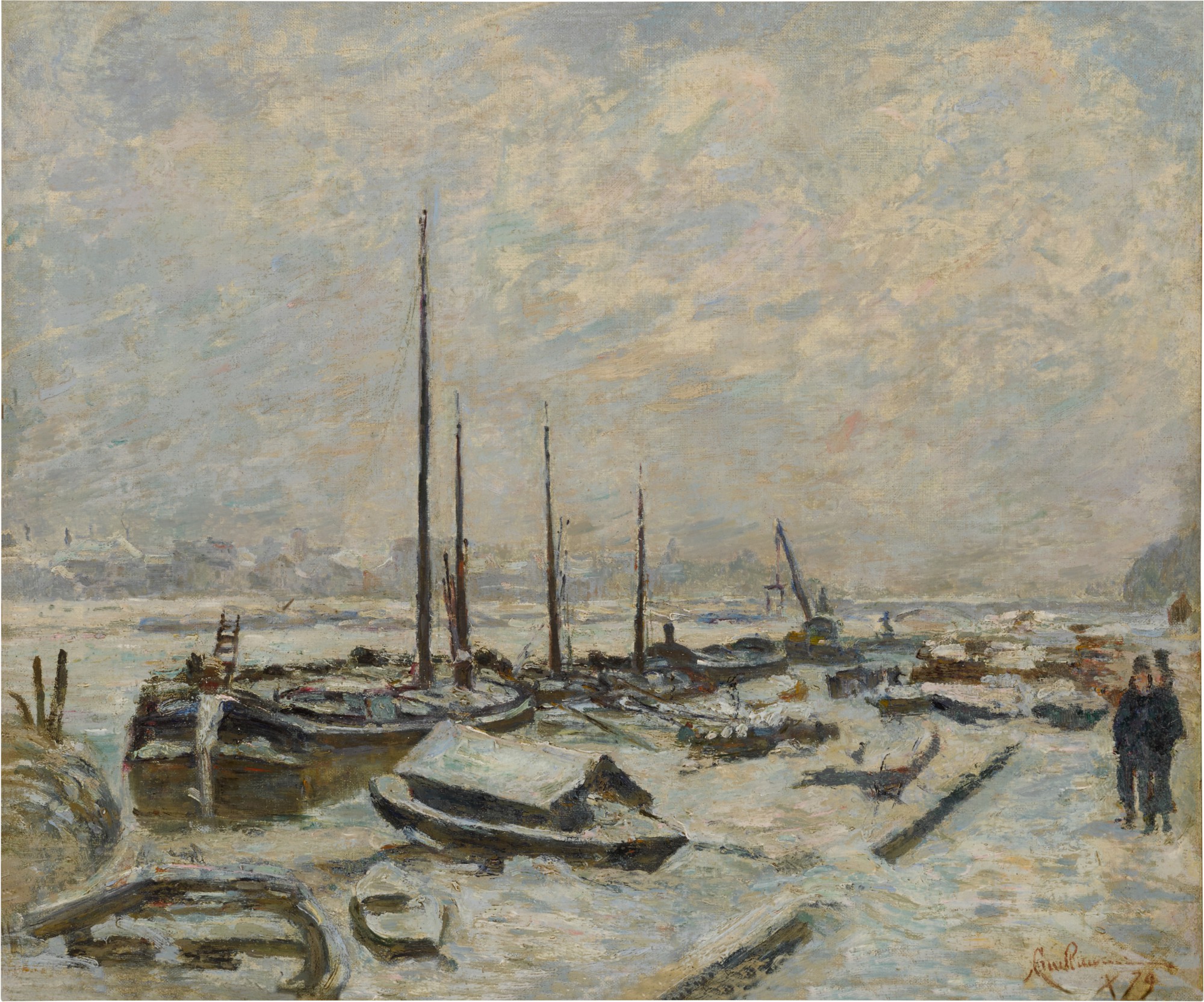
Berges de la seine à Paris, hiver
Guillaumin participated in six of the eight historic Impressionist exhibitions held between 1874 and 1886, making him one of the most consistent presences in that defining chapter of modern art. He was there at the beginning, in the first exhibition of 1874 held in the studio of photographer Nadar, when the movement received both its name and its earliest critical ridicule. Guillaumin's artistic development traced a course from the industrial outskirts of Paris, where he painted the Seine quays and the smoking factories of Ivry and Charenton with an unflinching directness, toward the wilder landscapes of the Creuse department in the Auvergne region. His early Paris suburban scenes, such as the luminous "Berges de la Seine à Paris, hiver," revealed a painter unafraid of ugly or unglamorous subject matter, finding poetry in the working river and the gray winter light of the city's margins.
These paintings share a compositional confidence and a tonal richness that set him apart from more tentative contemporaries. Then came the Creuse, and everything intensified. Following the path that Monet had also briefly explored, Guillaumin returned to the Creuse valley repeatedly across the 1890s and into the twentieth century, and there his color became something close to incandescent. The works produced in and around Crozant, the village perched above the confluence of the Creuse and Sédelle rivers, represent the fullest expression of his mature vision.
Armand Guillaumin
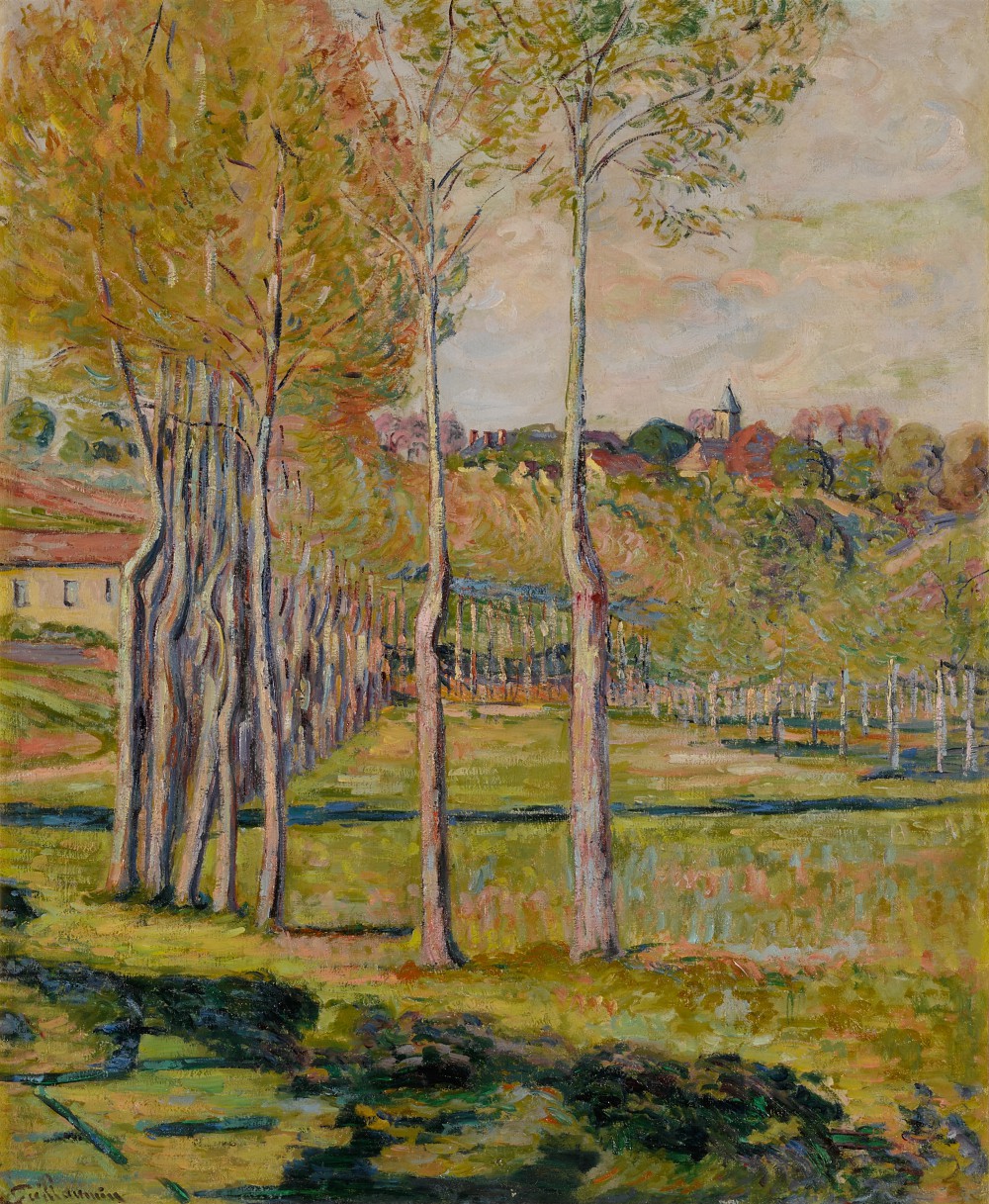
Printemps à Epinay-sur-Orge
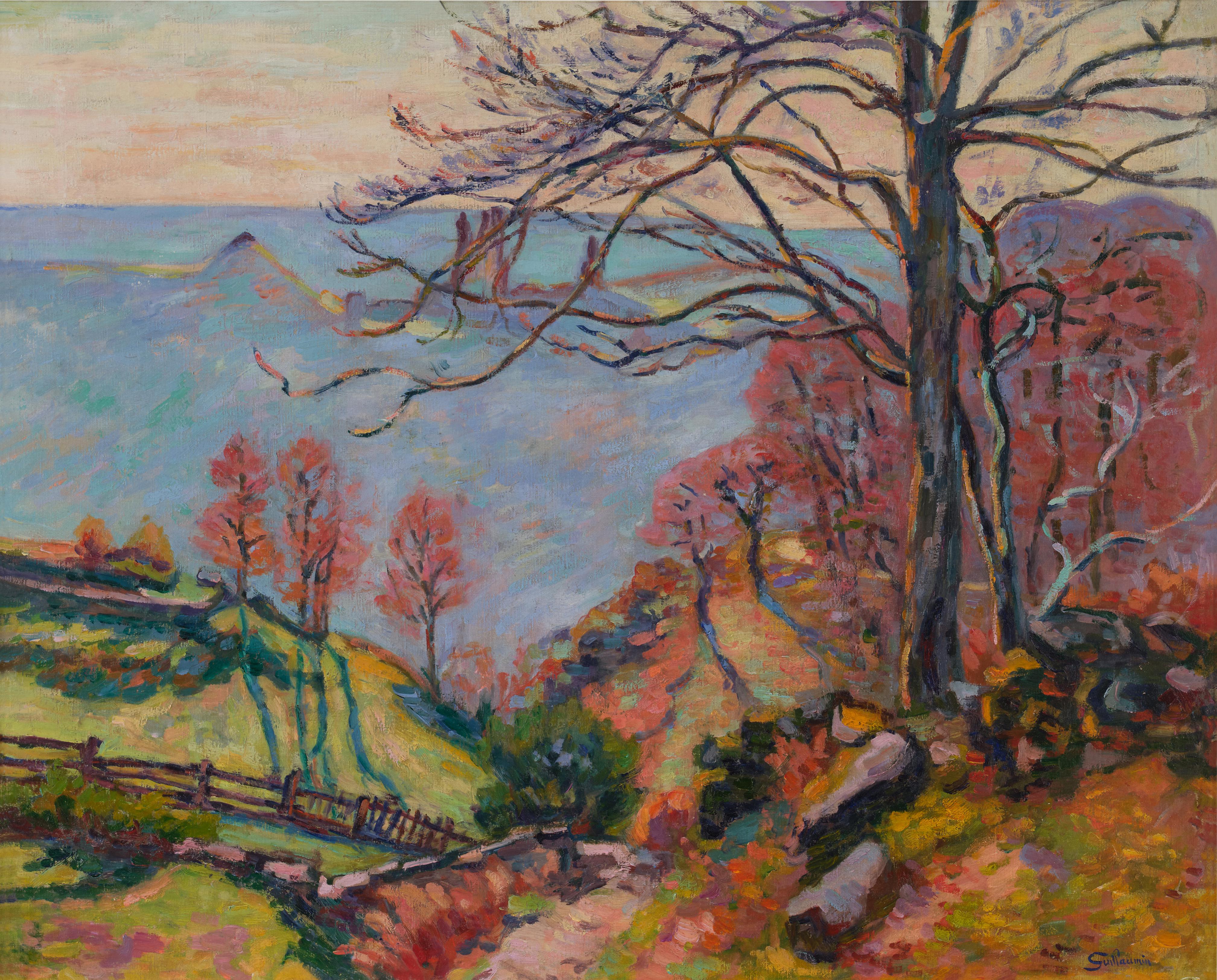
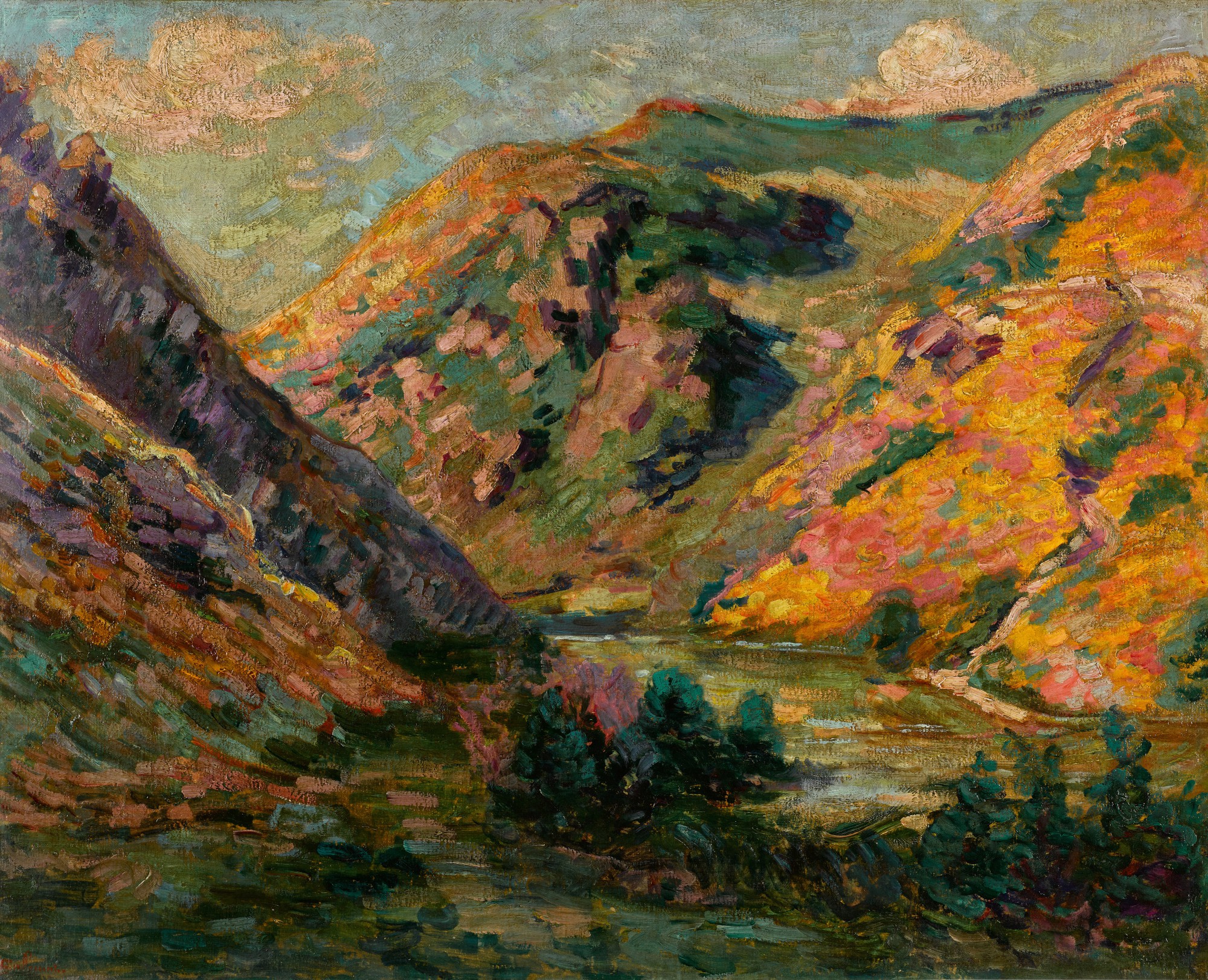
Canvases such as "Crozant, la folie, le soir" from 1910 and "La Côte, face au Pont Charraud" from 1916 demonstrate a chromatic intensity that feels genuinely prescient. The purples, oranges, and acid greens that Guillaumin laid across rocky hillsides and river reflections anticipate the Fauve palette of Matisse and Derain by several years, and yet they are arrived at through careful observation rather than theoretical program. "Chaumière en Creuse" from 1910 shows the same quality, a thatched cottage rendered in colours that seem to pulse with interior energy. His pastels, including the tender and voluptuous "Nature morte aux fruits" from 1900, reveal a softer register, a reminder that behind the blazing landscapes was a painter of genuine sensitivity and craft.
Guillaumin's financial circumstances transformed dramatically and unexpectedly in 1891, when he won 100,000 francs in the national lottery. The windfall was not merely material relief after decades of economic precarity. It was a liberation. He resigned his municipal job and devoted himself entirely to painting, traveling to the Mediterranean coast, to Holland as evidenced by the 1909 color etching "View from Saardam," and continuing his annual pilgrimages to the Creuse.
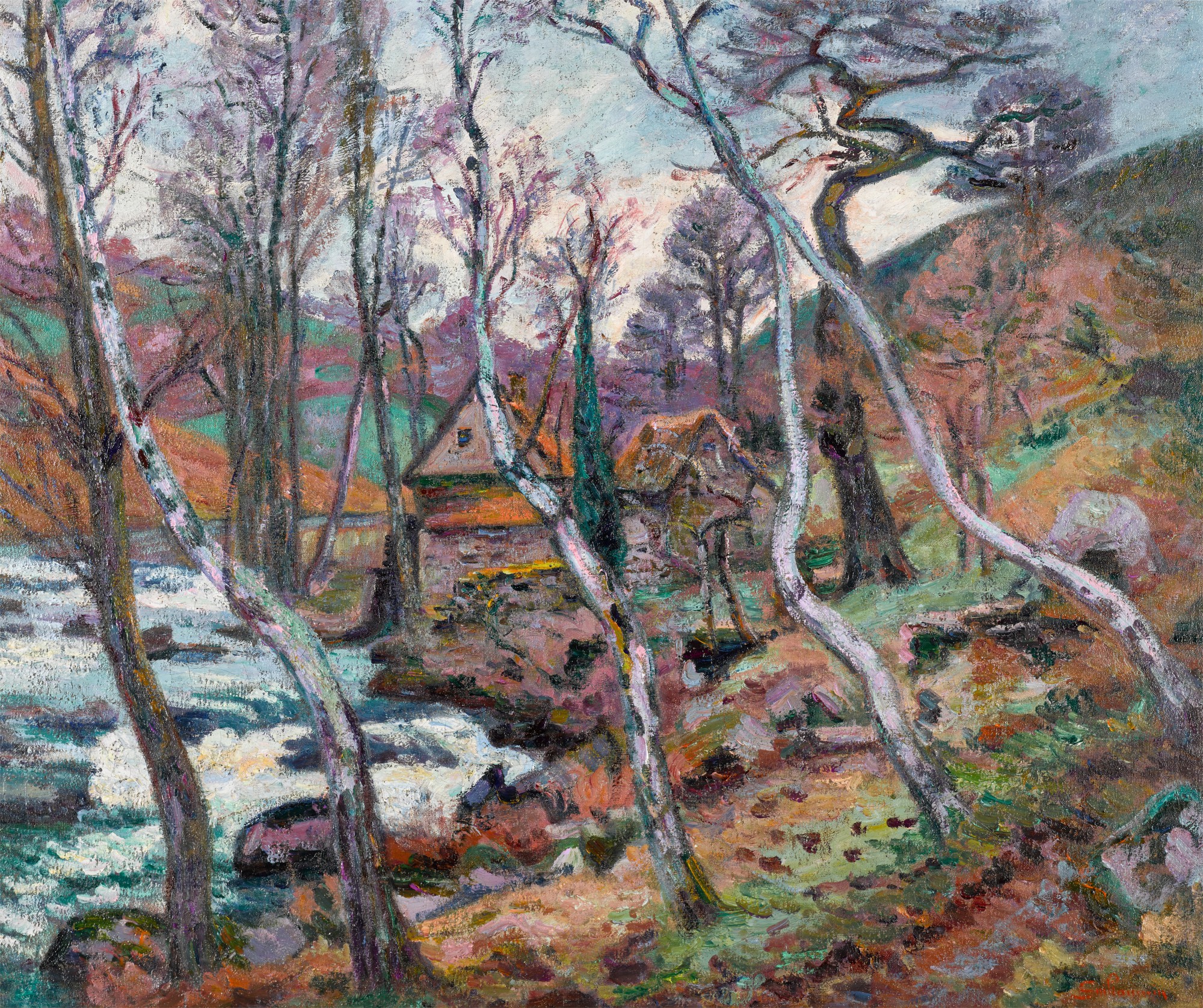
Armand Guillaumin
Le Moulin Bouchardon, Creuse
The lottery win became a minor legend in Impressionist circles, a story that seemed almost too perfectly literary, the struggling colorist finally freed by fortune. He painted prolifically for another three and a half decades, living until 1927, long enough to see his early colleagues canonized and the movement they had built together become the dominant aesthetic inheritance of the modern world. For collectors, Guillaumin presents a compelling case. His works occupy a position that serious advisors have long recognized as undervalued relative to his historical significance and the quality of the best canvases.
Major Impressionist names command prices that place them beyond the reach of most private buyers, but Guillaumin, despite his central role in the movement and his documented friendships with Cézanne and Pissarro, can still be acquired at prices that reflect genuine collecting opportunity. The Creuse landscapes of the 1890s through 1910s are widely considered his strongest and most desirable work. Buyers should seek canvases with strong provenance and clear exhibition history, and pay particular attention to the handling of color relationships, his richest works show a layering and vibration of tone that photograph poorly and reward sustained looking in person. Within the broader arc of art history, Guillaumin sits at a productive intersection.
He bridges the Impressionist generation and the Fauvist explosion, without having been academically claimed by either camp. He is a painter's painter in the truest sense, admired by those who understand the difficulty of achieving with paint what he achieved, the recreation of light not as description but as sensation. His friendship and artistic dialogue with Cézanne is particularly significant. The two men painted together on multiple occasions, and the mutual influence, though difficult to trace with precision, runs deep in both directions.
To collect Guillaumin is to own a piece of that extraordinary moment when a small group of friends reinvented the possibilities of painting, and to live with color that still, more than a century later, refuses to be still.
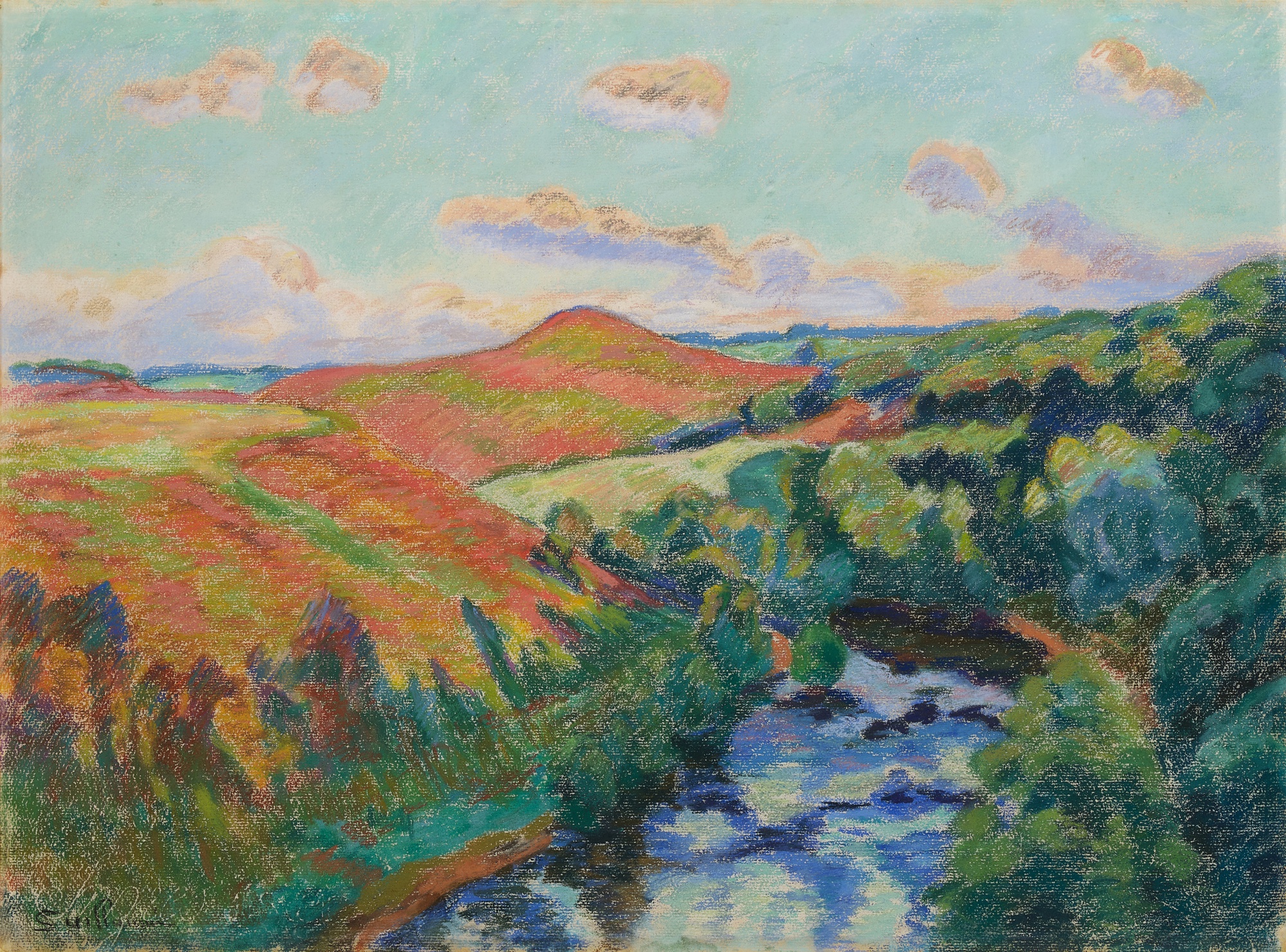
Featured Works
Explore books about Armand Guillaumin
Armand Guillaumin: Sa vie, son oeuvre
Gustave Geffroy
Armand Guillaumin
Jean Boggs
Guillaumin: Catalogue Raisonné de l'Oeuvre Peint
Gérard Serret and Dominique Fabiani
Armand Guillaumin 1841-1927
Gérard Serret
Armand Guillaumin: A Retrospective
Richard R. Brettell