Arman: Accumulation, Abundance, and Enduring Wonder
Artist Spotlight · The Collection Editorial
“I wanted to show the accumulation of objects as a portrait of our civilization.”
Arman, interview with Pierre Restany
In the spring of 2024, Christie's Paris offered a luminous plexiglas vitrine filled with nail polish bottles, their jeweled colors refracting light across the saleroom walls. The work stopped bidders in their tracks, not simply because of its beauty but because of the unmistakable intelligence behind it. That piece, characteristic of Arman's long engagement with the poetry of mass production and repetition, reminded a new generation of collectors why this French born American artist remains one of the most vital and collectible figures to emerge from the postwar avant garde. Decades after his most celebrated works were made, Arman continues to command serious attention in auction rooms from New York to Geneva, and his presence in major institutional collections from the Centre Pompidou to the Museum of Modern Art in New York confirms a reputation that only deepens with time.
Arman
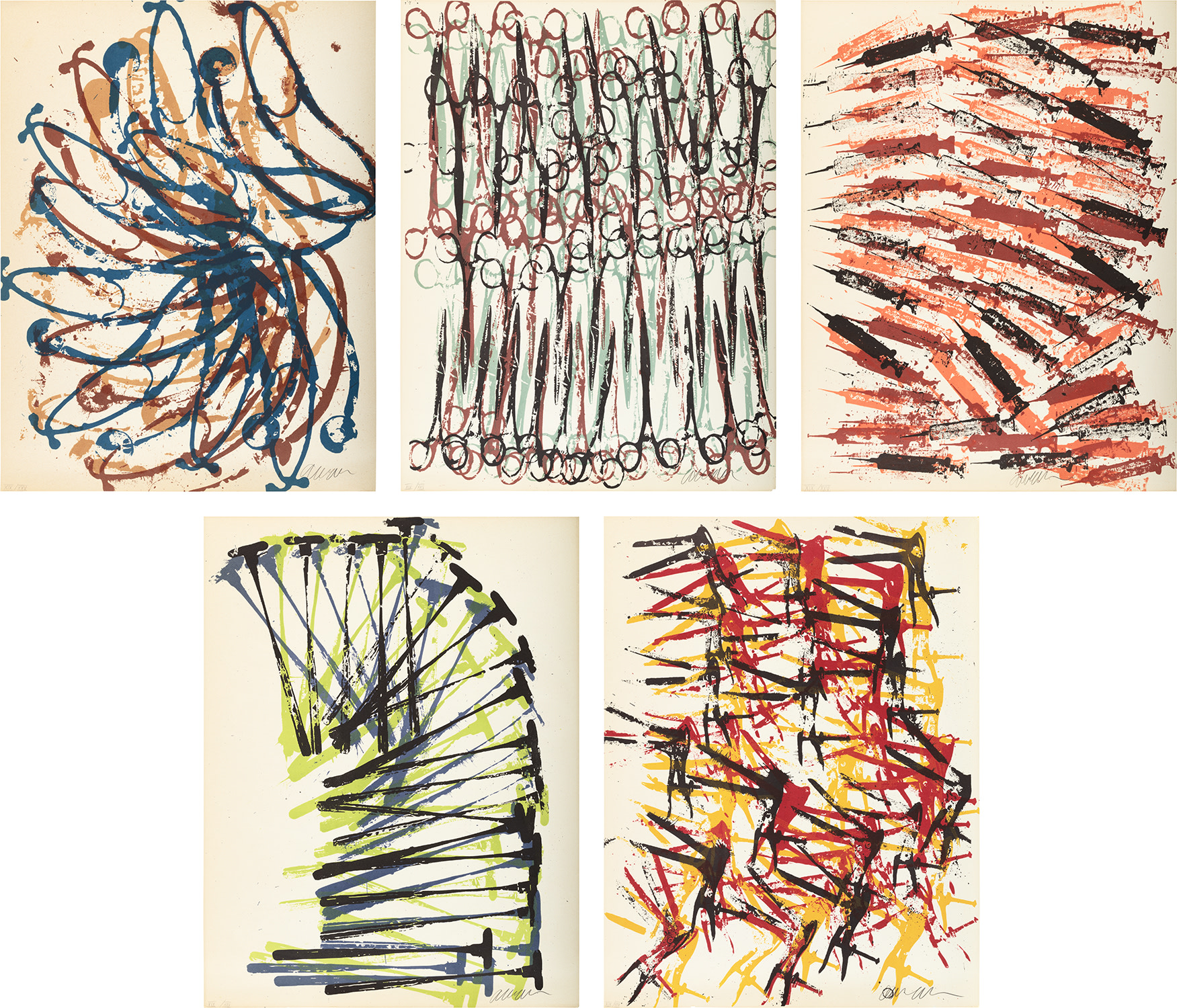
Doctor's Special (O. & M. 247)
Armand Pierre Fernandez was born in Nice, France, in 1928, into a family steeped in creativity. His father, an antique dealer and amateur musician, filled the family home with objects, instruments, and the particular atmosphere of things accumulated with care and intention. It was an upbringing that planted the seeds of what would become one of the most distinctive artistic methodologies of the twentieth century. Young Armand studied at the École Nationale des Arts Décoratifs in Nice and later at the École du Louvre in Paris, where he encountered the history of objects and their cultural meaning with a seriousness that would inform everything he later made.
His friendship with Yves Klein, formed during these formative years, proved electric, and the two young artists pushed each other toward increasingly radical positions about what art could be and what it could contain. By the late 1950s, Arman had arrived at the gestures that would define his legacy. In 1958, the same year he created works like the ink and rubber stamp compositions now recognized as early masterpieces, he began experimenting with what he called Accumulations, dense arrangements of identical or related objects sealed within transparent containers or adhered to surfaces. The logic was both simple and profound: by multiplying a single object to the point of saturation, Arman transformed it from a functional item into a sculptural field, something that oscillated between abundance and anxiety, beauty and excess.
Arman
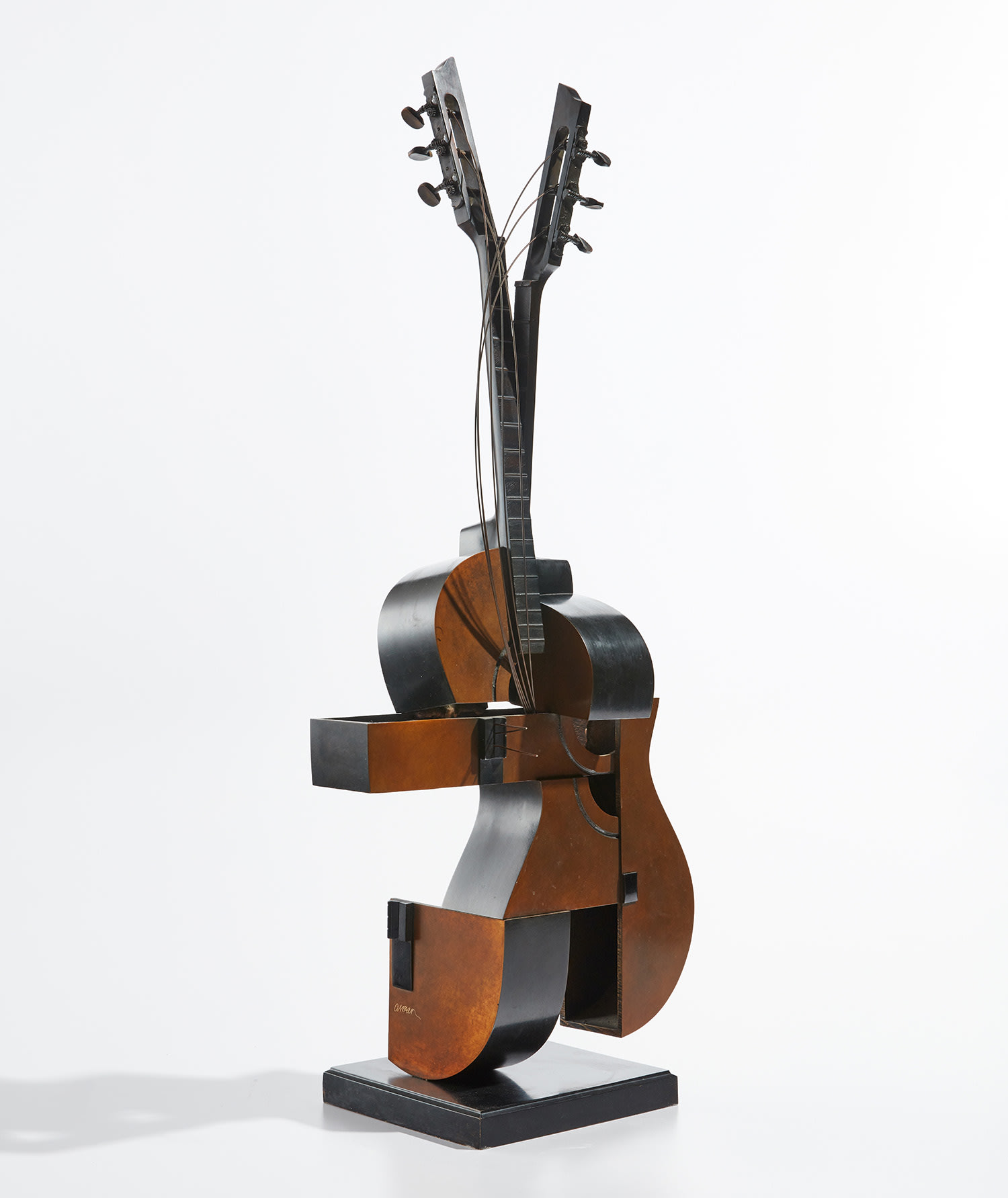
Abacale Guitar
These were not found object assemblages in the tradition of Dada, though that lineage was certainly present. Arman was doing something more systematic, more philosophical, more attuned to the rhythms of consumer society. His formal association with the Nouveau Réalisme movement, founded by the critic Pierre Restany in 1960, gave Arman a theoretical framework and a community of fellow travelers that included Klein, Jean Tinguely, Niki de Saint Phalle, and Raymond Hains. Restany's manifesto celebrated the appropriation of the real, the direct incorporation of everyday life into artistic practice, and Arman embodied this principle with exceptional rigor and range.
“The object is never innocent. It carries within it the whole history of the people who made it and used it.”
Arman
His Poubelles, accumulations of refuse sealed in glass cases, made their debut to considerable controversy, yet they also signaled the artist's refusal to distinguish between high and low, beautiful and discarded. In 1960, Galerie Iris Clert in Paris hosted a landmark exhibition in which Arman filled the entire gallery space with garbage, a gesture that remains one of the defining provocations of the postwar era and one that anticipated installation art by decades. The evolution of Arman's practice over the following decades reveals an artist of remarkable restlessness and ambition. His Combustions, works incorporating charred and burned objects, explored destruction as a creative act.
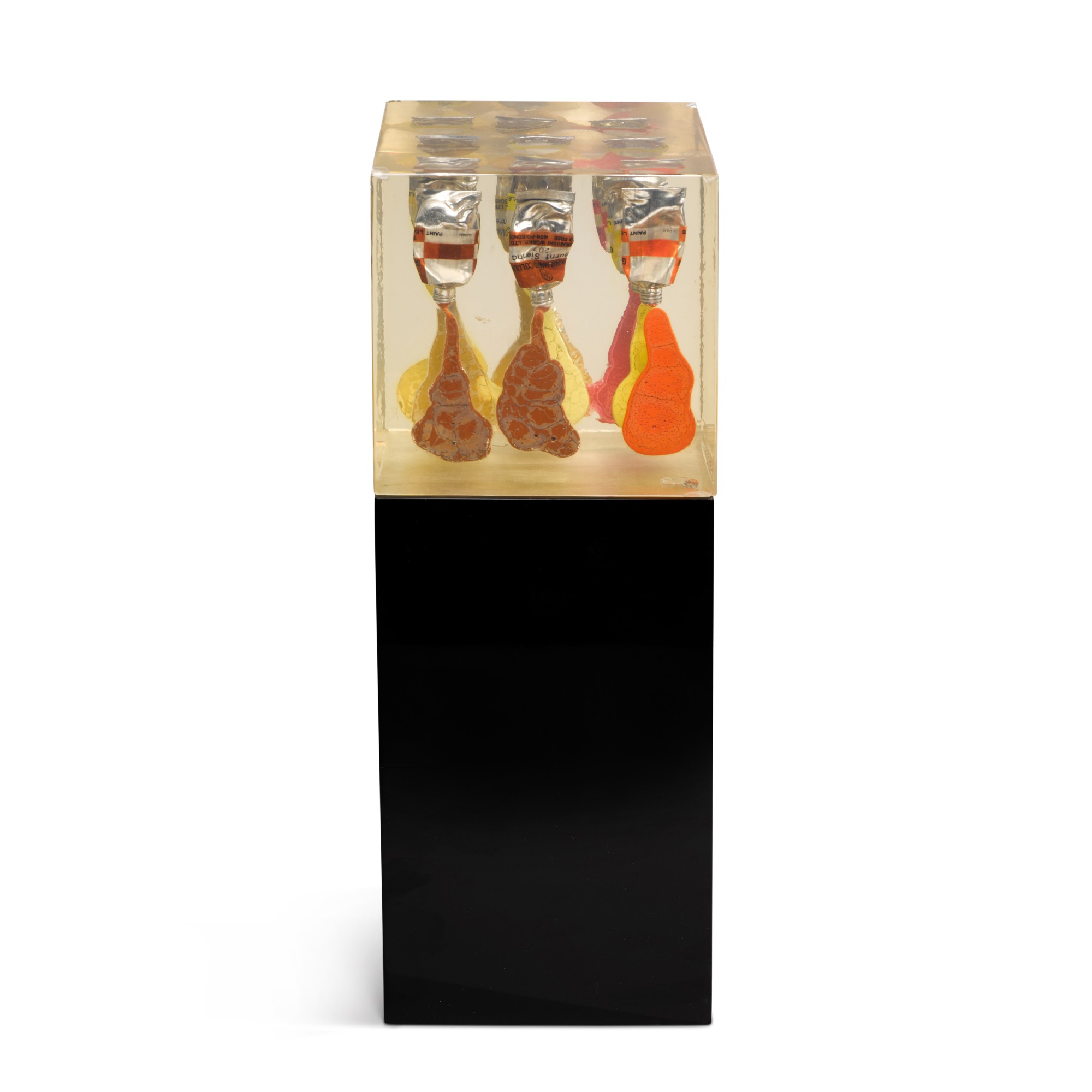
Arman
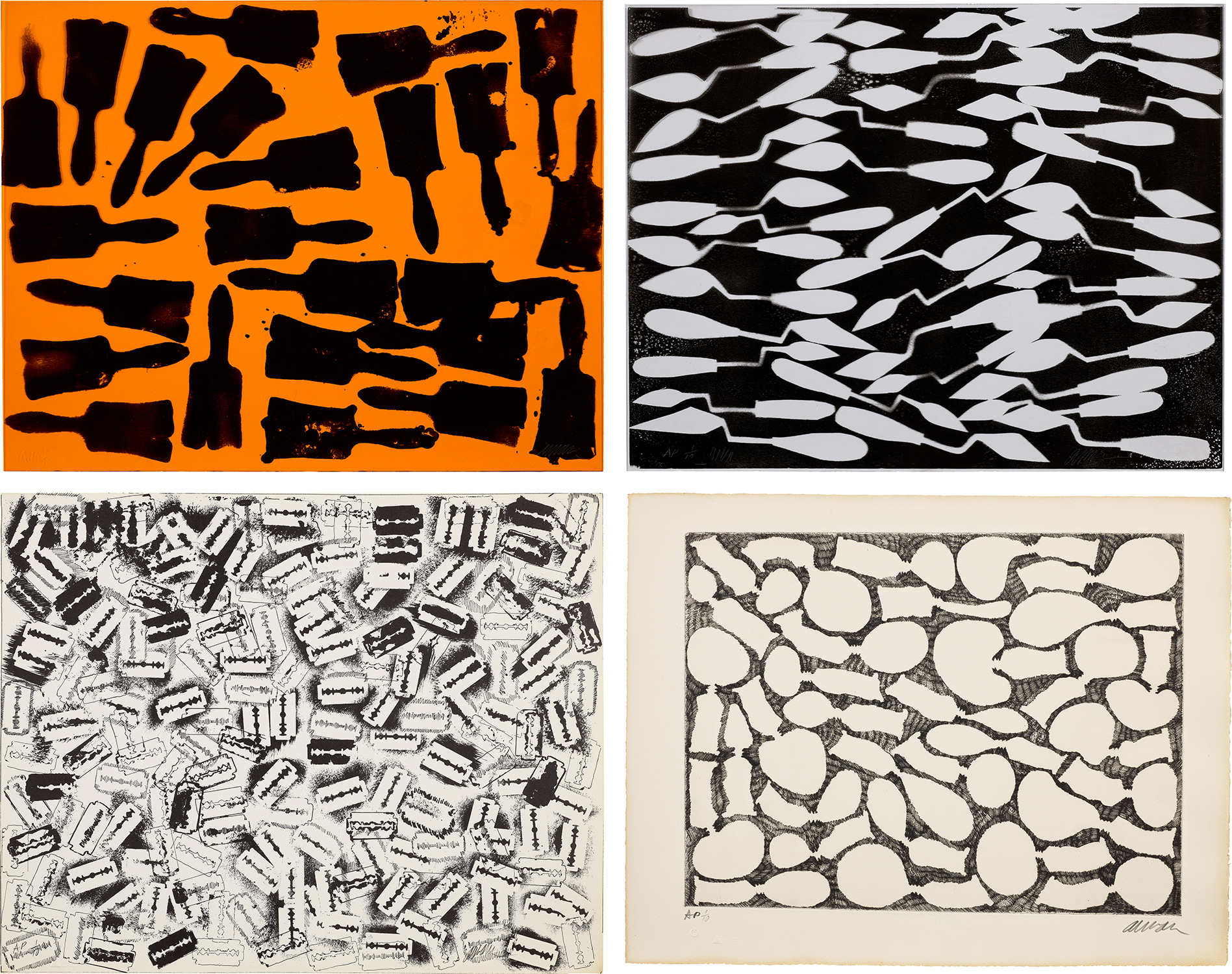
Untitled (Paint Tubes)
His Coupes, or cuts, sliced familiar objects such as violins, cellos, and chairs into sections and reassembled them in slightly displaced arrangements, producing a kind of visual stutter that was at once witty and melancholy. The musical instrument works deserve particular attention: Arman, himself an accomplished musician and collector of instruments, brought a genuine intimacy to these pieces that elevates them far beyond conceptual exercise. Works such as Saxophones from 1983 demonstrate how his formal intelligence could transform even a familiar subject into something genuinely revelatory. His Bronzes, cast accumulations of tools, brushes, or instruments frozen in permanent abundance, brought his practice into dialogue with classical sculpture while retaining every volt of conceptual energy.
For collectors, the range and accessibility of Arman's output is one of its great attractions. His multiples, including editions published by Galerie Bonnier in Geneva and other distinguished European houses, allow entry into his world at approachable price points without sacrificing the full charge of his ideas. Works like Doctor's Special, a numbered edition bearing his characteristic wit and formal confidence, offer the pleasures of ownership alongside genuine art historical significance. At the higher end of the market, unique Accumulations and large scale bronzes have achieved substantial results at the major auction houses, with works regularly appearing at Sotheby's, Christie's, and Artcurial.
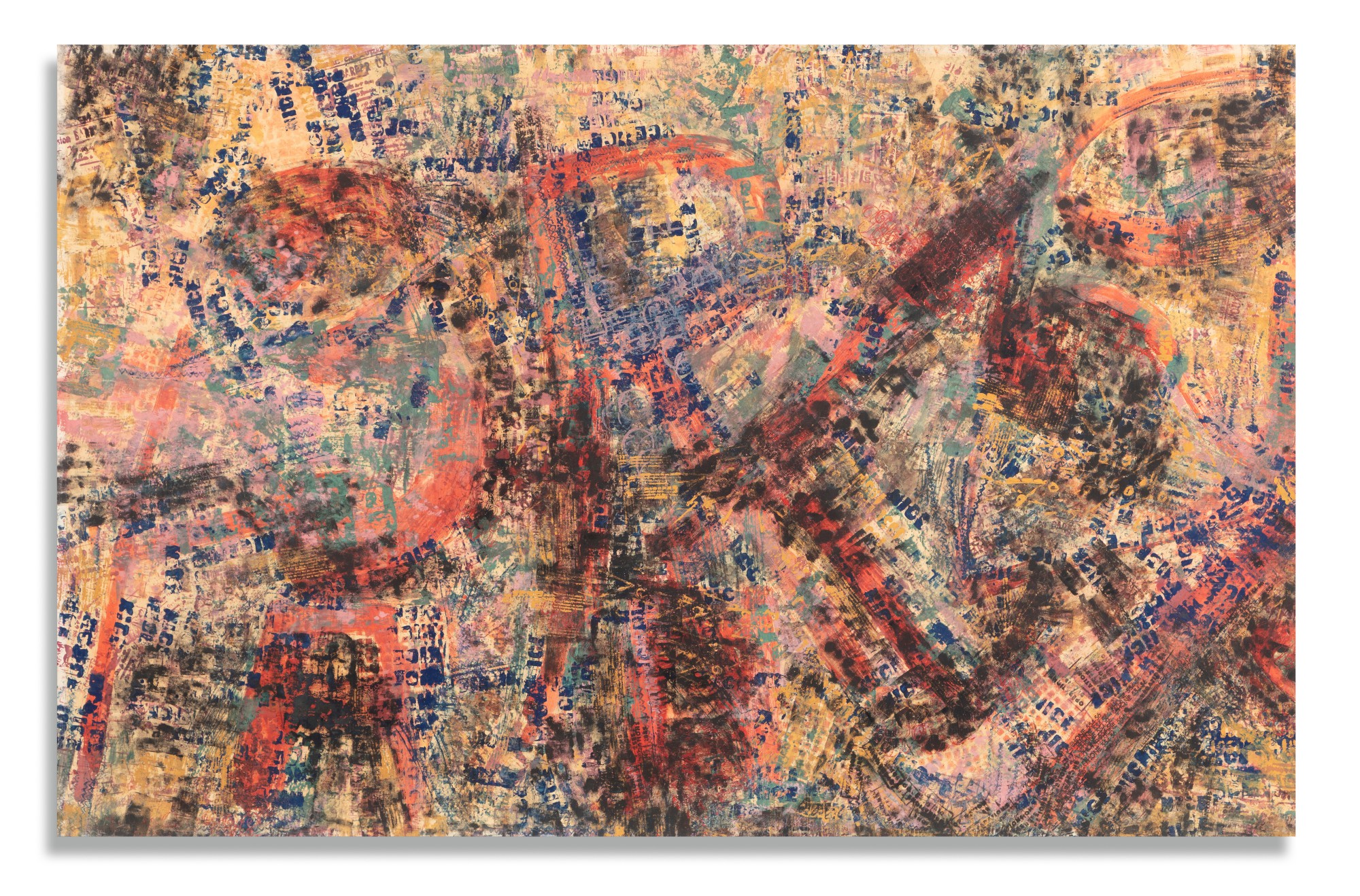
Arman
Cachet, 1958
Collectors who focus on the transitional works of the late 1950s and early 1960s, the period when Arman was crystallizing his most original ideas, are acquiring pieces of genuine rarity and historical weight. The Untitled Paint Brushes Accumulation from 1990 and the plexiglas works incorporating nail polish bottles represent the full maturity of a practice that never stopped evolving. To understand Arman fully, it helps to place him in conversation with the broader constellation of artists working with objects, repetition, and consumer culture in the postwar decades. Andy Warhol's embrace of seriality and mass production runs parallel to Arman's Accumulations, though the two artists arrived at similar conclusions from very different cultural contexts.
Joseph Cornell's boxes and Daniel Spoerri's tableaux pièges share with Arman a fascination with the charged life of objects, while the work of Claes Oldenburg and the American Pop artists explored adjacent territory from the perspective of scale and spectacle. What distinguishes Arman is the combination of French intellectual rigor, genuine sculptural mastery, and a warmth toward the material world that keeps his work from ever feeling cold or merely theoretical. Arman became an American citizen in 1973, having relocated to New York in the late 1960s, and the city's energy, its abundance of material culture and its appetite for scale, fed his practice richly. He remained extraordinarily productive until his death in New York in 2005, leaving behind a body of work that spans painting, sculpture, printmaking, installation, and public commission.
His legacy today is that of an artist who understood, earlier and more deeply than almost anyone, that the objects surrounding us are not neutral, that they carry history, desire, memory, and meaning in equal measure, and that art is the most powerful instrument for revealing what those objects have to say. For collectors and institutions who live with his work, that understanding is renewed every time they enter a room where an Arman is present.
Explore books about Arman