Aristide Maillol
Maillol: The Master Who Redefined Human Form
Artist Spotlight · The Collection Editorial
“A work of art must have harmony. Harmony is everything.”
Aristide Maillol
When the Musée d'Orsay in Paris gathered a sweeping survey of Aristide Maillol's work in recent years, visitors encountered something that felt at once ancient and startlingly alive. The bronze figures stood in the galleries with a calm, self contained authority that stopped people mid stride. Here was an artist who had spent a lifetime in devoted conversation with the human body, and whose sculptures still communicate across the distance of a century with the directness of a held breath. That quality, serene and monumental and utterly without artifice, is precisely what has made Maillol one of the most enduring figures in the history of Western sculpture.
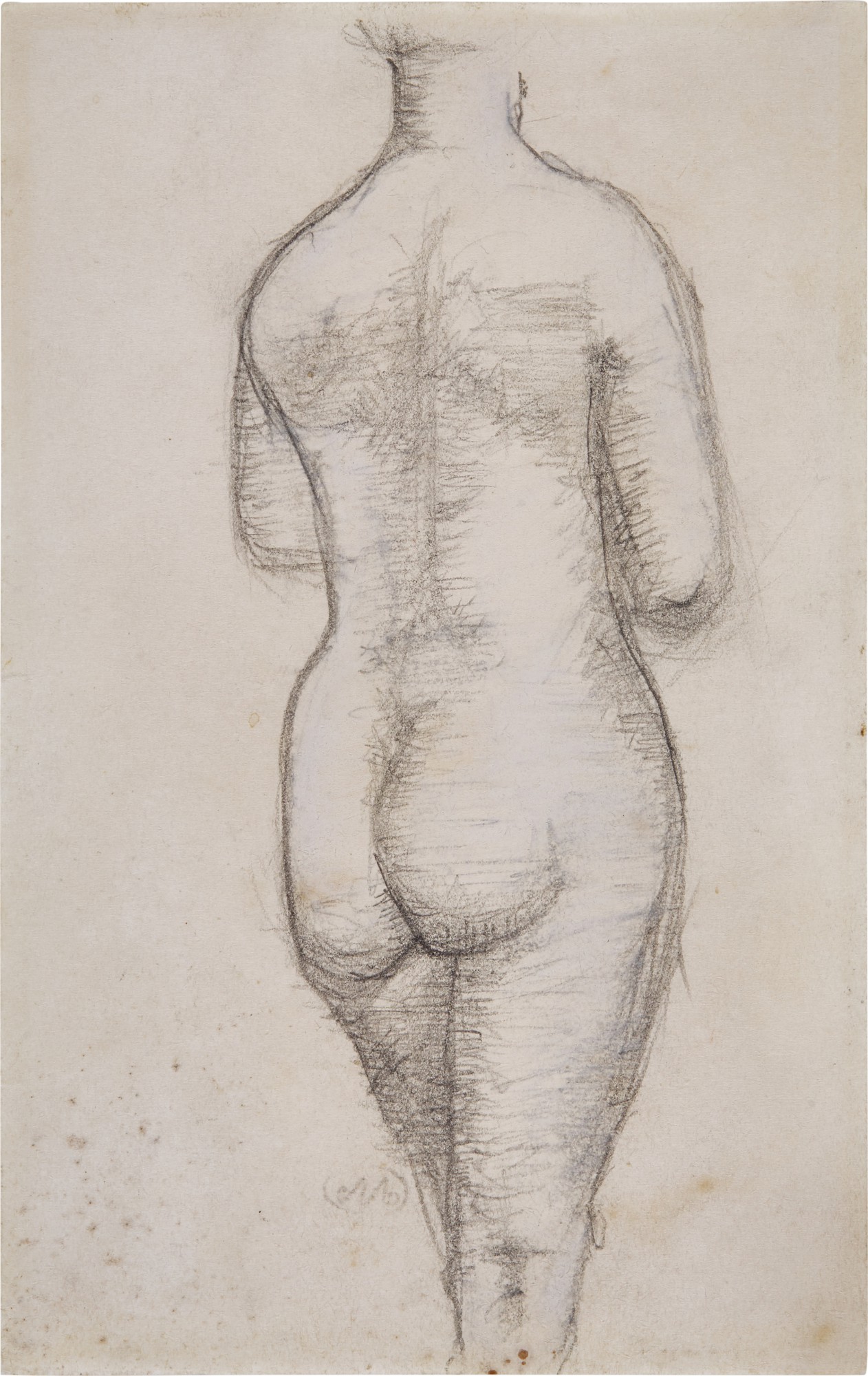
Aristide Maillol
Nude Study, 1881
Aristide Maillol was born in 1861 in Banyuls sur Mer, a small fishing village on the Catalan coast of southern France, close to the Spanish border. That Mediterranean origin mattered enormously. The landscape of Catalonia, its warm light, its ancient olive groves, its proximity to the classical world of Greece and Rome transmitted through centuries of southern European culture, saturated Maillol's sensibility from childhood. He came to Paris in 1881 to study at the École des Beaux Arts, where he found the academic curriculum useful but ultimately insufficient.
His early drawings, including the delicate and searching "Nude Study" of 1881 executed in red brown crayon and graphite, reveal a young artist already possessed of an unusually direct eye, someone interested in the body not as an occasion for drama but as a structure of quiet truth. In his twenties and thirties, Maillol moved through several artistic identities before arriving at the one that would make him famous. He was first drawn to painting and to the decorative arts, particularly tapestry, and his work in that medium brought him into contact with the Nabis, the circle of artists that included Paul Gauguin, Pierre Bonnard, and Édouard Vuillard. The influence of Gauguin in particular was significant, steering Maillol toward simplified forms and an aesthetic grounded in primal feeling rather than academic refinement.
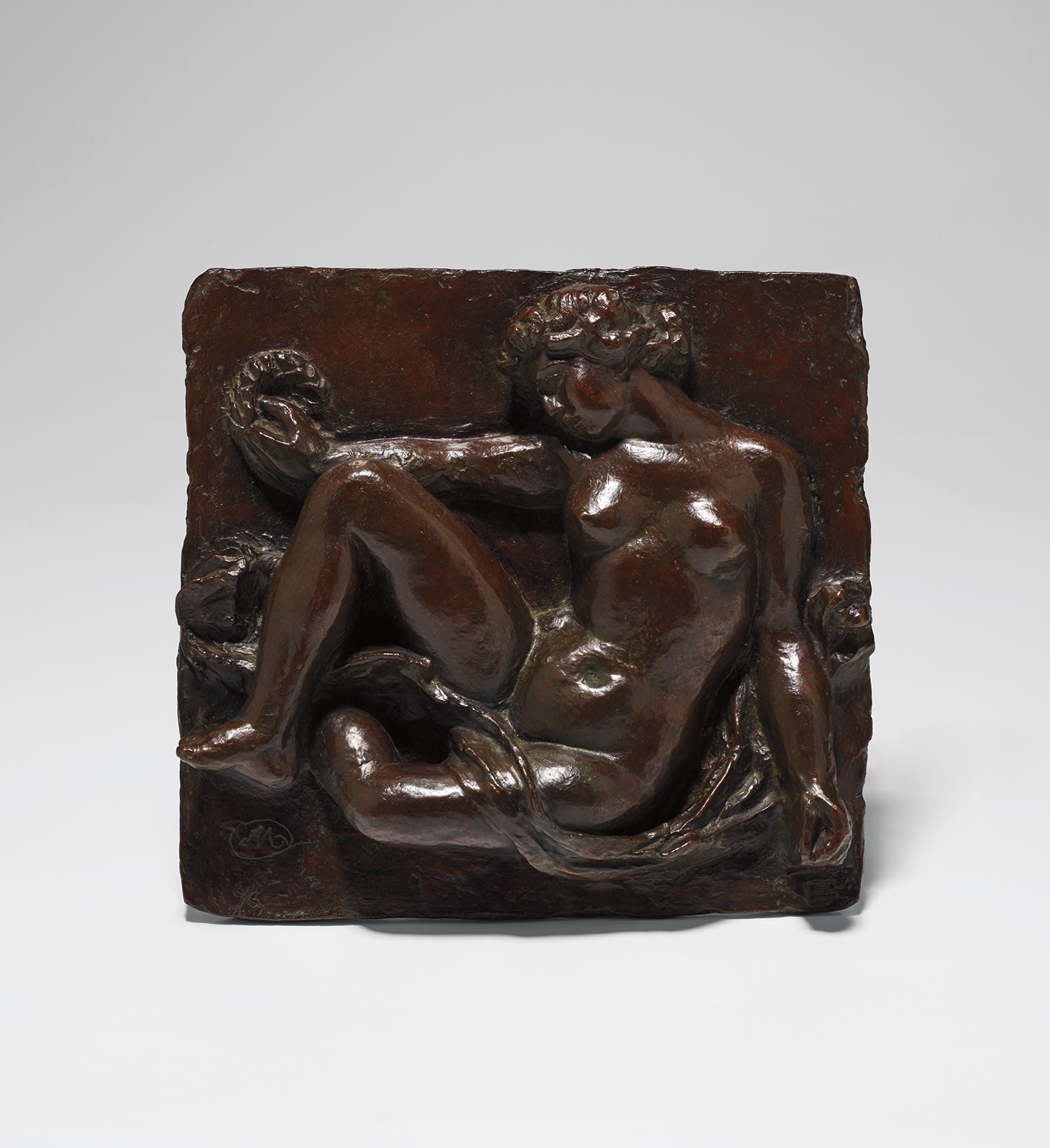
Aristide Maillol
Relief, La Victoire, 1921
His lithographs from the 1890s, among them "Two Bathers under a Tree at the Water's Edge" from 1895 and the graceful "Music" of 1893, show a printmaker alive to rhythm and silhouette, a sensibility already moving toward the monumental. It was not until around 1900, after persistent eye trouble forced him away from the detailed work of tapestry, that Maillol turned seriously to sculpture. He was nearly forty years old. The pivot would define everything that followed.
“I look for beauty in volume, not in line. The Greeks taught me that.”
Aristide Maillol
What Maillol brought to sculpture was a determined stripping away. Where Auguste Rodin, his great contemporary and the dominant force in French sculpture at the turn of the century, charged his surfaces with psychological tension and dramatic movement, Maillol sought stillness. His figures, almost always female, almost always nude, rest in themselves. They do not implore or anguish.
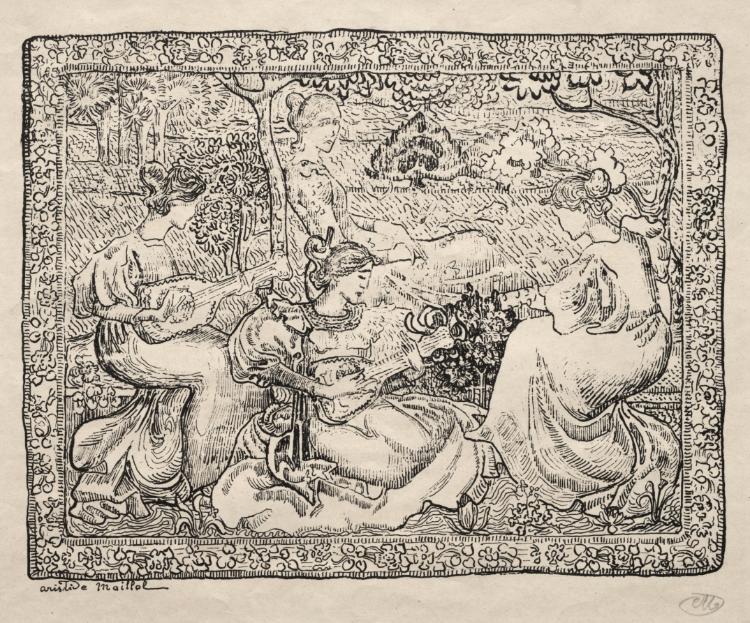
Aristide Maillol
Music, 1893
They exist with a kind of vegetable sufficiency, as rooted and untroubled as the Mediterranean landscape that shaped him. Rodin himself recognized Maillol's achievement immediately, and the two men shared a mutual respect that says something important about how genuinely different and how equally legitimate their visions were. Maillol's work drew also from his admiration of ancient Greek sculpture, particularly the archaic and classical periods, though he arrived at his simplified forms through feeling rather than strict archaeological study. His bronze "Le Couple" of 1897 marks an early statement of this direction, two figures held in relation to each other with a gravity that feels timeless.
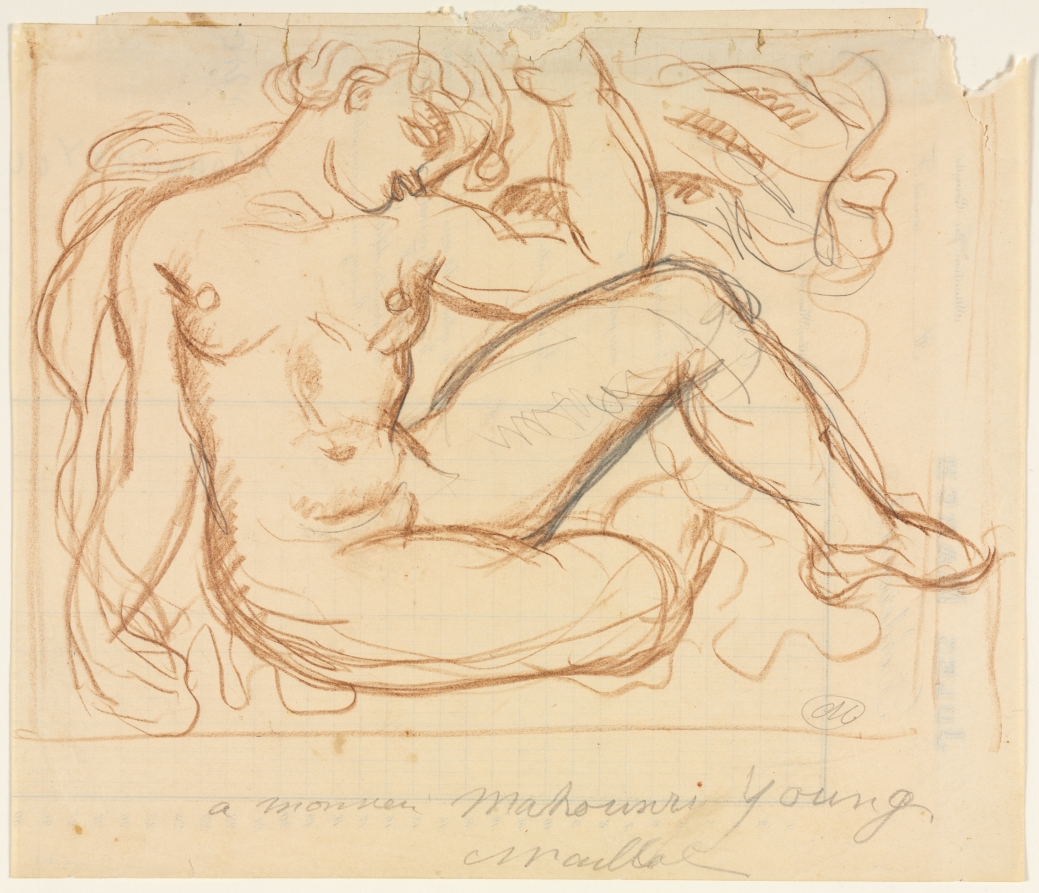
The public commissions that came to Maillol in the early twentieth century gave his formal ideas monumental scale and civic permanence. His "Relief, La Victoire" of 1921 exemplifies the way he could invest even a commemorative subject with his characteristic calm grandeur, refusing the easy gestures of triumph or grief in favor of something more archetypal and enduring. His study for the monument to Paul Cézanne, "Jeune fille couchée" of 1912, is particularly beloved by scholars and collectors because it reveals the tenderness behind the apparent severity of his mature style. The reclining figure is at once a specific body observed with care and an image of pure formal invention.
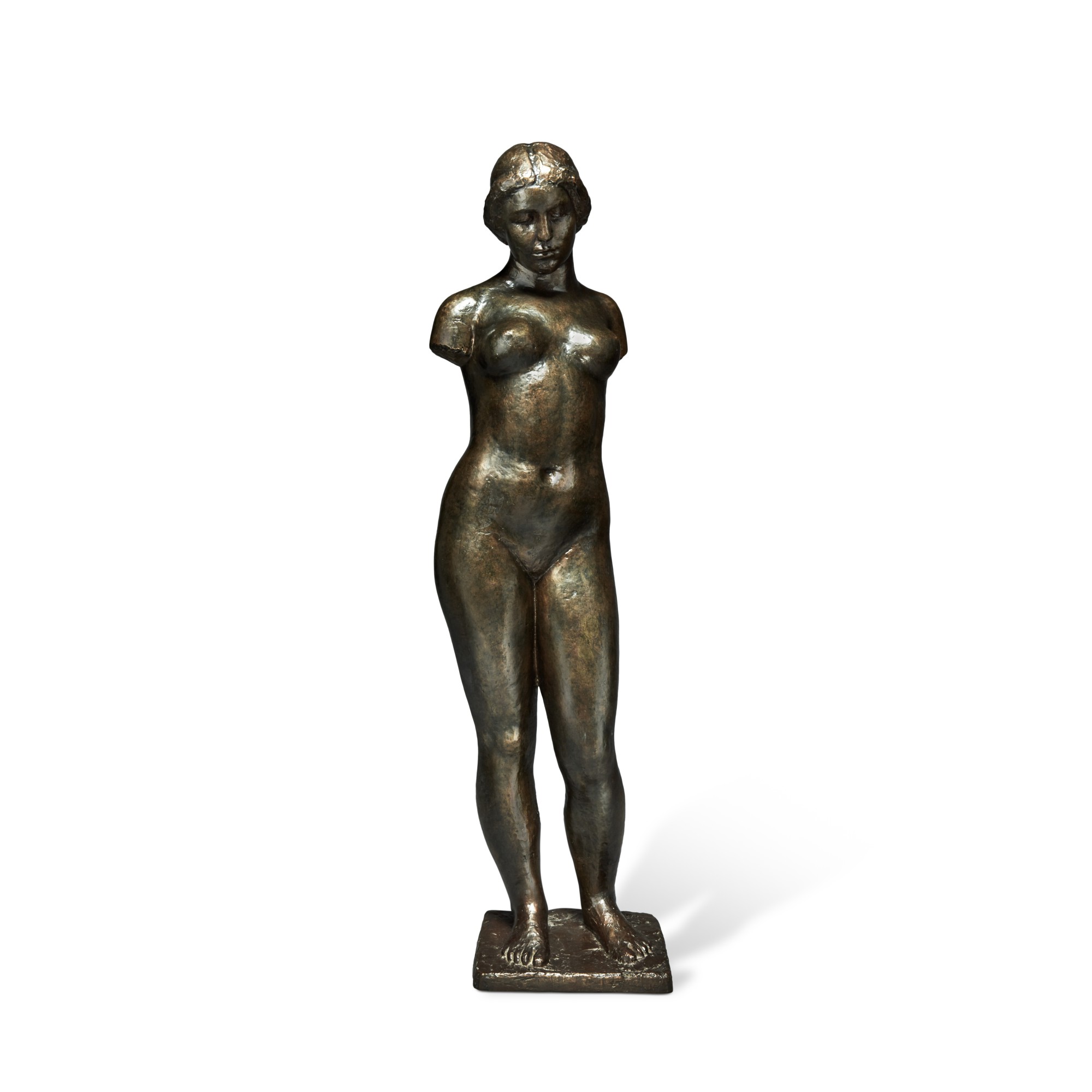
Aristide Maillol
Étude pour "L'Harmonie", 1942
Maillol's late bronze "Étude pour L'Harmonie" of 1942, completed in the last years of his life, demonstrates that his powers of formal concentration never diminished. Works such as "Femme à l'épine" from 1920 and "Baigneuse bras écartés" from 1930 and the exquisite small "Petite Flore nue" of 1911 in bronze represent him across the full arc of his career and remain among the most sought after works in his catalogue. For collectors, Maillol occupies a position of unusual security and prestige. His work sits at the intersection of several of the most durable collecting categories: classical modernism, the blue chip French tradition, figurative sculpture with deep art historical roots, and the kind of formal intelligence that rewards sustained looking.
Bronze casts from his lifetime and from authorized posthumous editions appear regularly at the major auction houses, and prices for significant works have climbed steadily over the past two decades, reflecting sustained institutional and private demand. Collectors who come to Maillol often speak of the way his sculptures command a room without dominating it, the way they create a zone of quiet around themselves. Works on paper, including his drawings and lithographs, offer an accessible point of entry into the practice of an artist whose bronzes can command prices that reflect his canonical status. His drawings in particular, such as the early crayon and graphite studies, reveal the observational intelligence that underpins the finished sculptures and are treasures in their own right.
To understand Maillol's place in art history it helps to think about his relationship to the arc running from Rodin through Henri Matisse to the broader tradition of twentieth century figuration. Matisse admired him. The sculptors Gaston Lachaise and Georg Kolbe both felt his influence. In the context of his own time he represented a counter to Expressionist distortion and to the fracturing energies of early abstraction, insisting that the unadorned human figure, handled with intelligence and love, remained inexhaustible as a subject.
That insistence looks, from the vantage of the present, not like conservatism but like a kind of principled faith. The body he returned to again and again was not an idealized fantasy but something rooted in real observation, weighted with gravity, comfortable in its own existence. Maillol died in 1944 near his birthplace of Banyuls sur Mer, killed in a road accident at the age of eighty three. He left behind a body of work that continues to grow in critical estimation and market stature.
The sculptures he placed in the Tuileries Gardens in Paris, where several of his major bronzes remain on permanent display, have become part of the texture of the city itself, proof that his ambition to make something permanent was not misplaced. For anyone drawn to the history of Western sculpture, to the question of what a human figure can mean when handled with patience and formal genius, Maillol remains an essential encounter. His work does not shout for attention. It simply stands, and waits, and rewards.
Explore books about Aristide Maillol
Aristide Maillol
Judith Cladel
Maillol
Alfred Werner

Aristide Maillol: 1861-1944
Waldemar George
Maillol: A Life
James Lord
Aristide Maillol: Catalogue Raisonné of Sculpture
Reginald Nicholson
Maillol and Modernism
Charles Millard
The Drawings of Aristide Maillol
Véronique Wiesinger