Antonio Asis
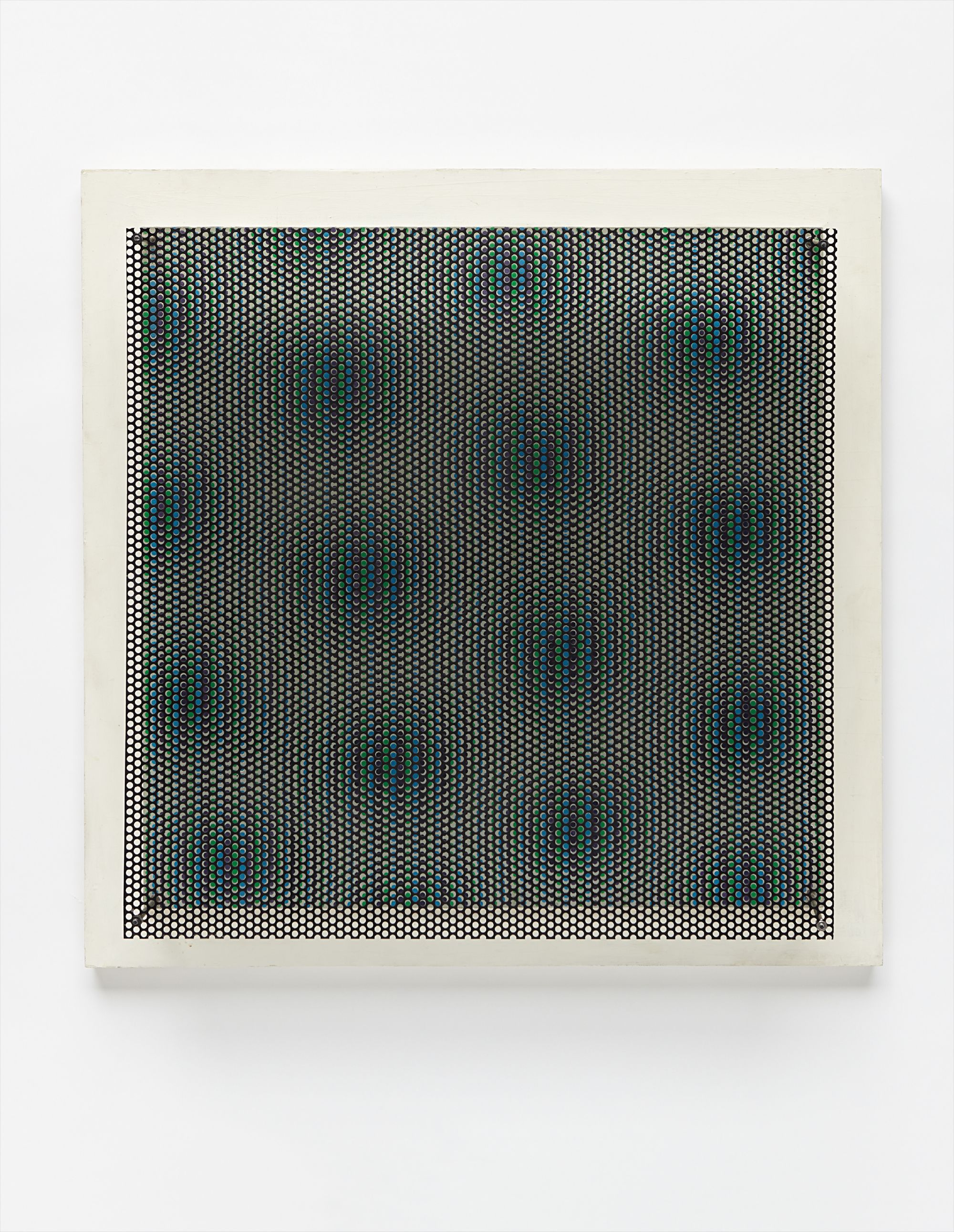
Antonio Asis: Light, Color, and Pure Joy
Artist Spotlight · The Collection Editorial
There is a moment, standing before a work by Antonio Asis, when the eye refuses to settle. The surface hums. Colors advance and retreat. Geometric forms seem to breathe.
Antonio Asis
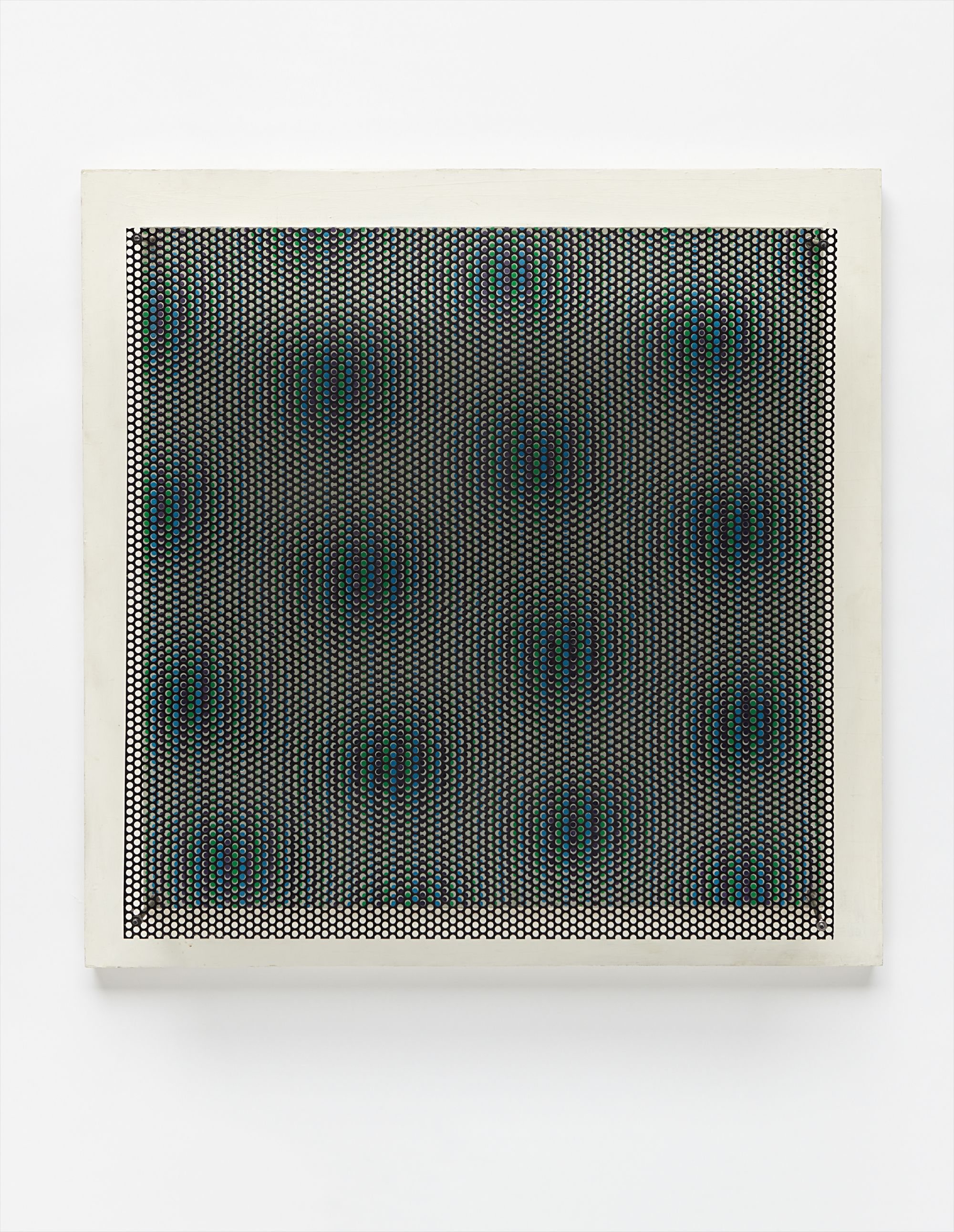
Vibration Couleur
It is not a trick, exactly, but a precise and deeply considered invitation to experience perception itself as a kind of pleasure. In recent years, as institutions across Europe and Latin America have returned sustained attention to the kinetic and Op Art generations, Asis has emerged as one of the most quietly essential figures of that extraordinary moment in twentieth century art, an artist whose work rewards rediscovery with an almost overwhelming generosity of sensation. Antonio Asis was born in 1932 in Argentina, a country that would produce a remarkable concentration of artists drawn to geometry, abstraction, and the investigation of visual phenomena. The Buenos Aires of his youth was a city in ferment, shaped by European modernism arriving in waves and by a homegrown avant garde that refused provincial limitations.
The legacy of Concrete Art, advanced in Argentina by figures such as Tomás Maldonado and the Arte Concreto Invención group in the 1940s, gave young Argentine artists a rigorous conceptual foundation, an insistence that form and color could carry meaning without recourse to representation. Asis absorbed this inheritance deeply before making the journey that would define his career. He arrived in Paris in the 1950s, joining a generation of Latin American artists who found in the French capital both an intellectual community and a freedom to experiment. Paris in those decades was the center of a genuinely international conversation about perception, movement, and the relationship between the artwork and the viewer.
Antonio Asis
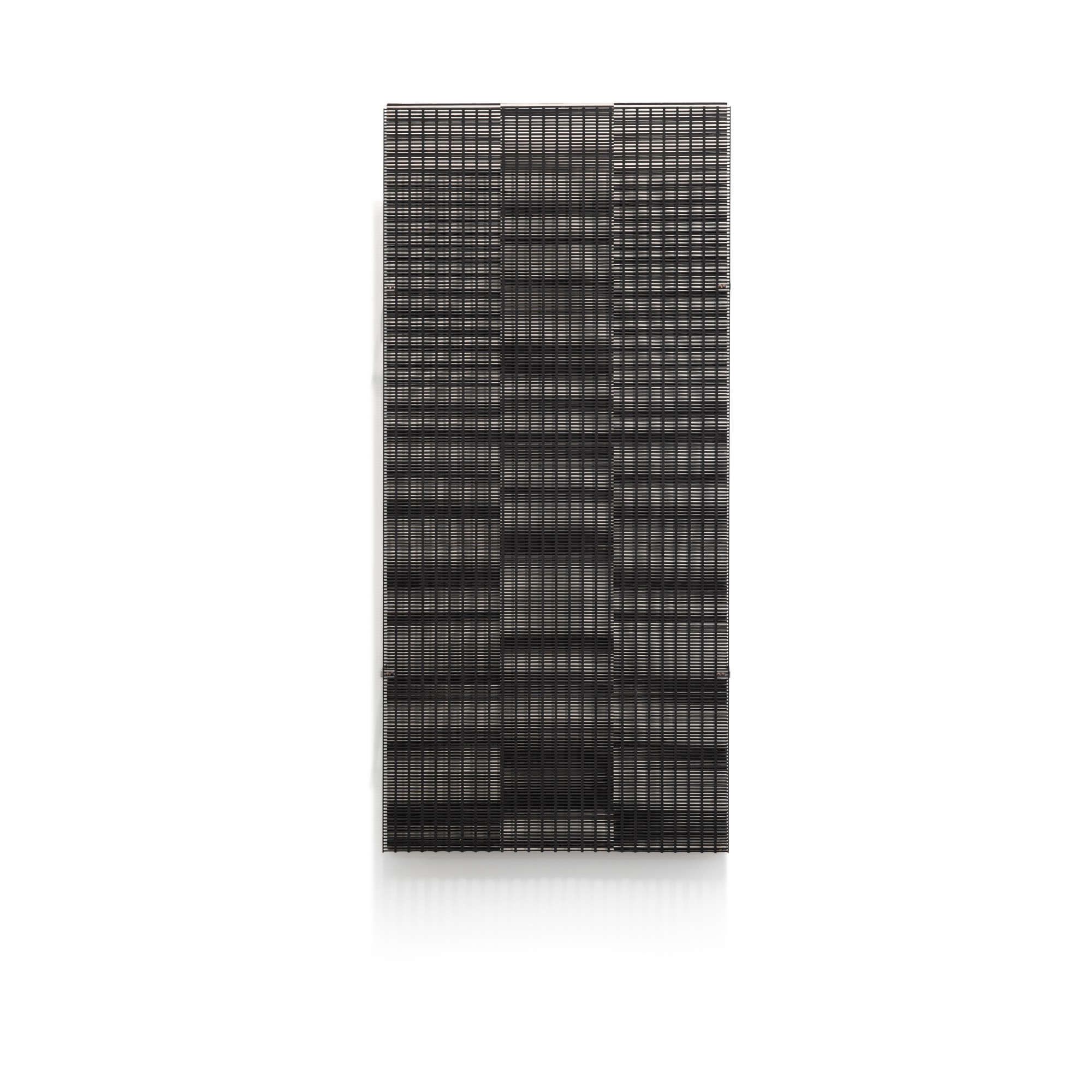
Untitled, 1974
Asis became associated with the Groupe de Recherche d'Art Visuel, known as GRAV, a collective founded in 1960 that included Julio Le Parc, Francisco Sobrino, Horacio Garcia Rossi, and others. GRAV was radical in its ambitions: the group rejected the romantic myth of individual artistic genius and sought instead to create work that activated the spectator, that turned looking into an experience of discovery and even physical participation. Their street happenings and labyrinthine installations in Paris during the 1960s were genuinely transformative events, drawing crowds into encounters with light and movement that felt unlike anything available in conventional galleries. Within this collective context, Asis developed a practice that was unmistakably his own.
His great subject was chromatic vibration: the way that colors placed in precise geometric relationships create the illusion of movement, depth, and luminosity without any mechanical component whatsoever. Where some of his GRAV colleagues pursued literal kinetics, motorized elements and actual light sources, Asis trusted the eye. He understood, with scientific precision and artistic intuition in equal measure, that the human visual system is itself an instrument of extraordinary sensitivity, capable of generating the experience of movement from a perfectly still surface. His works are not passive objects.
Antonio Asis
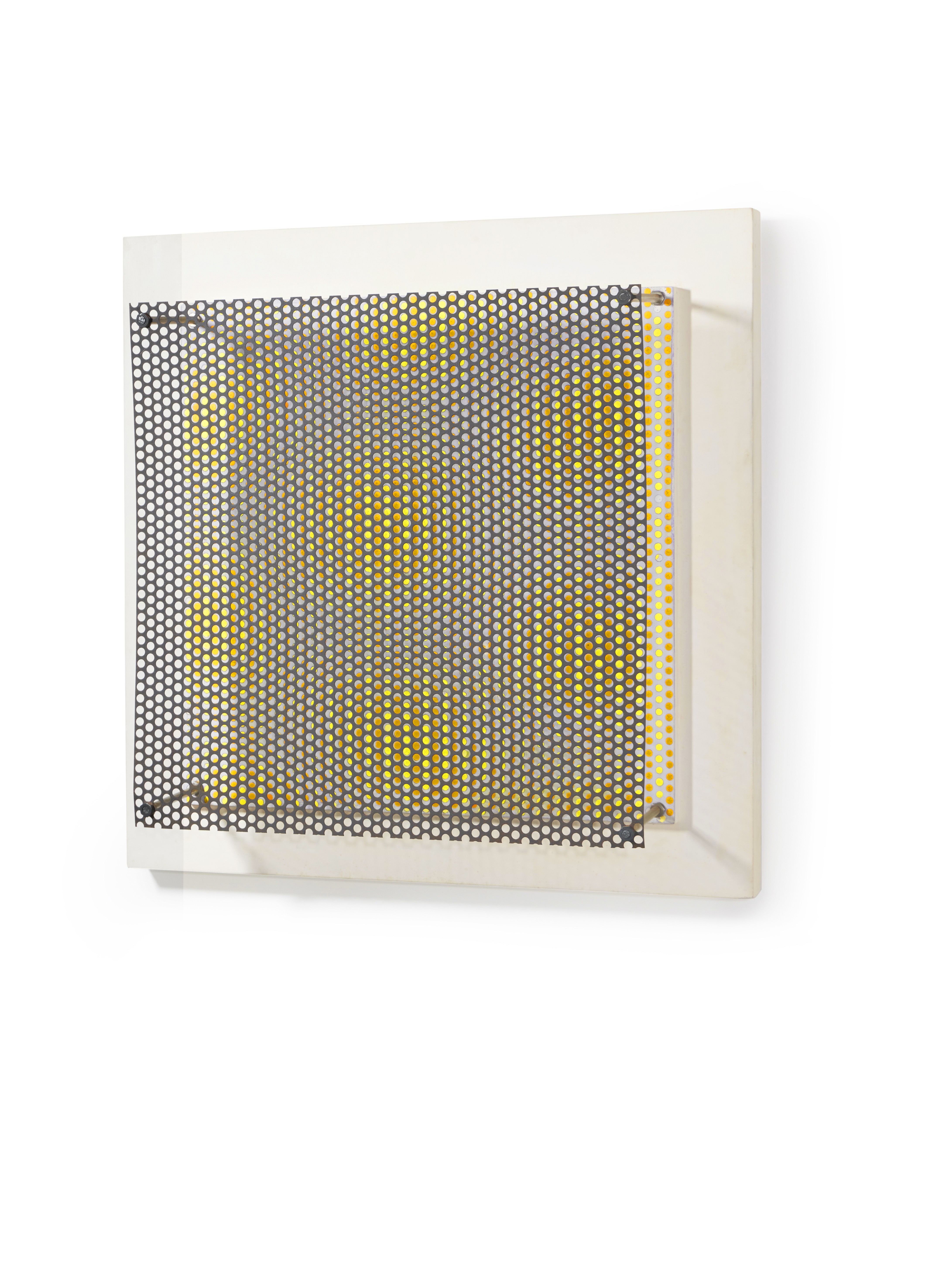
Grilla violeta y amarilla, 1971
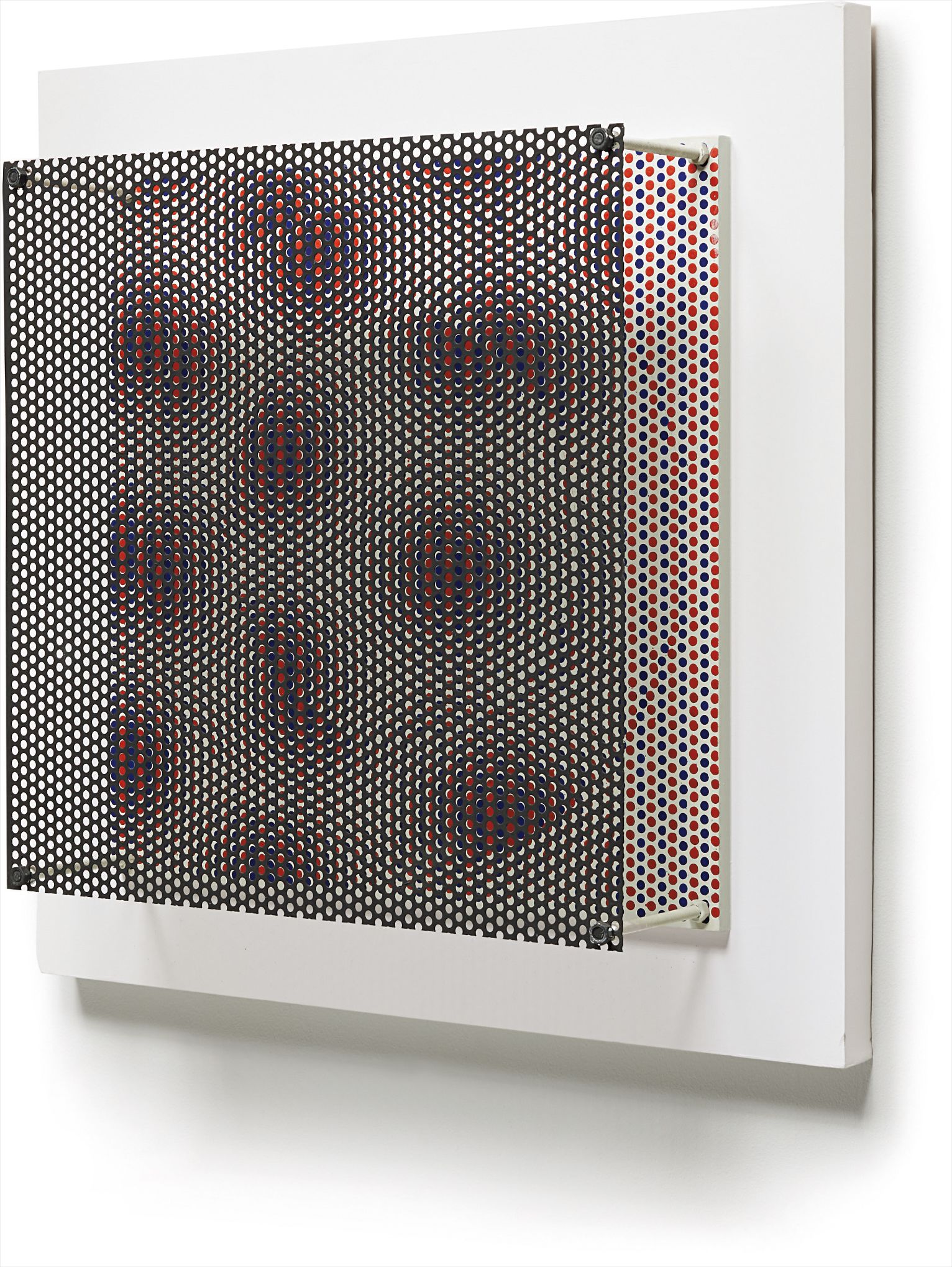
They perform. The signature works that have come to define his reputation demonstrate the full range of this achievement. "Vibration Couleur," executed in oil and metal screen on wood, is characteristic of his method: a layered construction in which a fine metallic mesh sits over a painted surface, creating a moiré interference pattern that shifts as the viewer moves. The experience is simultaneously optical and almost physical, as though the painting is radiating energy.
"Grilla violeta y amarilla" from 1971 extends this investigation through a grid structure in which violet and yellow engage in a relationship of maximum chromatic contrast, generating a luminous instability that seems almost audible. "Círculo Rojo y Negro Sobre Blanco" distills the approach to its most elemental: a red and black circle on white, mediated through his characteristic screen, achieves an intensity that far exceeds the simplicity of its description. These are works that change depending on where you stand, on the quality of light in the room, on the speed at which your eye travels across the surface. They are, in the truest sense, alive.
Antonio Asis
Círculo Rojo y Negro Sobre Blanco
For collectors, Asis represents something increasingly rare in the market: a figure of genuine art historical importance whose work remains accessible and whose place in the canon continues to solidify. His association with GRAV connects him directly to one of the most historically significant collectives of the postwar period, a group that anticipated both the dematerialization of the art object and the participatory aesthetics that would come to define so much late twentieth century practice. Works by his GRAV colleagues, particularly Julio Le Parc, have achieved considerable auction visibility in recent decades, and growing institutional attention to the kinetic generation as a whole has drawn new scrutiny to Asis. Collectors who appreciate the cerebral pleasures of artists such as Bridget Riley, Victor Vasarely, and Carlos Cruz Diez will find in Asis a sensibility that is at once rigorously systematic and warmly sensuous.
His use of the metal screen as a structural element gives his works a distinctive material presence that photographs cannot fully convey: they must be experienced in person, which makes them all the more rewarding to live with. The art historical context in which Asis belongs is rich and continues to be productively reassessed. The kinetic and Op Art movements, long dismissed by certain critical factions as decorative or merely clever, have been subject to serious scholarly rehabilitation over the past two decades. Major exhibitions at institutions including the Museum of Modern Art in New York, the Tate in London, and the Museo Nacional Centro de Arte Reina Sofía in Madrid have reframed these movements as central rather than peripheral to the story of postwar modernism.
The Latin American contribution in particular, long underrepresented in northern hemisphere art histories, has received overdue recognition. Asis stands among a group that includes not only his GRAV collaborators but also Jesús Rafael Soto, Gyula Kosice, and Hélio Oiticica as artists who fundamentally expanded what geometric abstraction could do and feel like. Antonio Asis passed away in 2019, leaving behind a body of work that continues to find new audiences and new admirers. His legacy is one of extraordinary generosity: art made not to impress or to intimidate but to delight, to activate, to share with the viewer the almost inexhaustible pleasure of seeing itself.
In a moment when the art world is hungry for work that connects across cultural backgrounds and speaks to universal experience, his paintings and constructions feel not like historical documents but like living propositions. To encounter an Asis is to be reminded that perception is not a passive act but a creative one, and that the right arrangement of color and form can make the world shimmer with possibility.
Explore books about Antonio Asis
Antonio Asis: Obra Completa
Jorge López Anaya
Antonio Asis: Cinétisme et Lumière
Frank Popper
Asis: Obra Plástica 1954-1974
Marta Minujín
Antonio Asis and Kinetic Art
Tomás Maldonado
Geometric Abstraction in Latin America: Antonio Asis
Shifra M. Goldman