Antonin Mercié
Mercié: The Sculptor Who Glorified the Human Spirit
Artist Spotlight · The Collection Editorial
In the grand halls of the Musée d'Orsay in Paris, where the collected ambitions of nineteenth century French sculpture line the galleries in bronze and marble, one name returns again and again to anchor the conversation: Antonin Mercié. His works carry a quality that transcends their academic origins, a trembling aliveness in cast metal and carved stone that continues to move viewers a century after his death. Collectors and curators alike are rediscovering the full range of his achievement, recognizing in him not merely a celebrated salon artist but a sculptor of genuine emotional power and technical brilliance. Marius Jean Antonin Mercié was born in Toulouse in 1845, a city with its own deep pride in artistic tradition, and it was clear from an early age that he possessed exceptional gifts.
Antonin Mercié
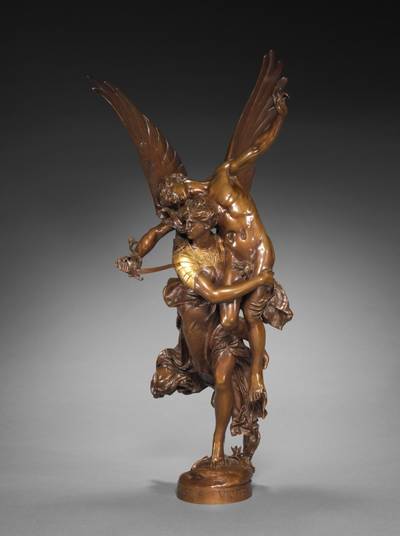
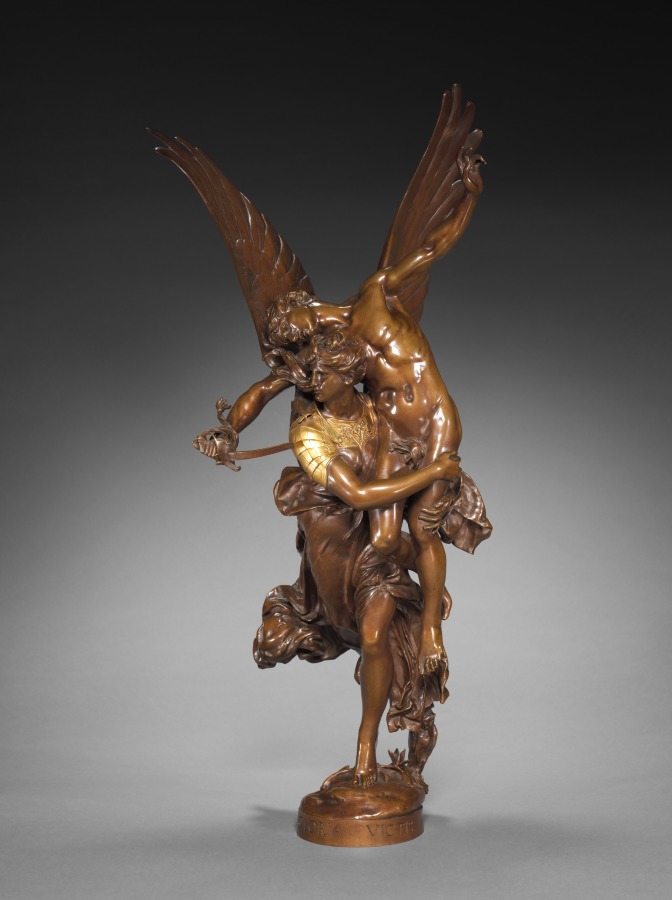
Gloria Victis, 1880
He entered the École des Beaux Arts in Paris, where he studied under the great academic sculptor Alexandre Falguière, a relationship that would prove formative. Falguière instilled in his student a rigorous discipline rooted in classical ideals while encouraging a sensitivity to surface, to the way light moves across bronze or marble, that would become one of Mercié's defining qualities. The two artists shared a southern French sensibility, a warmth and directness that set them apart from cooler Parisian stylists. The decisive moment in Mercié's early career came in 1868 when he won the prestigious Prix de Rome, the highest honor available to a French art student, which sent him to the Villa Medici in Rome for five years of study.
Those Roman years were transformative. Surrounded by antiquity and the achievements of the Renaissance, Mercié absorbed lessons about monumental form, about how sculpture could carry narrative and allegory without sacrificing physical beauty. He returned to Paris in 1873 with his reputation already forming, bringing with him the model for a work that would make him famous across Europe. That work was David, completed in 1872 and exhibited at the Salon of 1872, where it was received with enormous enthusiasm.
Antonin Mercié
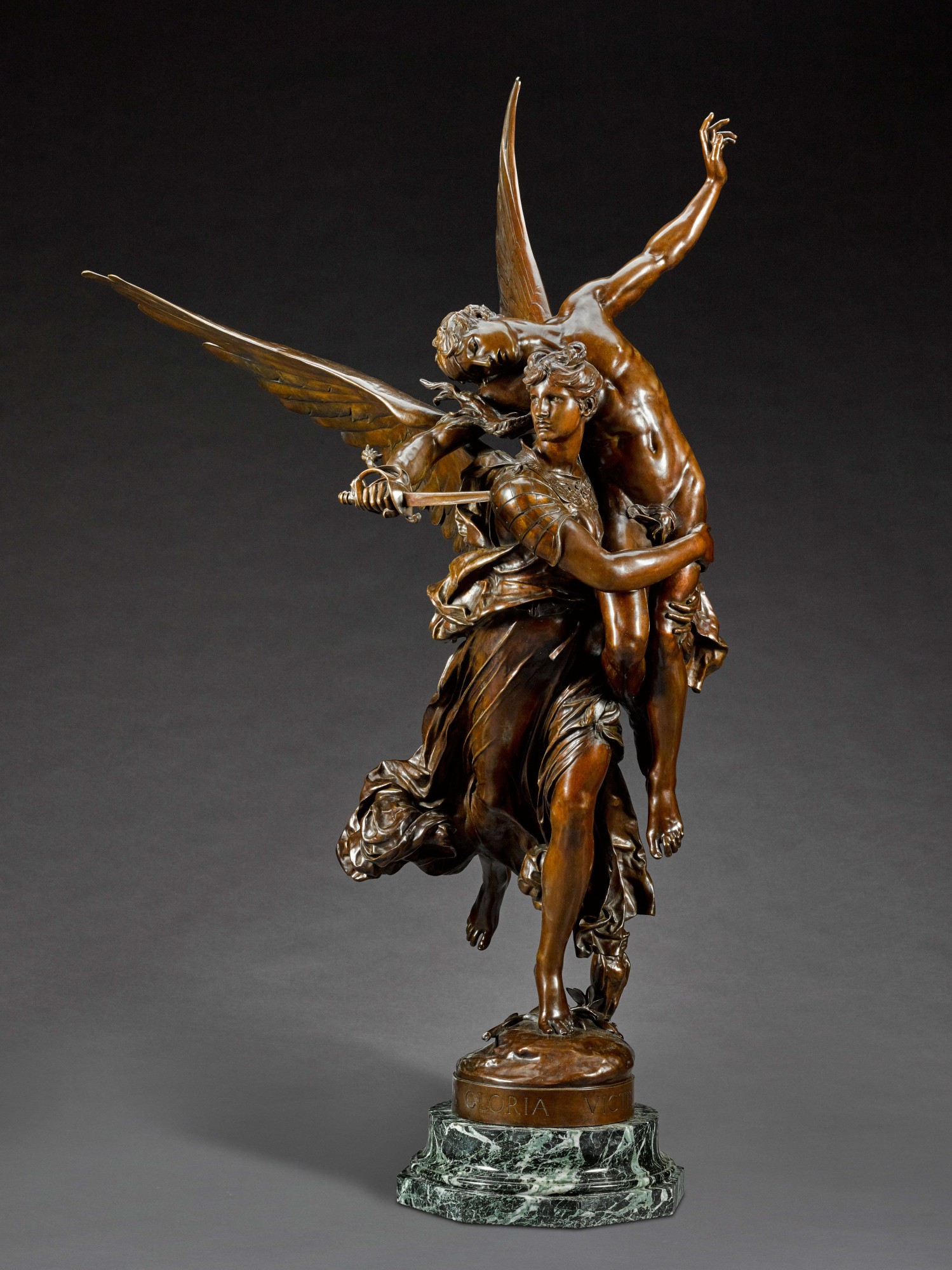
Gloria Victis
Mercié's David is not the colossal, defiant figure of Michelangelo but something more intimate and psychologically complex: a young man in the immediate aftermath of his victory over Goliath, looking down at the severed head with an expression that mingles triumph with something closer to wonder or even unease. The sculpture captures a moment of transition, the boy becoming aware of what he is capable of, and its surface handling, particularly in the treatment of the bronze skin and the loosely draped garment, demonstrates a virtuosity that left critics searching for superlatives. The work earned Mercié the medal of honor at the Salon and established him as the leading sculptor of his generation. If David announced Mercié's arrival, it was Gloria Victis, first exhibited at the Salon of 1874, that secured his place in the history of French art.
The work was conceived in the shadow of the Franco Prussian War of 1870 to 1871, a national catastrophe that had left France shattered and humiliated, its provinces of Alsace and Lorraine ceded to the new German empire. Gloria Victis, whose title translates as Glory to the Vanquished, is an allegory of this defeat: a winged female figure, representing Fame, carries the body of a fallen warrior whose sword is broken, lifting him upward in an act of posthumous consecration. The emotional charge of the work was overwhelming for contemporary audiences. Mercié understood that the French public needed art that could transform grief into dignity, and Gloria Victis provided exactly that.
Antonin Mercié
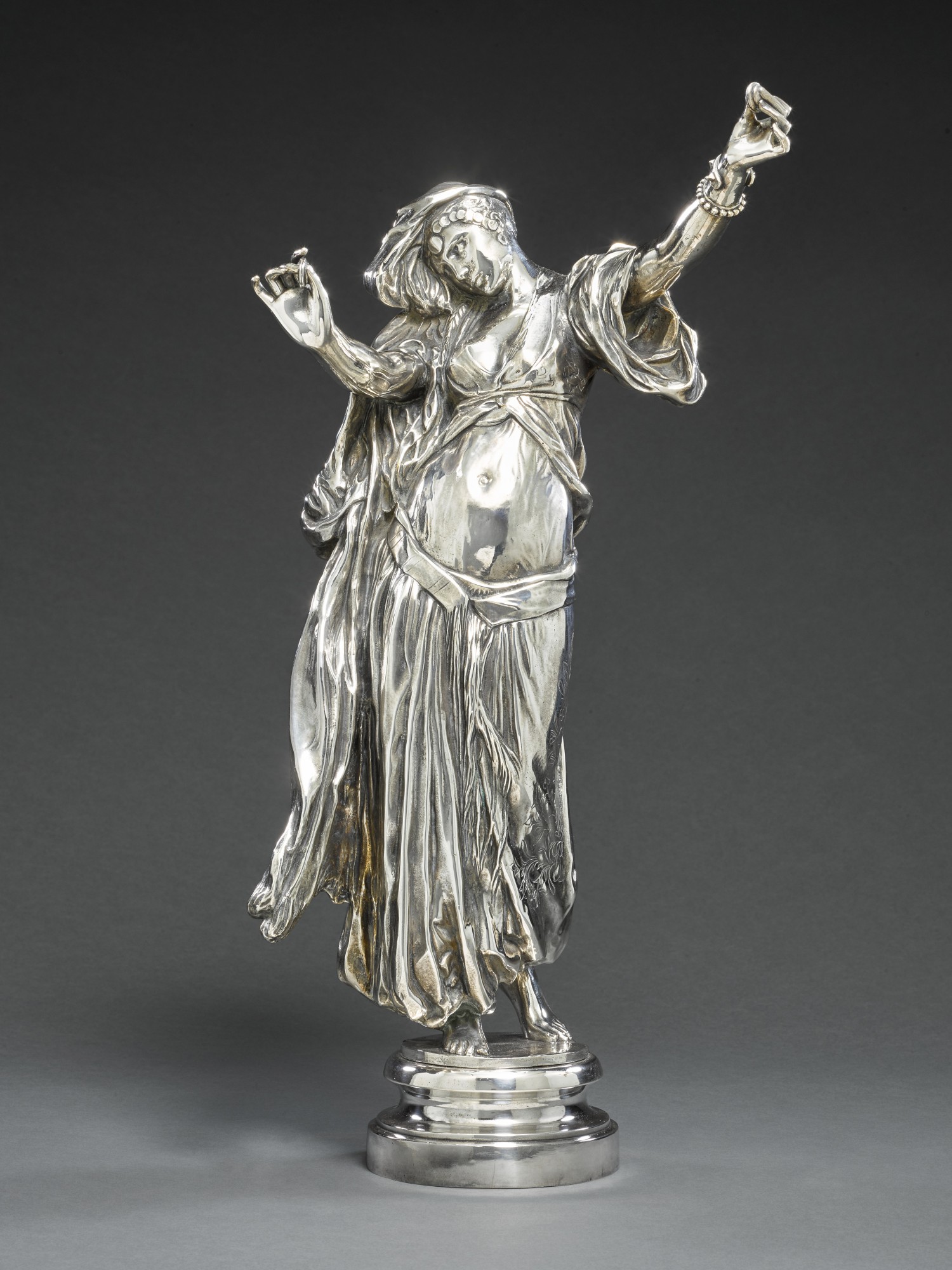
L'Almée (Oriental Dancer)
The work was reproduced in numerous editions and versions, in different scales and patinas, and those bronzes entered collections throughout France and across the world. The versions that appear on the market today, including finely cast examples with rich mid brown patinas on verde antico marble bases, represent some of the most sought after bronzes of the entire academic period. Mercié was far more than a sculptor of patriotic allegory. His range was considerable, and among the most delightful expressions of that range are the works he devoted to orientalist themes and to the female figure.
L'Almée, his depiction of an oriental dancer, reveals a different sensibility entirely: sensuous, rhythmic, and alive with movement. Cast in bronze with a silvered patina, the figure captures the sinuous quality of dance with a fluency that suggests Mercié had studied movement as carefully as he studied anatomy. The paired version presenting both L'Almée and a companion Danse du Sabre figure is among the most refined examples of his decorative work, the kind of object that transforms any interior it inhabits. Similarly, La Toilette de Diane in white marble demonstrates his command of the carving tradition, the cool luminosity of the stone perfectly suited to a subject drawn from classical mythology.
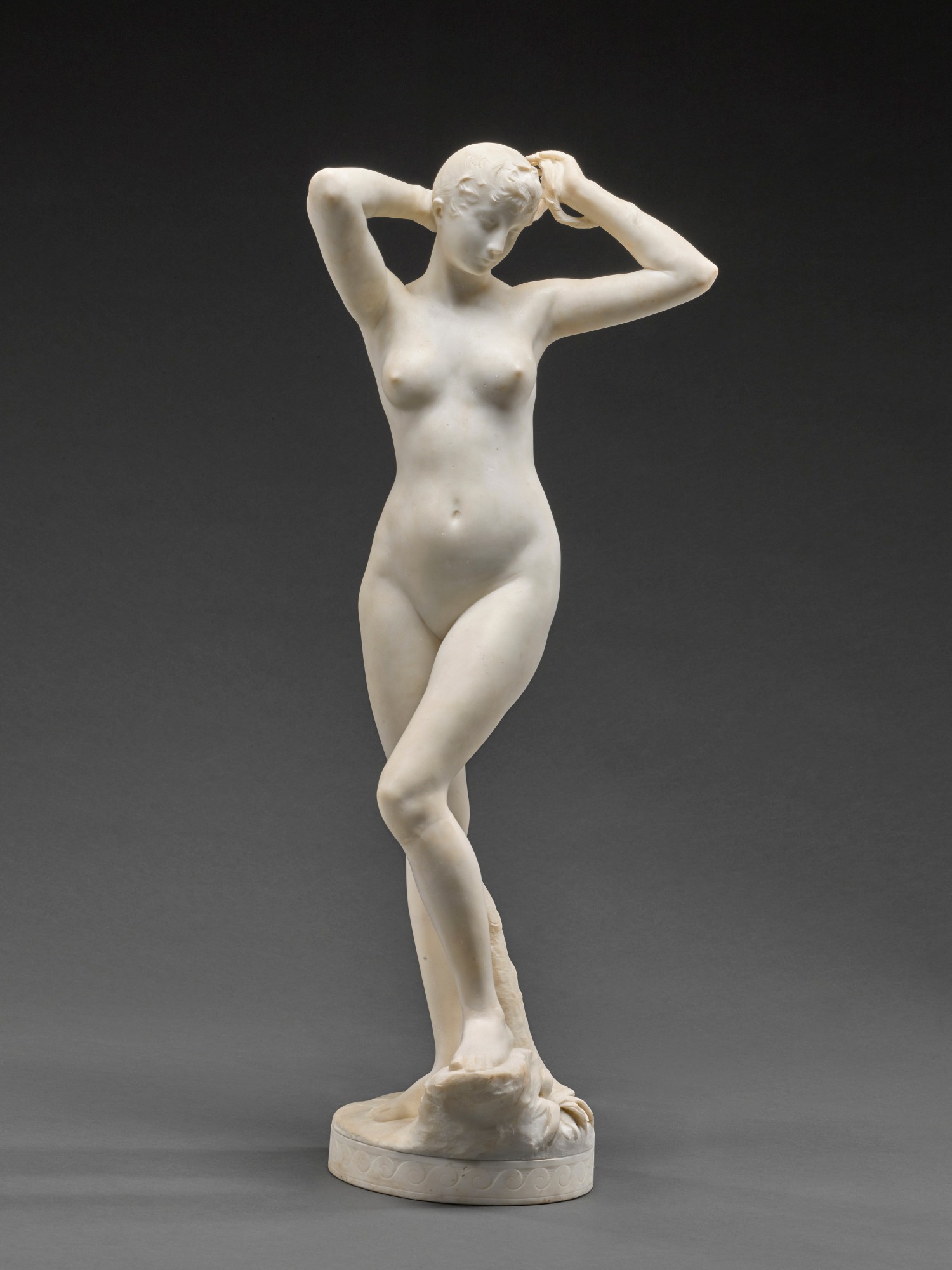
Antonin Mercié
La Toilette de Diane (The Toilet of Diana)
For collectors approaching Mercié today, several considerations make his work particularly compelling. His bronzes span a wide range of scale and ambition, from monumental public versions of Gloria Victis to intimate cabinet bronzes that fit comfortably within a domestic collection. Provenance matters, as does the quality of the casting and the condition of the patina, and Mercié's work was produced by some of the finest foundries active in late nineteenth century Paris. When a strong example appears at auction, whether at Sotheby's, Christie's, or specialized sales at Dorotheum or Artcurial, it reliably attracts serious bidding from collectors who recognize the combination of historical significance and sheer beauty that defines his best work.
The market for academic bronzes of this quality has strengthened considerably over recent decades as a new generation of collectors has moved beyond the prejudices against salon art that characterized much of the twentieth century. Mercié belongs to a constellation of French sculptors whose collective achievement in the second half of the nineteenth century represents one of the great flowerings of the medium. His contemporaries and near contemporaries include Auguste Rodin, whose more radical temperament pointed toward modernism, Jean Baptiste Carpeaux, whose exuberant dynamism influenced an entire generation, and Emmanuel Frémiet, master of the dramatic historical subject. Mercié occupies his own distinct place within this company, committed to an ideal of classical beauty refined through deep feeling, and his influence extended to students and followers throughout the academic tradition.
His election to the Académie des Beaux Arts recognized not only his achievements as a sculptor but his role as a custodian of a tradition he genuinely believed in. His death in 1916, during the years of the First World War, marked the close of a career that had spanned more than four decades of extraordinary productivity. What endures is not merely the technical achievement, remarkable as that is, but the human quality of his vision. Mercié believed that sculpture could carry meaning, that it could honor the dead, celebrate beauty, and console the living.
In works like Gloria Victis, that belief achieved something close to the sublime. For collectors and admirers encountering his work today, the experience remains what it was for those first Salon audiences: an encounter with an artist who gave everything he had to the making of beautiful, meaningful things.
Explore books about Antonin Mercié
Antonin Mercié: Sculpteur
Stanislas Lami
Mercié: Un Maître de la Sculpture Française au XIXe Siècle
Charles Saunier
Les Sculpteurs Français du XIXe Siècle
Léonce Bénédite
Dictionnaire de la Sculpture Française du XIXe Siècle
Édouard de Beaumont
French Sculpture of the Nineteenth Century
Athena S. E. Tacha