Antoni Clavé
Antoni Clavé, A Master Who Defied Borders
Artist Spotlight · The Collection Editorial
There is a moment, standing before one of Antoni Clavé's richly encrusted surfaces, when the eye refuses to settle. Layers of oil, collage, and raw texture pull the gaze inward and then outward again, as if the painting itself is breathing. It is this quality, an almost physical generosity in the work, that has drawn renewed attention to the Catalan master in recent years. Major European institutions and the international auction market have continued to affirm what devoted collectors have long understood: Clavé was one of the twentieth century's most genuinely original voices, a painter who synthesised the grand traditions of European modernism and made them entirely his own.
Antoni Clavé
Candide
Antoni Clavé was born in Barcelona in 1913, into a city that was alive with creative and political tension. Catalonia's fierce cultural identity, its particular light, and the Mediterranean sensibility that shaped everything from its cuisine to its architecture left an indelible mark on the young Clavé. He trained at the Escola de Belles Arts de la Llotja in Barcelona, the same institution that had shaped Pablo Picasso a generation before him, and it was there that he developed the rigorous draughtsmanship that would underpin even his most experimental later work. The Spanish Civil War forced Clavé into exile in 1939, a rupture shared by a generation of Spanish intellectuals and artists who would scatter across Europe and the Americas, carrying their culture with them like something precious and irreplaceable.
Clavé settled in Paris, a city that in the postwar years crackled with possibility. He arrived with almost nothing, but found himself quickly absorbed into the artistic community that had made the French capital the centre of world art. He befriended Pablo Picasso, a relationship that would prove formative and sustaining, and through Picasso he encountered the full weight of Cubism's legacy at close quarters. But Clavé was never content to be a disciple.
Antoni Clavé
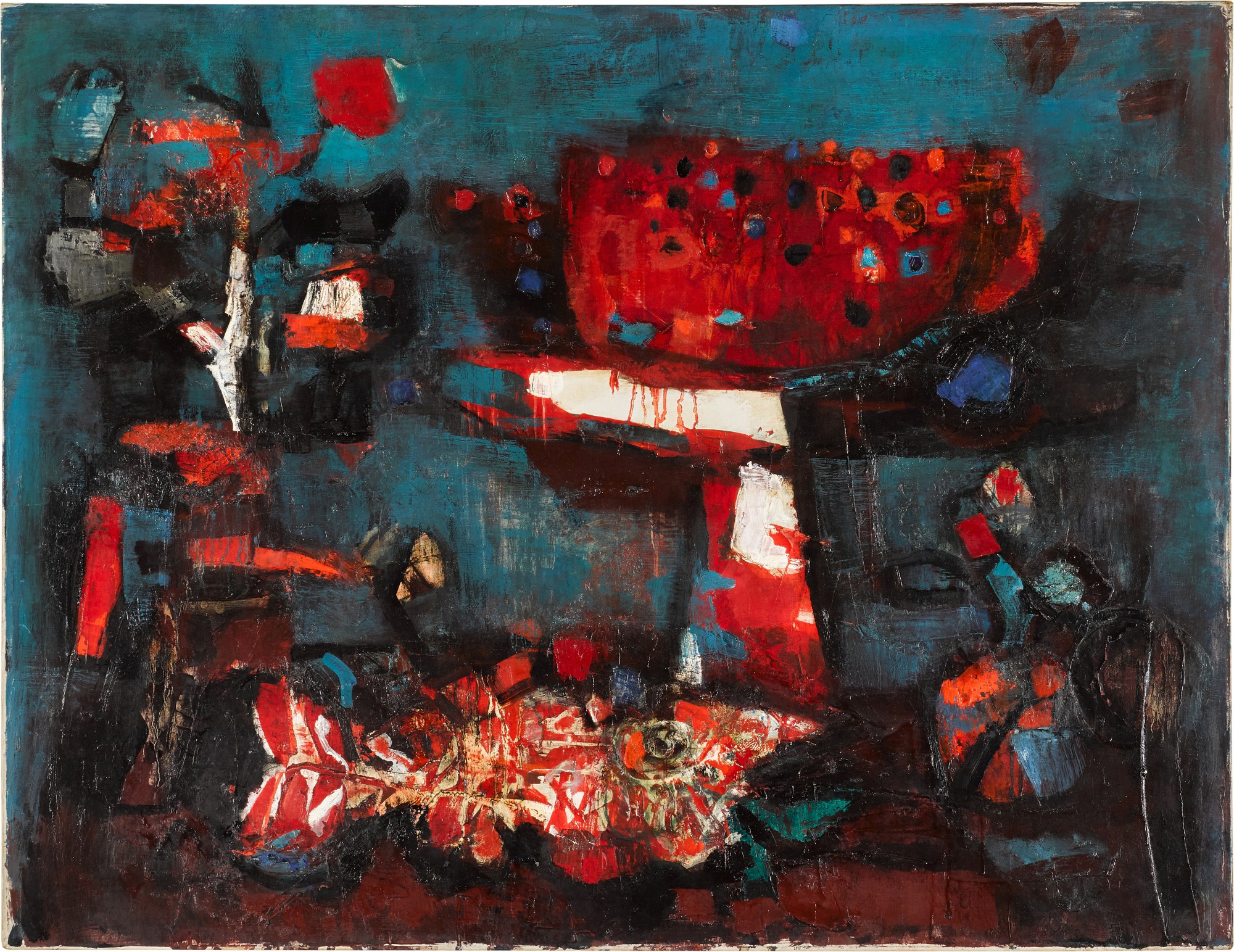
Peix Vermell amb Copa, 1956
He moved through influences the way a skilled navigator moves through weather, taking what he needed and pressing forward. By the late 1940s and into the 1950s, he had begun to develop a personal visual language that set him apart from his contemporaries: dense, worked surfaces, a palette that ranged from earthy ochres and deep blacks to moments of sudden, startling colour, and a compositional instinct that felt simultaneously archaic and entirely modern. The 1950s represent perhaps the richest single decade of Clavé's painted output. Works such as Peix Vermell amb Copa, painted in 1956, demonstrate how fluently he absorbed the still life tradition while transforming it into something charged and psychological.
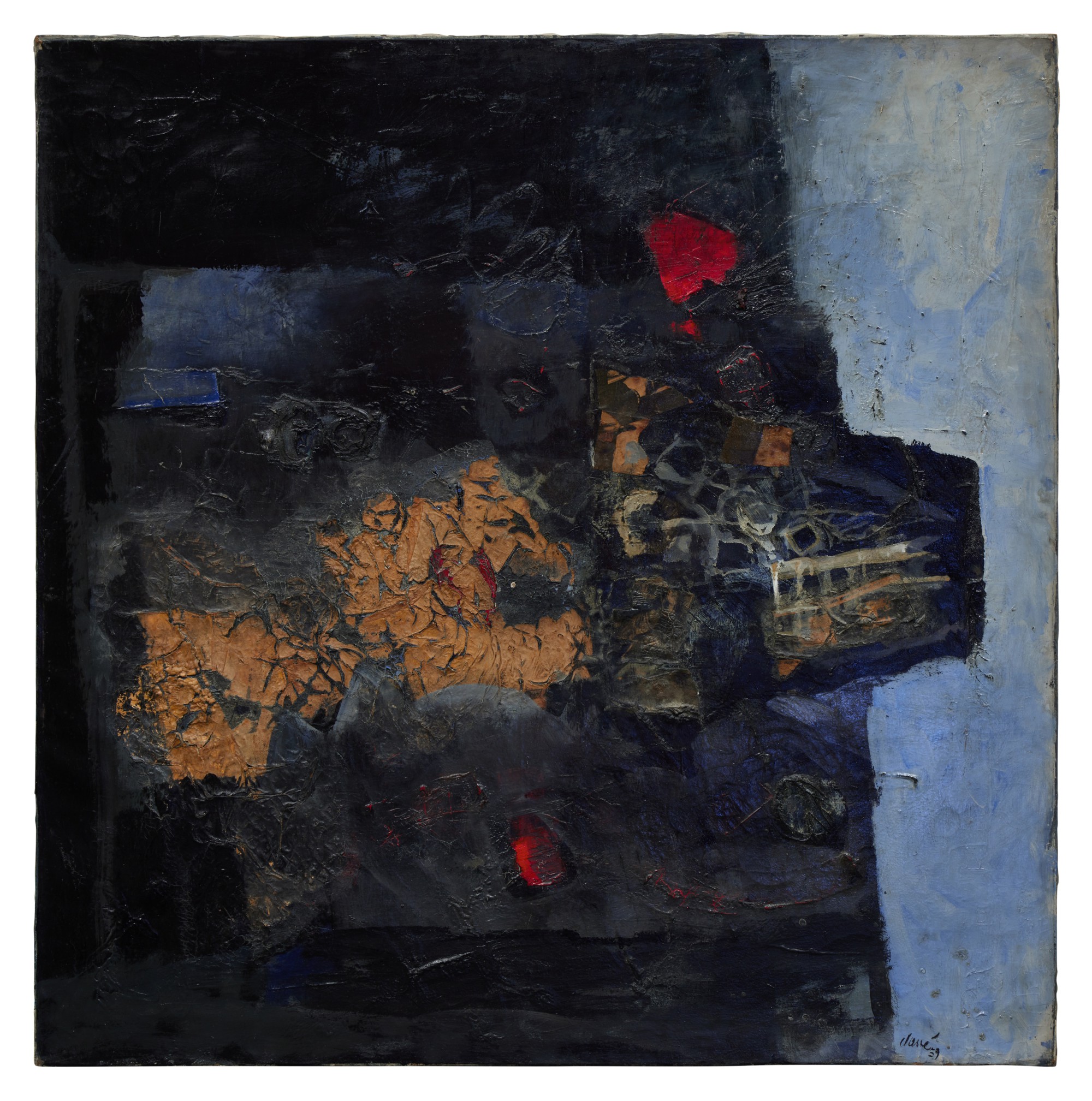
The fish, the glass, the table: objects that had occupied European painters since Chardin, but here rendered with an urgency that feels almost confessional. Poisson à la table noire, from 1959, deepens this inquiry, with collage elements introduced into the oil surface, creating a tension between the handmade and the found that anticipates Arte Povera by nearly a decade. Nature morte au tapis, also from 1958, shows Clavé working on burlap, the coarse weave of the support becoming an active participant in the image rather than a passive ground. These are paintings that reward sustained looking and generous collecting instincts in equal measure.
Antoni Clavé
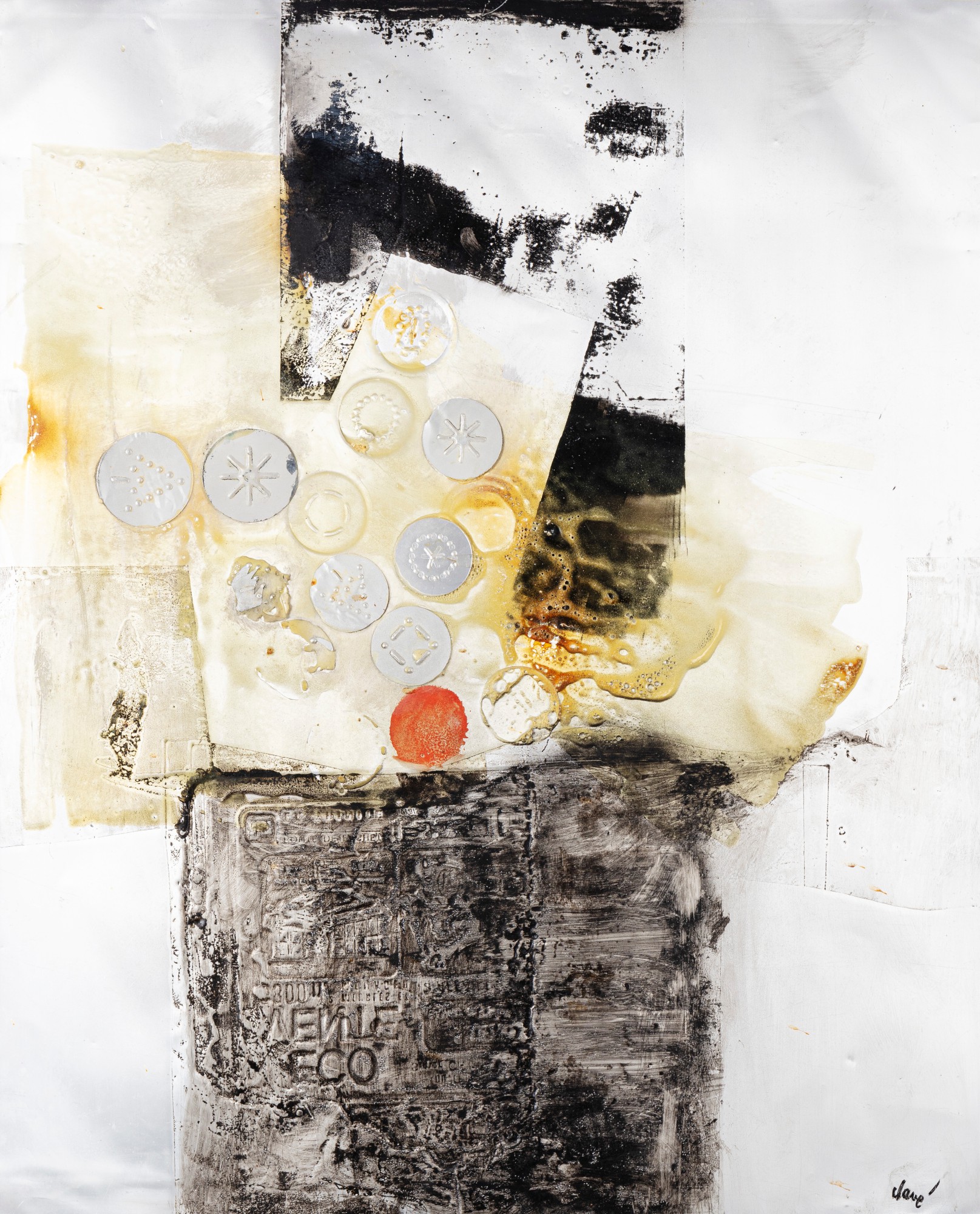
Composition, 1974
Clavé's practice extended far beyond painting, and it is important to understand the full breadth of his achievement to appreciate his singular position in art history. He was a gifted printmaker who worked across etching, lithography, and screen printing with the same exploratory rigour he brought to canvas. His work in the theatre, designing sets and costumes for major productions across Europe, gave his art a dramatic, gestural quality that never tipped into mere theatricality. And then there was his contribution to cinema: in 1952, his work on the film Hans Christian Andersen earned him two Academy Award nominations, a remarkable distinction that brought his name to international attention far beyond the gallery world.
Clavé, it turned out, was one of those rare artists whose gifts translated across every medium he chose to inhabit. From a collecting perspective, Clavé occupies a genuinely compelling position. His work appears regularly at auction houses in Paris, London, and Barcelona, and prices reflect both the consistent quality of his output and the growing appreciation for European postwar art among international collectors. Works on paper and mixed media pieces such as The King, from 1959, offer entry points for collectors drawn to his textural inventiveness, while major oil paintings command significant attention and prices that reflect their art historical weight.
Antoni Clavé
Poisson à la table noire, 1959
What to look for: the works of the late 1950s and early 1960s represent the sweet spot of his mature style, where the surface energy is at its most intense and the relationship between image and material is most productively unresolved. Collectors who have built relationships with Clavé's work often describe the experience in almost physical terms, as if the paintings exert a kind of gravitational pull. To understand Clavé's place in art history is to understand the broader story of European modernism's survival and transformation in the postwar period. He belongs to a constellation of artists working in Paris in the 1950s who drew on Cubism, Expressionism, and the rich traditions of Mediterranean painting to forge something new.
Jean Dubuffet, with his excavated and abraded surfaces, is a natural point of comparison. So too is Nicolas de Staël, whose anguished negotiations between abstraction and figuration resonate with Clavé's own. Antoni Tàpies, Clavé's great Catalan contemporary, shared his fascination with material and surface, and the two artists together represent the finest flowering of a distinctly Iberian modernist sensibility. Clavé's friendship with Picasso also places him within the living tradition of Spanish innovation in art, a tradition that runs from Velázquez through Goya and into the twentieth century.
Antoni Clavé lived until 2005, continuing to work well into his ninth decade, and the full arc of his career remains one of the most remarkable in modern European art. He was an exile who made himself entirely at home in the world, a figurative painter who understood abstraction from the inside, and a printmaker and designer who brought the same intelligence to every form he touched. For collectors today, his work represents not only a sound and rewarding acquisition but an invitation into one of the deepest and most generous conversations that twentieth century painting has to offer. To live with a Clavé is to live with something that continues to unfold.
Explore books about Antoni Clavé
Antoni Clavé
Joan Teixidor
Clavé
Alexandre Cirici-Pellicer
Antoni Clavé: Catalogue Raisonné of Paintings
Pierre Daix
Clavé: Obra Gráfica Completa
Various authors
Antoni Clavé: The Collages
Francoise Marquet