Anthony Cudahy
Anthony Cudahy Paints the Tender, Luminous Now
Artist Spotlight · The Collection Editorial
There is a particular quality of attention that distinguishes the most compelling figurative painters working today, a willingness to slow down, to sit with a body in a room, to let the paint itself carry the emotional weight of being present with another person. Anthony Cudahy possesses this quality in abundance. His recent exhibitions on both sides of the Atlantic, including showings with Stems Gallery and at fairs where his canvases have stopped viewers mid stride, have confirmed what a growing community of perceptive collectors already understood: Cudahy is among the most emotionally intelligent painters of his generation, and his work is only deepening in its reach and resonance. Cudahy was born in 1989 and came of age as a painter during a period of remarkable ferment in American figurative art.
Anthony Cudahy
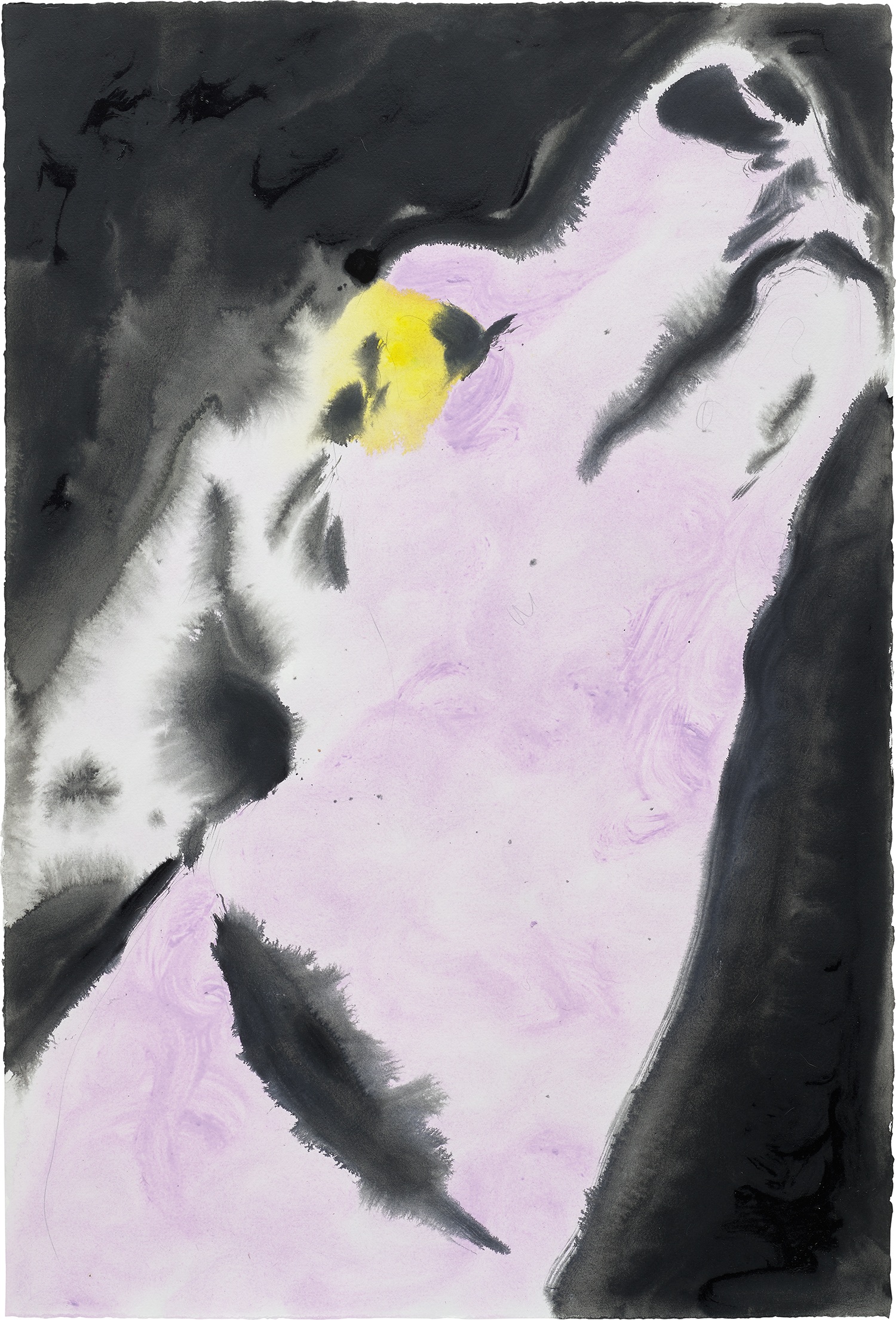
Howling, 2021
The cultural conversation around queer visibility, intimacy, and the politics of who gets to inhabit a canvas was shifting rapidly, and Cudahy entered that conversation not with polemic but with something far more enduring: genuine tenderness. His formation as a painter drew on art history broadly, from the saturated color fields of northern European expressionism to the quiet domestic interiors of earlier American realism, yet his synthesis is entirely his own. Looking closely at the three paintings visible here, what strikes you first is the palette. Cudahy works in ranges that feel almost botanical, lush greens that pulse against warm ambers and yellows, flesh tones that shift from peach to gold to a bruised, shadowed ochre depending on the light he imagines falling across a figure.
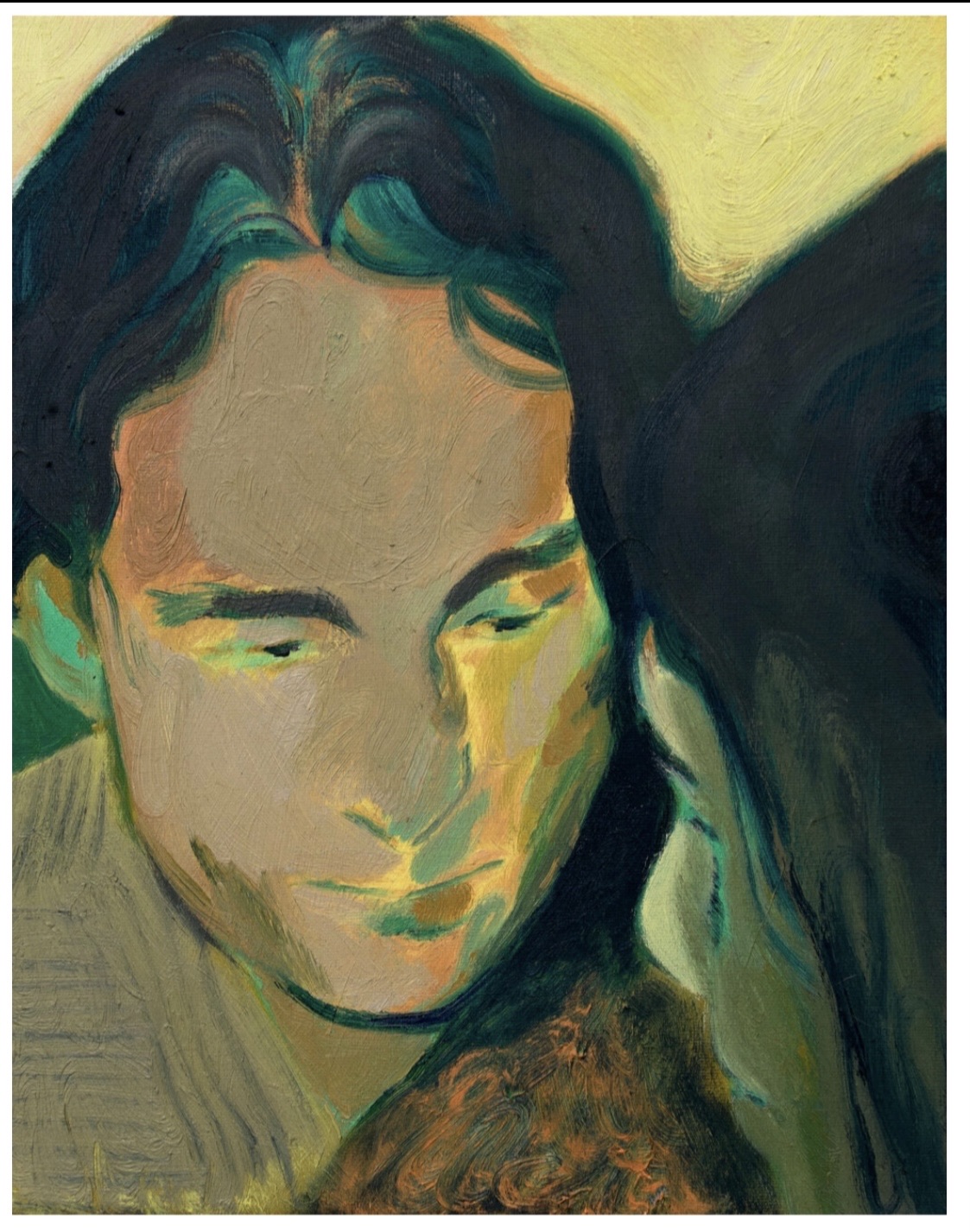
In the close portrait study, a figure with dark hair bows their head slightly, eyes lowered, the face rendered in planes of sage, lemon, and warm sienna. The brushwork is neither tight nor loose but something more interesting: it is provisional, as though the painter is reaching toward likeness rather than insisting on it. The background collapses into a dark green void, focusing all attention on the interiority of the subject. The second painting is among the most arresting things Cudahy has made.
Anthony Cudahy
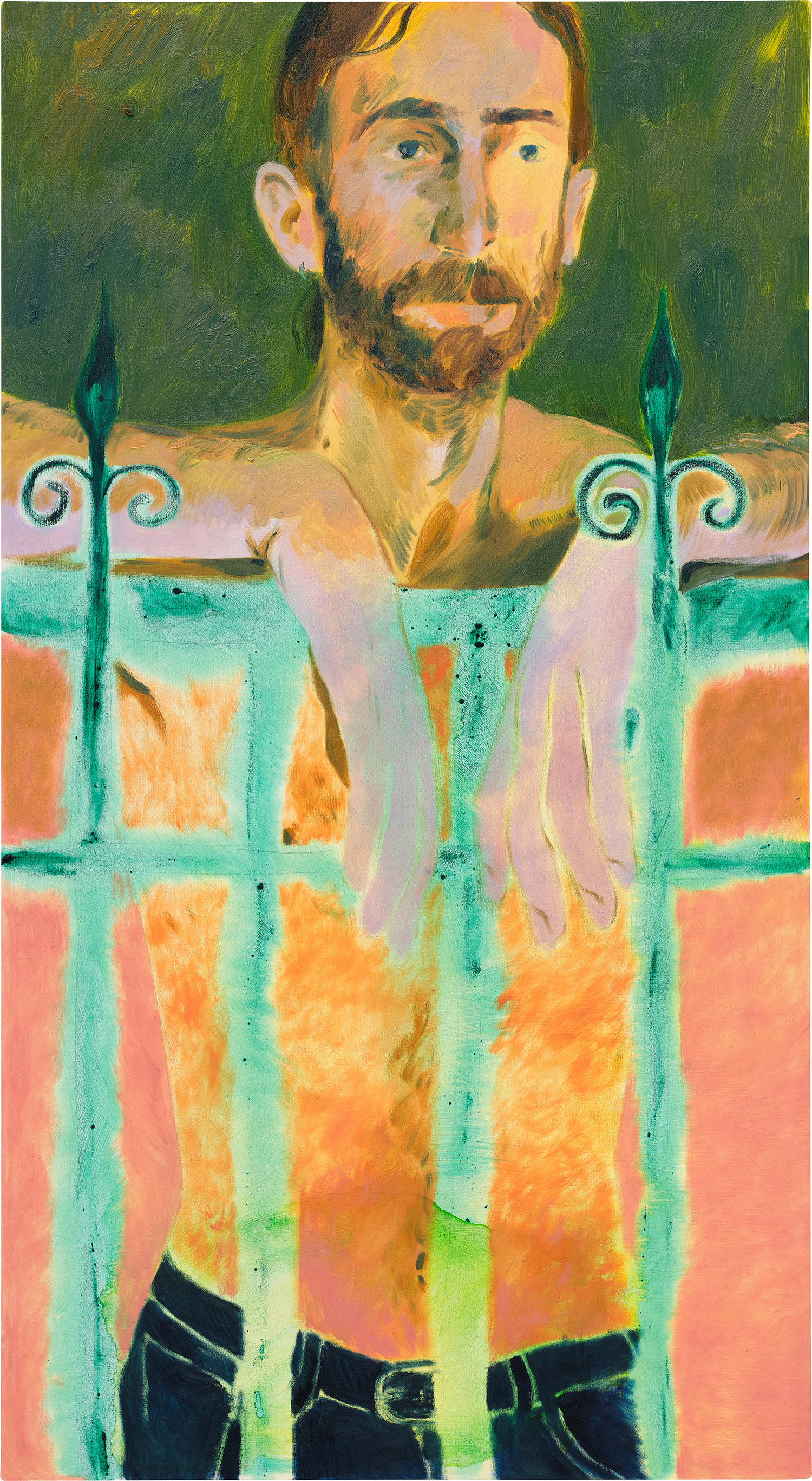
Ian on the border, 2020
A shirtless figure stands before ornate iron railings, their torso a field of vivid orange and gold, arms draped along the horizontal bars of the gate with a quality that hovers between cruciform tension and casual ease. The gate itself is painted in that signature turquoise that recurs through Cudahy's work, a color both decorative and slightly otherworldly, drawn from somewhere between a dream of the Mediterranean and a memory of a particular afternoon. The background is a flat coral pink behind the figure and a dense forest green above, and together these planes create a stage rather than a setting. The figure is both contained by and commanding of the space around him.
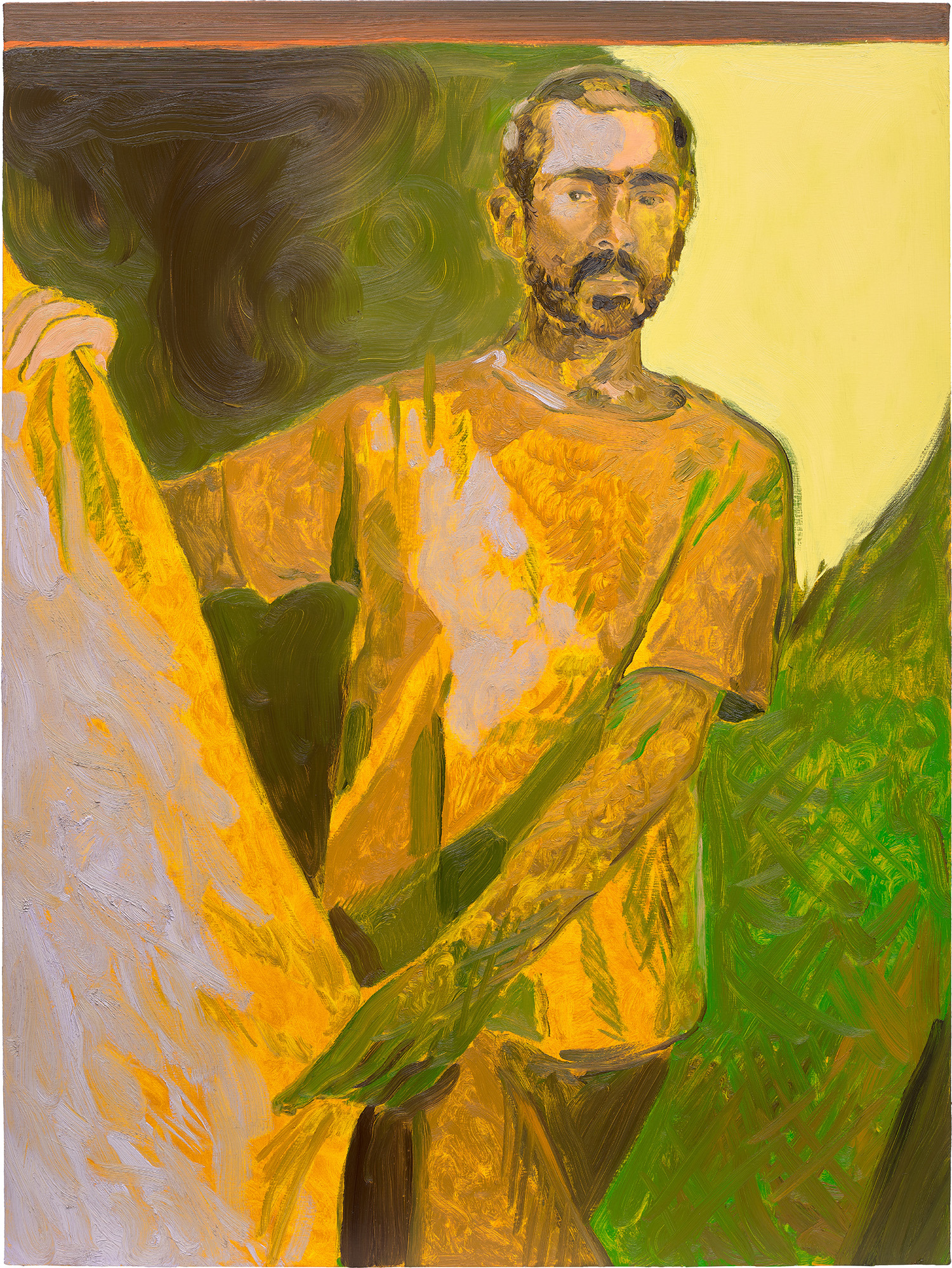
In the third painting, a man in an amber shirt stands in a landscape, one hand drawing back what appears to be a large cloth or sheet, revealing or concealing depending on how long you look. The yellow is almost aggressive in its warmth, the figure lit as though from within, and the gesture of pulling back fabric carries a quality of quiet revelation. These three canvases together demonstrate the range Cudahy moves across: the intimate close portrait, the architecturally structured figure study, the figure in landscape performing some private act of disclosure. Each mode is equally assured.
Anthony Cudahy
Untitled
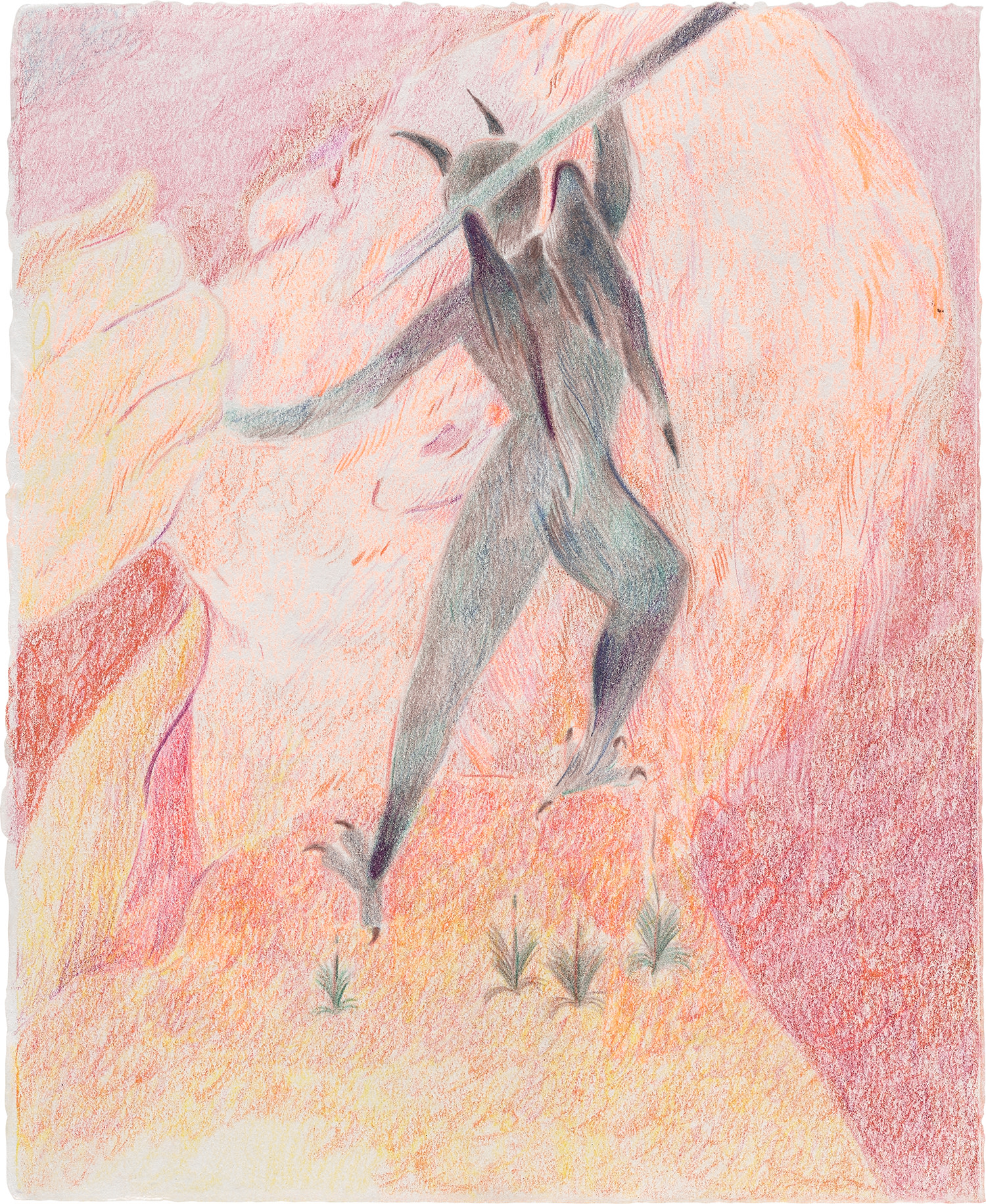
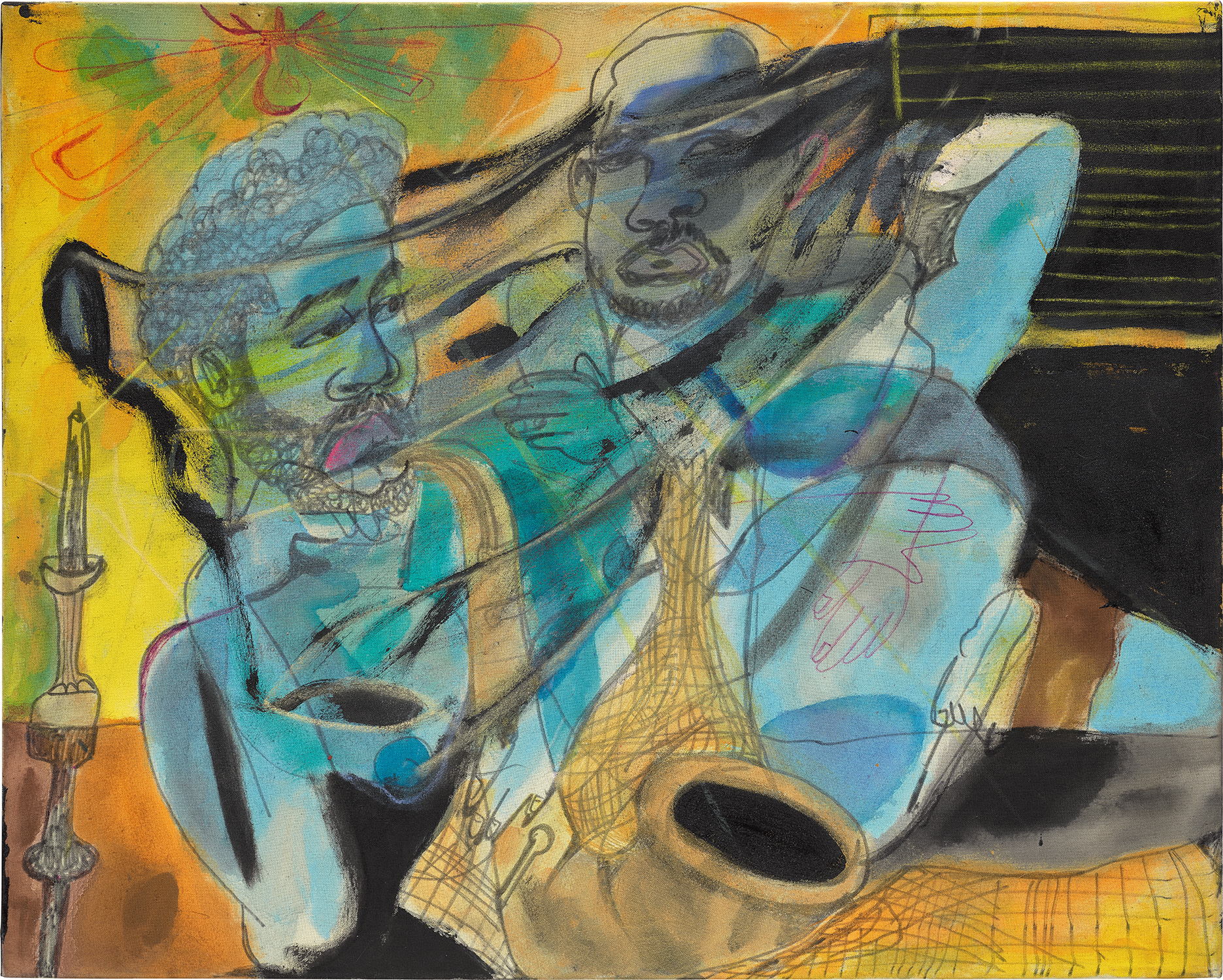
The works in Cudahy's wider practice, including paintings such as Ian on the Border, Two in Conversation, and Stage Layers, extend these themes with a formal rigor that becomes more apparent the more time you spend with his oeuvre. His titled works often place figures in relation to one another or to the edges of spaces, and the titles themselves carry a gentle narrative charge without over explaining. Ian with Knots, from 2017, suggests both physical constraint and emotional entanglement; Touch and Demon, a colored pencil work on paper, shows his facility with the more intimate register of drawing. Across media, the emotional temperature remains consistent: warm, searching, never resolved too quickly.
For collectors, Cudahy's work represents one of the more compelling opportunities in contemporary American painting right now. He works across scales, from more intimate works on paper to substantial oil canvases that command a wall with authority, and the variety of media means there are genuine entry points at multiple price levels. His oils, particularly those featuring figures in the layered architectural or domestic settings he favors, are the works most likely to appreciate in significance over time. The palette is distinctive enough to be immediately recognizable but not so mannerist that it limits the work; these are paintings that live well in rooms, that reward sustained looking, and that hold their weight among other strong works in a collection.
Anthony Cudahy
Stage (layers), 2021
Within the broader landscape of contemporary figurative painting, Cudahy occupies a position adjacent to but distinct from artists like Jordan Casteel, Issy Wood, or Toyin Ojih Odutola, all of whom share an interest in the representation of intimacy and the politics of who is seen. What distinguishes Cudahy is a particular quality of light and a commitment to depicting figures at moments of private withdrawal, of looking down or away, of being caught in thought rather than in performance. His figures do not return the viewer's gaze with frequency; they are absorbed in themselves, which paradoxically draws the viewer in more completely. Cudahy matters today because he is doing something that is genuinely difficult: he is making paintings about tenderness that are not sentimental, about the body that are not voyeuristic, about queer life and queer love that carry no apology and no explanation.
The paintings ask only that you come close and look carefully, which is everything a great painting should ask. As the conversation around figurative art continues to expand and deepen, Cudahy's work will be among the touchstones that define what this moment in American painting was reaching toward.
Featured Works
Explore books about Anthony Cudahy
Anthony Cudahy: American Painter and Modernist Pioneer
Sarah Mitchell
The Cudahy Collection: Paintings and Drawings 1950-1990
Museum of Contemporary Art Milwaukee
Modernism in Milwaukee: The Cudahy Legacy
James Peterson
Color and Form: Anthony Cudahy's Abstract Vision
Eleanor Davies