Andrew Salgado
Andrew Salgado Paints the World Gloriously Alive
Artist Spotlight · The Collection Editorial
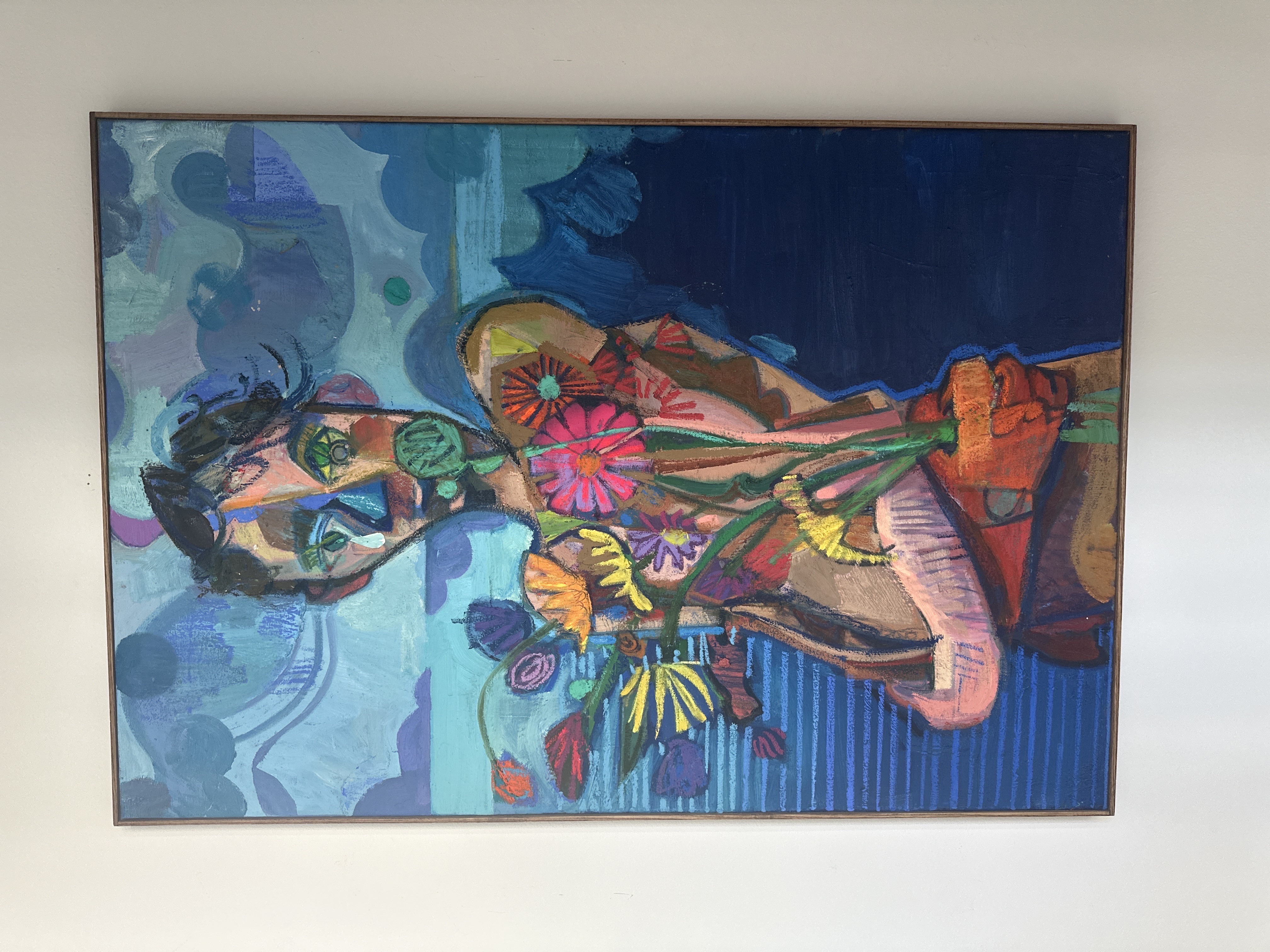
There are painters who render the figure and painters who resurrect it. Andrew Salgado belongs firmly to the second category. His canvases arrive with the force of a revelation, figures emerging from storms of color and gesture as though the act of painting them into existence is itself an act of love. In recent years, his work has attracted serious institutional and collector attention across Europe and North America, and his 2025 canvas Venus As A Boy stands as a powerful declaration of intent from an artist who continues to deepen and expand his already formidable practice.
Andrew Salgado
Venus As A Boy, 2025
At a moment when figurative painting commands the heights of the contemporary art world, Salgado is not merely participating in the conversation. He is shaping it. Salgado was born in 1982 in Regina, Saskatchewan, a city on the vast Canadian prairies whose particular quality of light and landscape leaves a mark on anyone who grows up beneath its enormous skies. He studied at the University of Regina, where his foundational sensibility was formed.
But it was his decision to leave Canada for London that catalyzed the transformation of a promising student into a serious artist. He completed his Master's degree at Chelsea College of Art and Design, one of the most rigorous and celebrated postgraduate programs in the world, a place that has shaped generations of painters who think carefully about what figurative art can do and say in the contemporary moment. London proved to be the right environment at the right time. The city's galleries, its density of cultural argument, its communities of queer artists and writers and thinkers all fed into a practice that was becoming more ambitious and more personal simultaneously.
Andrew Salgado
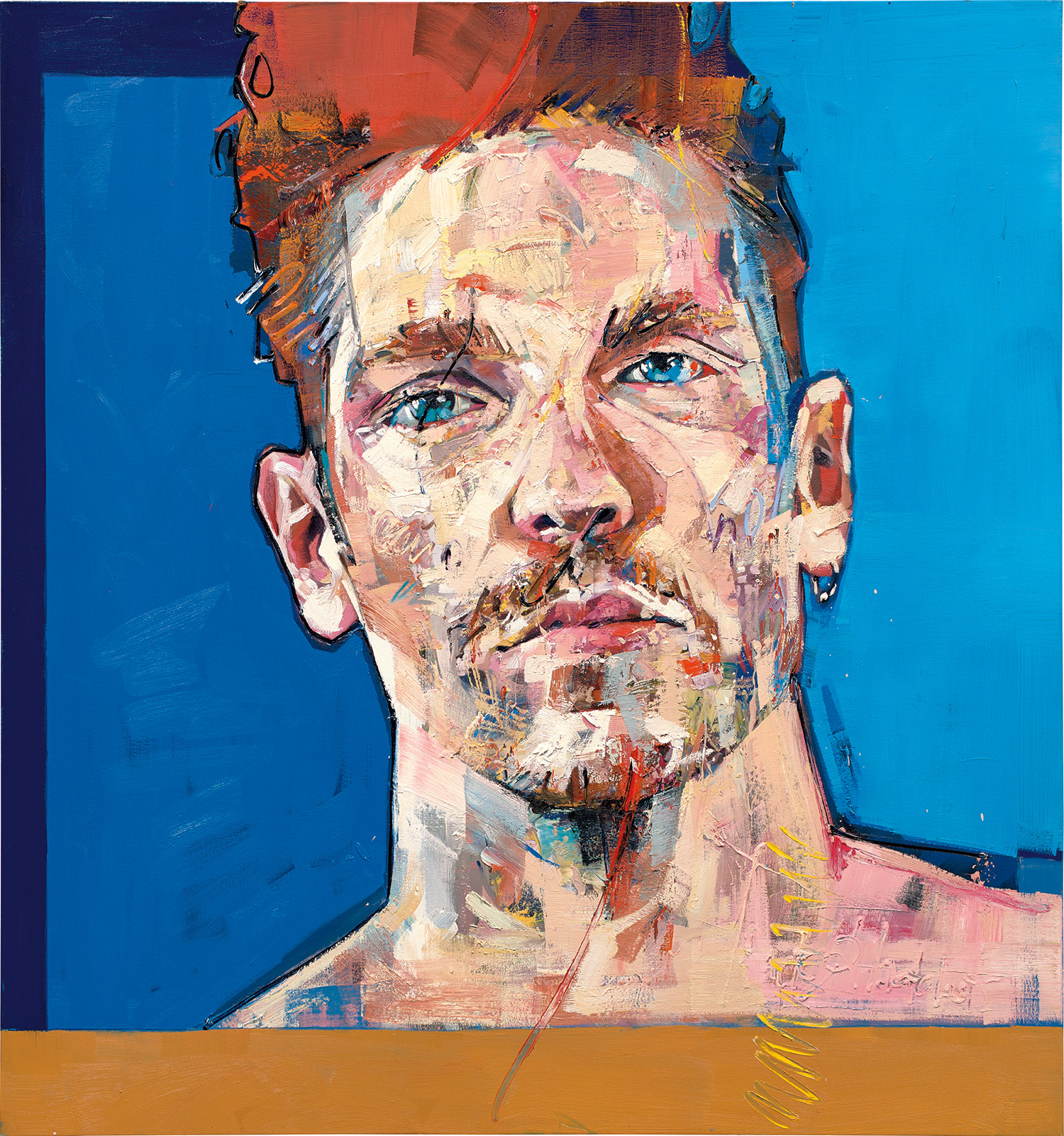
Blue Portrait of Jake, 2015
Salgado began exhibiting seriously in London and built a reputation as an artist unafraid to bring emotional velocity to the painted surface. His work from the mid 2010s onward shows a painter in full command of his means, deploying bold gestural brushwork and a vibrant, sometimes confrontational color palette in service of a vision that is both formally sophisticated and humanly urgent. The figures in his paintings do not sit still. They vibrate with interiority.
The body of work Salgado has produced over the past decade is defined by a sustained engagement with portraiture as a form of witness. His paintings frequently feature figures rendered with expressive distortion, faces and forms that suggest psychological complexity rather than literal description. Blue Portrait of Jake, painted in 2015, is an excellent example of what makes his portraiture so distinctive. The work does not simply document a sitter.
It inhabits a shared emotional space between painter and subject, the blue palette functioning not as a mood descriptor but as a structural language, a way of organizing feeling on the surface of the canvas. There is a tenderness in this painting that stops you, and a technical confidence that sustains your attention long after the initial emotional impact lands. Venus As A Boy, completed in 2025, marks a new chapter. The title alone signals the richness of Salgado's intellectual ambitions.
By placing a mythological figure associated with beauty, desire, and femininity in dialogue with a more fluid and contemporary sense of identity, Salgado creates a painting that speaks to both art history and the present tense with equal fluency. It is characteristic of his best work in that it refuses easy resolution. The painting holds its tensions with grace, which is a much harder achievement than it might first appear. Artists who work at the intersection of queer identity, portraiture, and painterly tradition must navigate a great deal of received imagery and received sentiment.
Salgado navigates it with real authority. For collectors, Salgado represents a compelling proposition at a particularly interesting moment. Figurative painting has moved to the center of the market with considerable speed over the past decade, and the artists being recognized as central to this movement are those whose work combines genuine emotional intelligence with formal seriousness. Salgado satisfies both criteria.
His earlier works, including canvases from the 2014 to 2018 period, offer collectors the opportunity to engage with a body of work that has already demonstrated its staying power, while new paintings like Venus As A Boy confirm that the artist is still in a period of active development and expanding ambition. Galleries representing his work have noted consistent and growing interest from both institutional and private buyers across the United Kingdom and internationally. In terms of art historical context, Salgado belongs to a lineage of painters for whom the figure is never merely decorative but always a site of interrogation. His work invites comparison with artists such as Lynette Yiadom Boakye, whose fictional portraits carry enormous psychological weight, and with the expressive figuration associated with painters like Cecily Brown and the legacy of Francis Bacon, though Salgado's particular combination of queer perspective and chromatic intensity gives his work its own distinct signature.
He is also in productive conversation with a generation of artists who have brought identity and sexuality to the painted surface without reducing those subjects to polemic. His paintings are arguments made in the language of pleasure. What Andrew Salgado ultimately offers is something the best figurative painting has always offered, which is the experience of feeling genuinely seen. His subjects look out from the canvas with a complexity that mirrors our own, and the generosity of his brushwork suggests a painter who approaches each figure as someone worth the full effort of attention.
At a time when the art world is correctly celebrating a wider range of voices and visions, Salgado's practice stands as a reminder that painting at its most ambitious is both a personal and a collective act. He paints individuals and in doing so reminds us what we share. That is not a small thing. That is exactly what painting is for.