Andreas Slominski
Andreas Slominski: The Wit of the Trap
Artist Spotlight · The Collection Editorial
There is a particular quality of stillness that settles over a room when Andreas Slominski has been at work. A mousetrap sits on a plinth. A windmill turns slowly in a gallery breeze. A roof hatch waits, sealed and patient, for someone who will never arrive.
Andreas Slominski
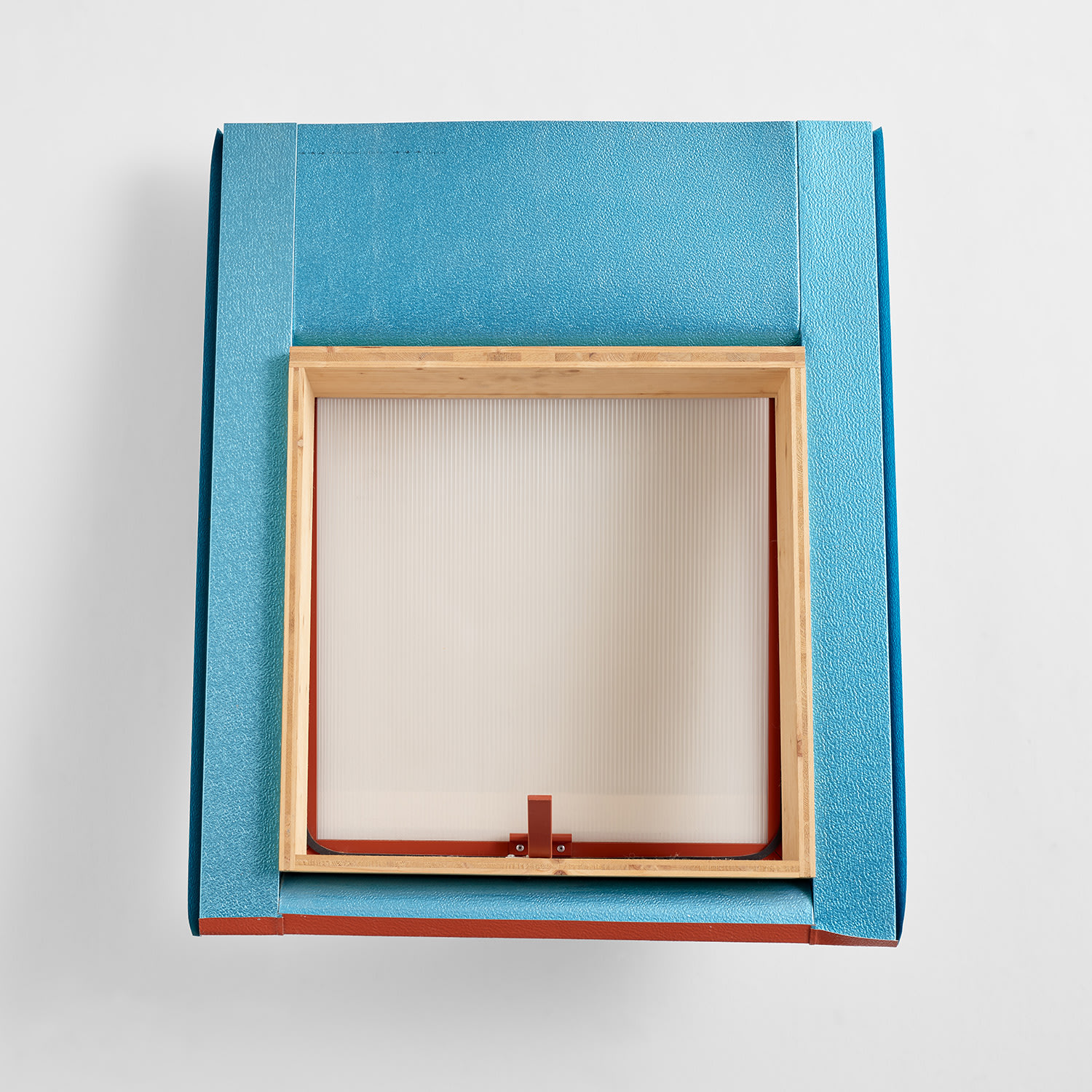
Roof Hatch, 2012
These are not decorations or provocations in the conventional sense. They are propositions, and the longer you spend with them, the more you feel that the proposition concerns you specifically. It is a feeling that has followed Slominski from the earliest days of his career in Hamburg through decades of international exhibitions, and it remains as potent today as it ever was. Slominski was born in 1959 in Germany, and his formation as an artist took place in Hamburg, where he studied at the Hochschule für Bildende Künste during the 1980s.
Hamburg was not Düsseldorf or Cologne, the twin capitals of postwar German art, and there is something deliberate in the way Slominski's practice seems to stand apart from the grand rhetorical gestures associated with those cities. Where Beuys sought transformation through mythology and Richter pursued the image through relentless conceptual pressure, Slominski went quieter, stranger, and in some ways more unsettling. His early work from the late 1980s, including pieces such as the fabric work from 1988, already signals an artist attuned to the gap between an object's appearance and its true purpose. The trap arrived as the defining motif of his practice in the late 1980s and early 1990s, and it has never really left.
Andreas Slominski
Schnürsenkelmühle, 1996
Slominski began constructing animal traps of extraordinary variety and invention, devices intended for foxes, moles, birds, and insects, built with the care and specificity of a craftsman and presented with the cool neutrality of a conceptualist. What made these works so disorienting was their ambiguity. They were functional objects, or at least they aspired to functionality. They were also sculptures of considerable beauty, their mechanisms rendered in painted wood, metal, and wire with a precision that rewarded close looking.
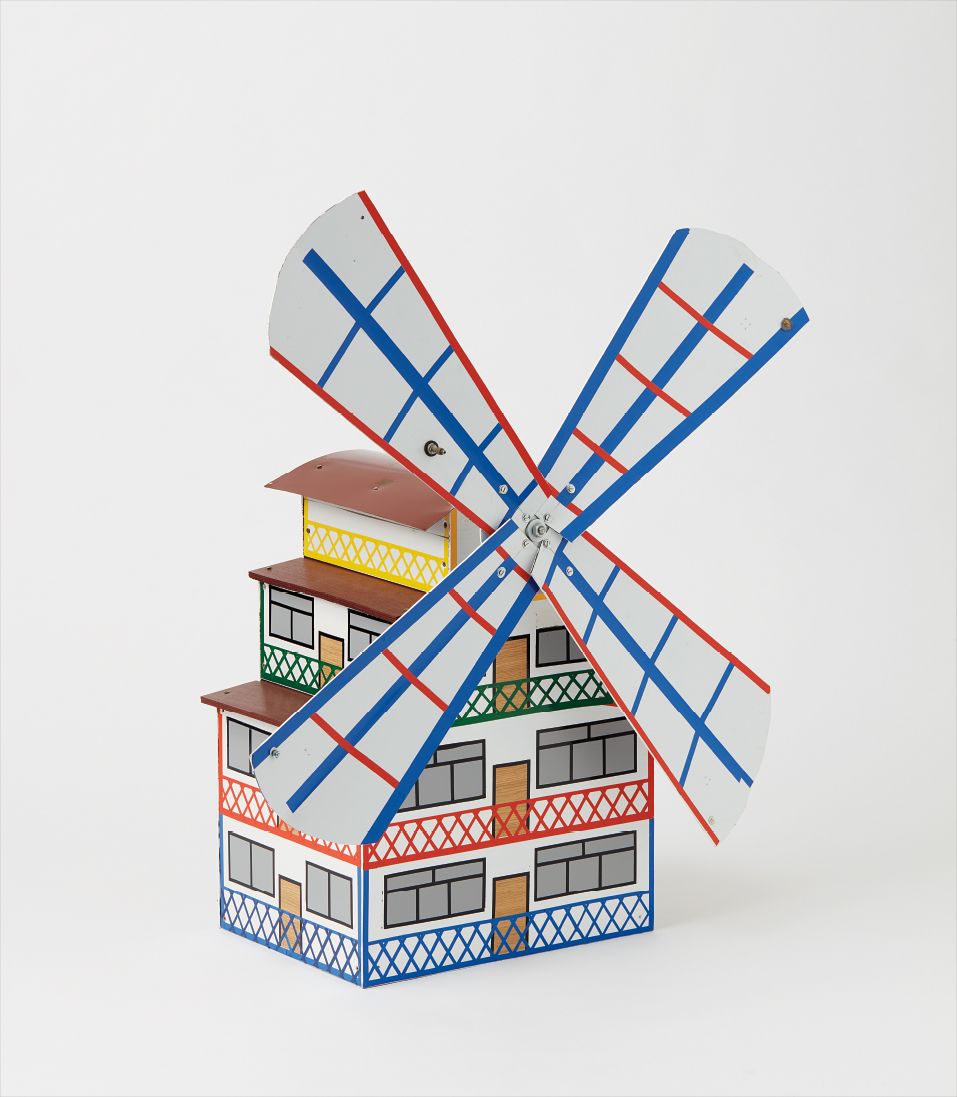
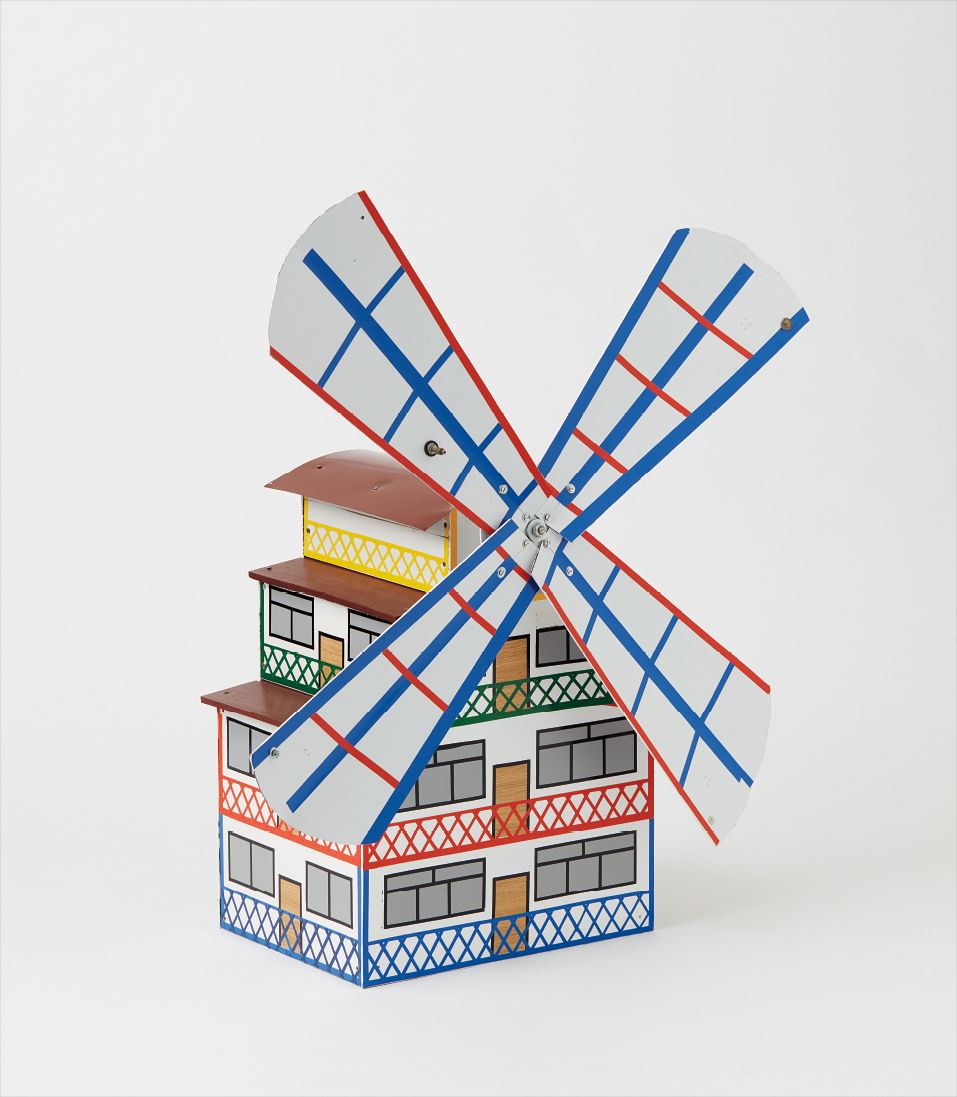
And they were ethical puzzles. To admire a trap is to occupy a complicated position, and Slominski understood that this complication was where the art lived. By the mid 1990s, Slominski had developed a body of work that placed him firmly within the conversation about institutional critique, absurdist sculpture, and the legacy of Duchamp, while remaining stubbornly individual. Works such as Schnürsenkelmühle from 1996, built from metal, painted wood, and colored film, and Windmühle from the same year, with its painted surfaces and vivid colored tape, reveal a sensibility in which mechanical logic and visual pleasure coexist with genuine strangeness.
Andreas Slominski
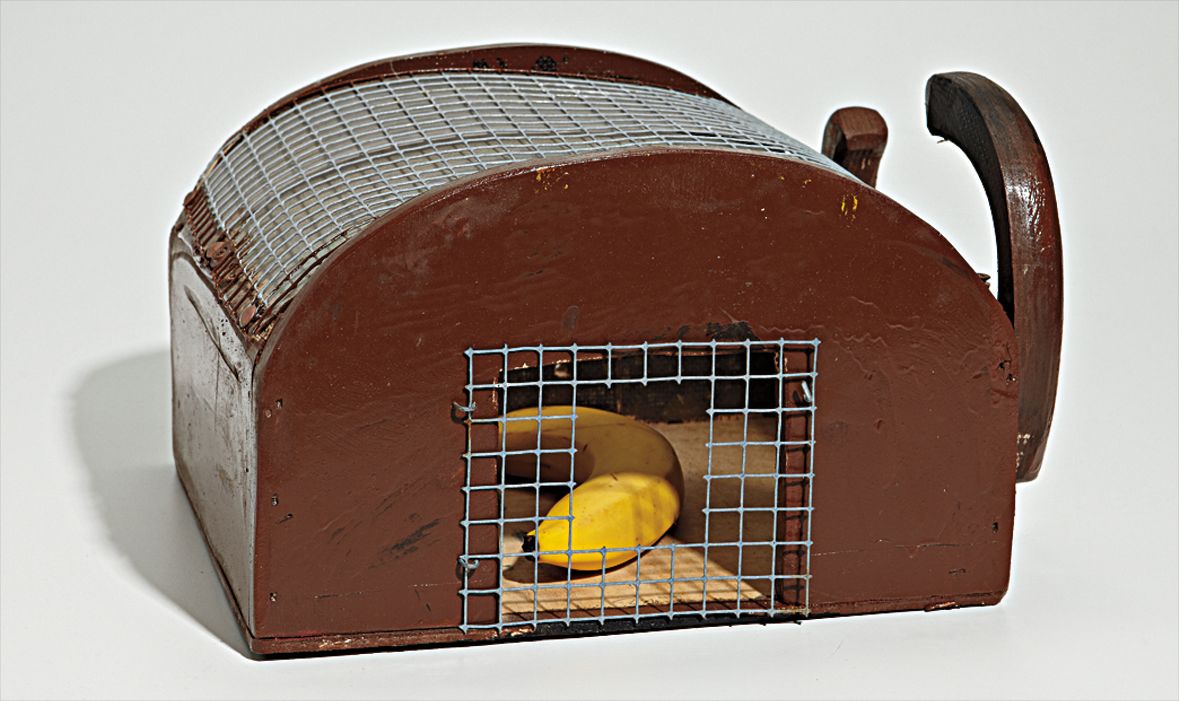
Monkey Trap
The windmill as a sculptural form is already rich with cultural association, evoking childhood, folk tradition, and the comic futility of Don Quixote, and Slominski mines all of that while remaining entirely his own. These are not illustrations of ideas. They are ideas that have taken physical form and chosen to behave oddly. The Monkey Trap stands as one of his most eloquent works in this regard.
Based on the folkloric device in which a monkey reaches into a narrow vessel to grasp a nut and cannot withdraw its fist without releasing the prize, the work operates simultaneously as object, story, and philosophical argument. The monkey is caught not by the trap but by its own desire, its own refusal to let go. Slominski does not need to say this. The work says it for him, with a patience and a dark good humor that is entirely characteristic.

Andreas Slominski
fabric, 1988
It is the kind of work that art historians reach for when they want to discuss complicity, and that collectors reach for when they want something that will reward years of living with it. Roof Hatch from 2012, one of his more recent major works, demonstrates how Slominski's thinking has continued to evolve without losing its essential character. Constructed from painted metal, wood, and plastic, it is a utilitarian object removed from utility, a threshold that leads nowhere or everywhere depending on your disposition. The hatch is a passage that has been closed, and the question of who closed it and why hangs in the air of whatever room it occupies.
It is a work of considerable formal confidence, and it sits beautifully within the context of collections that favor conceptual sculpture with a strong material presence. For collectors, Slominski represents a particularly compelling proposition. His work is held in significant public and private collections across Europe and beyond, and his institutional exhibitions have included major presentations at venues including the Kunsthalle Hamburg and galleries across Germany, Switzerland, and the wider international circuit. The work operates across a wide range of scales and materials, which means that a serious collection can represent his practice with genuine depth, from smaller works such as Mausefalle, the painted wood and string mousetrap with its almost pedagogical clarity, to the larger installations that transform entire rooms.
What collectors consistently report is the durability of the work's interest. These are pieces that do not exhaust themselves on first viewing. They accumulate meaning over time the way good literature does. Within art history, Slominski occupies a space that touches on several important lineages without being reducible to any of them.
The influence of Duchamp's readymade is obvious, but where Duchamp made the gesture of designation the point, Slominski complicates that gesture by insisting on craftsmanship, on the handmade, on the specific logic of functional objects. There are resonances with the humor of Fischli and Weiss, with the institutional scrutiny of Marcel Broodthaers, and with the behavioral interest in objects that runs through Arte Povera, yet the work remains distinctly German in its seriousness and its unwillingness to make things easy. He is an artist who rewards collectors who are willing to sit with discomfort and find the pleasure in it. Slominski's legacy is the legacy of an artist who understood that the most interesting territory in contemporary art often lies precisely where things do not work as they are supposed to.
His traps do not only catch animals. They catch attention, catch assumptions, catch the viewer in the act of thinking one thing and discovering they mean another. That is a rare achievement, and it is one that places him among the most genuinely original voices in the art of his generation. To collect Slominski is to invite a particular quality of aliveness into a space, the sense that something is always just about to happen.