Amedeo Modigliani
Modigliani: A Singular Vision, Eternally Modern
Artist Spotlight · The Collection Editorial
“What I am searching for is neither the real nor the unreal, but the subconscious, the mystery of what is instinctive in the human race.”
Amedeo Modigliani
There are artists whose work you recognize before you can name them, whose visual language feels so complete and so personal that it seems to have arrived fully formed from some private universe. Amedeo Modigliani is one of those artists. In recent years, his presence in major institutions has only grown more insistent: the Tate Modern in London devoted significant attention to his nudes in a landmark exhibition that drew enormous crowds and reignited debate about the radical intimacy of his gaze, while auction houses including Christie's and Sotheby's have consistently placed his oils and drawings among the most coveted lots in 20th century sales. A 2018 sale at Sotheby's saw one of his female portraits exceed expectations in a room crackling with competitive energy.
Amedeo Modigliani
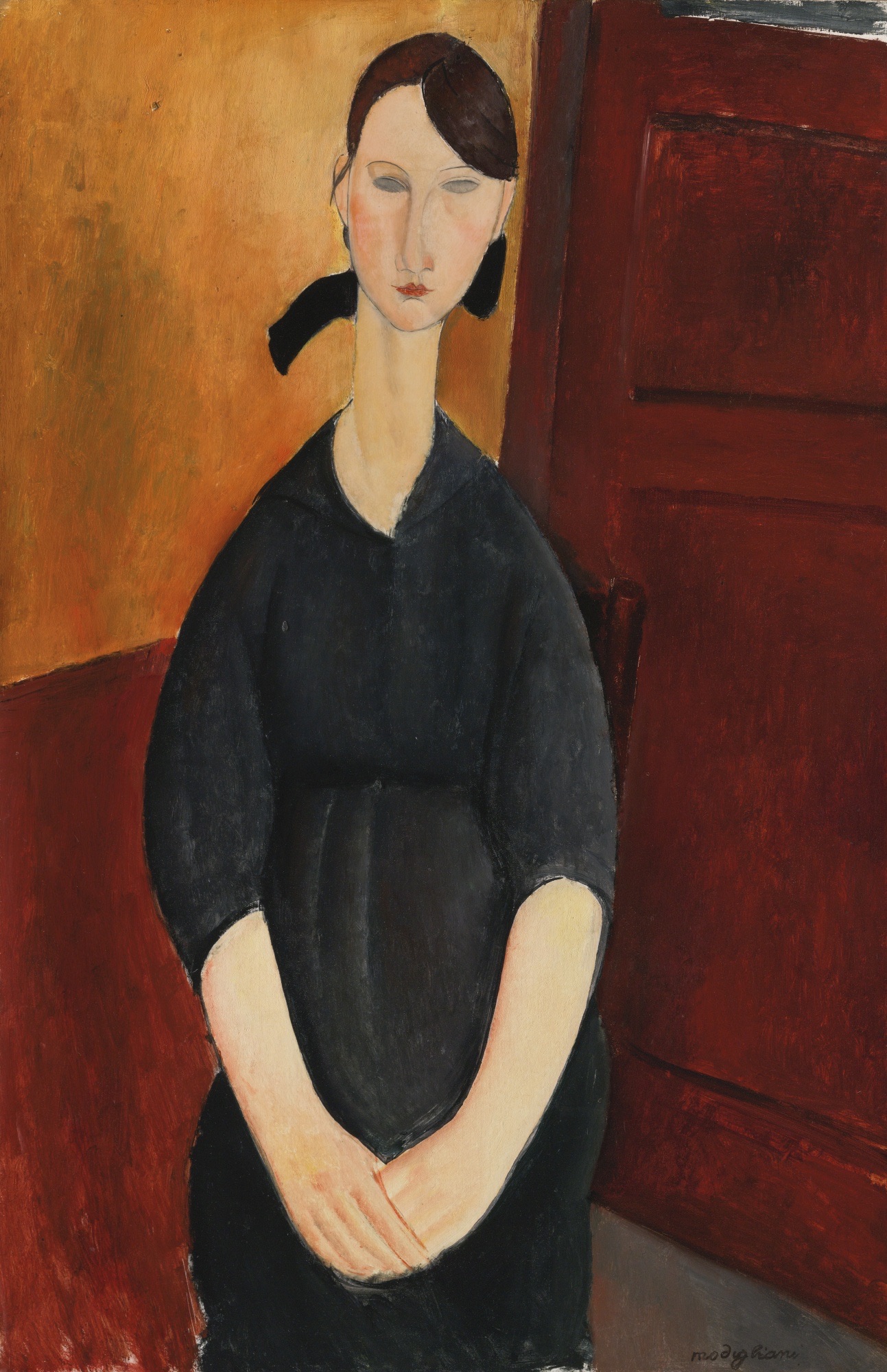
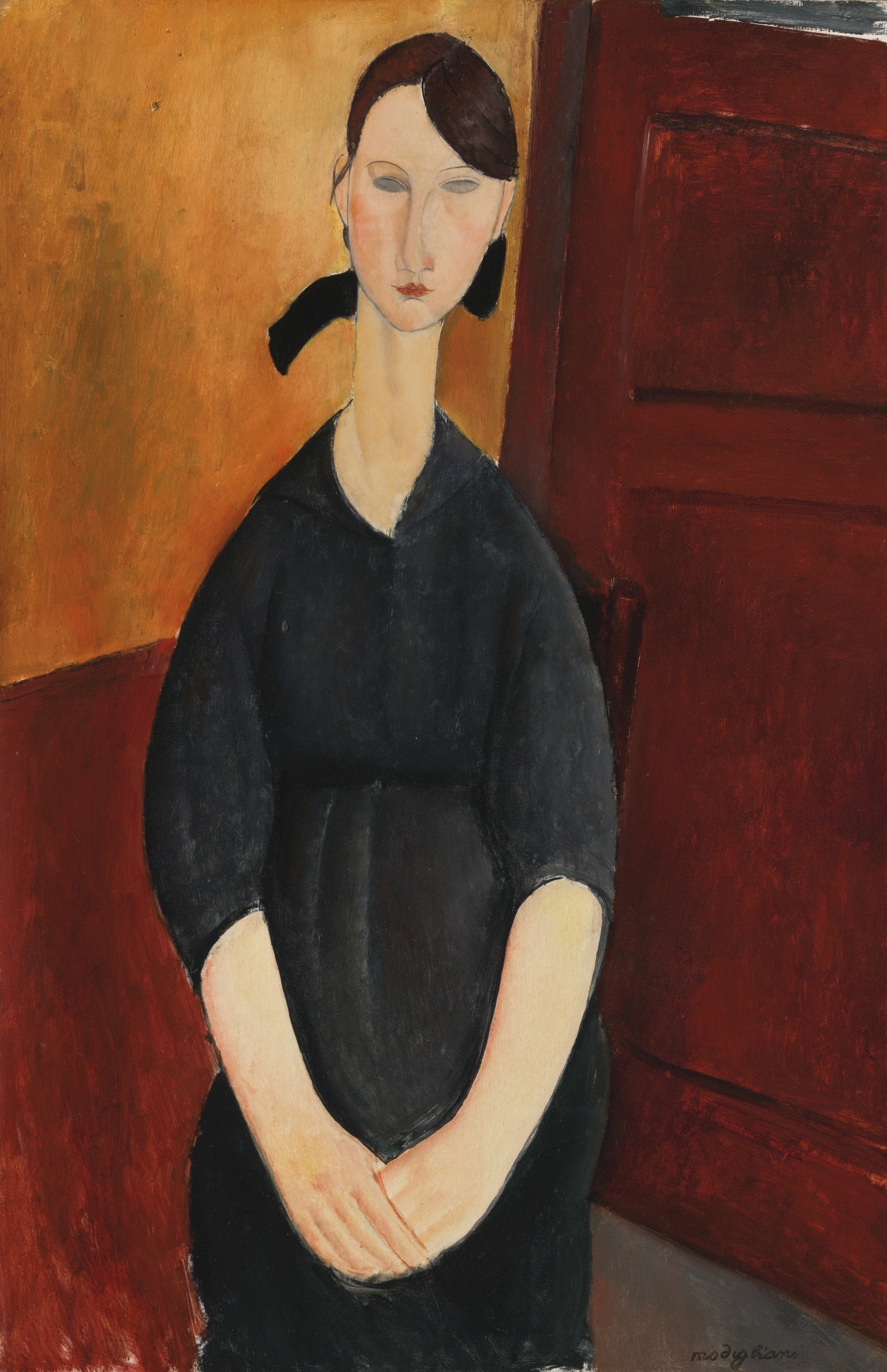
Paulette Jourdain, 1919
For collectors and scholars alike, Modigliani remains a figure of inexhaustible fascination. Amedeo Clemente Modigliani was born in Livorno, Italy, in 1884, the youngest child of a Sephardic Jewish family whose fortunes had recently declined. The culture of that household was rich in conversation and ideas even when material comfort was scarce, and his mother Eugenia, a woman of considerable intelligence who kept a diary and ran a school, recognized her son's gifts early. Illness defined much of his childhood: tuberculosis shadowed him from adolescence onward, shaping both his physical fragility and a certain intensity of purpose that would mark everything he did.
He studied drawing and painting in Livorno, then in Florence and Venice, absorbing the lessons of the Italian Renaissance with a seriousness that never left him even as he went on to embrace modernism with equal conviction. In 1906, Modigliani arrived in Paris, settling eventually in the bohemian enclave of Montparnasse, where he would spend the rest of his short life. The city was seething with creative ambition. Pablo Picasso had just completed Les Demoiselles d'Avignon.
Amedeo Modigliani
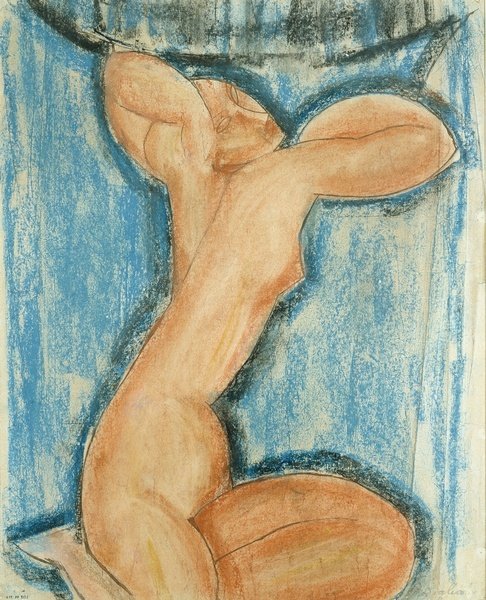
Cariatide, 1913
Constantin Brancusi, who would become a close friend and lasting influence, was distilling sculpture to its most essential forms. Modigliani threw himself into this world with characteristic abandon, befriending artists, poets, and dealers, drinking in the galleries and the conversations of cafes in equal measure. He spent several years working primarily as a sculptor, carving elongated stone heads that bear the clear imprint of his encounters with African art and with the ancient Mediterranean traditions he had studied as a young man in Italy. The physical demands of stone carving, combined with the dust it produced, proved too great a strain on his lungs, and he gradually returned to painting and drawing, bringing with him everything sculpture had taught him about volume, weight, and the eloquence of simplified form.
The paintings and drawings that followed represent one of the most immediately distinctive bodies of work in all of modernism. Modigliani's portraits and nudes are recognizable at a glance: the faces elongated as if seen through a gently distorting lens, the necks stretching upward with a swanlike gravity, the eyes rendered as tilted almond shapes that are sometimes filled with a flat, unmodulated color and sometimes left entirely blank, their pupils absent in a way that feels neither inhuman nor cold but rather profoundly interior. He was never a Cubist in the strict sense, though he understood what Picasso and Braque were doing and responded to it on his own terms. He was equally attentive to the formal economy of Cézanne and to the sinuous line of Italian Mannerism.
Amedeo Modigliani
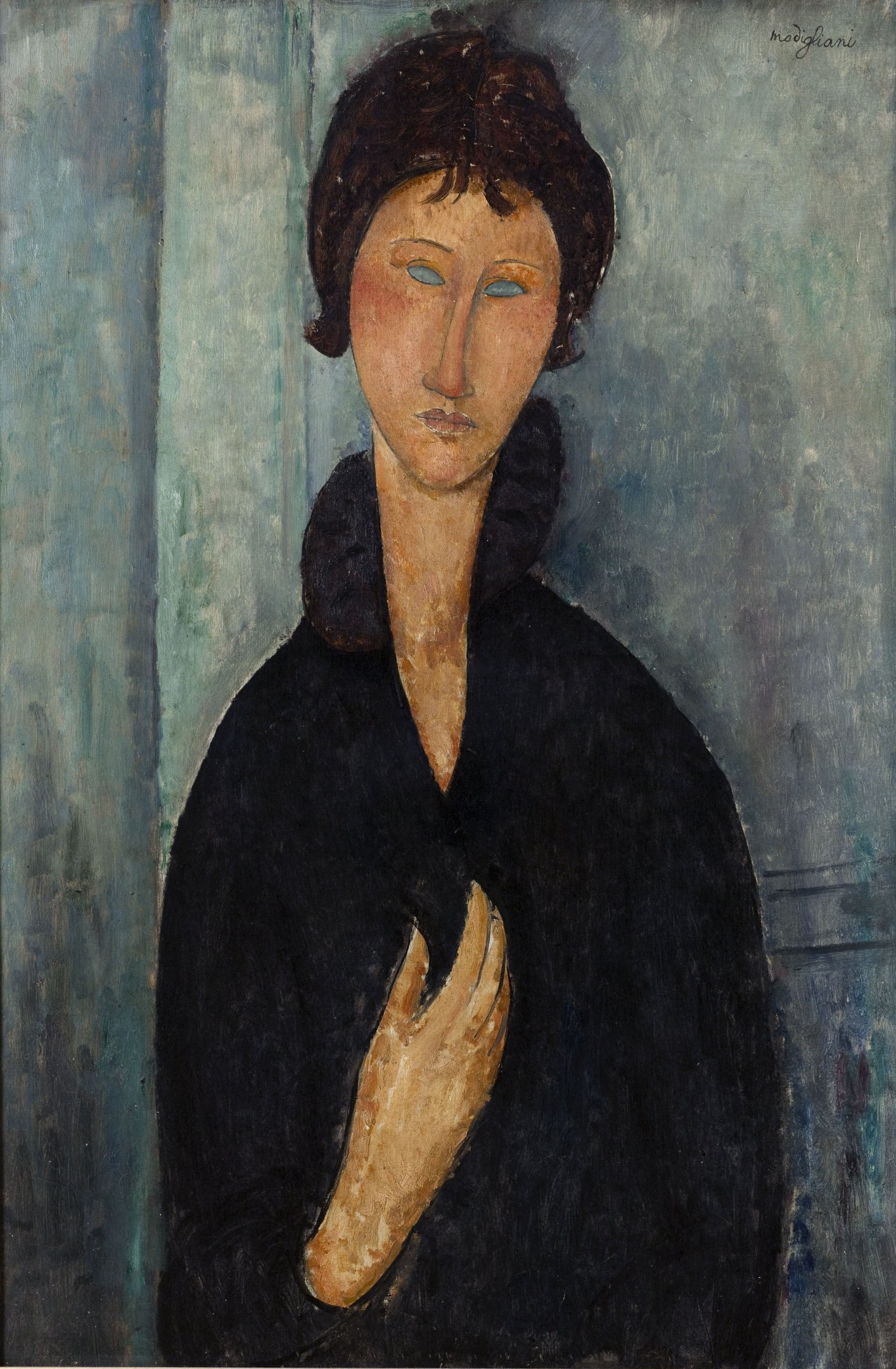
Femme aux yeux bleus, 1918
What emerged from all of these encounters was something that belonged entirely to him: a style of portraiture in which psychological depth and formal beauty reinforce rather than compete with one another. Among the works available on The Collection are some of the finest examples of his draftsmanship and painterly skill. "Paulette Jourdain" from 1919 is a late portrait of remarkable warmth, painted just a year before his death, in which the sitter's youth and Modigliani's by then deeply practised hand combine to produce something quietly radiant. "Femme aux yeux bleus" from 1918 demonstrates his mastery of oil paint at full stretch, the blue eyes of the title making the work both arresting and tender in equal measure.
The drawings, including the crayon works from 1913 and the ink studies of female figures, reveal the foundation of his practice: a line of extraordinary confidence and sensual intelligence, capable of describing the entire weight and presence of a human body in a handful of fluid gestures. "Cariatide" from 1913, executed in graphite, connects his sculptural preoccupations to his draughtsmanship in ways that reward close study. These works on paper are not preparatory sketches in the conventional sense; they are finished thoughts, complete in themselves. From a collecting perspective, Modigliani occupies a position of secure and enduring importance in the blue chip tier of the modern art market.
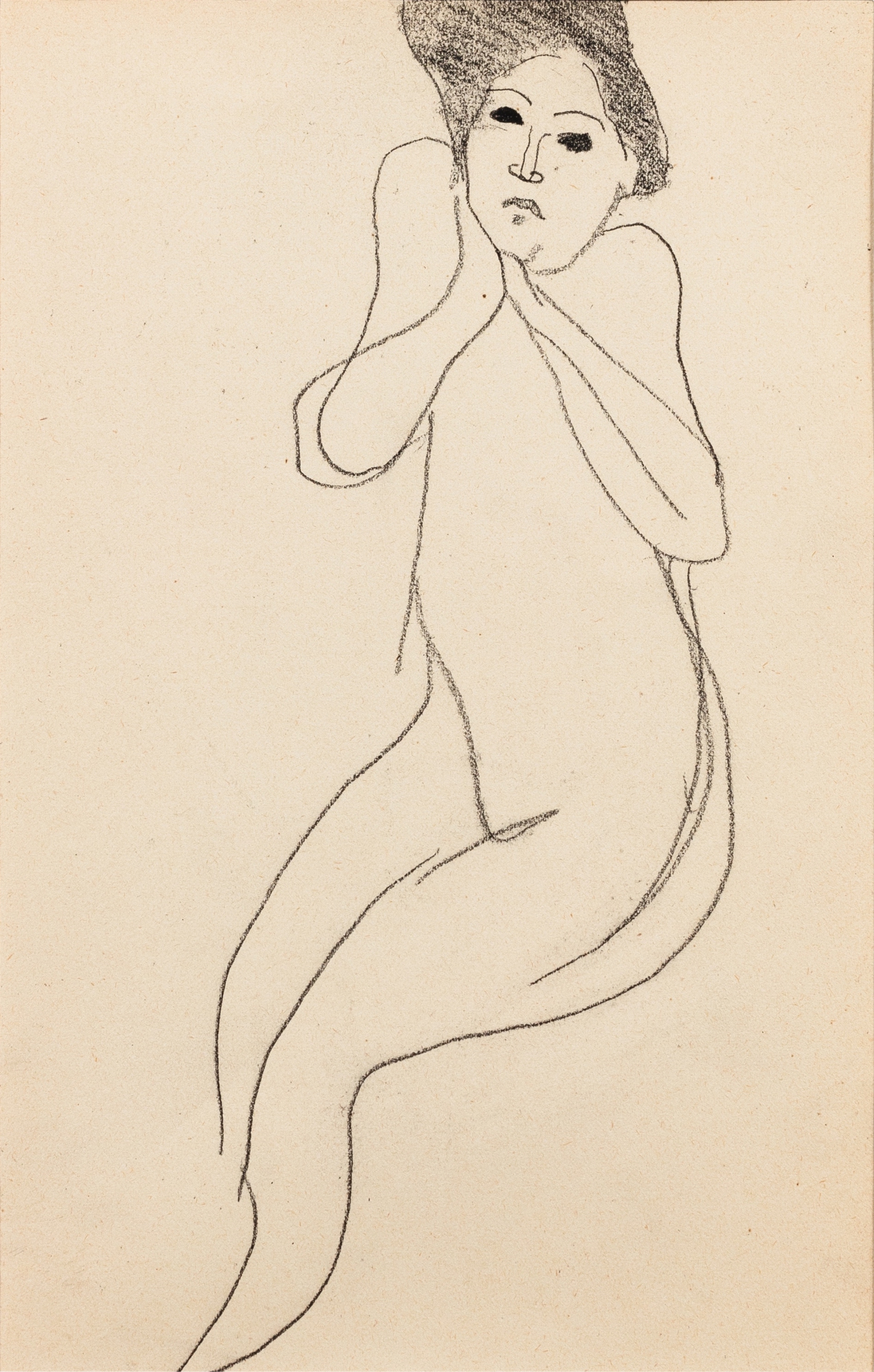
Amedeo Modigliani
Femme nue de trois quarts vers la gauche étendue sur un canapé, main au menton (recto); Deux têtes d'homme de face dont un autoportrait présumé de Modigliani (verso), 1905
His oils command the highest prices, with major portrait canvases having sold for tens of millions of dollars at auction over the past two decades. His works on paper, however, represent one of the more compelling opportunities in the market for serious collectors: they are more accessible in price while demonstrating the full force of his artistic intelligence, and they connect directly to the sculptural and figurative concerns that animated his entire career. Provenance is a particularly important consideration with Modigliani, given the long and complex history of his estate and the significant number of forgeries that have circulated over the decades. Collectors are advised to work closely with specialists and to seek works with clear and well documented histories.
To understand Modigliani fully, it helps to see him in the company of those he worked alongside and those who shared his preoccupations. Chaim Soutine, his close friend and fellow resident of Montparnasse, brought an expressionistic violence to figuration that contrasts productively with Modigliani's cooler, more formally resolved approach. Brancusi's influence on his sculpture is direct and acknowledged. The Italian tradition he carried within him places him in a longer lineage that runs from Botticelli through the Mannerists and into the modern era.
He was also deeply shaped by Paul Cézanne's structural thinking and by the way African art had challenged European conventions of representing the human face, a challenge he answered in his own entirely personal terms. Amedeo Modigliani died in Paris in January 1920, at the age of thirty five, from tubercular meningitis. He left behind a body of work that has only grown in stature with time. What makes him matter today is not the pathos of his biography, compelling as that story is, but the quality of sustained attention that every painting and drawing demands and rewards.
He looked at the people in front of him, the artists and poets and lovers and strangers of Paris, with a concentration and a tenderness that transformed looking itself into a kind of devotion. In an era when figurative painting has returned to a position of genuine critical seriousness, his example feels not like history but like a living conversation.
Explore books about Amedeo Modigliani
Modigliani: A Life
Jeanne Modigliani
Modigliani
Douglas Hall
Modigliani: Prince of Montparnasse
izzy Wilde
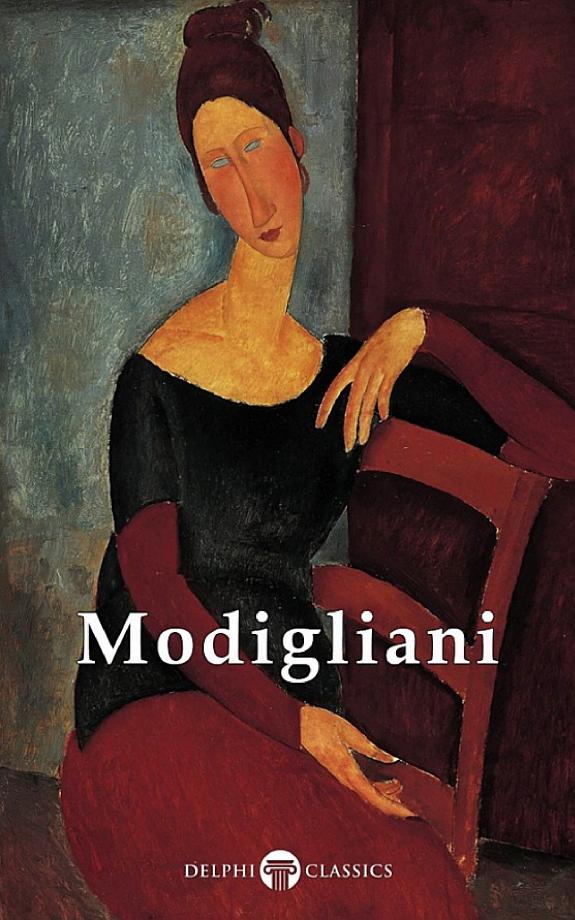
The Complete Paintings of Modigliani
Franco Russoli and Filiberto Menna
Modigliani: Catalogue Raisonné
Arnaldo Francini and Marc Restellini
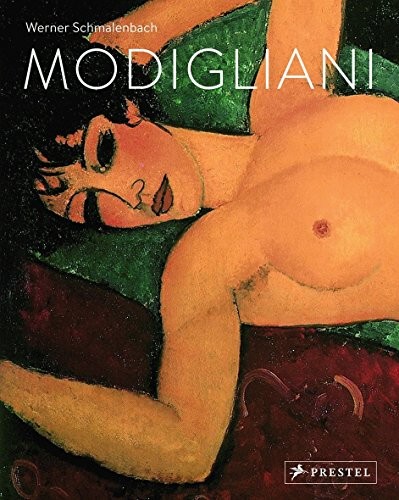
Modigliani
Werner Schmalenbach
Modigliani: The Pure Modernist
Mason Klein