Ambrosius Benson
Benson's Bruges: Where Two Worlds Meet
Artist Spotlight · The Collection Editorial
Imagine Bruges in the first decades of the sixteenth century, a city still glowing with the residual warmth of its golden age, its canals reflecting the spires of churches filled with devotional art. It is here, in this atmosphere of quiet mercantile piety and exacting craft, that a painter born in Lombardy planted himself and made something entirely new. Ambrosius Benson arrived in the Southern Netherlands as an outsider and left as one of the most quietly distinguished masters of the Flemish Renaissance, a figure whose reputation has only grown more compelling as scholars and collectors look more closely at the complex cultural crosscurrents of early sixteenth century Europe. Benson was born around 1495 in Lombardy, the northern Italian region whose artistic culture was shaped by Leonardo da Vinci's lingering influence and a long tradition of refined figure painting.
Ambrosius Benson
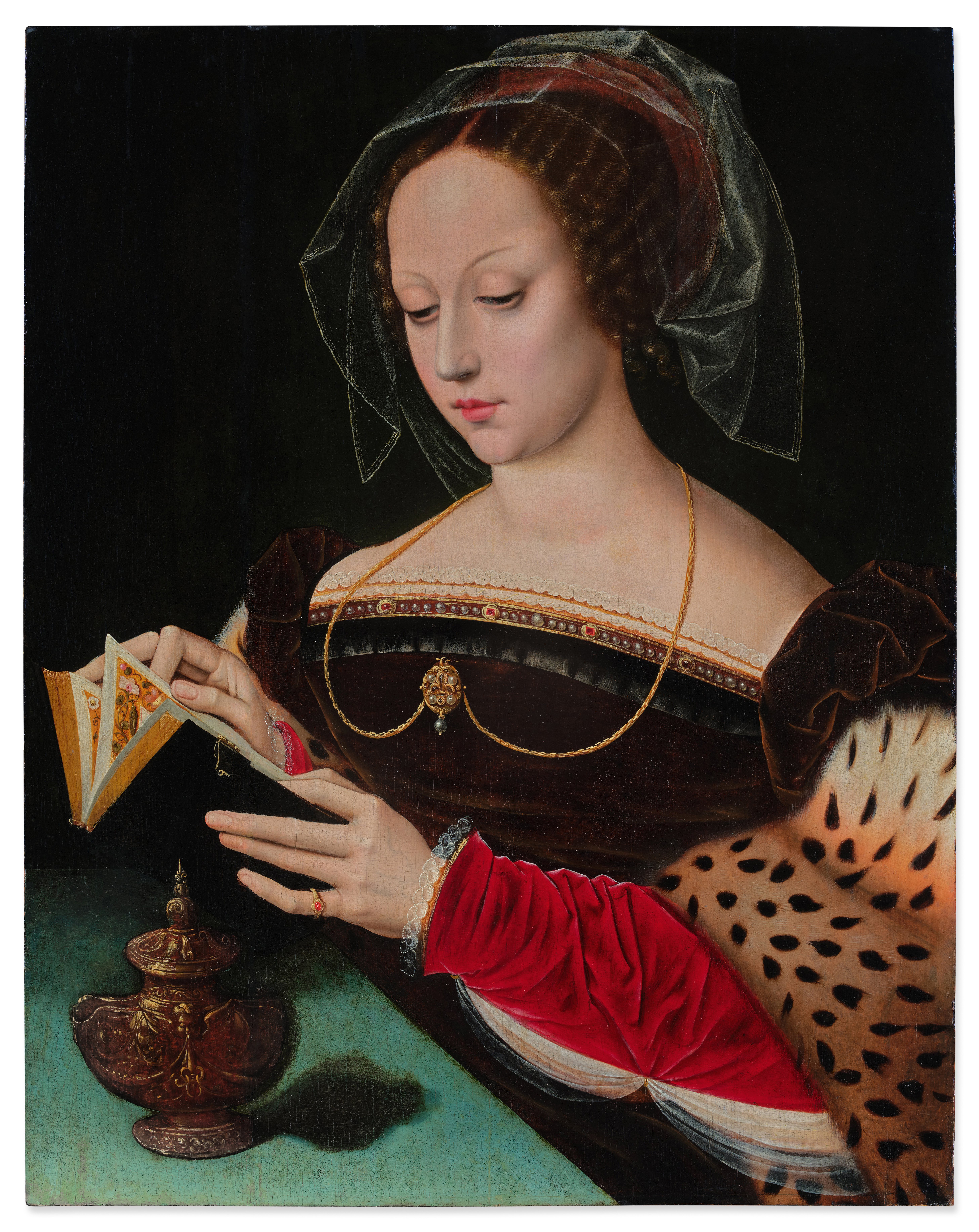
Saint Mary Magdalene Reading an Illuminated Manuscript
The precise circumstances of his early training remain something of an open question, but the evidence of Italian sensibility in his mature work is unmistakable. There is a softness in his handling of light, a sculptural warmth in the way he models faces, that speaks to a formation shaped at least in part by the Italian peninsula before he ever encountered the meticulous oil traditions of the North. He emigrated to Bruges at some point in the early sixteenth century, entering the workshop of Gerard David, one of the last great masters of the Flemish primitive tradition. His time in David's workshop was not without friction.
Benson's relationship with his master eventually soured, and legal disputes over workshop materials and practices entered the historical record, giving us one of the more vivid glimpses into the competitive and legally minded world of the Bruges guild system. By 1519 he had registered as an independent master in the Bruges painters' guild, a moment that formalized what his talent had already suggested: he was ready to work entirely on his own terms. From that point forward, his workshop became a significant production center, attracting commissions not only from local Flemish patrons but also from merchants and ecclesiastical clients in Spain and Portugal, where Flemish painting enjoyed enormous prestige. What makes Benson's artistic development so fascinating is precisely the tension between his two inheritances.
Ambrosius Benson
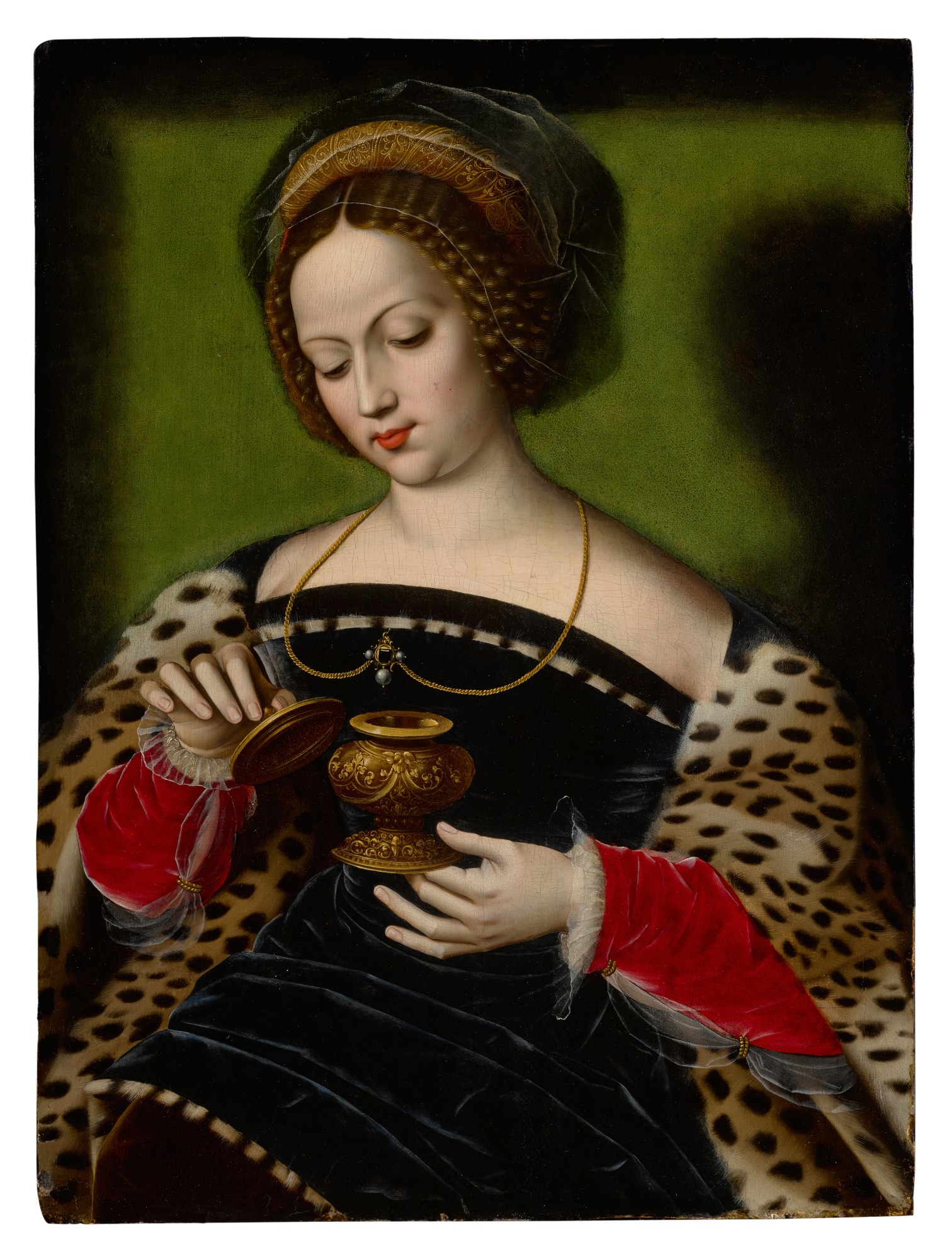
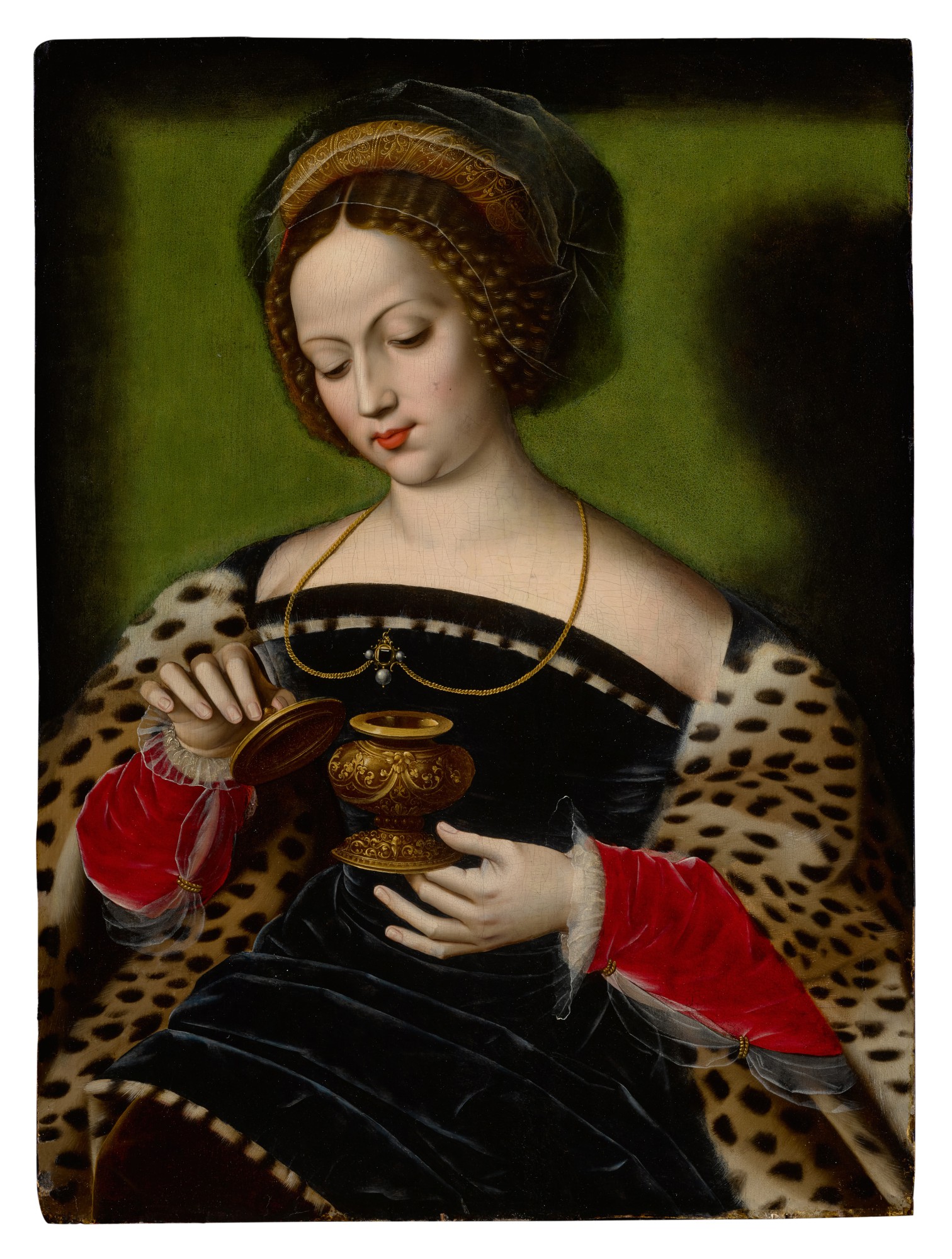
Mary Magdalene holding an ointment jar
On one hand, he absorbed from Gerard David the Flemish tradition's extraordinary commitment to surface and detail, the patient rendering of fabric, jewelry, architectural setting, and the natural world that had distinguished painters from Jan van Eyck onward. On the other hand, he brought to that tradition a Mediterranean ease, a slightly softer atmospheric quality, and an approach to portraiture that feels more intimately psychological than many of his Bruges contemporaries. The result is a body of work that feels genuinely hybrid in the best possible sense, belonging fully to neither Italy nor Flanders but existing in a luminous space between the two. Among the most celebrated expressions of this synthesis are his treatments of Saint Mary Magdalene, a subject to which he returned with notable devotion.
His painting of the Magdalene reading an illuminated manuscript is a deeply considered image, the saint absorbed in devotional text, her gaze lowered, her world contracted to the quiet intimacy of the book in her hands. Every detail of the manuscript's gilded pages and the saint's garments is rendered with the kind of attention that rewards slow, close looking. His companion work depicting Mary Magdalene holding an ointment jar takes a slightly different approach, presenting the figure with a calm, almost ceremonial composure. Together these panels represent some of the finest devotional portraiture of the northern Renaissance, images that are simultaneously specific enough to feel like real people and elevated enough to carry genuine spiritual weight.
From a collecting perspective, Benson occupies an interesting and genuinely attractive position. He is well documented in the scholarly literature and held in major museum collections across Europe and North America, yet he remains less universally recognized than contemporaries such as Jan Gossart or Bernard van Orley. This means that serious collectors who engage with his work are often those with real depth of knowledge, people who have moved beyond the obvious names and are exploring the full richness of the Flemish Renaissance. His Iberian connections also mean that his work carries particular resonance for collectors interested in the art historical exchange between Northern Europe and the Iberian Peninsula, one of the most productive and underappreciated chapters in Renaissance cultural history.
Works by Benson that appear at auction attract measured but consistent interest from museum curators and private collectors alike, particularly those panels where his signature qualities of refined portraiture and careful devotional atmosphere are strongly present. Benson's closest artistic neighbors help to situate him more precisely. Gerard David, his teacher and sometime adversary, provides the essential Flemish foundation. Jan Gossart, who was also navigating the intersection of Italian and Flemish modes during the same decades, represents a parallel experiment in cultural synthesis, though one that leans more explicitly into classical architecture and mythological subject matter.
The Master of the Female Half Lengths, whose charming small panels of women reading and making music share a certain quiet intimacy with Benson's devotional figures, suggests the broader community of taste in which Benson's work found its audience. Looking southward, the influence of Leonardo's circle in Milan and the broader Lombard tradition of refined, psychologically attentive portraiture can be felt as a persistent undertone in his finest works. What makes Benson genuinely matter today is not simply historical interest. His paintings speak to a contemporary appetite for images that reward patience, that ask the viewer to slow down and attend to surface, atmosphere, and the inner life of a depicted figure.
In an era when the Flemish Renaissance is being reconsidered with fresh eyes, when the complex migrations and cultural exchanges of the early sixteenth century are being understood as formative rather than peripheral, Benson emerges as an exemplary figure. He crossed borders, navigated guild politics, served patrons from multiple cultures, and throughout it all produced work of consistent beauty and quiet intelligence. That is a legacy worth celebrating, and a practice well worth knowing.
Explore books about Ambrosius Benson
Ambrosius Benson and the South Netherlandish Painting in the Sixteenth Century
Lorne Campbell
The paintings of Ambrosius Benson
Max J. Friedländer
Ambrosius Benson: the Master and His Workshop
Till-Holger Borchert