Alexander Rodchenko
Rodchenko: The Eye That Remade Everything
Artist Spotlight · The Collection Editorial
“One has to take several photos of a subject, from different points of view, as if one examined it in the round.”
Alexander Rodchenko, "Against the Synthetic Portrait, For the Snapshot," 1928
There is a photograph that stops you cold. A staircase, shot from above, spiraling downward in a cascade of hard diagonals and deep shadow, the geometry so severe and so alive that it feels less like documentation and less like art and more like a declaration. Alexander Rodchenko made that image, titled simply "Staircase, Pravda," sometime in the late 1920s, and it remains one of the most arresting photographs of the twentieth century. When the Museum of Modern Art in New York staged its landmark survey of Constructivist art and design, Rodchenko's prints anchored the conversation about what Soviet avant garde practice achieved at its absolute peak.
Alexander Rodchenko
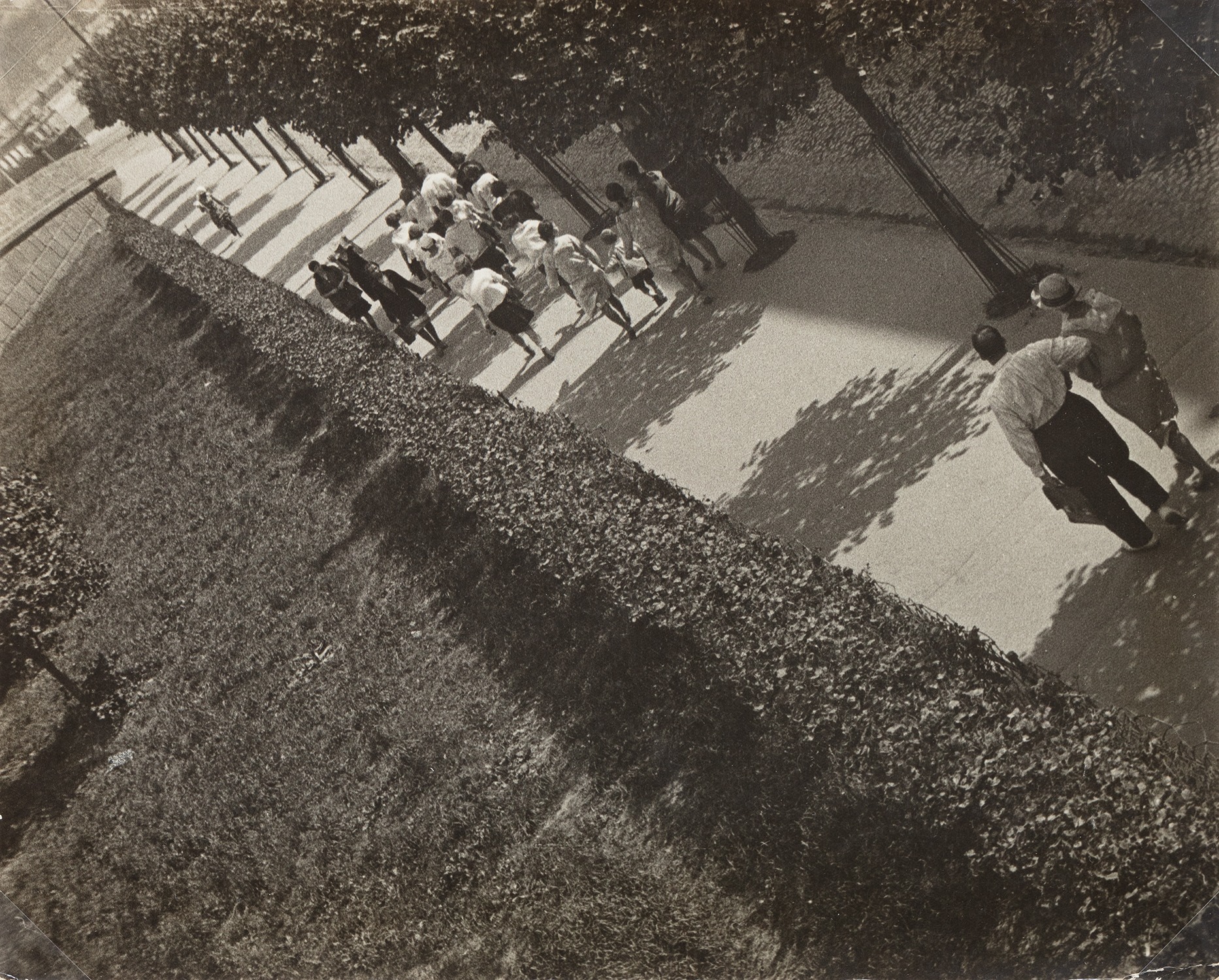
The Central Park Of Culture And Leisure, Alley
That conversation has never really stopped. Alexander Mikhailovich Rodchenko was born in Saint Petersburg in 1891, the son of a theater props maker, and grew up in Kazan, a provincial city far from the cultural capitals of imperial Russia. His early exposure to the theater world gave him an instinctive feel for composition, staging, and the power of an image to command a room. He studied at the Kazan Art School beginning around 1910, where he encountered the ideas sweeping through Russian artistic life, ideas about pure form, about the relationship between art and society, about what a painter or designer might owe to the world around them.
When he arrived in Moscow in 1914 he entered a scene already crackling with ambition, and he found his people immediately. In Moscow, Rodchenko fell into the orbit of Kazimir Malevich and the Suprematist circle, absorbing the radical proposition that geometric abstraction could carry spiritual and political weight. But where Malevich retreated toward the metaphysical, Rodchenko turned toward the material. By the early 1920s he had articulated a distinctly Constructivist position, one that insisted art must be useful, must enter daily life, must build something rather than merely contemplate.
Alexander Rodchenko
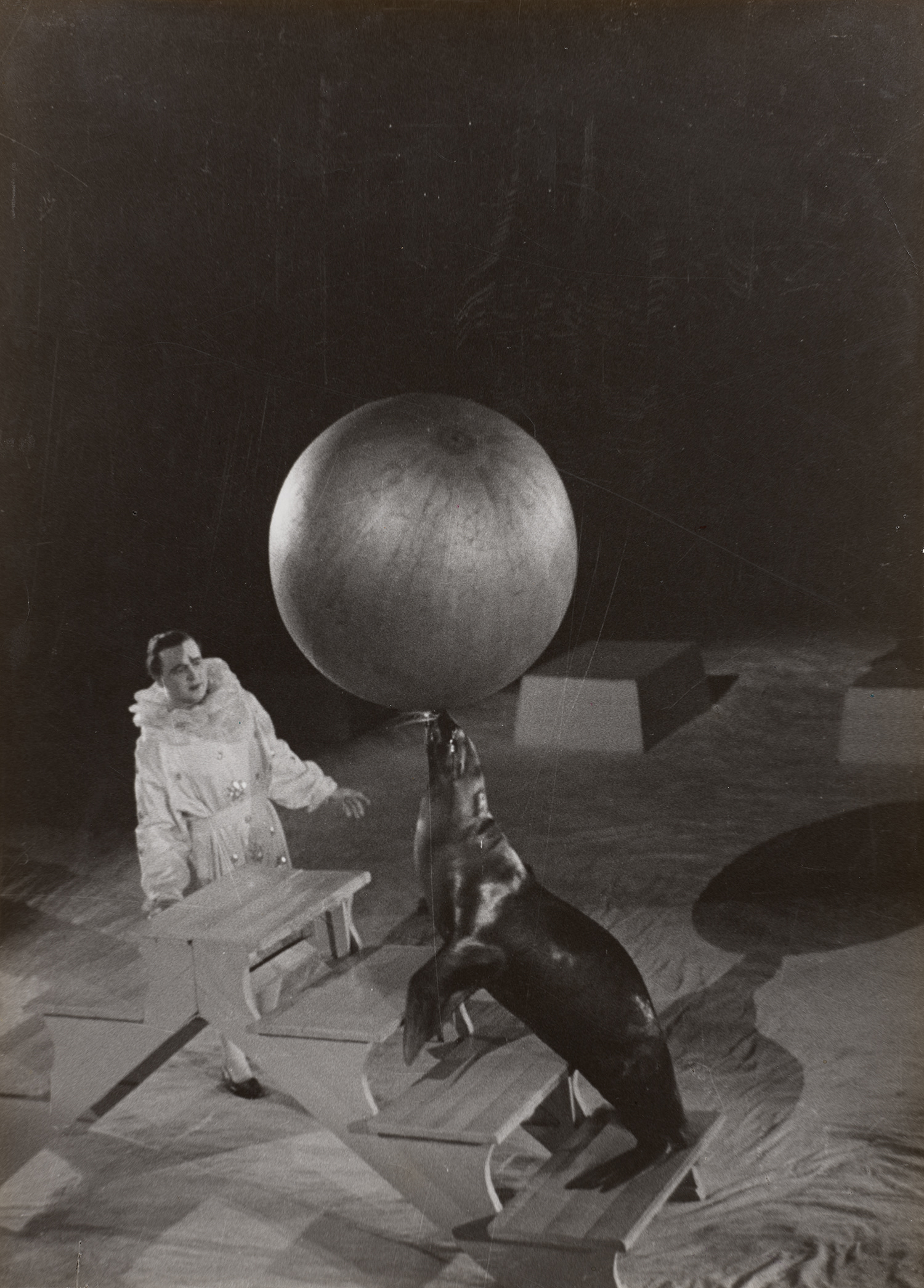
Vladimir Durov and the Sea Lion
He famously exhibited three monochrome canvases in 1921, one red, one yellow, one blue, declaring the death of painting as a fine art and announcing his intention to redirect his energies toward graphic design, photography, and industrial production. It was a provocation that meant exactly what it said. His marriage and creative partnership with Varvara Stepanova was central to everything he made. The two collaborated constantly, sharing ideas about typography, textile design, and the visual grammar of the new Soviet state.
“In order to accustom man to seeing from new viewpoints it is essential to take photos of everyday familiar subjects from completely unexpected angles.”
Alexander Rodchenko, notes on photography, circa 1928
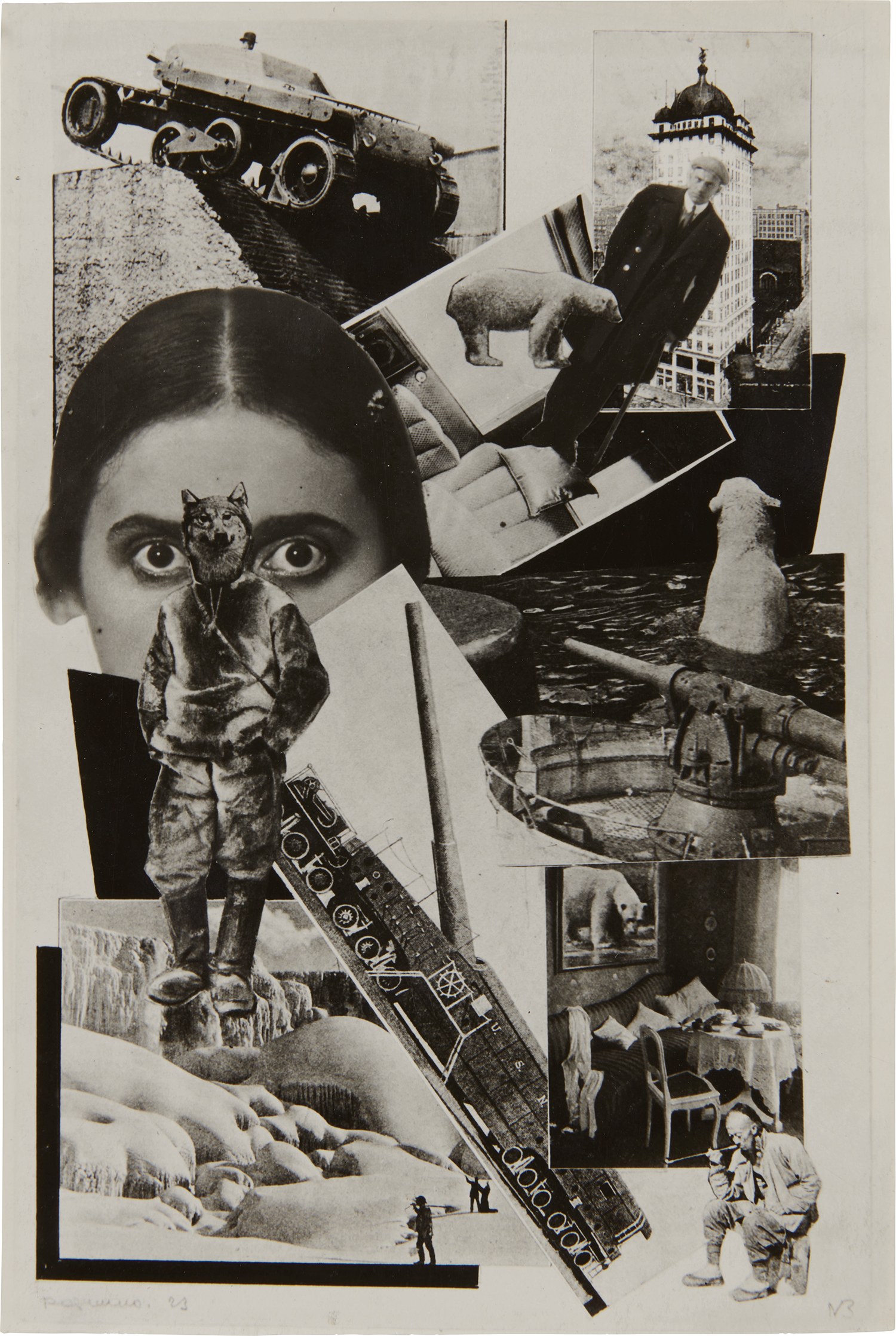
Together they worked on the journal LEF, edited by their close friend and collaborator Vladimir Mayakovsky, producing covers and layouts that remain touchstones of twentieth century graphic design. Rodchenko's photomontages for Mayakovsky's 1923 poem "Pro Eto" are among the most celebrated works of the period, cutting and recombining photographic imagery with a restless, almost cinematic intelligence. The gelatin silver print of that illustration, held in several major collections and available on The Collection, shows exactly how radical his approach to the photographic image already was before he had fully committed to the camera as his primary instrument. By the mid 1920s, photography had become his obsession.
Alexander Rodchenko
Illustration from Vladimir Mayakovsky's 'Pro Eto. Et I mne'
Rodchenko approached the camera the way a sculptor approaches stone, looking for the angle that would reveal structure rather than merely record it. He shot upward from the ground, downward from rooftops, tilted his frame to transform a row of trees or a crowd of athletes into an abstract rhythm of light and form. His images of Red Square gymnasts, of leisure crowds along Moscow's park alleys, of the architect's construction sites and the journalist's staircases, all share this quality of having been seized from exactly the right position, the position no one else had thought to stand in. Works like "Rhythmic Gymnastics on Red Square" and "The Central Park of Culture and Leisure, Alley" demonstrate how completely he understood that the photograph is not a window but a choice.
For collectors, Rodchenko's photographs represent one of the most compelling opportunities in the modernist market. Gelatin silver prints, many produced in small editions or as unique works, have appeared at Christie's, Sotheby's, and Phillips over the past two decades, with significant prints regularly achieving five and six figure sums at auction. The Museum Series portfolios, produced through the Rodchenko and Stepanova Archives in collaboration with Howard Schickler Fine Art in the 1990s, brought authoritative posthumous prints to a wider collecting audience, printed by Alexander Lavrentiev and Yuri Plaksin under archival supervision. These portfolios, including the Classic Images and Portraits series, offer collectors a rigorous and beautifully presented entry point into his photographic legacy.
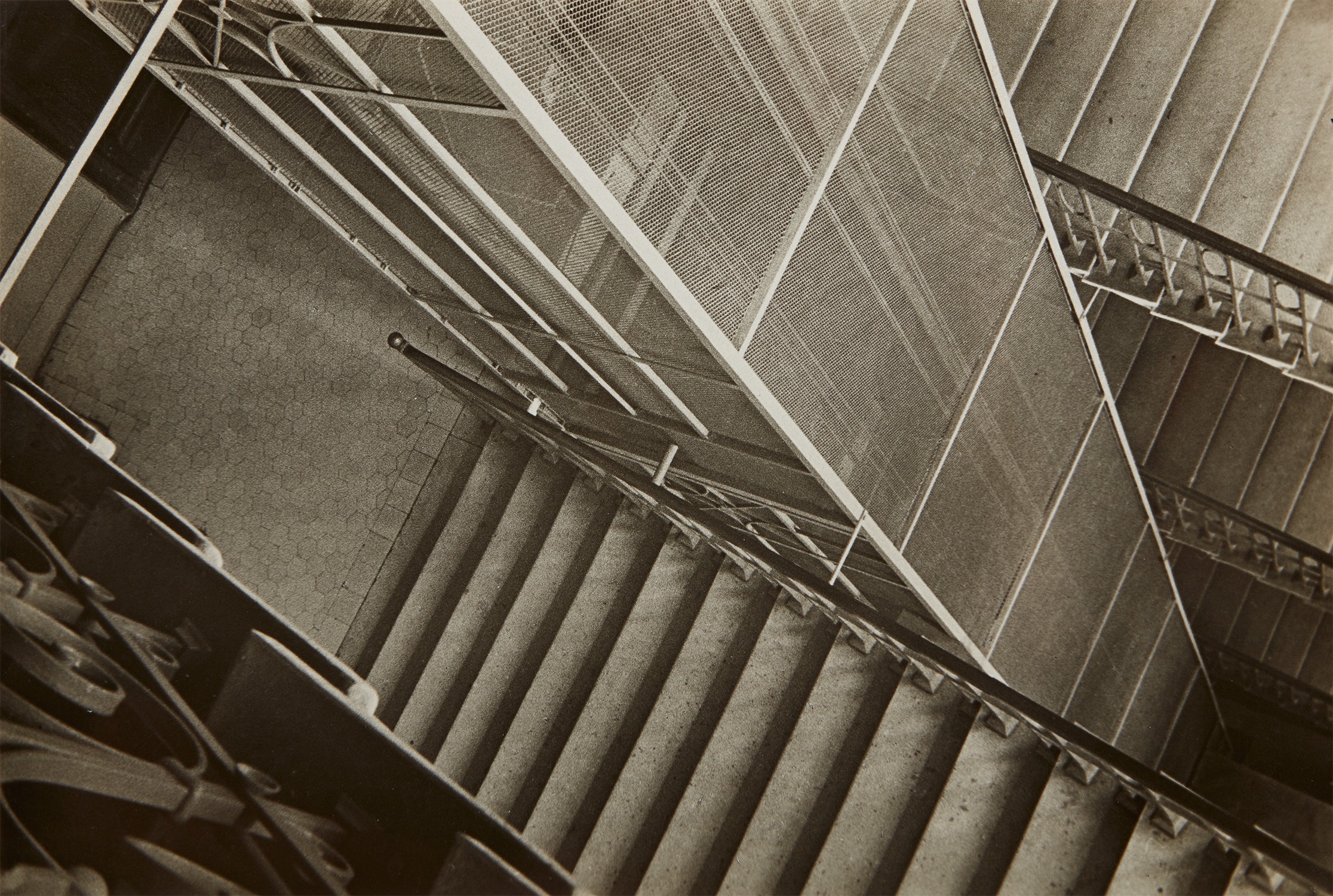
Alexander Rodchenko
Staircase, Pravda
What to look for is consistency of tone, the clarity of the geometric composition, and the sense of genuine formal intelligence at work rather than mere pattern making. Rodchenko sits at the center of a constellation of artists whose work collectively defines the heroic period of European modernism. Collectors drawn to El Lissitzky's typographic experiments, to László Moholy Nagy's light studies, or to the work of Dziga Vertov in film will find in Rodchenko a figure who synthesizes all of those energies into a single coherent vision. His influence on subsequent generations is almost impossible to overstate.
You can trace a direct line from his photographic diagonals to the work of William Klein, from his graphic design to the visual language of Swiss International Style, from his ideas about art and production to the program of the Bauhaus. He is not a precursor. He is a source. Rodchenko died in Moscow in 1956, having survived the Stalinist era at considerable personal and professional cost, watching much of the avant garde project he helped build be suppressed or dismantled around him.
That survival, and the body of work that preceded it, is its own kind of testament. Today, as institutions from the Garage Museum of Contemporary Art in Moscow to the Art Institute of Chicago continue to engage with his photographs, his photomontages, and his designs, what is most striking is how contemporary he feels, how much his insistence on the relationship between form and purpose still speaks to artists working now. To collect Rodchenko is to hold a piece of one of the great intellectual adventures of the modern era, the moment when a generation decided that art could change the world and set about proving it.
Explore books about Alexander Rodchenko

Alexander Rodchenko
Selim Khan-Magomedov
Rodchenko and the Arts of Revolutionary Russia
David Elliott
Alexander Rodchenko: A Russian Avant-Garde Photographer
Gerry Badger
Rodchenko: The Complete Work
Alexander Lavrentiev
Alexander Rodchenko: Revolution in Photography
Jennifer Homans
Alexander Rodchenko: Painting, Drawing, Prints, Sculpture
Museum of Modern Art

Rodchenko & Popova: Defining Constructivism
Magdalena Dabrowski