Alec Monopoly
Alec Monopoly: Street Art Royalty Reigns Supreme
Artist Spotlight · The Collection Editorial
“I want my art to make people happy. I want it to be an escape.”
Alec Monopoly
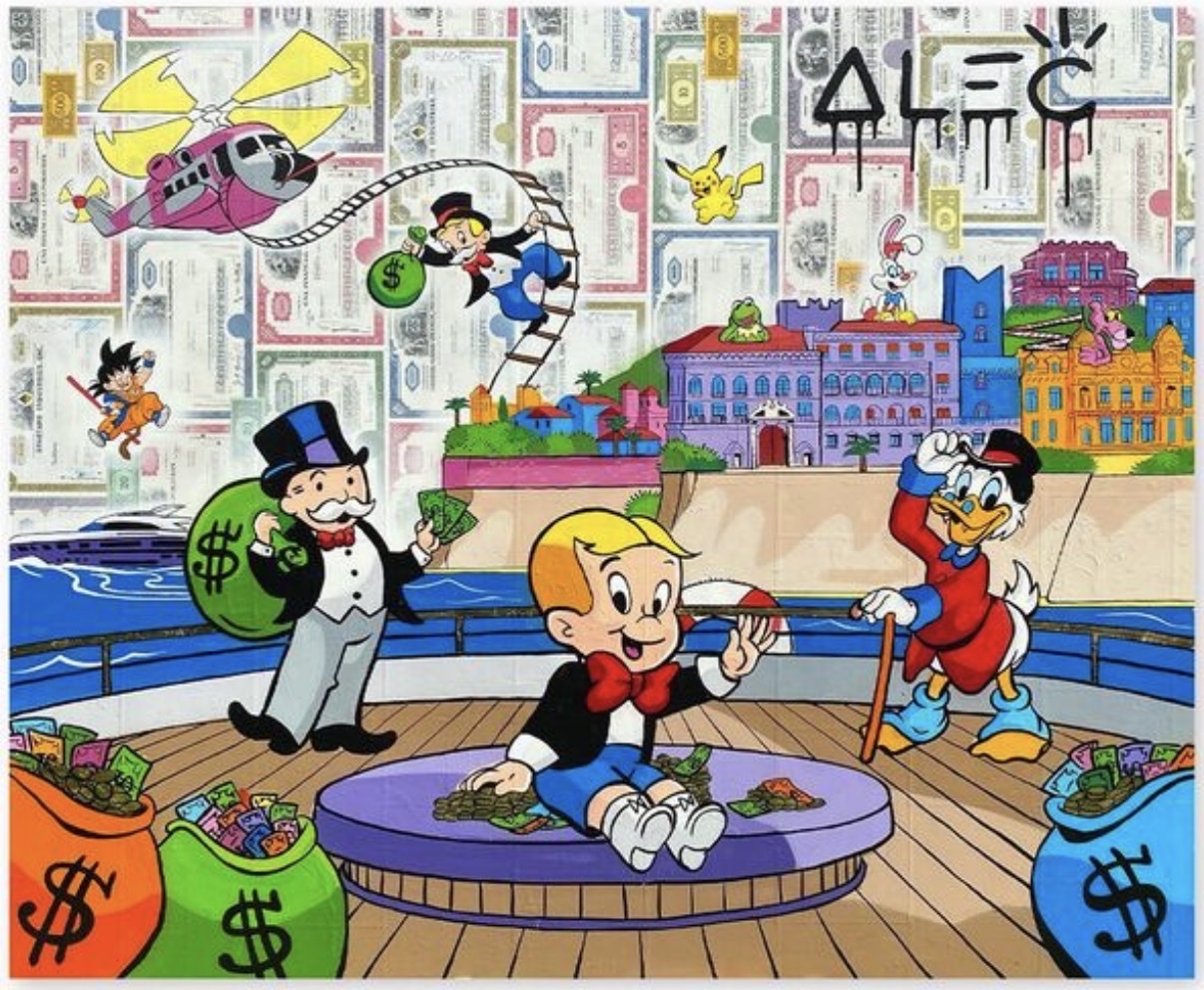
In 2025, Alec Monopoly delivered one of his most ambitious works to date: a sweeping mixed media painting depicting his signature Rich Uncle Pennybags surveying a yacht coastline, dollar signs and pop iconography cascading across the canvas in a riot of color and confidence. The piece encapsulates everything that has made this New York born artist one of the most recognizable and commercially vital figures in contemporary street art. More than a decade after he first began pasting his monocled, top hatted mascot onto the walls of Los Angeles and Miami, Monopoly shows no signs of slowing down, and the art world is paying close attention. Alec Monopoly was born Alec Andon in New York City in 1986, coming of age in a city defined by the long shadow of graffiti culture and the emerging energy of the post Jean Michel Basquiat generation.
Alec Monopoly
$ Team and Characters Back of Yacht Coastline View, 2025
New York in the late 1990s and early 2000s was a city in transition, its walls still carrying echoes of the wildstyle writers and tag artists who had claimed public space as their canvas in the decades prior. For a young artist with an instinct for imagery and a sharp sense of cultural irony, this environment was formative. The decision to relocate to Los Angeles proved pivotal, placing him within reach of both the sprawling urban canvases of Southern California and the celebrity culture that would soon become woven into the fabric of his work. His rise to prominence in the late 2000s and early 2010s was swift and unmistakable.
Operating under his pseudonym and often photographed with his face obscured, Monopoly cultivated an air of mystery that amplified the resonance of his work. His unauthorized interventions on walls across Los Angeles, New York, and Miami introduced Rich Uncle Pennybags, the beloved mascot of the Monopoly board game, as a vehicle for social commentary on wealth, capitalism, and the absurdities of American consumer culture. The choice of character was inspired: instantly legible across generations and cultures, Pennybags carried with him a century of associations around money, luck, and the tilted playing field of economic life. Monopoly transformed this familiar figure into something urgent and contemporary.
Alec Monopoly
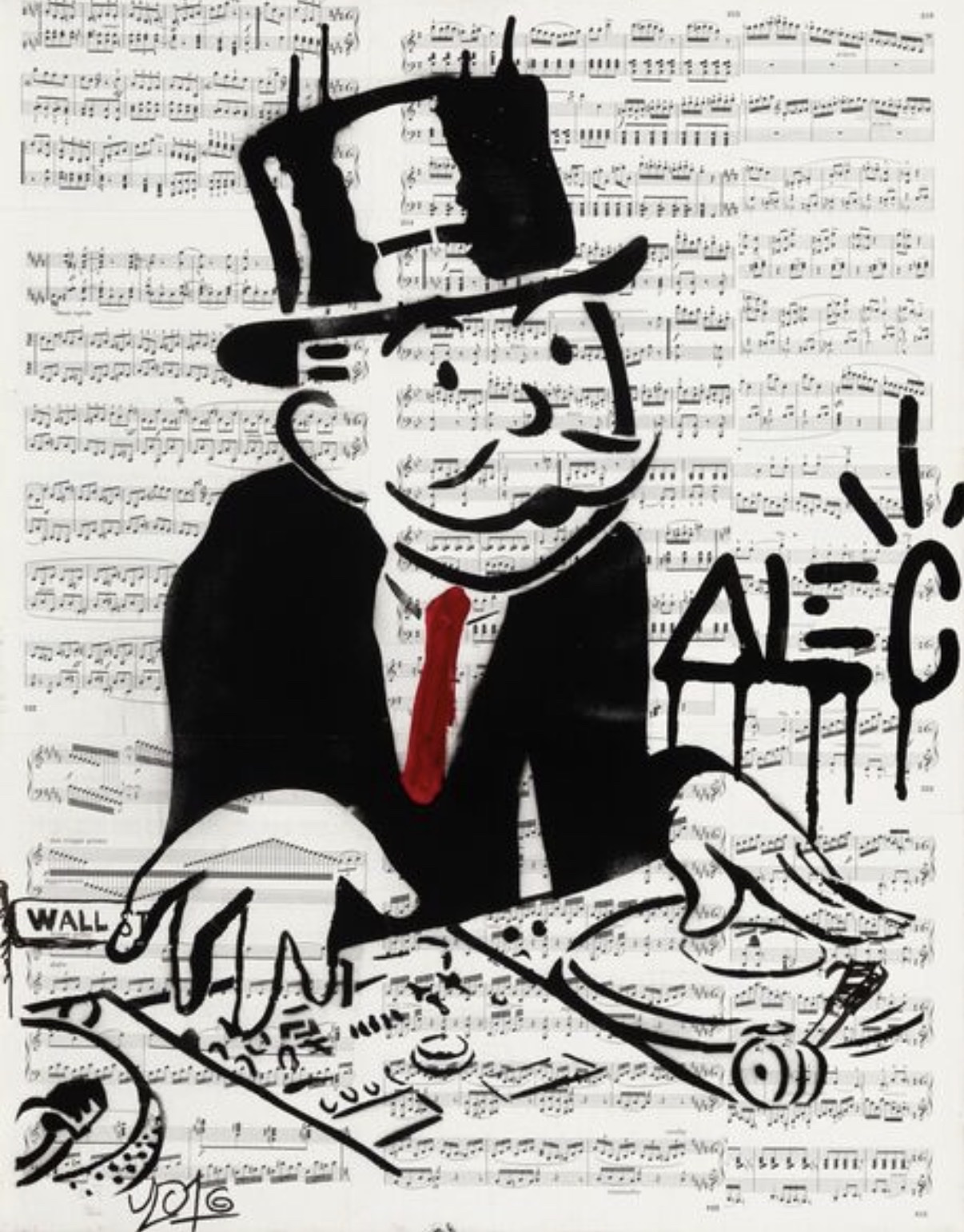
Untitled (DJ Monopoly), 2010
The evolution of his practice from street walls to gallery and studio work represents one of the more compelling transitions in recent street art history. Artists like Shepard Fairey and Banksy navigated similar passages from unauthorized public interventions to the white cube, but Monopoly brought a particular exuberance and a pop sensibility rooted in the language of graffiti, collage, and acrylic painting. His 2010 work Untitled (DJ Monopoly), rendered in acrylic, spray paint, and collage on canvas, stands as an early statement of intent: layered, kinetic, and alive with the textures of urban culture. The work bridges his street origins and his studio ambitions, demonstrating that the energy of the wall was never lost in translation but rather amplified and refined.
What distinguishes Monopoly's best paintings is the density of their visual conversation. His canvases are not simply portraits of a cartoon plutocrat but rather dense fields of pop cultural reference: currency, luxury brand imagery, celebrity iconography, and the graphic language of street art all colliding in compositions that reward extended looking. There is genuine craft in the layering, the way spray paint bleeds beneath painted passages and collaged elements create unexpected depth. Collectors have responded to this quality, recognizing in Monopoly's work a rare combination of immediate visual impact and sustained pictorial interest.
His studio works have found homes with high profile collectors and enthusiasts of contemporary street art globally, and his collaborations with luxury brands and cultural figures have extended his reach well beyond the traditional gallery circuit. From a collecting perspective, Monopoly occupies a fascinating position in the current market. Works from his early period, particularly those on canvas from 2009 through 2013, carry both historical significance and genuine rarity, as they document a moment when his visual language was still being forged in real time on city streets. His more recent large scale mixed media paintings, such as the 2025 yacht coastline work, demonstrate the continued ambition and technical development of a mature artist who has not coasted on the strength of a signature image alone.
Collectors entering the market now benefit from the clarity that comes with an established body of work, while still being part of an ongoing story whose most significant chapters may lie ahead. As with the works of his contemporaries in the broader street art and urban fine art space, condition, provenance, and the presence of a strong documentary record all bear on long term value. In situating Monopoly within art history, it is useful to consider him alongside the generation of artists who transformed graffiti and street based practice into a legitimate and influential strand of contemporary art. Jean Michel Basquiat established the template for the street trained artist as fine art force.
Keith Haring demonstrated that bold graphic language and popular iconography could carry genuine conceptual weight. Shepard Fairey and Banksy, working from either coast and across the Atlantic, showed that anonymity and public intervention could generate both critical discourse and serious market attention. Monopoly inherits all of these lineages while adding something distinctly his own: a fixation on the mythology of American wealth and a lightness of touch that makes even his sharpest observations feel celebratory rather than didactic. Alec Monopoly matters today because he has kept faith with the core impulse of street art, which is to make art that belongs to everyone, while simultaneously building a body of studio work that holds its own in serious collections.
He has expanded the vocabulary of his chosen mascot across more than fifteen years without exhausting it, finding in Rich Uncle Pennybags a figure capacious enough to hold the contradictions of contemporary life: aspiration and critique, humor and pathos, the dream of abundance and the comedy of its pursuit. For collectors who believe that the most vital art of our era emerges from the streets as much as from the academies, and that visual pleasure and cultural intelligence are not mutually exclusive, Monopoly's work offers a genuinely compelling proposition.