Albrecht Dürer
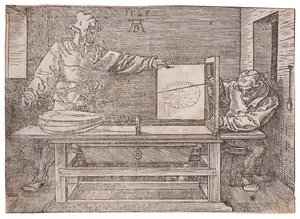
Albrecht Dürer: The Renaissance Master Who Remade Everything
Artist Spotlight · The Collection Editorial
“What beauty is, I know not, though it adheres to many things.”
Albrecht Dürer, written notes, circa 1512
Imagine standing in a room at the Germanisches Nationalmuseum in Nuremberg, surrounded by the works of a man who, five centuries ago, looked at the world and decided it was not enough to simply record what he saw. He needed to understand it, measure it, theorize it, and then translate it onto paper and copper with a precision that still stops viewers cold. Albrecht Dürer was that rare convergence: an artist of supreme technical gifts who was also a rigorous intellectual, a traveler who carried ideas across borders the way merchants carried spices, and a craftsman whose prints circulated through Europe with the force of a new language. To encounter his work today is to feel the full ambition of the Northern Renaissance pressing through every line.
Albrecht Dürer
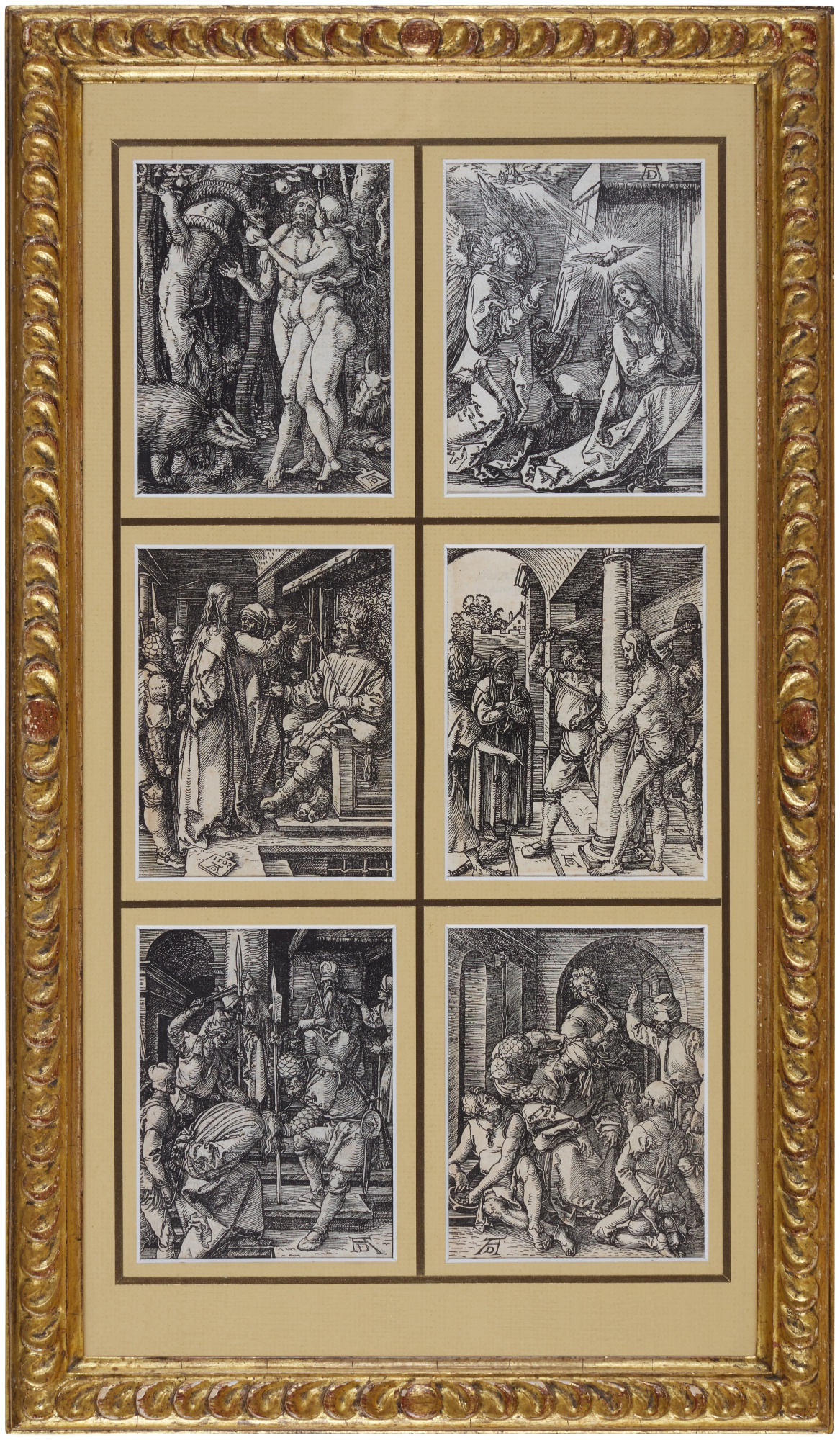
The Small Passion: Six Plates (B. 17,19, 28, 30, 32, 33; M., Holl. 126, 128, 137, 139, 141, 142)
Dürer was born in Nuremberg in 1471, the third of eighteen children, the son of a Hungarian goldsmith who had settled in one of the most prosperous trading cities in the German lands. That workshop upbringing was formative in the most literal sense: Dürer learned to hold a tool, to see at close range, to prize precision and patience before he learned anything else. He apprenticed under the painter and book illustrator Michael Wolgemut from 1486 to 1489, absorbing the conventions of late Gothic painting and woodcut production, before embarking on his Wanderjahre, the customary journeyman years that took him through the Upper Rhine and eventually to Basel and Colmar, where he had hoped to meet the great Martin Schongauer. Schongauer died just before Dürer arrived, but the ambition of that pilgrimage tells us everything: Dürer already understood that engraving was a domain where greatness was possible, and he intended to claim it.
The decisive transformation came with his first journey to Italy in 1494 and 1495, and then again with a longer stay in Venice from 1505 to 1507. Northern European artists had absorbed Italian ideas secondhand, through prints and pattern books, but Dürer went to the source. He studied classical proportion, met Giovanni Bellini, absorbed the Venetian command of color and atmosphere, and returned to Nuremberg carrying something no other German artist possessed: a genuine synthesis. He did not simply import Italian Renaissance ideas.
Albrecht Dürer
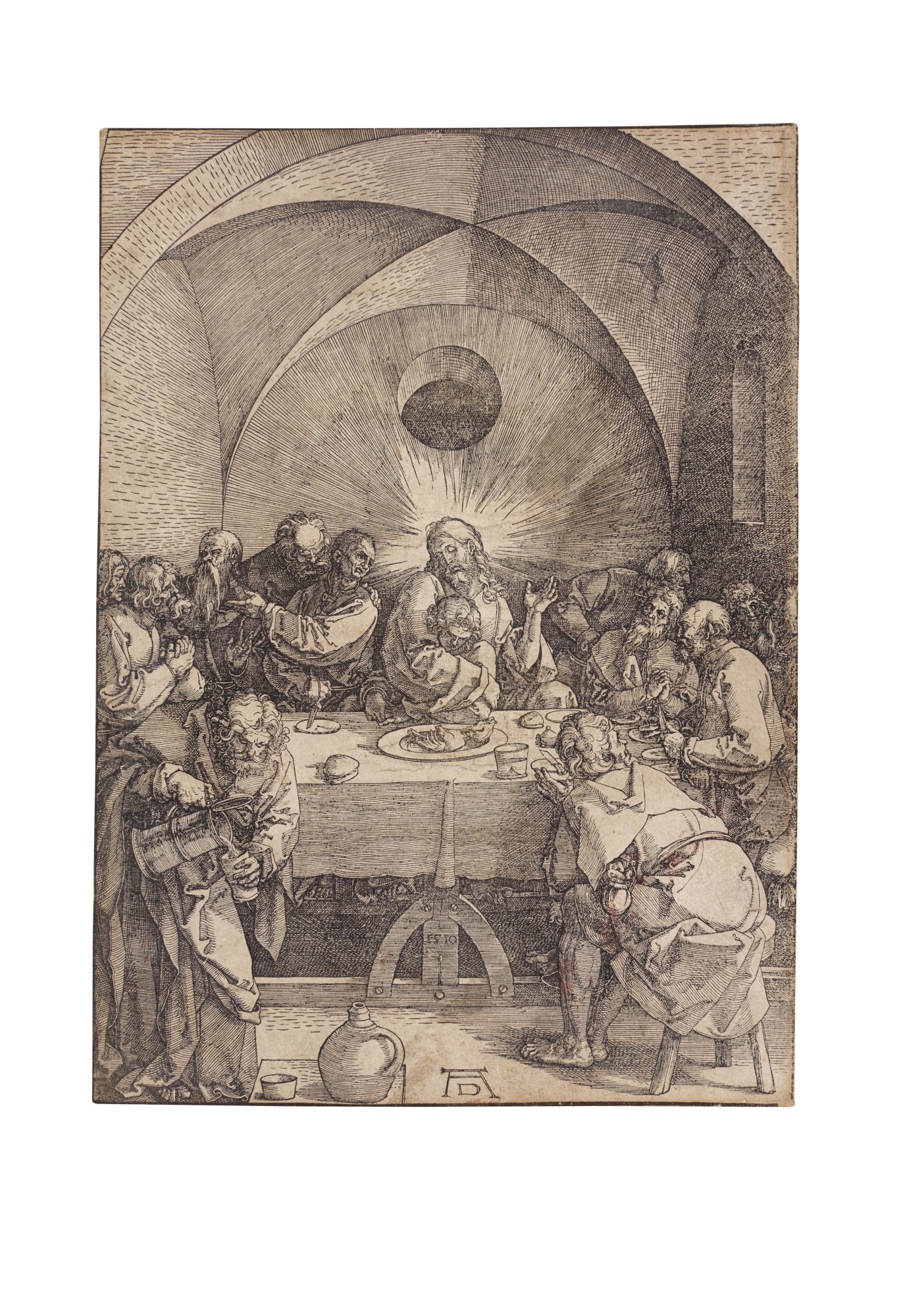
The Last Supper; and Ecce Homo (B. 5, 9; M., Holl. 114, 118)
He interrogated them, tested them against his own Northern training, and produced something new. His theoretical writings, including his treatise on measurement published in 1525 and his four books on human proportion completed just before his death in 1528, show a mind that needed to understand the rules before it could transcend them. The works that made Dürer's reputation across Europe were, above all, his prints. The three great cycles produced around the turn of the sixteenth century, The Apocalypse of 1498, The Large Passion begun around 1496 and published in 1511, and The Life of the Virgin completed by 1511, established woodcut as a medium capable of the grandest artistic statement.
“The more closely and precisely a work resembles life, the better it appears.”
Albrecht Dürer, treatise on painting
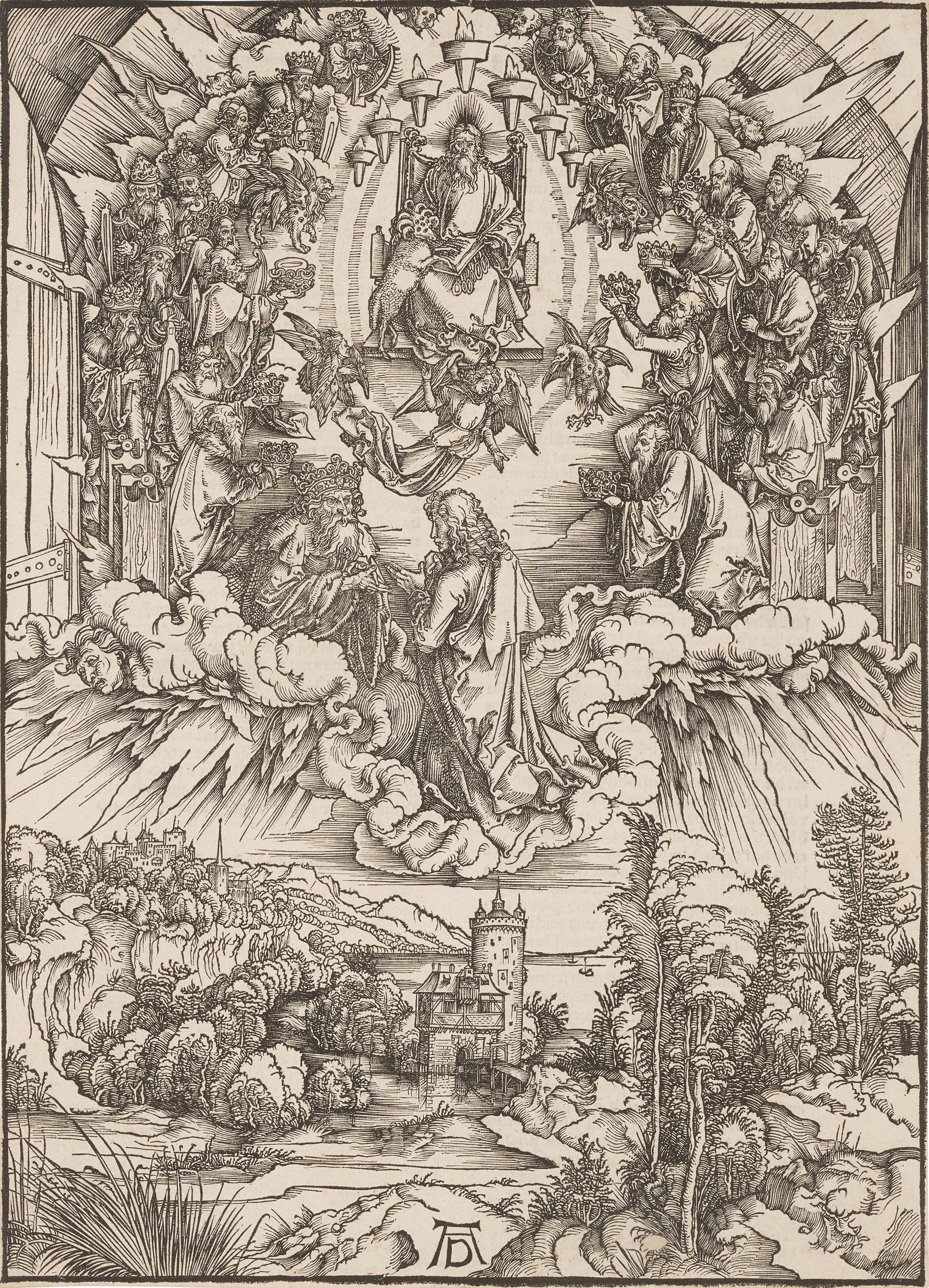
These were not merely devotional objects or book illustrations, though they functioned as both. They were compositions of extraordinary spatial complexity, emotional intensity, and narrative intelligence. His woodcut of Saint John before God and the Elders, from The Apocalypse series, deploys the entire surface of the sheet as a theater of divine spectacle, with the heavenly court arranged in tiers that anticipate the compositional ambitions of Baroque painting. Works from The Life of the Virgin series, including The Betrothal of the Virgin and The Flight into Egypt, show Dürer moving with equal confidence between architectural grandeur and intimate human tenderness.
Albrecht Dürer
Saint John before God and the Elders, from The Apocalypse
And in a masterwork like his 1504 engraving Adam and Eve, widely considered among the finest impressions of any Renaissance print, Dürer announced what the burin could do in trained hands: the nudes are rendered with a scientific attention to ideal proportion while remaining fully alive, their figures emerging from the dense, shadowed forest with an almost uncanny plasticity. For collectors, Dürer's prints occupy a singular position in the market. The quality of an impression, described through the Meder classification system developed by Joseph Meder in the early twentieth century, is the primary determinant of value and desirability. Early impressions, those printed before the plate or block deteriorated, before text editions introduced different paper stocks, carry the full authority of Dürer's design: sharp, deep, resonant.
A Meder a impression of a major engraving or a strong early woodcut from a significant series represents one of the great attainments in print collecting. Institutions including the British Museum, the Metropolitan Museum of Art, the Albertina in Vienna, and the Kunsthalle in Hamburg hold the benchmark collections, but important examples continue to appear at auction through the major houses, and private collectors have always competed seriously for them. What distinguishes the most committed collectors of Dürer is an appreciation for the complete picture: watermarks, paper quality, impression depth, and provenance all contribute to the singular experience of holding a sheet that has survived five centuries in near perfect condition. Dürer belongs to a Northern Renaissance tradition that includes his near contemporaries Lucas Cranach the Elder, Hans Holbein the Younger, and Matthias Grünewald, artists who were grappling with the same tensions between Gothic heritage and Italian innovation, between religious tradition and humanist inquiry.
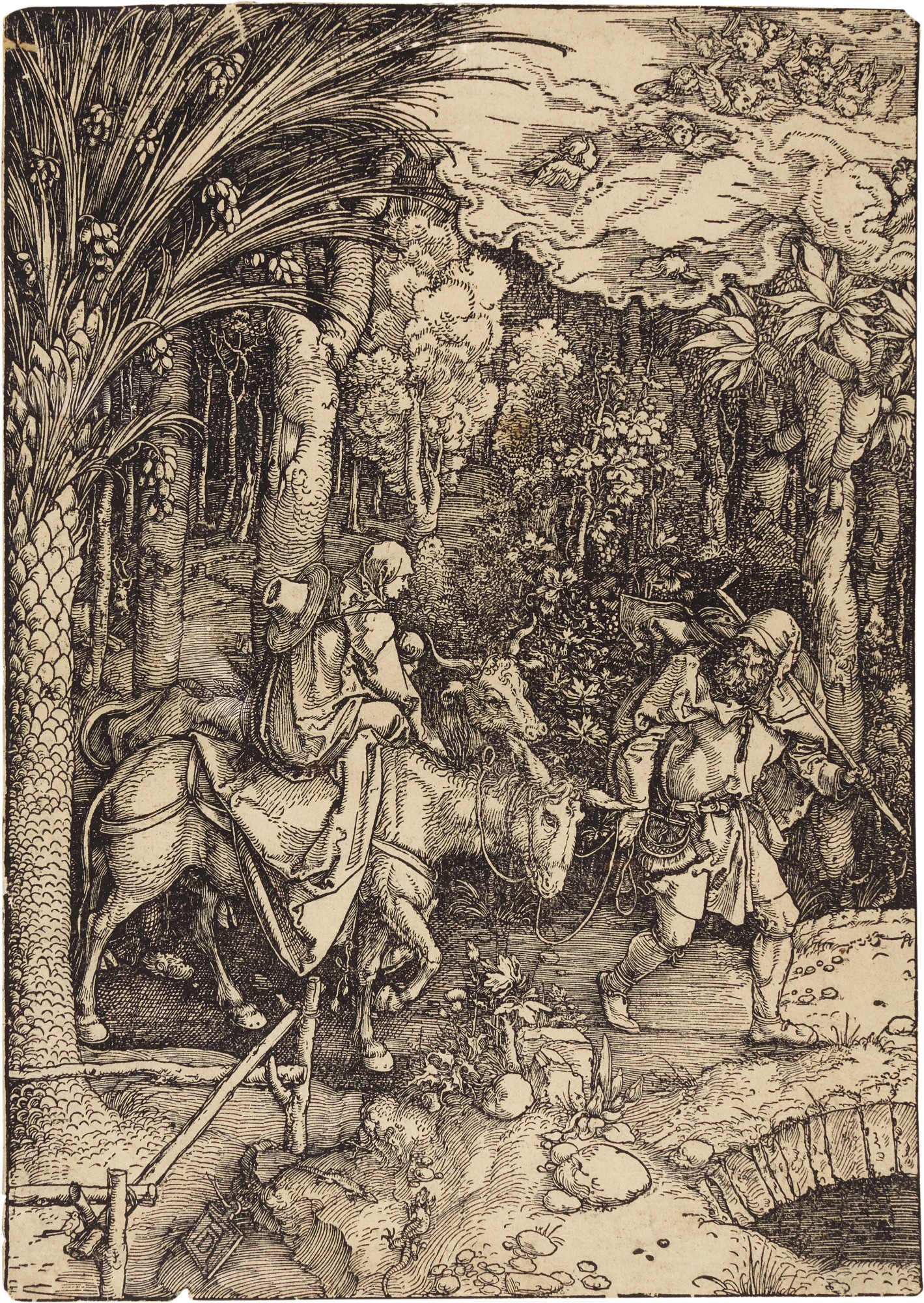
Albrecht Dürer
The Flight into Egypt (B. 89; M., Holl. 201)
But Dürer stands somewhat apart from all of them, partly through the ambition of his theoretical program, and partly through the sheer range of his achievement. His painted portraits, including the famous self portraits that assert the dignity of the artist with an almost startling directness, his watercolor studies of plants and animals, and his drawings, which are among the most admired in the Western tradition, all speak to an intelligence that refused to stay within any single domain. He was in correspondence with Erasmus, he corresponded with the reformers of his time, and he moved through a world of ideas with the confidence of a man who had earned his place at the highest table. What makes Dürer matter now, in a world of digital reproduction and algorithmic image making, is precisely the argument his work makes for the handmade mark as a vehicle of thought.
Every line in an engraving by Dürer is a decision: there is no undoing it, no filter, no correction layer. The sustained concentration required to produce something like Adam and Eve is itself a form of meaning, inseparable from the finished image. Collectors who live with his prints describe the experience of looking more closely over time, of finding new things in compositions they have known for years. That is the quality of a mind encoded in a surface, and it is what places Albrecht Dürer among the very few artists whose work rewards any level of attention, from the casual glance to the scholar's decade of study.
Explore books about Albrecht Dürer
Albrecht Dürer: His Life and Work
Erwin Panofsky
Dürer: A Very Short Introduction
Jonathan Zoete
The Complete Engravings, Etchings and Drypoints of Albrecht Dürer
Arthur M. Hind
Albrecht Dürer: Master Printmaker
David A. Hanks
Dürer and his Culture
Peter-Klaus Schuster
The Renaissance Print
David Landau and Peter Parshall

Albrecht Dürer: The Complete Drawings
Winkler
Dürer's Rhinoceros
Joaneath Spicer