Albert Rosenthal
Albert Rosenthal, Master of the Enduring Face
Artist Spotlight · The Collection Editorial
There is a particular pleasure in standing before a portrait etching and feeling, with absolute certainty, that the face looking back at you has been understood rather than merely recorded. Albert Rosenthal spent the better part of six decades pursuing that distinction, and the results remain among the most quietly powerful works in American printmaking history. His etchings of founding fathers, jurists, and statesmen carry the weight of official memory while vibrating with something warmer and more personal, the sense that a thoughtful, technically gifted artist genuinely wanted to know the people he rendered. As interest in American realist printmaking continues to grow among collectors and curators alike, Rosenthal's oeuvre stands ready for the serious reappraisal it deserves.
Albert Rosenthal
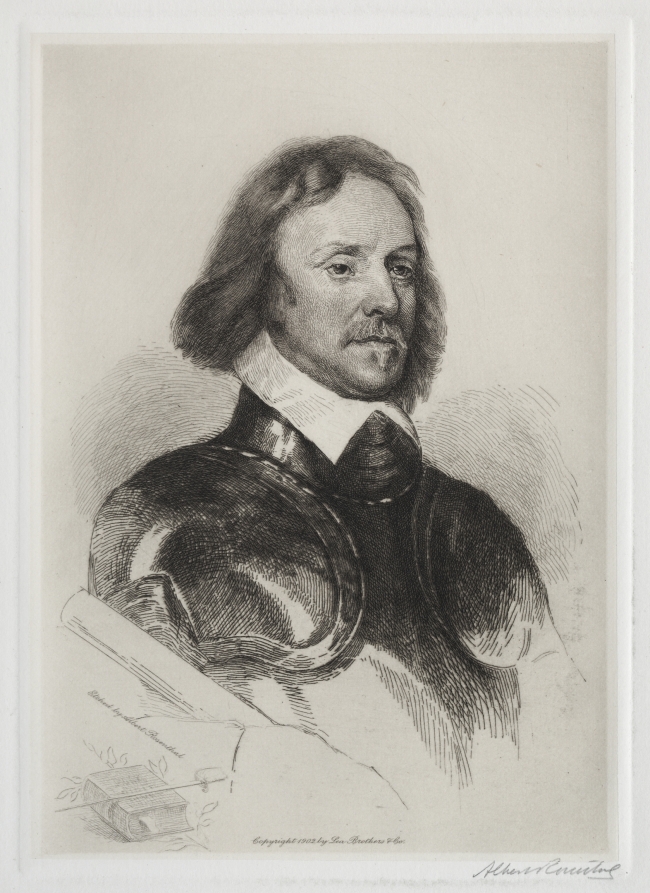
Oliver Cromwell, 1902
Albert Rosenthal was born in Philadelphia in 1863, a city that was then, as it had long been, a vital center of American arts and civic life. Philadelphia nurtured a tradition of rigorous draughtsmanship, and the young Rosenthal absorbed that tradition deeply. He trained at the Pennsylvania Academy of the Fine Arts, one of the oldest and most distinguished art schools in the United States, an institution whose faculty and alumni shaped the course of American realism throughout the nineteenth century. The Academy's emphasis on close observation, anatomical precision, and technical mastery left a permanent mark on Rosenthal's sensibility, and he carried those values into every medium he worked in across a career that spanned nearly eight decades of life.
Rosenthal worked as a painter, lithographer, and etcher, but it is in etching that his particular genius found its fullest and most lasting expression. Etching demands patience and an intimate knowledge of the copper plate, the acid bath, and the press, and it rewards artists who think in terms of line rather than mass or color. Rosenthal thought very much in terms of line. His portraits built form through accumulation, layering fine strokes of varying weight and direction until a face emerged from the plate with the solidity and presence of a carved relief.
Albert Rosenthal
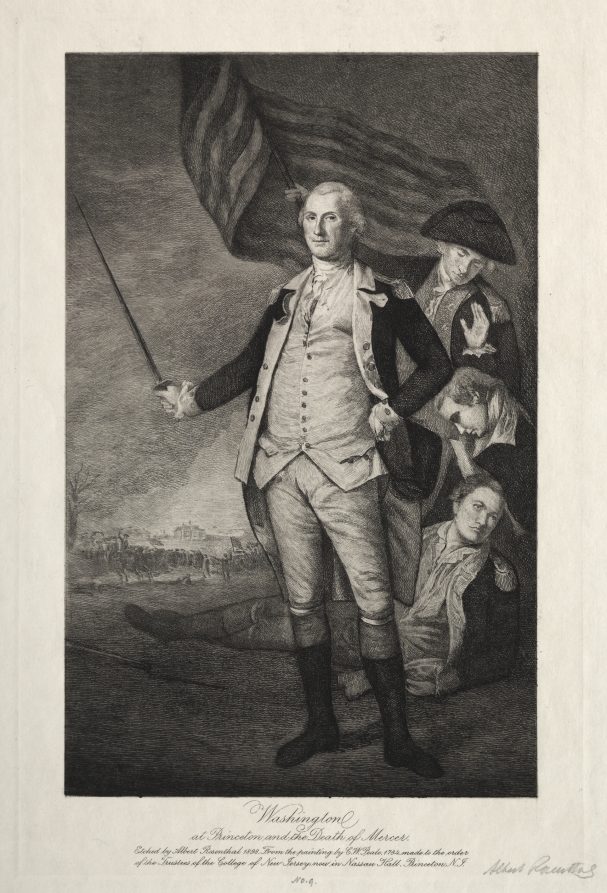
George Washington at Princeton, 1898
He was working at a moment when etching enjoyed a broad revival across Europe and America, inspired in part by the advocacy of Francis Seymour Haden and the example of James McNeill Whistler, and Rosenthal brought to that moment a distinctly American subject matter rooted in history and civic identity. The body of work Rosenthal produced in portraiture reads almost like a visual archive of American public life. His etching of George Washington at Princeton, completed in 1898, captures the General with a dignity that feels earned rather than imposed, derived from careful study of earlier portraits and historical records. His rendering of Alexander Hamilton from 1895 is similarly alert to the complexity of its subject, conveying intelligence and intensity without slipping into hagiography.
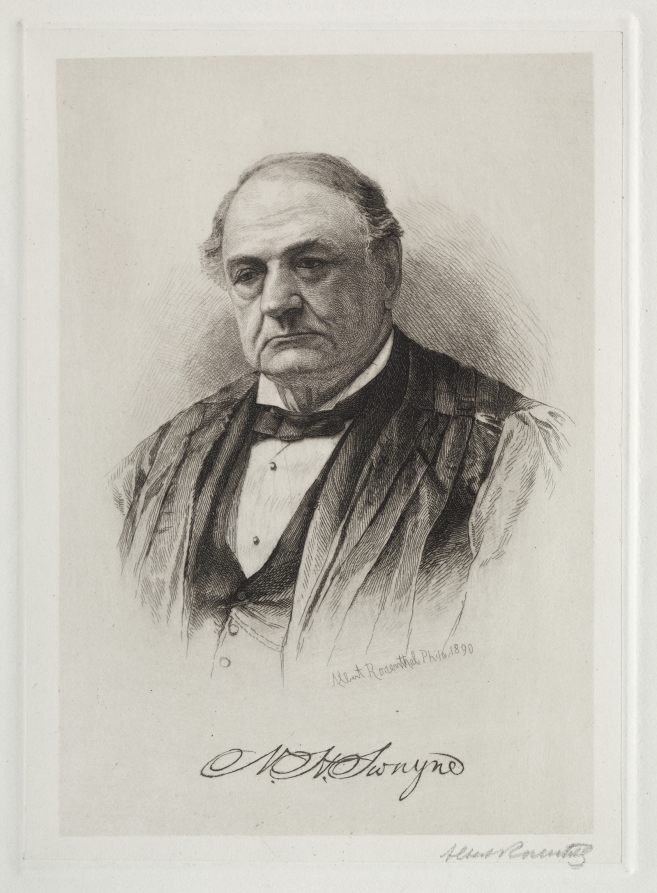
The 1887 portrait of John Jay and the 1890 etching of Horace Gray demonstrate his range across different eras and temperaments, each face rendered with individualized attention to character. Perhaps most striking is his 1902 etching of Oliver Cromwell, a subject drawn from English rather than American history, which reveals an artist confident enough in his craft to move beyond the familiar and into more demanding interpretive territory. These works were not mere reproductions of existing images but active acts of interpretation, Rosenthal bringing his own eye to bear on the documentary record. Beyond the historical portraits, works such as his 1888 etching of Sir Andrew Snape Hammond and his 1890 portrait of W.
Albert Rosenthal
W. H. Swayne, 1890
H. Swayne illustrate Rosenthal's capacity for capturing individuals whose legacies sit outside the most celebrated tier of American memory. There is something especially valuable in this. A great portraitist is not only interested in the famous but in the human face as such, in the particular lines and shadows that make one person different from every other person who has ever lived.
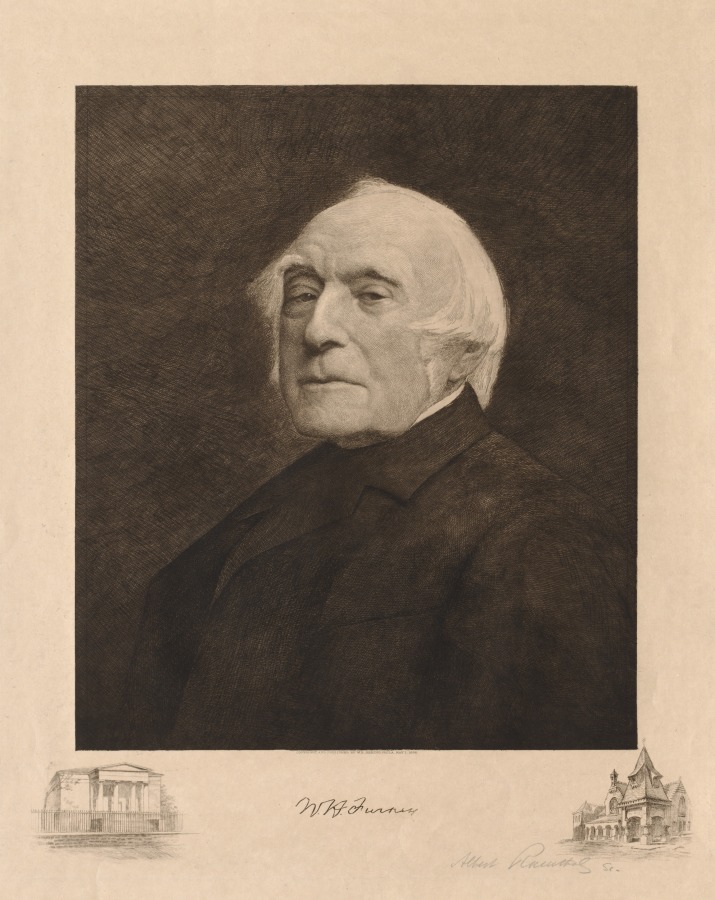
Rosenthal's 1896 etching of W. H. Furness, the Philadelphia Unitarian minister and abolitionist, is a fine example of this sensitivity, the portrait of a man of conscience rendered with appropriate gravity and warmth. His 1889 etching of M.
Albert Rosenthal
W. H. Furness, 1896
W. Fuller extends that same attentive care to a figure of judicial distinction. For collectors, Rosenthal's work offers a compelling combination of historical significance and aesthetic refinement. Works on paper by American realist printmakers of the nineteenth and early twentieth centuries have attracted sustained attention from both institutional and private collectors, and Rosenthal occupies an underappreciated position within that field.
His etchings are relatively rare in the open market, which makes each appearance an event worth noting. Collectors drawn to similar artists working in the tradition of American realism and printmaking will find points of comparison with such figures as Samuel Hollyer and John Sartain, both of whom shared Rosenthal's commitment to the engraved portrait as a form of historical record and artistic achievement. The intersection of Rosenthal's work with the broader Philadelphia realist tradition also invites comparison with the circle of Thomas Eakins, though Rosenthal's primary medium gave his output a distinct character and purpose. Rosenthal continued working well into the twentieth century, his career bridging the world of nineteenth century realism and the more fragmented modernist landscape that succeeded it.
He died in 1939, having lived long enough to see American art transform itself several times over, yet his commitment to figuration, portraiture, and the disciplined craft of printmaking never wavered. That steadfastness, which could easily be misread as conservatism, is better understood as a form of artistic conviction. He believed in the portrait as a serious form, in the etched line as a vehicle of truth, and in the faces of American public life as worthy subjects for sustained artistic attention. Those beliefs produced a body of work that rewards careful looking and that speaks, across more than a century, with clarity and warmth.
For the collector who values craft, history, and the quiet power of a face rendered in line, Albert Rosenthal is an artist whose time is very much still arriving.