Albert Bierstadt
Bierstadt's West, Boundless and Breathtaking
Artist Spotlight · The Collection Editorial
“We are now in the midst of the Rocky Mountains, the scenery is wild and magnificent.”
Letter from Albert Bierstadt, 1859
Stand before a large Albert Bierstadt canvas and something remarkable happens. The room falls away. The traffic outside, the gallery chatter, the ambient noise of modern life all dissolve into silence, replaced by the imagined roar of a waterfall or the hush of alpenglow settling over granite peaks. It is a quality few painters in the history of American art have achieved with such consistency, and it explains why Bierstadt continues to command devoted attention from museums, scholars, and collectors more than a century after his death.
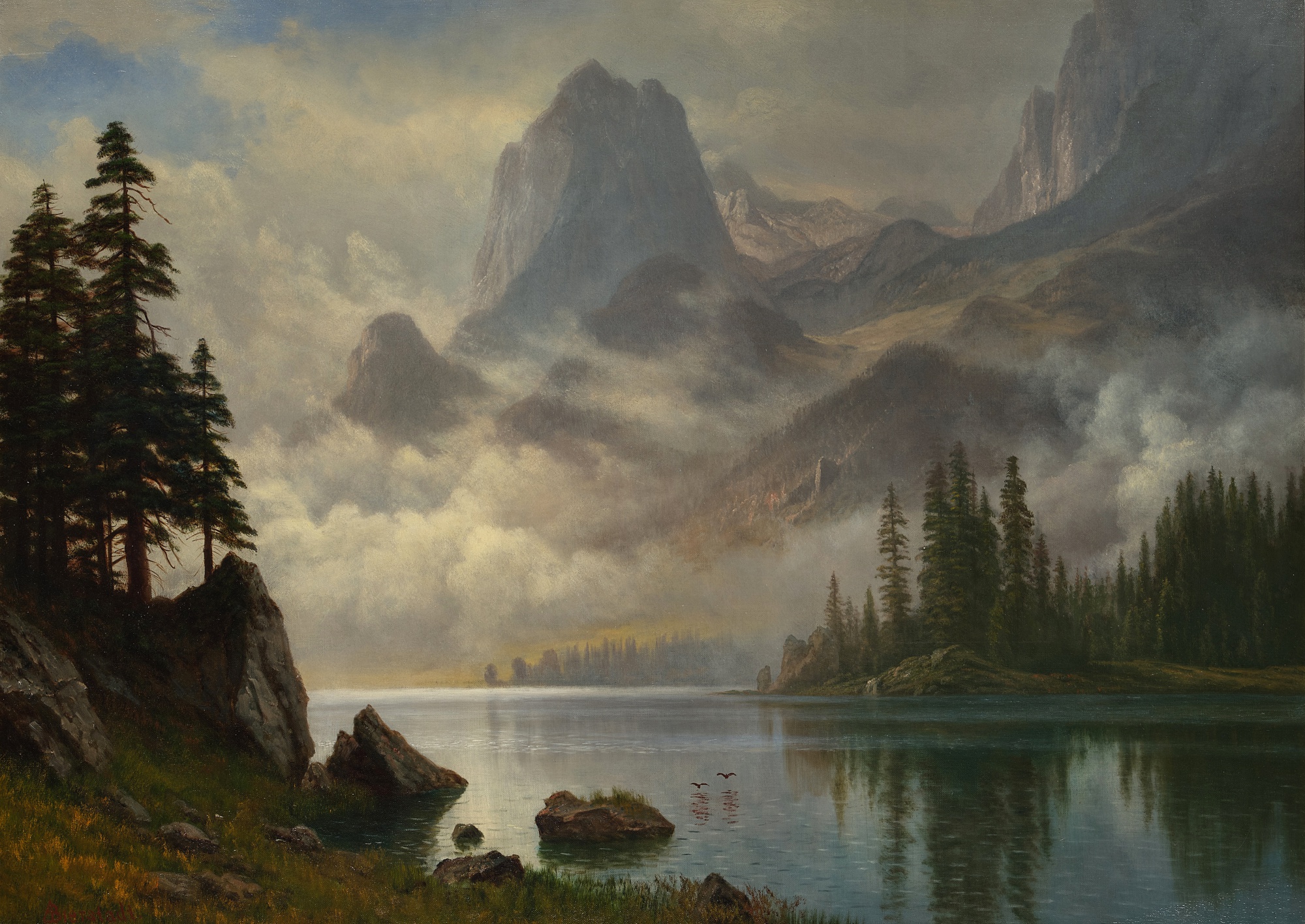
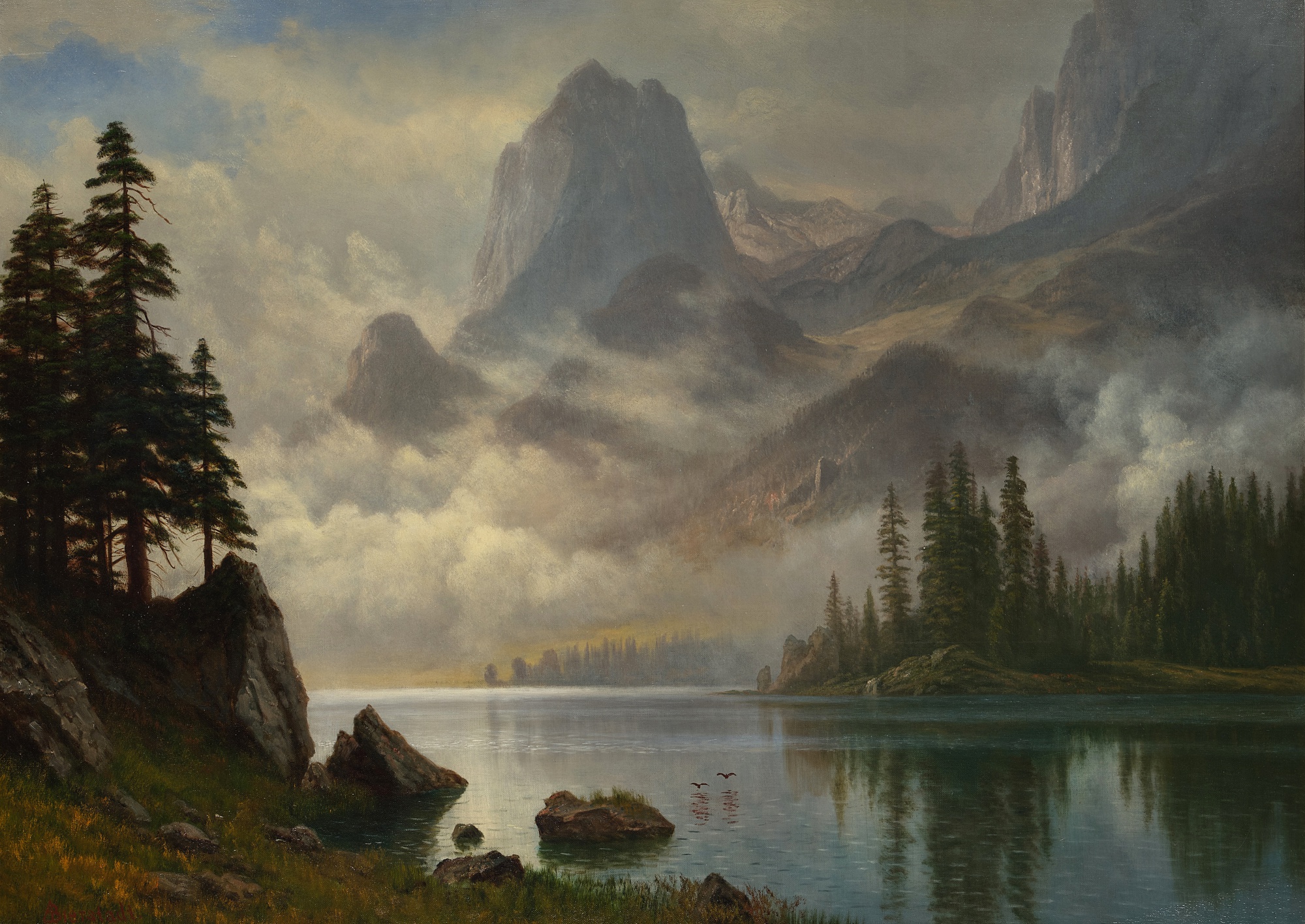
Albert Bierstadt
Mountain Out of the Mist, 1889
His vision of the American West remains one of the most potent and emotionally persuasive landscapes in the entire tradition of Western painting. Albert Bierstadt was born in Solingen, in what is now Germany, in 1830, and his family emigrated to New Bedford, Massachusetts when he was still an infant. He grew up in a port city shaped by industry and ambition, a place accustomed to men who ventured far into unknown territory and returned with extraordinary stories. By his early twenties, Bierstadt had resolved to become a painter and made the journey back to Europe to study at the Düsseldorf Academy in Germany, one of the most rigorous and technically demanding art schools of the nineteenth century.
There he absorbed the Düsseldorf School's commitment to meticulous draughtsmanship, precise atmospheric observation, and grand compositional architecture. He also spent time painting in the Swiss Alps, an experience that would prove prophetic. The Jungfrau and the mountain ranges surrounding it taught him how to render altitude, how to make a viewer feel the thinning of air and the particular cold luminosity that exists above the treeline. He returned to the United States in 1857 and soon attached himself to a government surveying expedition heading west under the command of General Frederick Lander.
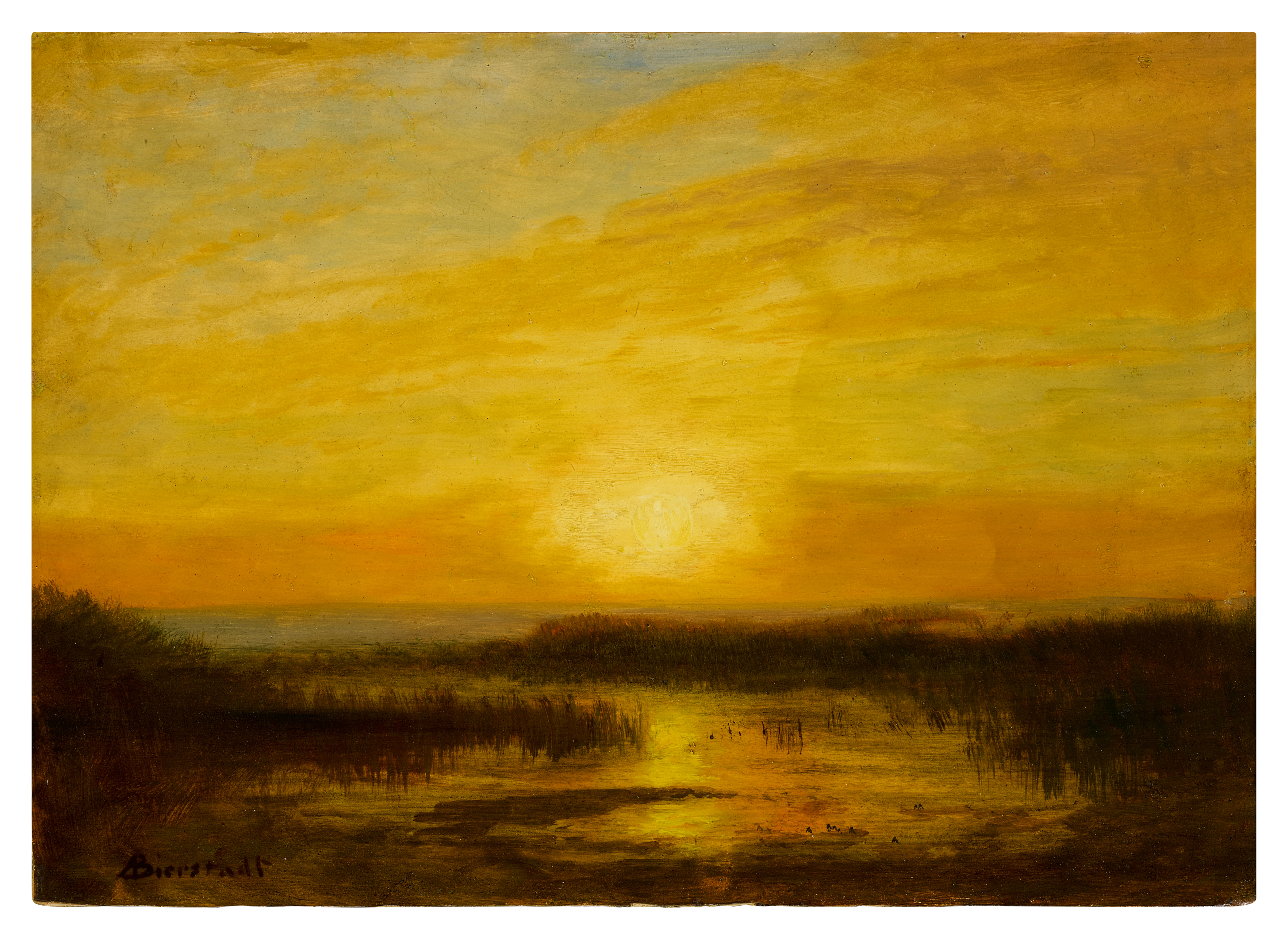
Albert Bierstadt
Sunset, 1870
It was the defining experience of his artistic life. Traveling through the Wind River country of Wyoming and into the Rocky Mountains, Bierstadt made hundreds of oil sketches and drawings, training his eye on the specific textures of western light, the scale of the terrain, and the dramatic meteorological theatre that the region produces with such generosity. These on site studies became the raw material for the monumental studio paintings that would make his reputation. When his first major western canvases appeared at the Tenth Street Studio Building in New York in the early 1860s, audiences responded with something close to astonishment.
Here was a painter who could make the American wilderness feel simultaneously infinite and intimate. The paintings that followed through the 1860s and 1870s represent the absolute summit of Bierstadt's powers. He made his first journey to the Yosemite Valley in California in 1863, and what he encountered there gave his ambition the scale it had been searching for. The sheer verticality of the valley walls, the cathedral quality of the light filtering through morning mist, and the almost theatrical perfection of the landscape seemed designed for his particular gifts.
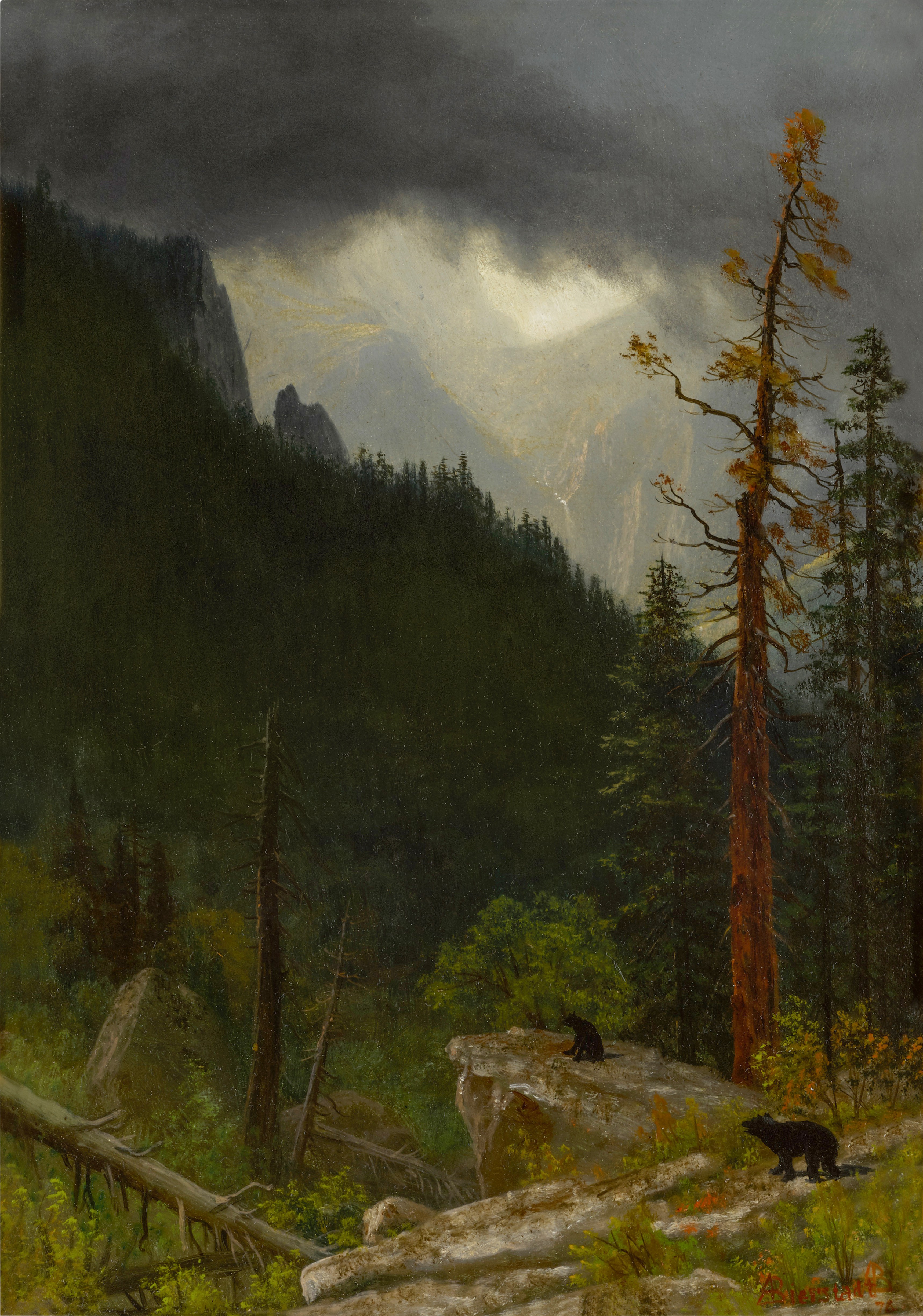
Albert Bierstadt
Rockies After a Storm
Works produced from that journey and subsequent visits, including his celebrated depictions of Mount Starr King, demonstrate his capacity to fuse documentary accuracy with Romantic grandeur. His Mount Starr King, Yosemite from 1866, available on The Collection, is an exemplary statement of his mature method: the foreground rendered with jeweler's precision, the middle distance softened into atmosphere, and the peak itself hovering in a zone somewhere between the geological and the spiritual. A work such as this is not merely a painting of a mountain. It is a painting of what it means to stand before something that exceeds human scale.
Bierstadt worked across a range of formats that collectors today find equally compelling. His large exhibition canvases established his public fame, but his more intimate oil sketches and works on paper reveal a painter of tremendous spontaneity and confidence. Pieces such as Sunset from 1870, executed in oil on paper mounted on board, and Coastal Scene, California from 1872 show how rapidly and surely he could capture the essential character of a moment of light. These works have a freshness and directness that the finished studio pictures, for all their magnificence, cannot quite replicate.
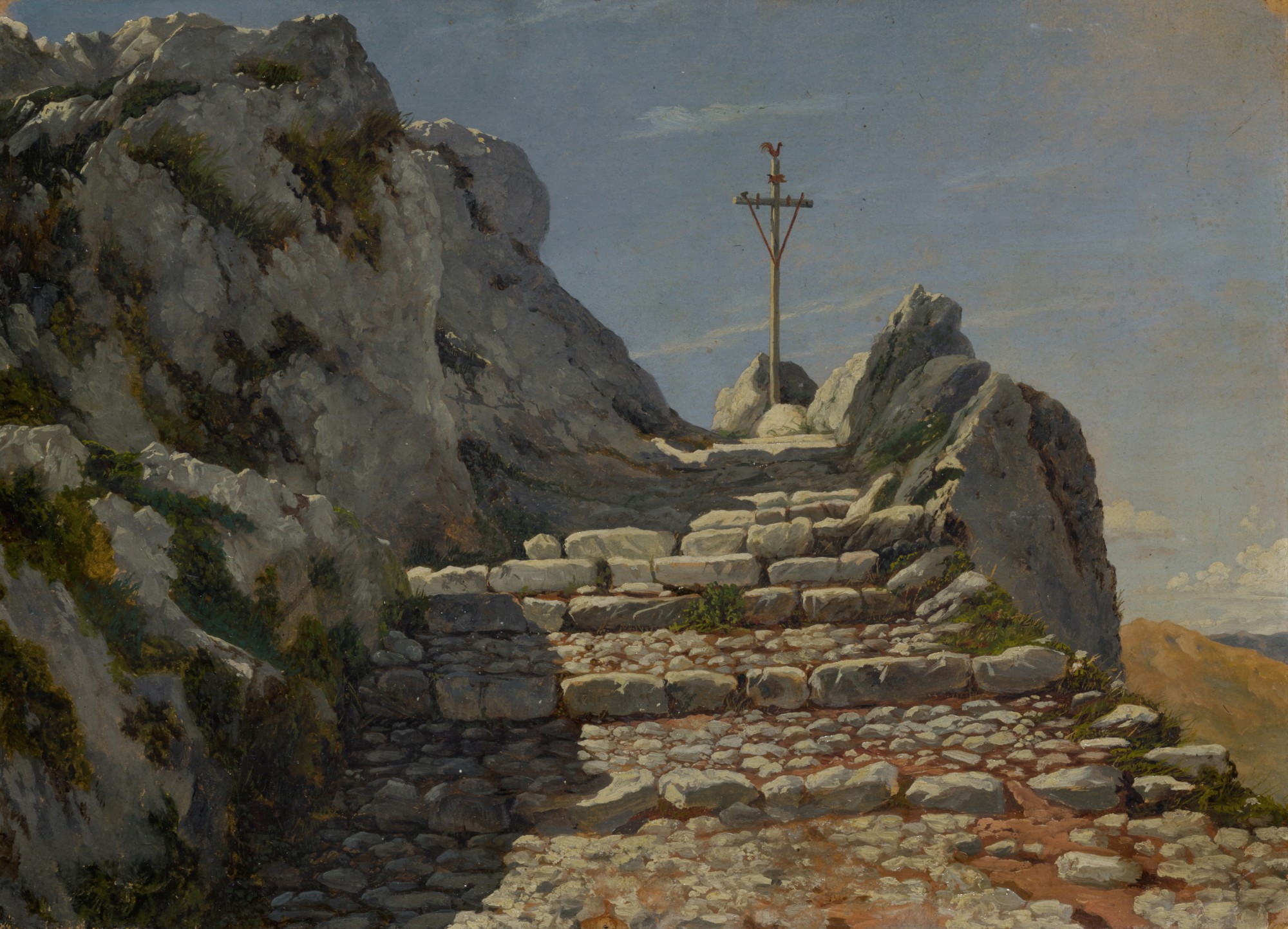
Albert Bierstadt
Landscape
They are among the most sought after works on the market today precisely because they show the artist thinking, observing, and responding rather than performing for a public audience. His Jungfrau After First Snow from 1867, another work on The Collection, connects his European formation to his American ambitions in a single, shimmering image. On the auction market, Bierstadt occupies a position of consistent strength. His large finished works, when they appear, routinely attract competitive bidding from major American and international institutions as well as private collectors.
Smaller works on paper and board, like those represented on The Collection, have become increasingly attractive to collectors who recognize their art historical significance and their relative accessibility compared to the monumental canvases. Bierstadt shares his moment in art history with other painters of comparable vision: Frederic Edwin Church, whose panoramic ambitions matched Bierstadt's own; Thomas Moran, whose Yellowstone paintings did for that landscape what Bierstadt did for the Rockies and Yosemite; and the Hudson River School painters who formed the immediate context for his emergence. Among European contemporaries, the Barbizon painters in France and the Düsseldorf masters in Germany provide useful points of comparison, though Bierstadt ultimately synthesized these influences into something distinctly American in its scale and optimism. The question of Bierstadt's legacy is no longer in serious dispute.
There were decades in the mid twentieth century when his reputation suffered, when critics who favored abstraction and conceptual austerity found his panoramic ambition excessive or sentimental. That period of undervaluation now looks like a failure of critical imagination rather than an honest assessment of the work. The paintings have outlasted their detractors with characteristic grandeur. Today Bierstadt is understood as a central figure not only in American art history but in the broader story of how human beings have imagined, idealized, and grappled with the natural world.
His work speaks with particular urgency in an era of environmental awareness, when the landscapes he painted with such reverence have become freighted with new meaning. To look at a Bierstadt is to understand what was at stake in the American West, and why it mattered, and why it still does.
Explore books about Albert Bierstadt
Albert Bierstadt
Gordon Hendricks
Albert Bierstadt: A Western American Master
Nancy K. Anderson and Linda S. Ferber
Bierstadt
Peter Hassrick
Albert Bierstadt: Painter of the American West
Andrew Wilton
Albert Bierstadt and the Business of Art
Victoria Sweet