Alan Davie
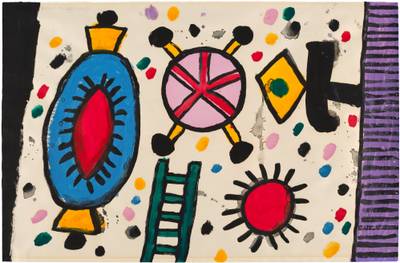
Alan Davie: Mystic Fire, Boundless Vision
Artist Spotlight · The Collection Editorial
“I want the painting to be a magical experience, something that happens to you, not something you simply look at.”
Alan Davie, artist statement
There are artists who work within the currents of their time, and then there are artists who seem to arrive from somewhere else entirely, carrying signs and symbols that belong to no single civilisation and every civilisation at once. Alan Davie was emphatically the latter. When a major survey of his work was mounted at the Scottish National Gallery of Modern Art in Edinburgh, audiences encountered canvases that felt simultaneously ancient and radically alive, their surfaces buzzing with totemic imagery, jazz rhythm, and a kind of sacred wildness that no critical label has ever quite contained. That the retrospective drew sustained attention from collectors and curators across Europe was a reminder that Davie's achievement, spanning more than six decades of painting, printmaking, and tapestry, remains one of the most extraordinary and undervalued stories in postwar British art.
Alan Davie
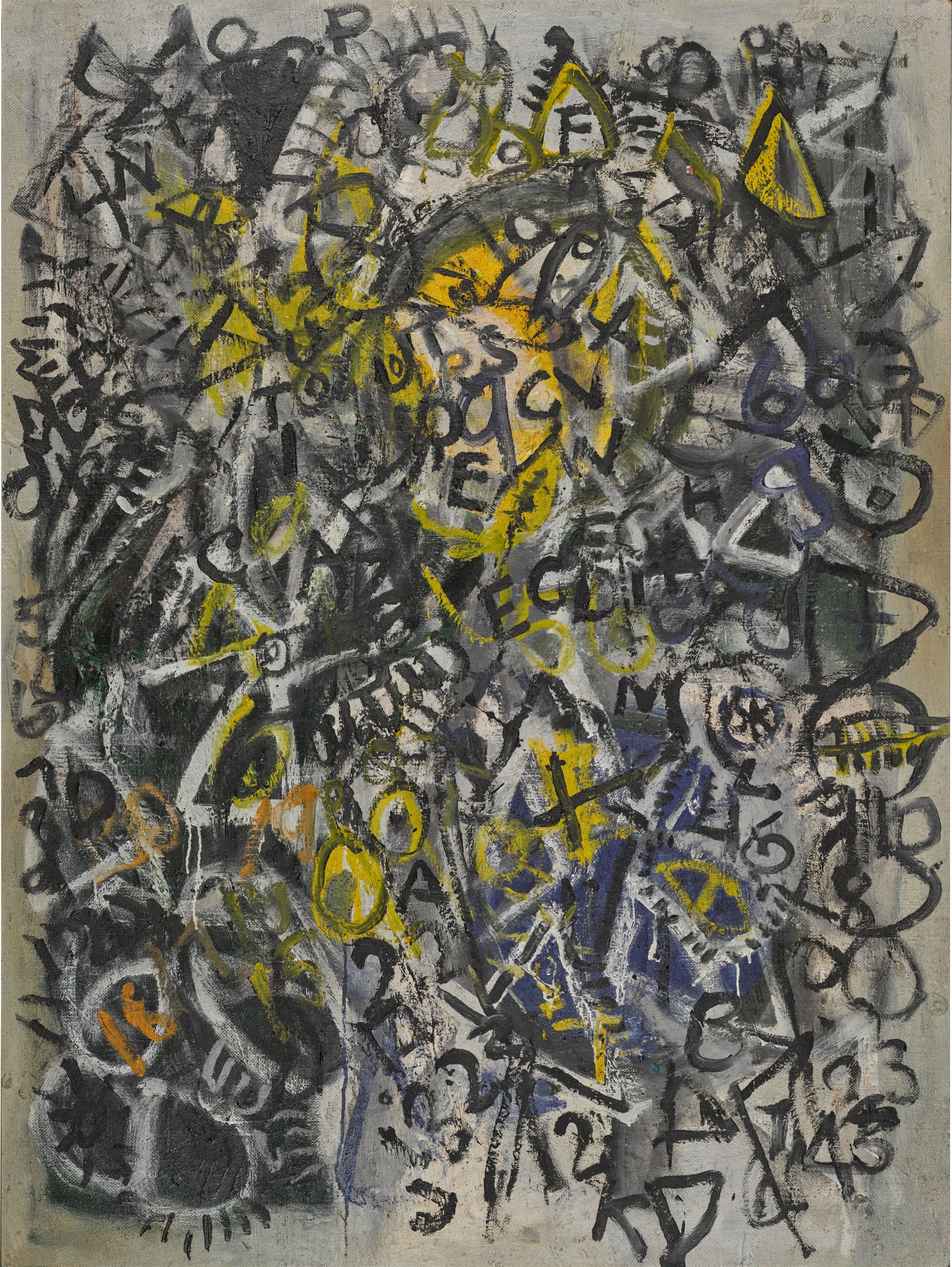
Bird Alphabet, 1955
Alan Davie was born in Grangemouth, Scotland, in 1920, into a family where creativity was the native language. His father was a painter and etcher, and the young Davie grew up understanding that art was not a luxury but a way of being in the world. He studied at Edinburgh College of Art in the late 1930s, where he trained as a painter and also developed a serious commitment to jazz, becoming an accomplished saxophonist and musician. That dual life as visual artist and improvising musician would prove foundational: the logic of jazz, its embrace of spontaneity, call and response, and the transformative power of the unrepeatable moment, would flow directly into his canvases for the rest of his life.
After serving in the Royal Artillery during the Second World War, Davie travelled through Europe on a travelling scholarship, an experience that proved formative in the most literal sense. In Venice in 1948 he encountered the collection of Peggy Guggenheim, and with it his first sustained exposure to the American Abstract Expressionists, among them Jackson Pollock, whose work Davie saw before almost any other European painter had the chance to do so. The encounter was electric. Yet where Pollock pursued the gesture as pure psychological release, Davie reached for something more ceremonial, more steeped in symbol and myth.
Alan Davie
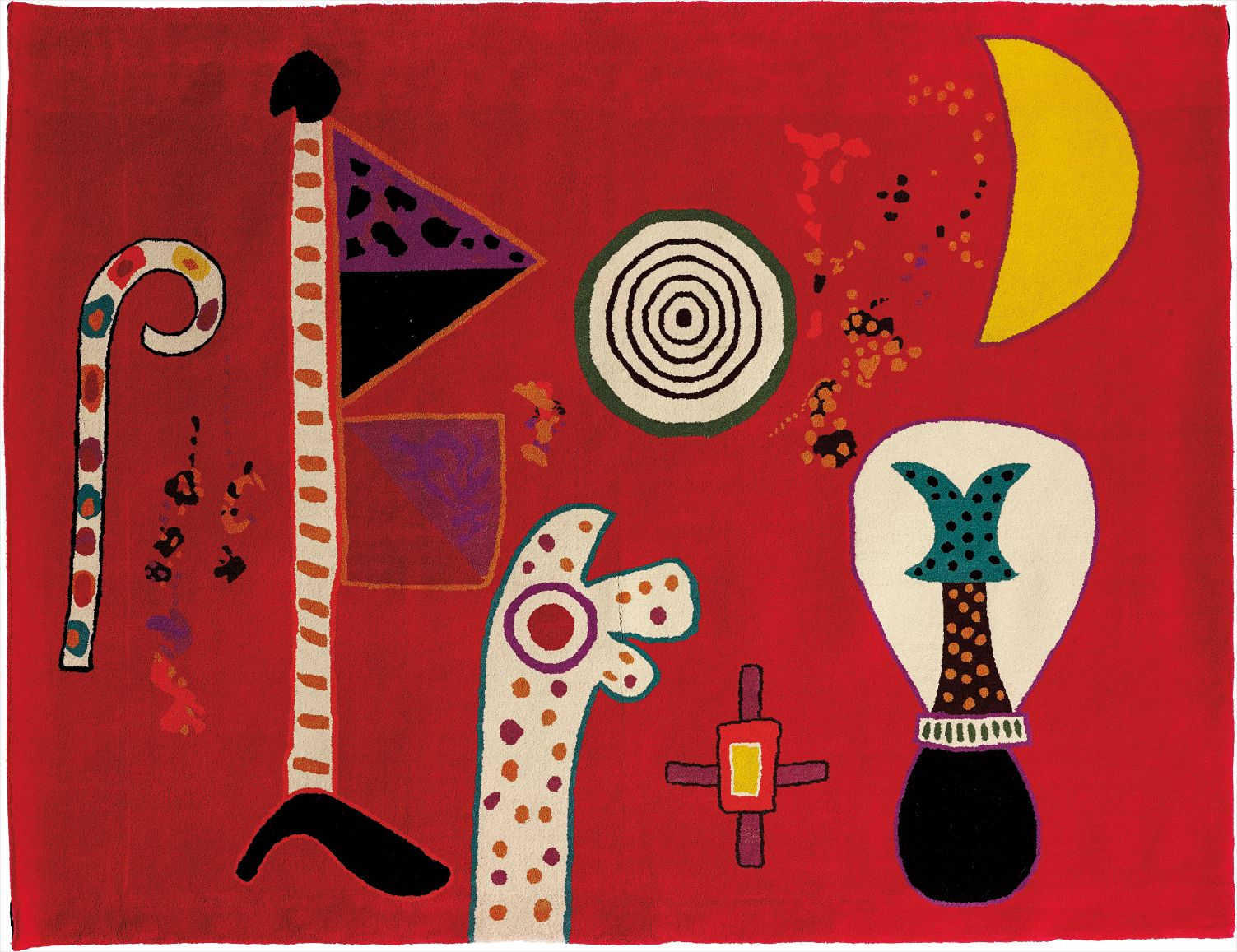
Flag Walk
He brought to the canvas not just the body's energy but the mind's hunger for meaning, for what he described as the mystery behind appearances. By the early 1950s Davie had developed a practice that was entirely his own. Working at scale, often on board or masonite, he built up densely layered surfaces crowded with signs that echoed Celtic knotwork, Zen calligraphy, African ritual objects, and the cave paintings of prehistoric Europe, all held together by an improvisational logic that owed as much to bebop as to Surrealism. Works from this period, such as Goddess of the Green from 1954 and the double sided Bird Alphabet of 1955, demonstrate this synthesis at its most urgent and assured.
These are paintings that seem to have been discovered rather than made, their symbols pressing upward through layers of paint as if the canvas were an archaeological site being excavated in real time. Davie himself spoke of painting as a form of magic, a ritual act rather than a representational one, and these early masterworks carry that conviction in every mark. The late 1950s and the 1960s brought both wider recognition and a deepening of Davie's symbolic vocabulary. His solo exhibitions at Gimpel Fils in London attracted serious critical attention, and his work entered significant international collections.
Alan Davie
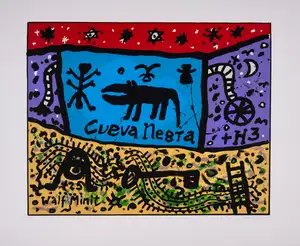
Cueva Negra; Sonik Sin and Haveth High (Three Prints)
Canvases such as Monkey Love from 1960 and Thingummy Jig from 1959 show the imagery becoming at once more playful and more charged, the signs multiplying and interlocking with a confidence that reflects an artist fully inside his own world. By the mid 1960s, works like the gouache and watercolour pair Rune Reader I and II demonstrate his remarkable fluency across media, bringing the same improvisational intensity to works on paper that he achieved on canvas. His tapestry work, including the richly woven Flag Walk, extended his reach into the textile tradition with characteristic ambition, translating the vocabulary of his painting into the slow, tactile language of wool. For collectors approaching Davie today, the range of his output offers genuine opportunity across price points and media.
His screenprints, including the celebrated triptych Cueva Negra, Sonik Sin and Haveth High produced in an edition of 30 and published by Gresham Studios in Cambridge around 2000 and 2001, offer an accessible entry point into a body of work where even the multiples feel infused with the same mythic energy as his unique canvases. Works on paper, including gouaches such as Monument to the Caribs No 10 and the luminous Mama Idol No. 3 in oil on canvas, represent the full reach of his ambition in more intimate formats. Auction appearances of significant Davie canvases have historically drawn competition from collectors with a sophisticated understanding of postwar British painting, and the estate continues to be carefully managed, ensuring that works entering the market carry proper documentation and provenance.
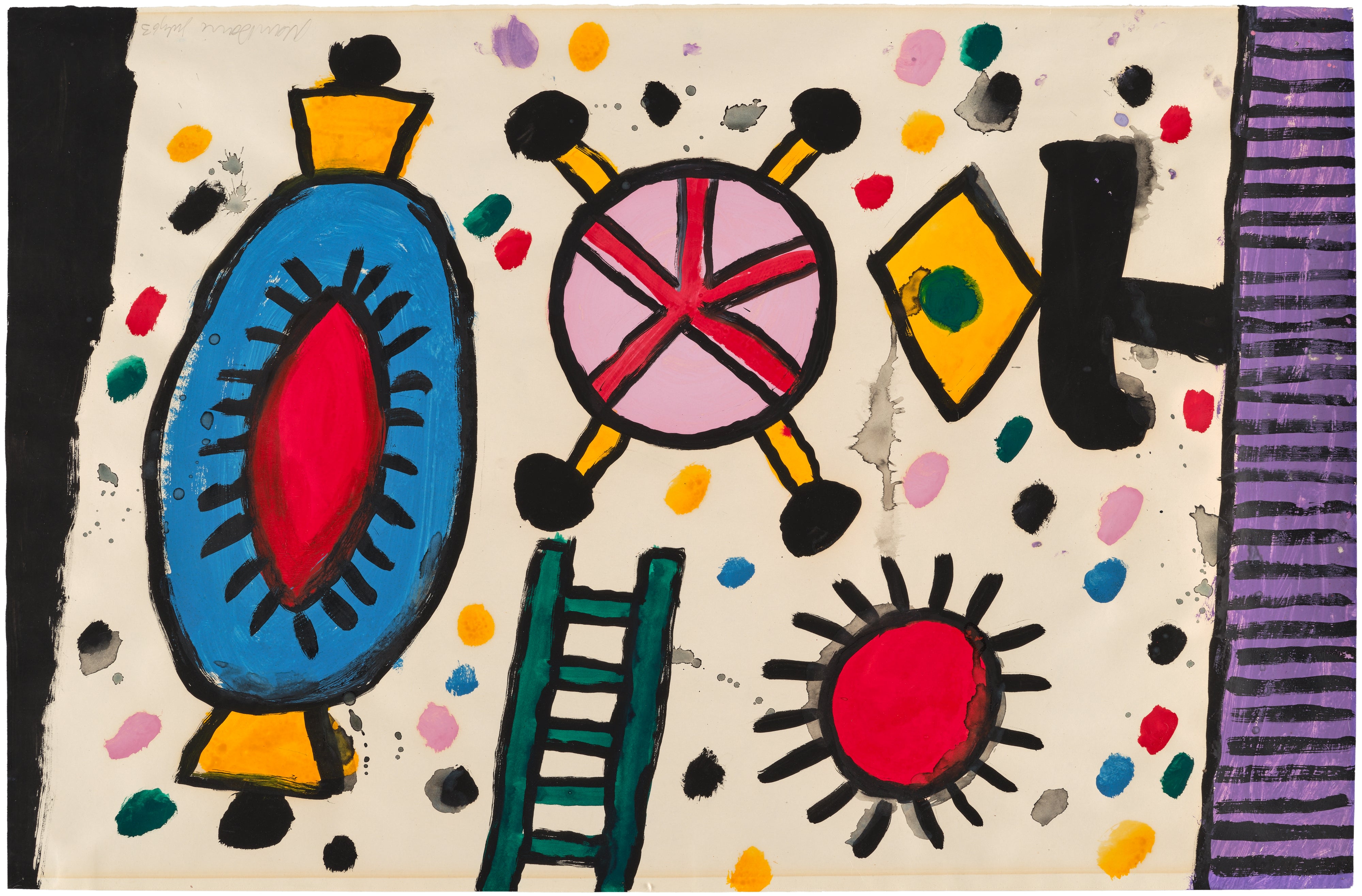
Alan Davie
Executed in July 1963, in the United Kingdom.
Davie sits within a constellation of British modernists that includes Victor Pasmore, Ben Nicholson, and Peter Lanyon, but his affinities run equally across the Atlantic and beyond. His relationship to American Abstract Expressionism is one of productive divergence rather than imitation. Where his transatlantic contemporaries sought the sublime through scale and gesture, Davie sought it through symbol and ceremony, aligning him as much with the Art Brut tradition of Jean Dubuffet and the shamanistic energies that Jean Tinguely and CoBrA artists also explored. He was an internationalist whose roots ran deep into the Scottish soil, and that tension between the local and the universal gives his work a peculiar, sustaining electricity.
The reasons to care about Alan Davie in the present moment are many and gathering force. As contemporary art increasingly returns to questions of spirituality, ritual, and the limits of purely materialist culture, Davie's paintings read not as historical documents but as live transmissions. His insistence on the painting as a space of genuine mystery, his refusal to subordinate the hand to the concept, and his lifelong belief that art could function as a form of knowledge unavailable through any other means: these commitments feel urgent and instructive rather than nostalgic. He died in 2014 at the age of 93, having worked with undiminished intensity almost to the end.
The world he built in paint and ink and wool remains wide open, waiting to be entered.
Explore books about Alan Davie