Agostino Bonalumi
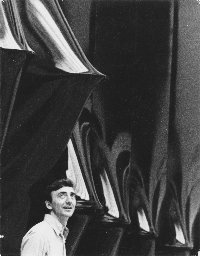
Bonalumi's Beautiful Surfaces Reach Out To You
Artist Spotlight · The Collection Editorial
In the great arc of postwar European art, certain moments announce themselves with unusual clarity. When Agostino Bonalumi stretched a canvas over carefully placed wooden forms and painted it a single, luminous white, he was not merely making a painting. He was proposing a new category of experience, one in which the wall itself seemed to breathe. That proposition, first advanced in Milan in the late 1950s and pursued with extraordinary discipline until his death in 2013, has never felt more urgent than it does now, as major institutions across Europe continue to reassess the Italian avant garde and collectors worldwide seek works that hold both intellectual and sensory power in equal measure.
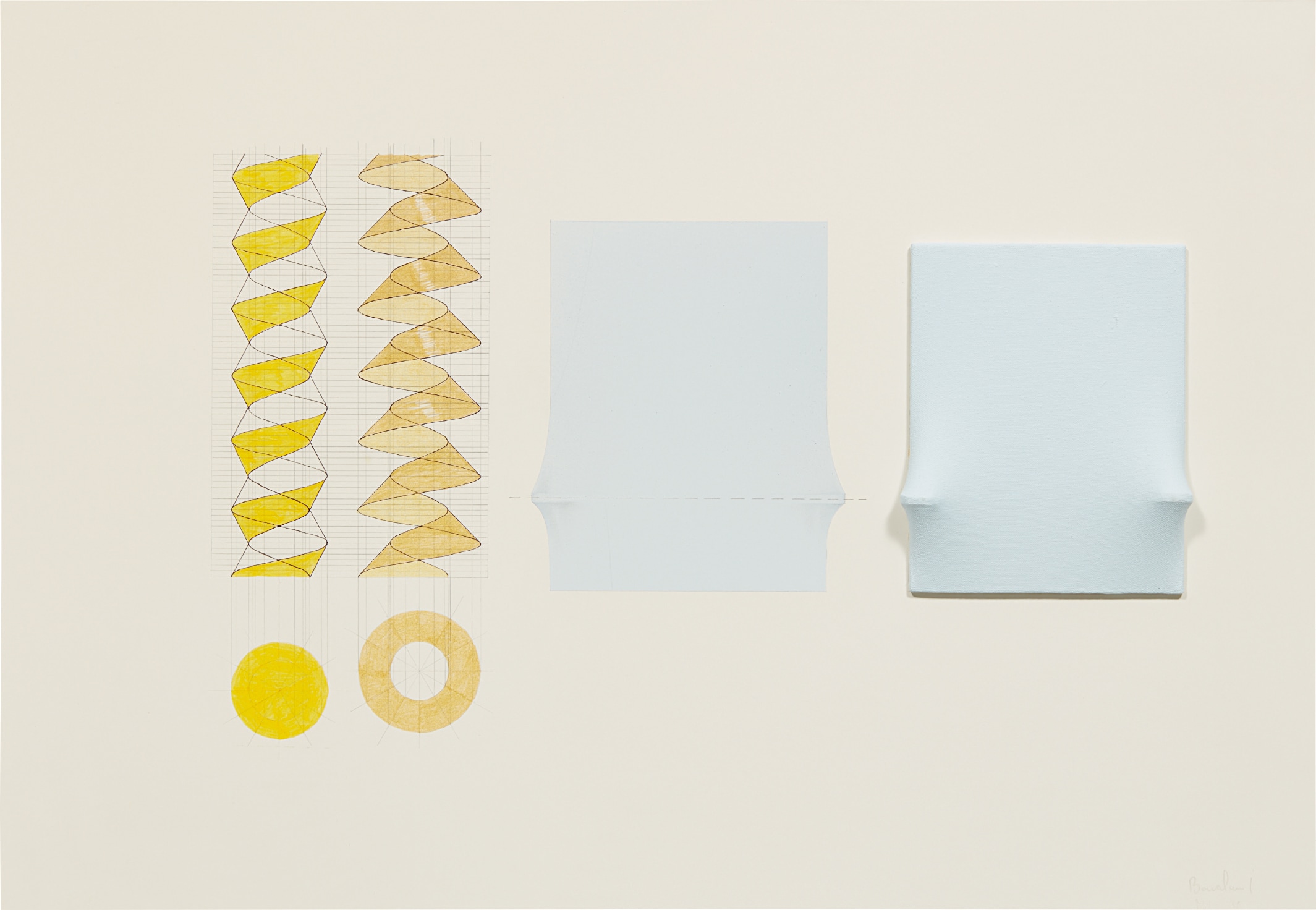
Agostino Bonalumi
Progetto, 1971
Agostino Bonalumi was born in Vimercate, in the province of Milan, in 1935. He came of age in a northern Italy rebuilding itself with fierce creative ambition, and the city of Milan in particular crackled with artistic energy in the postwar decades. Bonalumi trained as a technical designer, a background that gave him a rigorous relationship with structure, form, and the logic of materials. This technical fluency would prove foundational.
He was never a painter who stumbled upon three dimensionality by accident. He arrived at it through precise, almost architectural thinking about what a surface could do and what it could mean. The decisive period in Bonalumi's formation was his friendship and collaboration with Enrico Castellani and Piero Manzoni, with whom he co founded the journal and gallery Azimuth in Milan in 1959. Azimuth was a crucible.
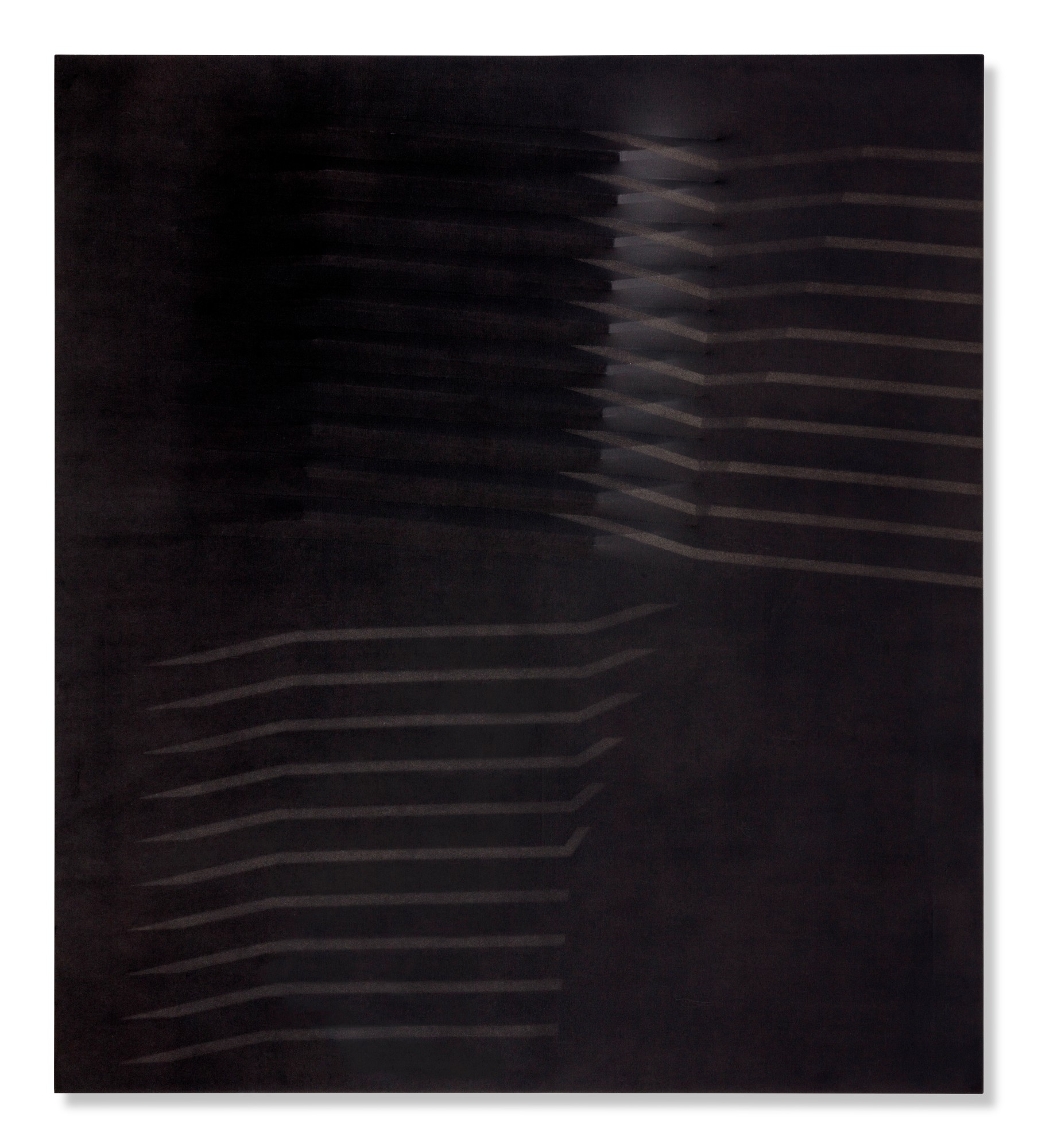
Agostino Bonalumi
Nero
It brought together artists who were fundamentally dissatisfied with the conventions of gestural abstraction and who wanted to relocate artistic meaning from expressive gesture to the material conditions of the work itself. Manzoni, with his Achromes and his conceptual provocations, pushed toward dematerialization. Castellani, whose nail activated reliefs of monochrome surfaces remain among the most quietly radical objects of the twentieth century, shared with Bonalumi a fascination with what happens when a painted surface is made to project into real space. These were not merely friendships.
They were the intellectual relationships that sharpened Bonalumi's ambitions and gave his work its theoretical backbone. Bonalumi's breakthrough came through what he called his shaped canvases, works in which the stretcher was built around protruding elements so that the painted surface rose and fell in organic, often biomorphic rhythms. Unlike Castellani's regular, nail punctuated grids, Bonalumi's forms were more voluminous and bodily, their undulations softer and more sensuous. He worked predominantly in monochrome, using vinyl tempera and later acrylic to achieve surfaces of extraordinary evenness, so that light became the only painter, raking across the curved forms and creating shadows that shifted with the viewer's position and the hour of the day.
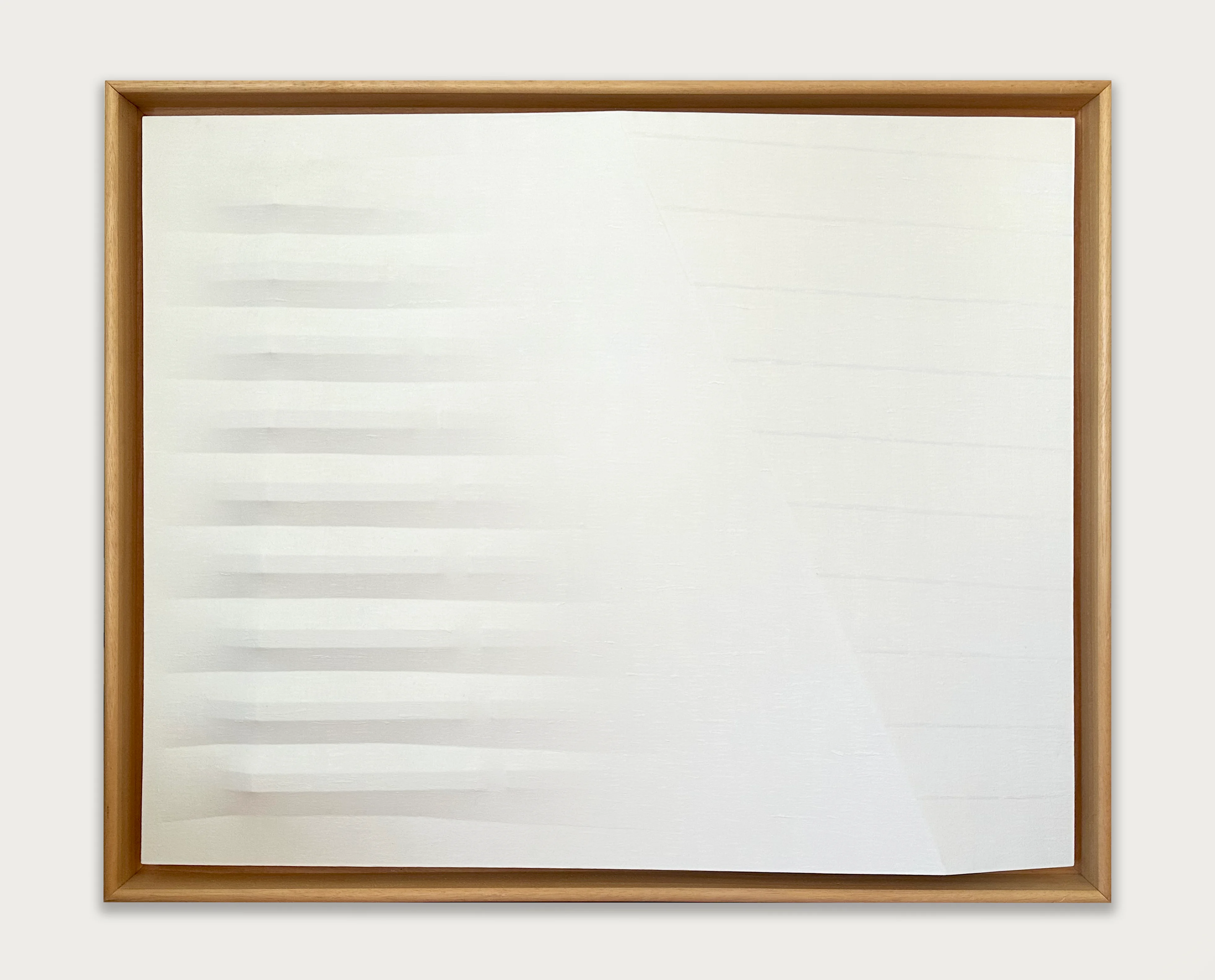
Agostino Bonalumi
Bianco, 1987
The work lived in time as well as space. Standing before a large Bonalumi is to experience something closer to sculpture than to painting, yet the wall hung format insists on its identity as a picture. The works available through The Collection span several decades of this practice and illuminate the full range of Bonalumi's chromatic intelligence. "Bianco e Nero" from 1964 is among his earliest explorations of tonal duality, demonstrating how even within a restricted palette the relief format generates almost infinite optical variation.
The 1968 version of the same title shows a deepened command of the formal vocabulary. "Blu" from 1979, executed in acrylic on shaped canvas, has the saturated depth that made his blue works so sought after, the color seeming to recede into and emerge from the surface simultaneously. "Bianco" from 1987 is a mature statement, stripped to essentials, utterly confident. And "Rosso" from 1995, rendered in acrylic on extruded paper, shows Bonalumi late in his practice still willing to experiment with support materials, still asking what a ground can do.
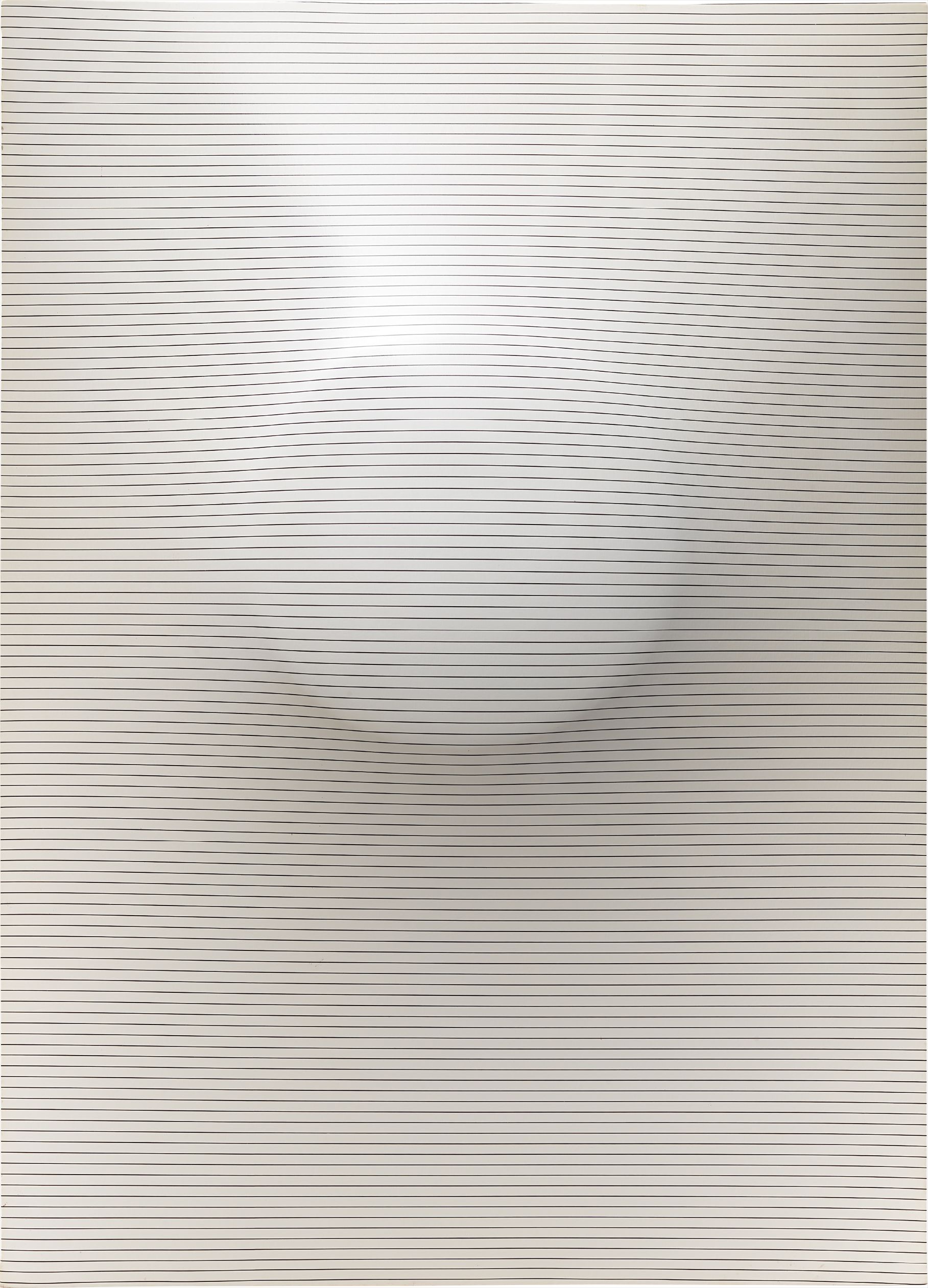
Agostino Bonalumi
Bianco e Nero, 1968
"Progetto" from 1971, a mixed media work on paper, offers a rare glimpse into his working process, the generative thinking that preceded the finished relief. For collectors, Bonalumi occupies a position that is both historically secure and still genuinely rewarding in market terms. His works have been handled by leading Italian galleries including Tornabuoni Art, and they appear regularly at the major international auction houses, where strong examples routinely achieve significant results. The artist's reputation has benefited from sustained institutional attention, with works held in the collections of the Museo del Novecento in Milan, the Mart in Rovereto, and numerous European private collections.
What draws serious collectors is the combination of rigorous concept and immediate sensory pleasure: a Bonalumi is never cold or merely theoretical. It is always, above all, beautiful. Works from the 1960s, when the shaped canvas vocabulary was being invented rather than refined, carry particular historical weight. The blue and white monochromes tend to be especially popular, though the rarer red and black examples reward attention and often represent stronger value propositions for the discerning buyer.
To understand Bonalumi fully is to understand a wider constellation of postwar European art that has only recently received its due international recognition. His peers and contemporaries include not only Castellani and Manzoni but also the artists of the Zero movement in Germany, among them Heinz Mack and Günther Uecker, and the broader Nouvelle Tendance network that connected Milan, Düsseldorf, and Paris in the early 1960s. Lucio Fontana, whose spatial investigations preceded and inspired Bonalumi's generation, is the obvious Italian forebear. In an international frame, the dialogue with American Minimalism is real but should not be overstated: where artists like Donald Judd or Robert Morris proceeded from industrial fabrication and philosophical skepticism about the art object, Bonalumi retained the handmade, body centered quality of painting and never abandoned the wall as his primary interlocutor.
Bonalumi died in Monza in 2013, leaving behind a body of work that continues to grow in stature. The decades since his death have seen a steady reappraisal of the Italian postwar avant garde, and Bonalumi stands at its center, not as a footnote to more famous names but as a primary figure whose contribution was distinctive, sustained, and genuinely original. His works ask something generous of the viewer: simply to stand still, to notice the light, to feel the way a surface can become an event. In an art world often crowded with noise, that invitation remains as clear and as quietly radical as it was when he first issued it in Milan more than sixty years ago.