Adolphe Monticelli
Monticelli: The Master of Luminous Abundance
Artist Spotlight · The Collection Editorial
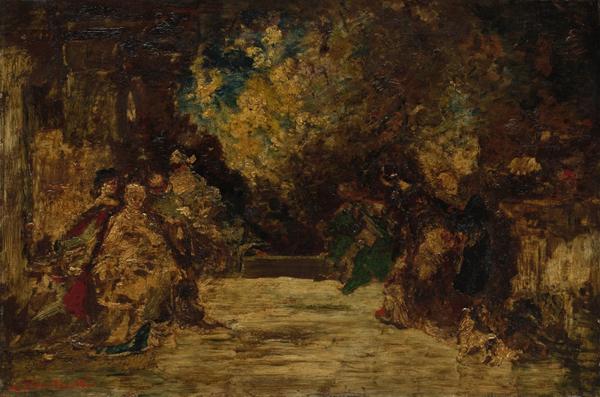
There is a particular kind of pleasure that comes from standing before a Monticelli and simply surrendering to it. The paint is piled on with something close to recklessness, jewel tones pressing against one another in arrangements that seem to defy ordinary logic, figures dissolving into atmosphere, light pooling in corners you did not expect. It is a sensory experience before it is an intellectual one, and that quality, so rare and so persuasive, is precisely why collectors and curators are returning to Adolphe Monticelli with fresh and genuinely admiring eyes. Recent years have seen renewed institutional attention to the painters who bridged French Romanticism and the expressive freedoms of the late nineteenth century, and Monticelli sits at that crossing with a singular and underappreciated grace.
Adolphe Monticelli
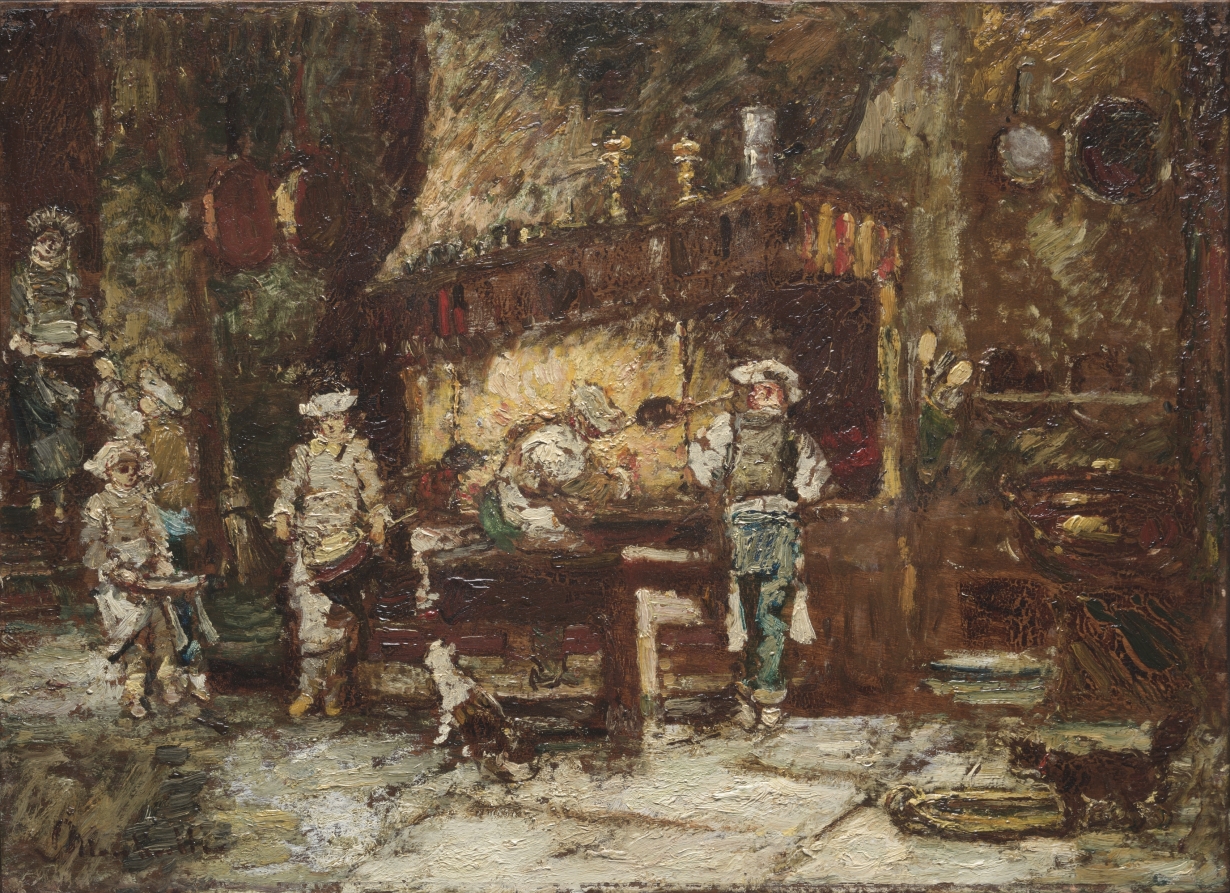
The Kitchen of the Rôtisserie des Deux Paons, 1875
Adolphe Joseph Thomas Monticelli was born in Marseille in 1824, the son of a Piedmontese father and a mother whose Provençal roots ran deep into the sun drenched south of France. Marseille in the early nineteenth century was a city of extraordinary cultural ferment, a Mediterranean port where North African light, Italian pictorial tradition, and French ambition converged. That geography left its mark on Monticelli permanently. He studied first at the École des Beaux Arts in Marseille before making the obligatory journey to Paris, where he entered the studio of Paul Delaroche in the late 1840s.
Delaroche was among the most celebrated academic painters of his generation, and time spent in his orbit gave Monticelli a thorough grounding in compositional discipline and historical subject matter. But it was the Louvre that truly educated him, and it was before the Venetian masters above all that he found his calling. Titian, Veronese, and Giorgione showed Monticelli what color could do when it was released from the obligation to merely describe. He spent long hours studying their canvases, absorbing not just technique but a philosophical stance toward painting, one that privileged sensation and atmosphere over topographical accuracy.
Adolphe Monticelli
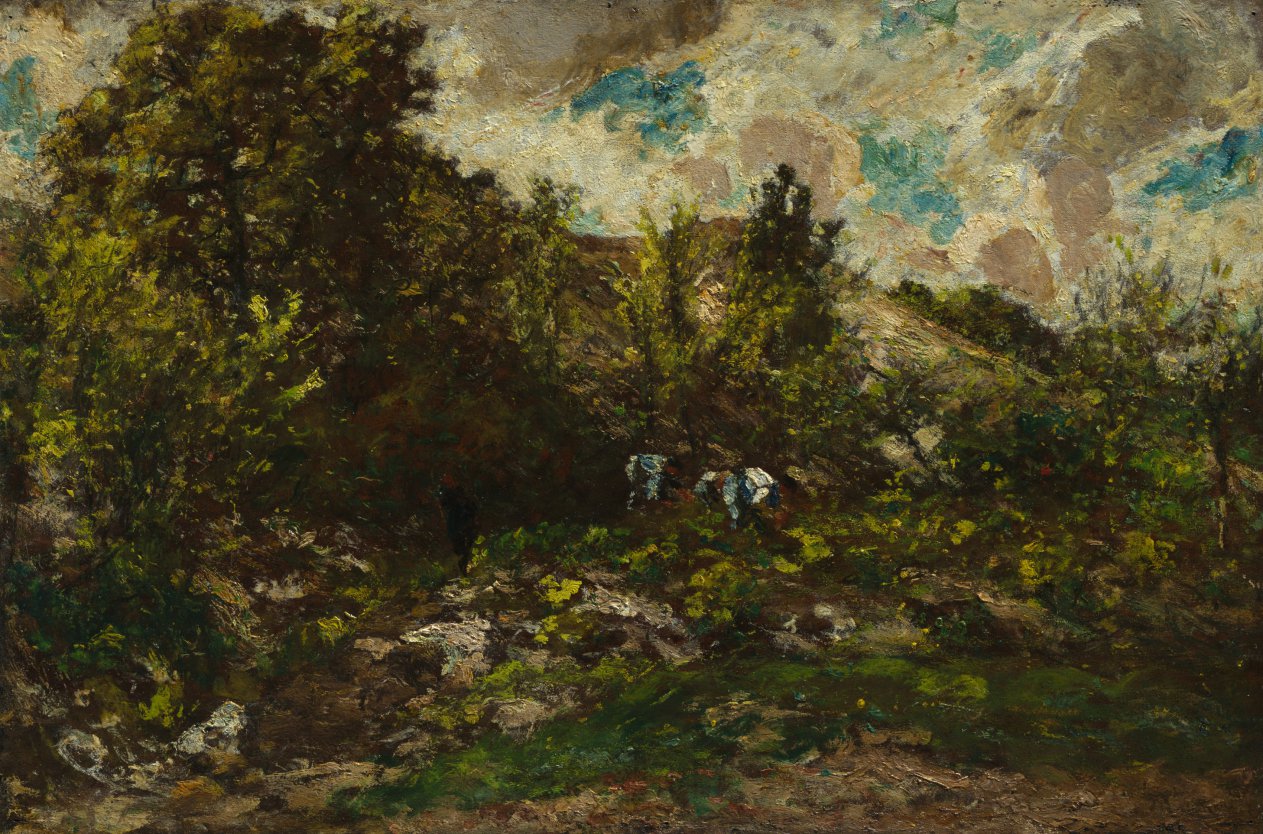
Autumn, 1867
He was also drawn deeply to Eugène Delacroix, whose Orientalist visions and sovereign command of warm, vibrating color spoke directly to everything Monticelli was becoming. The influence of Delacroix is visible throughout Monticelli's mature work in the way he allows color relationships to carry emotional weight that figures and settings alone cannot bear. It was a lesson he absorbed completely and made entirely his own. Monticelli's artistic development can be understood in broad terms as a movement from relative restraint toward ever greater chromatic and textural boldness.
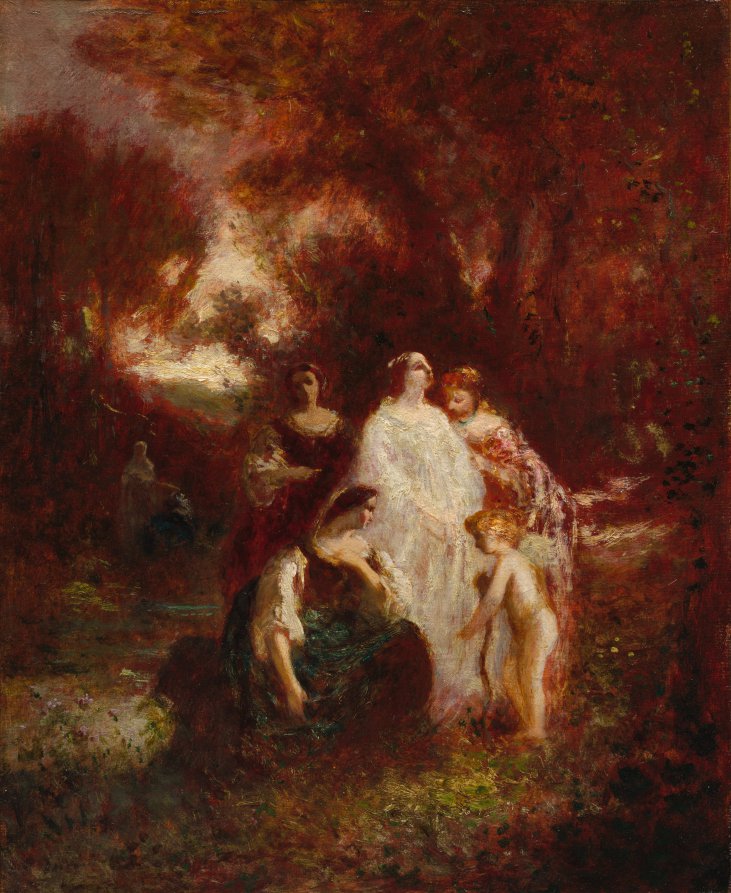
His earlier works, such as "A Woodland Fête" from 1853 and "Figures in the Woods" from 1857, already show his characteristic fondness for dappled, enclosed garden spaces and for figures whose identities are suggested rather than declared. By the time of "A Garden Party" in 1860 and "Autumn" in 1867, something has been unlocked. The paint handling grows more urgent, the color more saturated, and the figures seem to shimmer within their settings rather than simply inhabiting them. The works from the late 1860s and 1870s represent the full flowering of his vision, and "The Kitchen of the Rôtisserie des Deux Paons" from 1875 stands among the finest achievements of that period.
Adolphe Monticelli
Figures in the Woods, 1857
This intimate interior scene, painted on wood panel as Monticelli so often preferred, demonstrates his ability to conjure warmth and life from loaded brushwork and a palette that seems almost to generate its own light. The wood panel support deserves particular attention because it is central to understanding what makes Monticelli's best work so compelling. Unlike canvas, panel does not absorb oil in the same way, and Monticelli exploited this difference brilliantly, building up surfaces of extraordinary texture and luminosity. His impasto passages catch light physically, so that a work changes appearance as you move around it or as the ambient light shifts during the day.
"Vase de fleurs" demonstrates this quality with particular force, the flowers pressing forward from the surface with an almost sculptural insistence. Collectors who have lived with a Monticelli panel describe the experience of returning to it again and again and finding something previously unnoticed, a quality that speaks to genuine pictorial intelligence at work beneath the apparently spontaneous surface. No account of Monticelli can be complete without Vincent van Gogh, who discovered the older painter's work in Paris during the 1880s and was profoundly altered by the encounter. Van Gogh collected Monticelli's paintings with genuine passion, and together with his brother Theo he was instrumental in bringing Monticelli's work to wider attention.
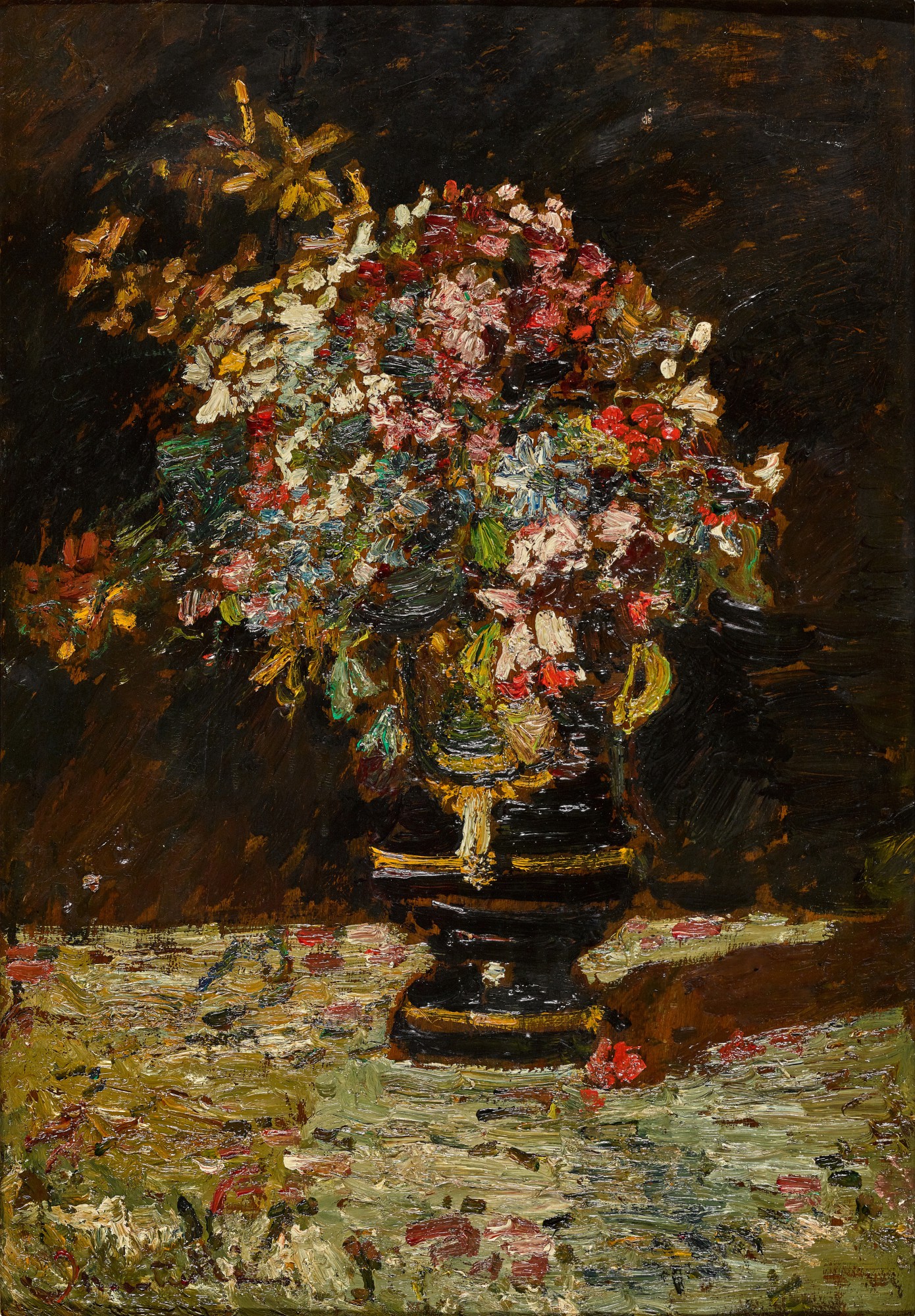
Adolphe Monticelli
Vase de fleurs
Van Gogh recognized in Monticelli a kindred pursuit of color as emotional language, and the expressive impasto surfaces that would define van Gogh's mature style owe a clear and acknowledged debt to his Marseillais predecessor. Paul Gauguin also admired Monticelli, and together these connections place him at the origin point of some of the most consequential developments in late nineteenth century painting. He belongs in conversation not only with Delacroix and the Romantic tradition but also with the early stirrings of Post Impressionism, Fauvism, and Expressionism. From a collecting standpoint, Monticelli occupies a genuinely interesting position in the current market.
His work has long been appreciated by discerning private collectors who prize quality of eye over name recognition, and his panels and canvases have appeared regularly at major auction houses including Christie's and Sotheby's, where strong examples consistently attract competitive bidding from European and American collectors. The relative intimacy of his scale, many works are modest in dimension but enormous in presence, makes them exceptionally well suited to living with. There is something generous about a Monticelli: it does not demand a dedicated gallery wall so much as it rewards proximity and repeated attention. For the collector drawn to the French nineteenth century, to the traditions of Romanticism and Orientalism, or simply to works of exceptional painterly quality, Monticelli represents a name worth knowing well.
His legacy, properly understood, is one of extraordinary generosity to the artists who followed him. He gave van Gogh permission to feel, gave Gauguin confirmation that color could carry narrative, and gave the twentieth century a model of paint as matter that speaks before it describes. Monticelli spent his final years in Marseille, returned to the city that made him, working with undiminished passion until his death in 1886. The Musée des Beaux Arts in Marseille holds significant holdings of his work, and those canvases and panels remain exactly as alive and exactly as demanding as they were when the paint was still wet.
That durability is the measure of genuine achievement, and Monticelli achieved it abundantly.
Explore books about Adolphe Monticelli
Monticelli
Alfred Sensier
Adolphe Monticelli: Sa vie et son œuvre
Théophile Gautier
Monticelli: The Man and His Work
Lionello Venturi
Adolphe Monticelli
Germain Bazin
Monticelli: Catalogue Raisonné
Keith Roberts