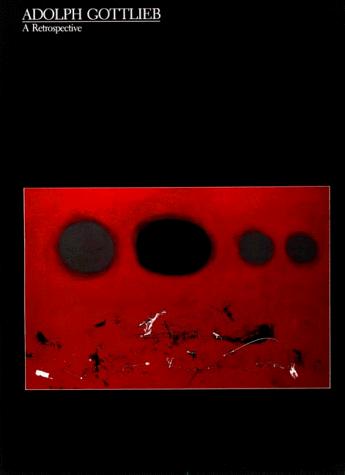
Adolph Gottlieb
Adolph Gottlieb: A Universe Beautifully Distilled
Artist Spotlight · The Collection Editorial
“I wanted to make a painting that was like a single word, a single irreducible image.”
Adolph Gottlieb, interview with David Sylvester, 1960
Few moments in postwar American art feel as electrifying in retrospect as standing before a Gottlieb Burst painting at full scale, the luminous orb hovering above a turbulent mass of marks like a sun presiding over a restless earth. The Adolph and Esther Gottlieb Foundation continues to steward his legacy with remarkable care, and recent years have seen sustained institutional attention to his place at the very center of the Abstract Expressionist story. Major museum collections from the Guggenheim and the Whitney to the Smithsonian American Art Museum hold his work as cornerstone examples of what American painting achieved at its most ambitious and original. That renewed attention is entirely warranted.
Adolph Gottlieb
Red Halo, White Ground, 1966
Gottlieb was not a peripheral figure in the New York School; he was one of its essential architects. Adolph Gottlieb was born in New York City in 1903, the son of Austrian Jewish immigrants, and grew up in Manhattan at a time when the city itself was being remade by waves of modernist ambition. He studied at the Art Students League under John Sloan, whose commitment to direct observation and urban realism left a mark on his early sensibility even as Gottlieb would eventually move far beyond it. At seventeen he ran away to Europe, spending time in Paris and traveling through France and Germany, absorbing the Fauvist and Expressionist currents that were reshaping Western art.
That early immersion in European modernism gave him a foundation that few of his American contemporaries could match, and it gave him the confidence, upon returning to New York, to think seriously about what an authentically American painting might look like. The 1930s were a period of formation and defiant community for Gottlieb. He was a founding member of The Ten, a loose collective of New York based artists that also included Mark Rothko and Ben Zion, who shared a commitment to expressionist and emotionally charged work at a moment when Social Realism dominated the American art conversation. The Ten staged exhibitions in New York and in Paris, refusing to be absorbed into the prevailing taste for nationalistic subject matter.
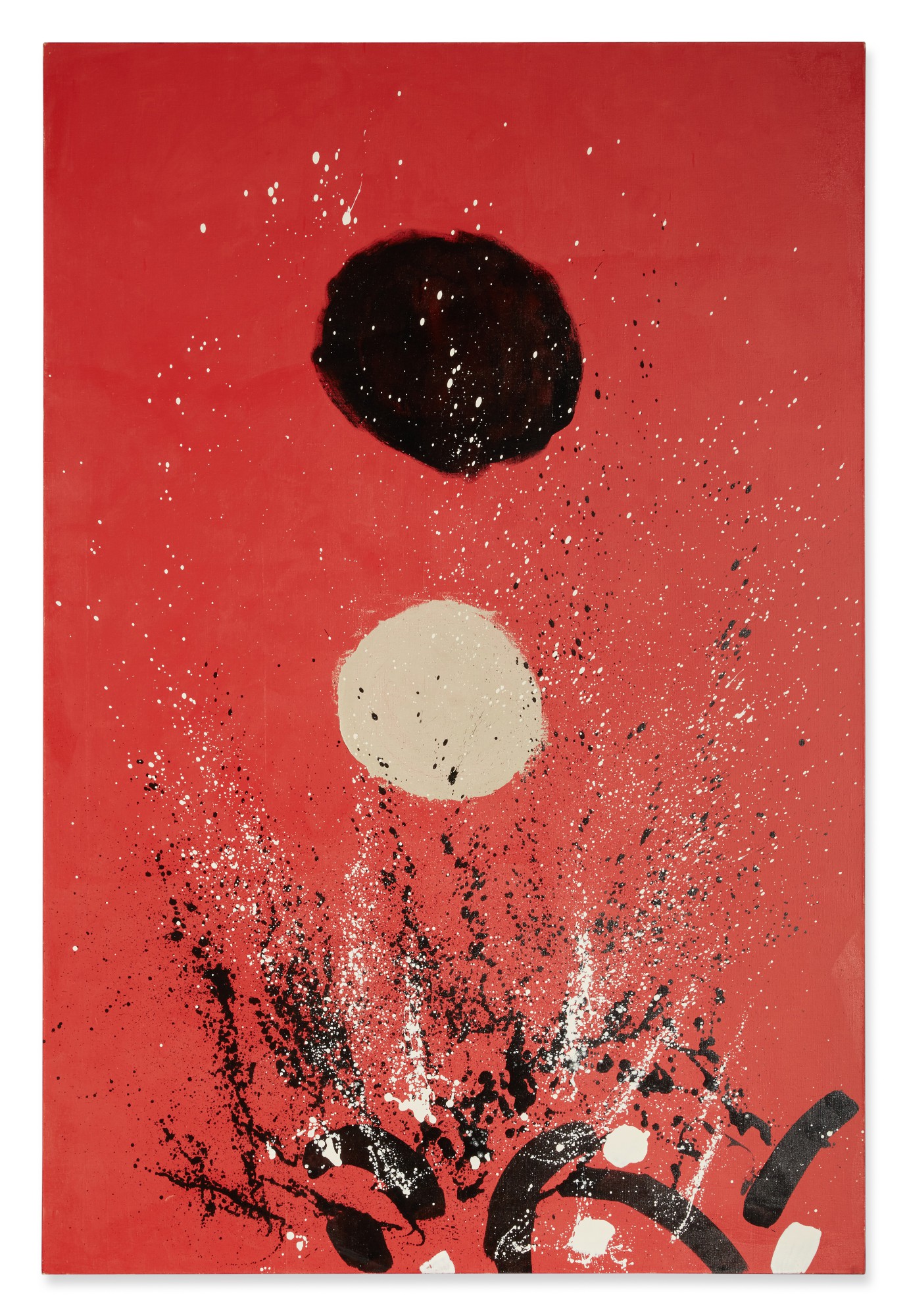
Adolph Gottlieb
Black Focal Point, 1973
Gottlieb was also shaped during this period by his friendship with Milton Avery, whose distilled color harmonies and flattened forms offered a quiet but persistent alternative to both academic painting and the heavy didacticism of the WPA era. These years of resistance and dialogue sharpened his instinct for emotional directness and his belief that painting could carry symbolic weight without illustration. The defining breakthrough of Gottlieb's career arrived around 1941 with the development of his Pictograph series, a body of work he would pursue for over a decade and that announced him as one of the most original minds of his generation. The Pictographs divide the canvas into a loose grid of compartments, each holding a mysterious sign or symbol drawn from African art, Native American imagery, Freudian psychology, and ancient mythology.
“There is no such thing as good painting about nothing. We assert that the subject is crucial.”
Letter to The New York Times, with Mark Rothko and Barnett Newman, 1943
Works like "Abstract Composition" from 1947, available in the collection as a luminous gouache on paper, demonstrate the richness of this period: each cell pulses with its own private logic while the whole radiates a unified, ceremonial energy. The Pictographs were not decorative arrangements but sincere attempts to access what Gottlieb and his colleagues believed were universal pictorial languages, myths older than the Western tradition. In 1943 Gottlieb and Rothko, along with Barnett Newman, published a remarkable letter in The New York Times responding to a critic's dismissal of their work, declaring their commitment to tragic and timeless subject matter. That letter reads today as a manifesto of Abstract Expressionism itself.
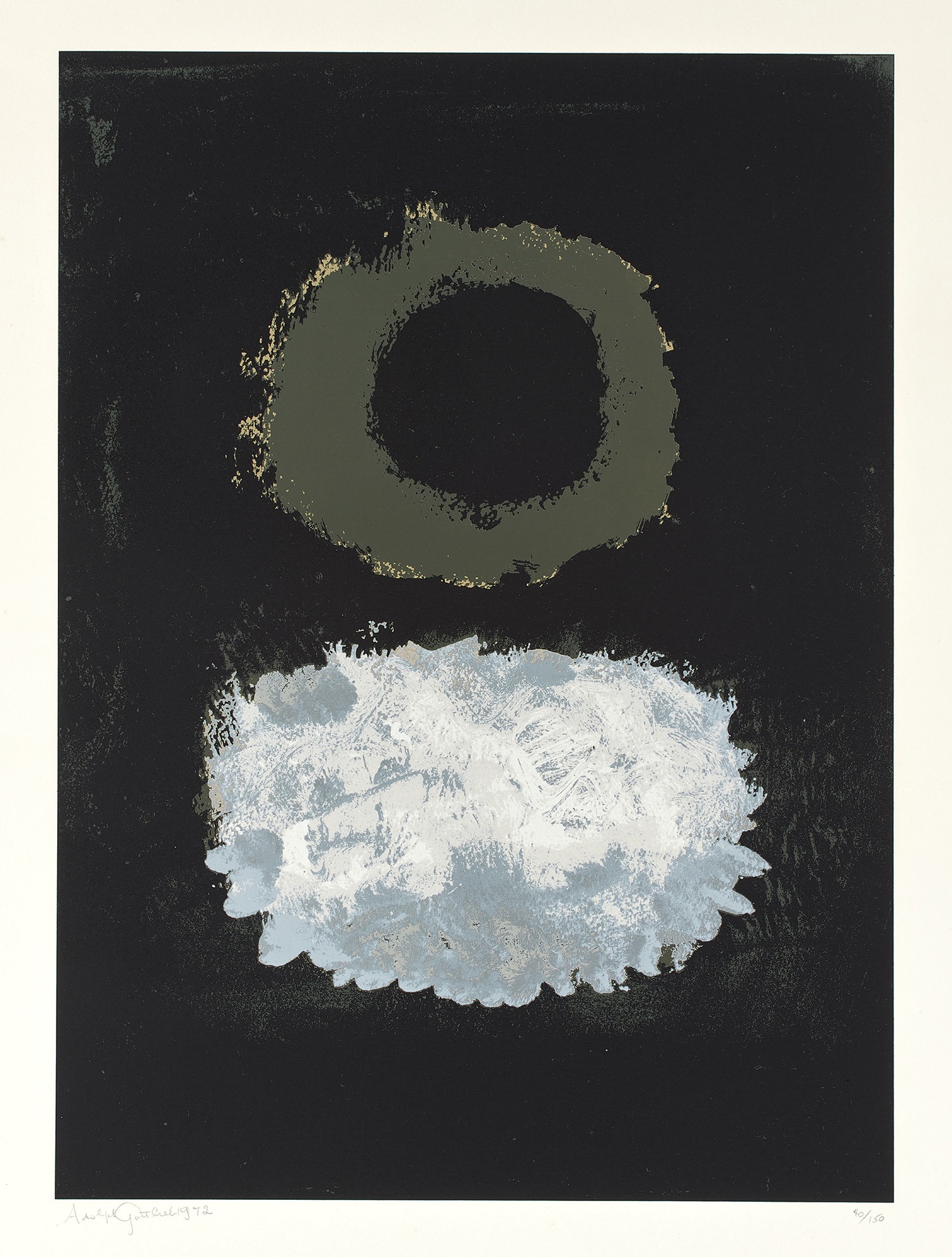
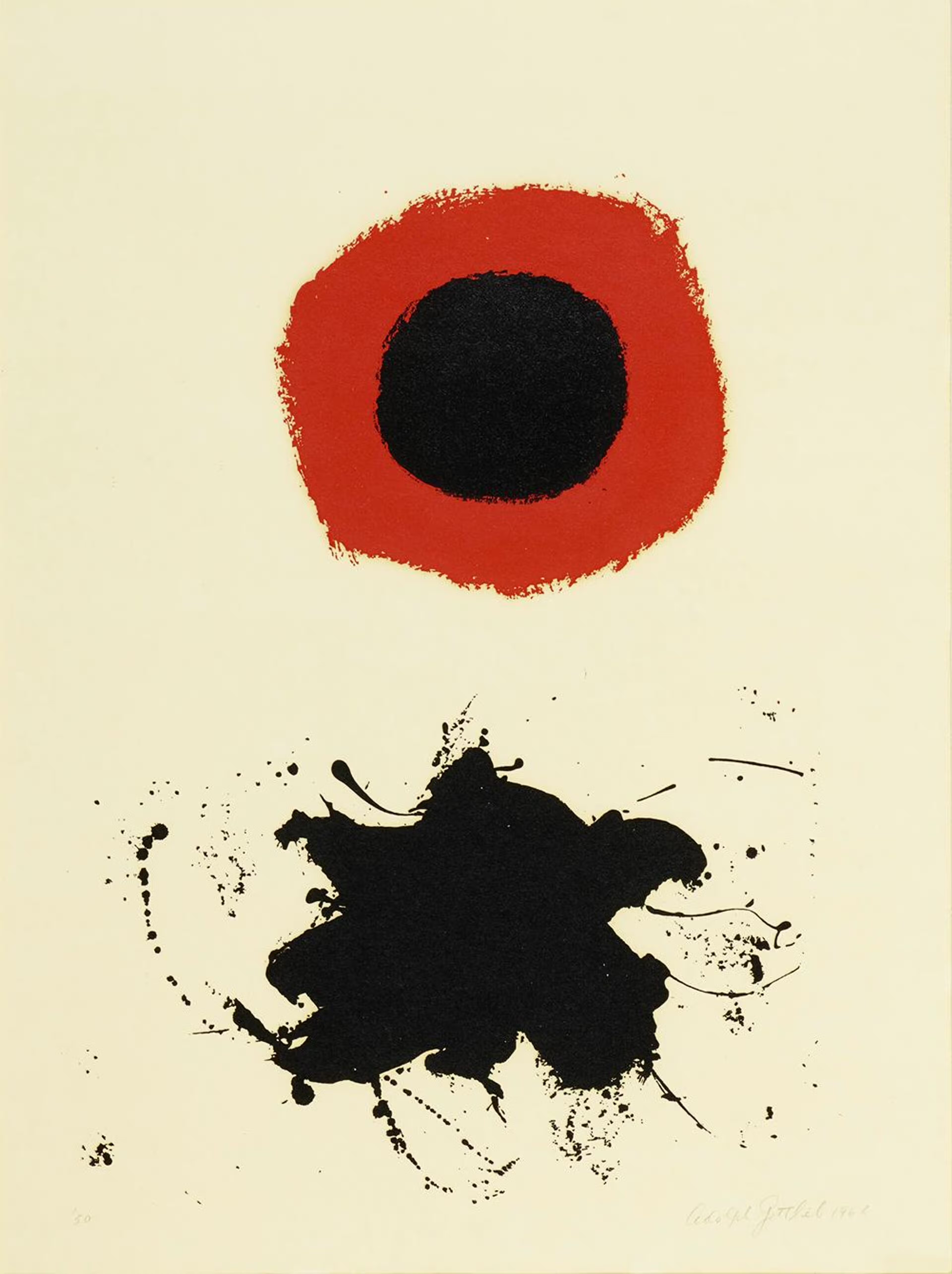
Adolph Gottlieb
Black Field (A.A.A. 74)
By the mid 1950s Gottlieb had moved through a transitional body of work he called the Imaginary Landscapes, in which thinly painted grounds of earth and sky set the stage for isolated symbolic marks, and then arrived at what many consider the summit of his achievement: the Burst paintings. In these works, a sphere of radiant color, warm or cool, dense or translucent, floats near the upper half of the canvas, while below it an agitated calligraphic explosion of dark paint erupts against a field of pure color. "Red Halo, White Ground" from 1966 is one of the most seductive examples of this format, the haloed orb suspended in perfect tension above the churning lower register. "Equal" from 1964 and "Black Focal Point" from 1973 extend and vary the formula across scale and material, each one a meditation on the relationship between stillness and energy, order and dissolution.
The Burst paintings were not merely compositional solutions; they were philosophical propositions about duality, about the coexistence of the celestial and the earthly, the contemplative and the violent. Gottlieb also worked with genuine distinction as a printmaker, and his screenprints repay close attention from collectors. Works like "Levitation" and "Black Field," both part of the celebrated AAA editions, translate the Burst vocabulary into the graphic medium with extraordinary fidelity and freshness. The relationship between the luminous fields of color and the deep blacks in these prints is, if anything, more concentrated than in the paintings, and they offer an accessible point of entry into his visual language at a range of price points.
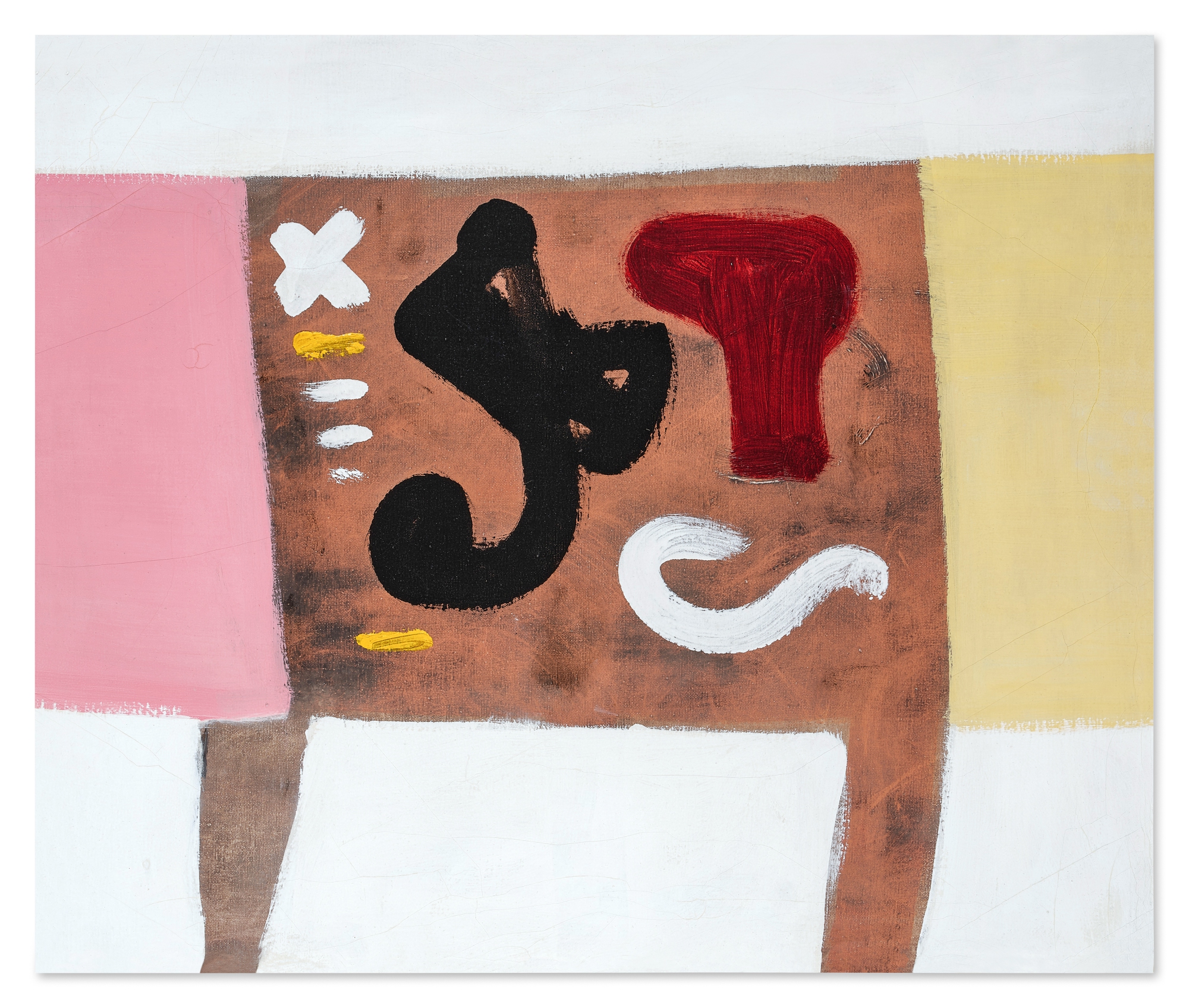
Adolph Gottlieb
Table, 1956
For collectors building a serious collection across movements, a Gottlieb print represents one of the most satisfying acquisitions in postwar American art: a work that is simultaneously intimate and monumental in its ambition. In the market, Gottlieb occupies a secure and respected position among the founding generation of Abstract Expressionists. Works on paper from the Pictograph period, such as "The Hunter" and "Abstract Composition," have attracted consistent collector interest for their directness and the documentary intimacy they offer into his working process. The Burst paintings command the highest prices at auction, with major canvases regularly appearing at Christie's, Sotheby's, and Phillips, where they are sought by serious institutional and private collectors alike.
What distinguishes a strong Gottlieb from a routine one is the quality of tension in the composition: the best works hold their opposing forces in a state of dynamic equilibrium that feels genuinely precarious and alive. Collectors drawn to Rothko, Franz Kline, Philip Guston in his abstract phase, and Joan Mitchell will find in Gottlieb a sensibility that shares their emotional directness while offering something distinctly his own in its cosmological symbolism. The legacy of Adolph Gottlieb is one of sustained intellectual ambition married to painterly pleasure. He was a thinker who never let theory overwhelm sensation, and a colorist of the first order whose sense of chromatic relationship feels as fresh and surprising today as it did in the decade of its making.
The Adolph and Esther Gottlieb Foundation has continued his and his wife's commitment to supporting working artists, funding grants that have benefited hundreds of painters, sculptors, and printmakers in the decades since his death in 1974. His art endures because it asks the deepest questions painting can ask, about what symbols mean, about where beauty lives in relation to darkness, about whether a single mark on a canvas can carry the weight of a myth. The answer, before a great Gottlieb, is always yes.
Explore books about Adolph Gottlieb