Adam Fuss
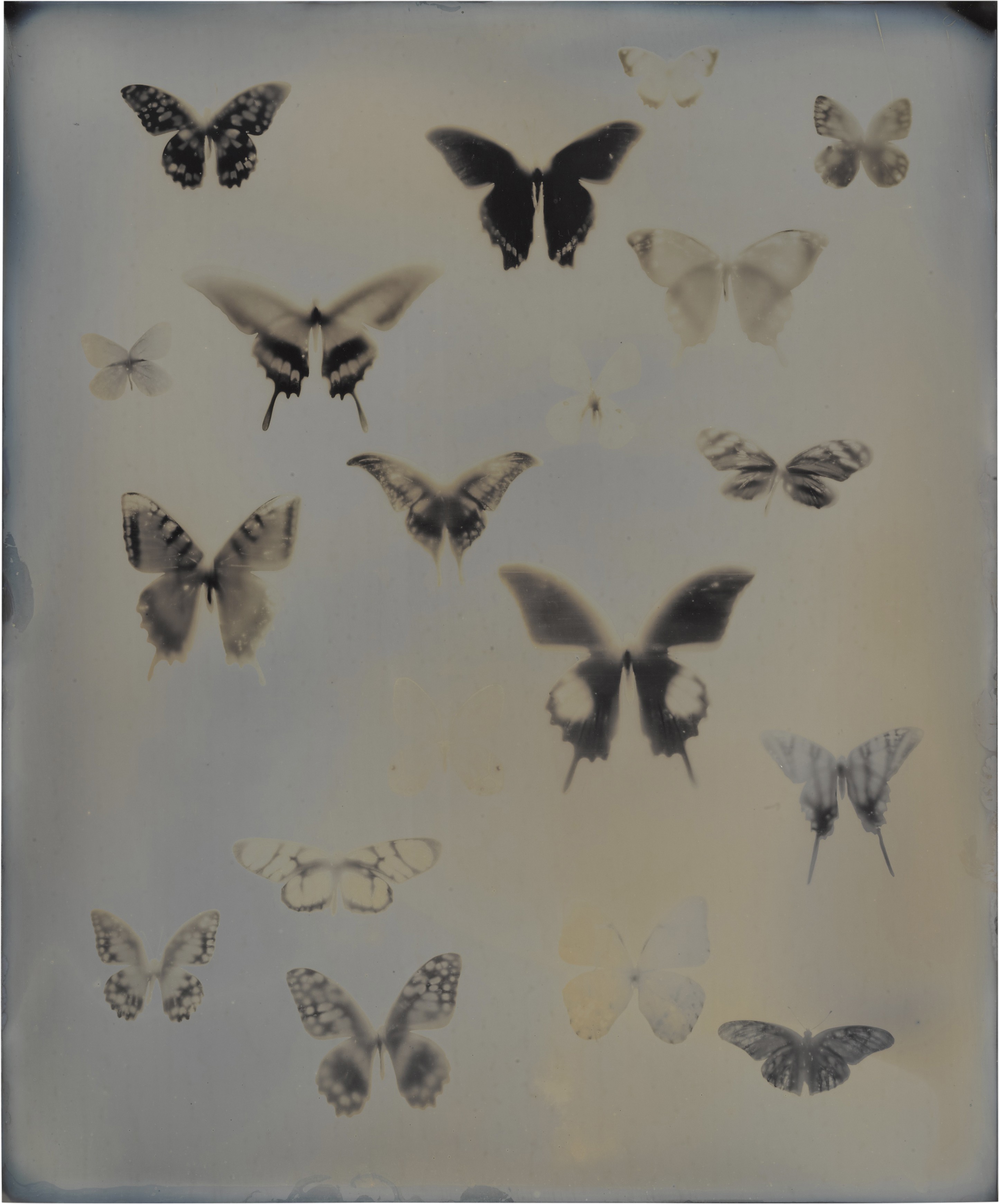
Adam Fuss: Light, Life, and Luminous Wonder
Artist Spotlight · The Collection Editorial
“I am interested in the photograph as a relic, as something that holds a trace of life.”
Adam Fuss, interview with Aperture
In the luminous and often digitally saturated landscape of contemporary photography, Adam Fuss stands apart as a singular and deeply committed artist whose work returns again and again to the most elemental act of image making: the direct encounter between light and light sensitive paper. His retrospective presentations at major institutions, including a celebrated survey at the Fraenkel Gallery in San Francisco and continued representation through Cheim and Read in New York, have cemented his reputation as one of the most original and spiritually searching photographers working today. To encounter a Fuss photogram in person is to feel the quiet authority of an image that arrived in the world without a camera, without a lens, without the mechanical mediation that defines so much of photographic history. The experience is closer to witnessing a natural phenomenon than to looking at a picture.
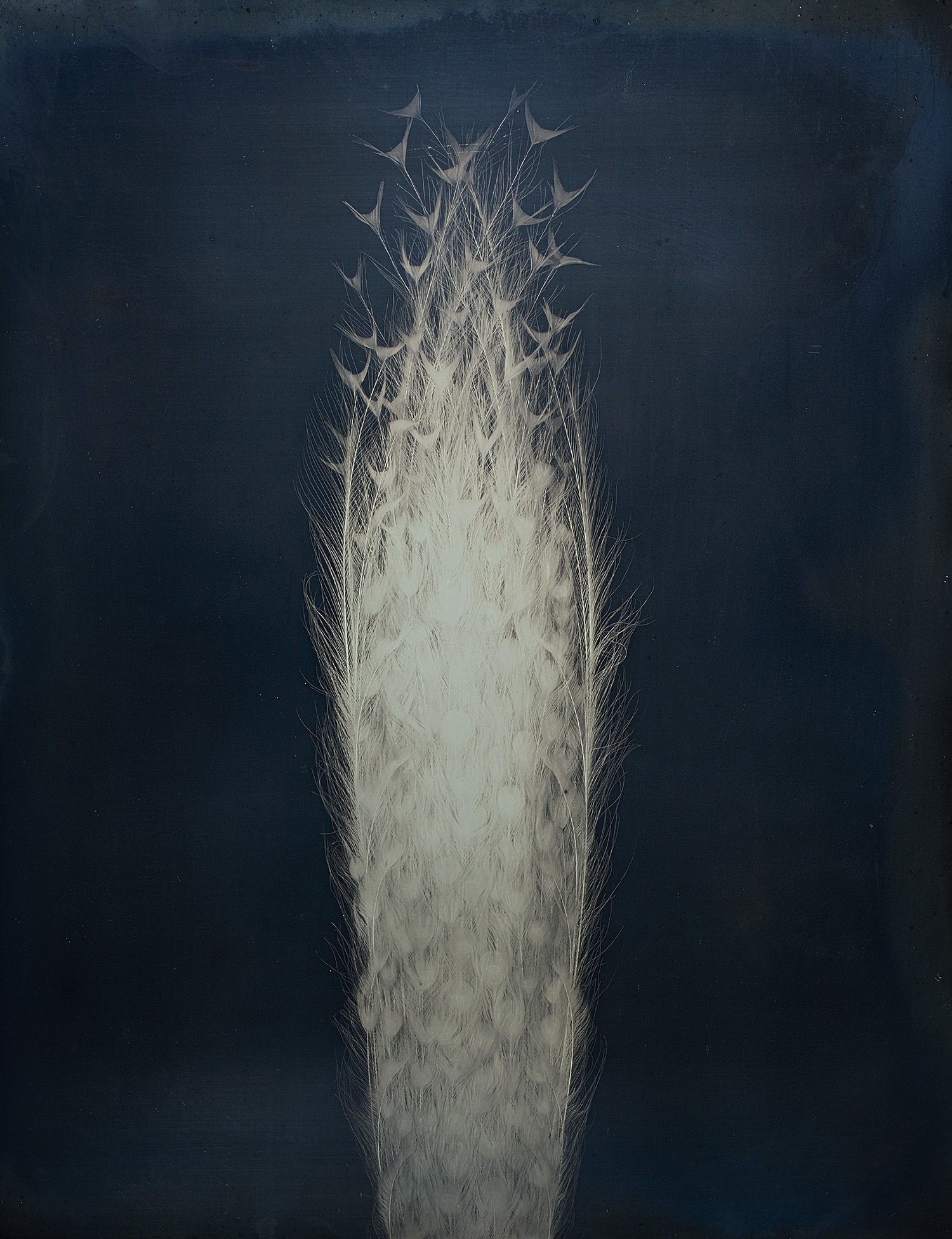
Adam Fuss
For Allegra from the series 'My Ghost'
Fuss was born in England in 1961 and spent his formative years absorbing the particular texture of British visual culture before relocating to New York in the early 1980s, the city that would become the crucible of his mature practice. He arrived at a moment of extraordinary creative ferment, when the East Village scene was alive with painters, photographers, and performance artists pushing hard against the boundaries of their respective disciplines. Fuss, characteristically, went in a direction entirely his own. Rather than embracing the irony and appropriation strategies that defined so much art of that moment, he turned toward silence, mystery, and the deep history of photography itself.
It was a courageous and, as it turned out, profoundly productive choice. The photogram, of course, is almost as old as photography itself. William Henry Fox Talbot called his early cameraless images photogenic drawings, and Man Ray later celebrated the technique under the name rayograph, transforming it into a celebrated tool of Surrealist investigation. László Moholy Nagy also explored its possibilities at the Bauhaus, finding in it a language of pure light and shadow.
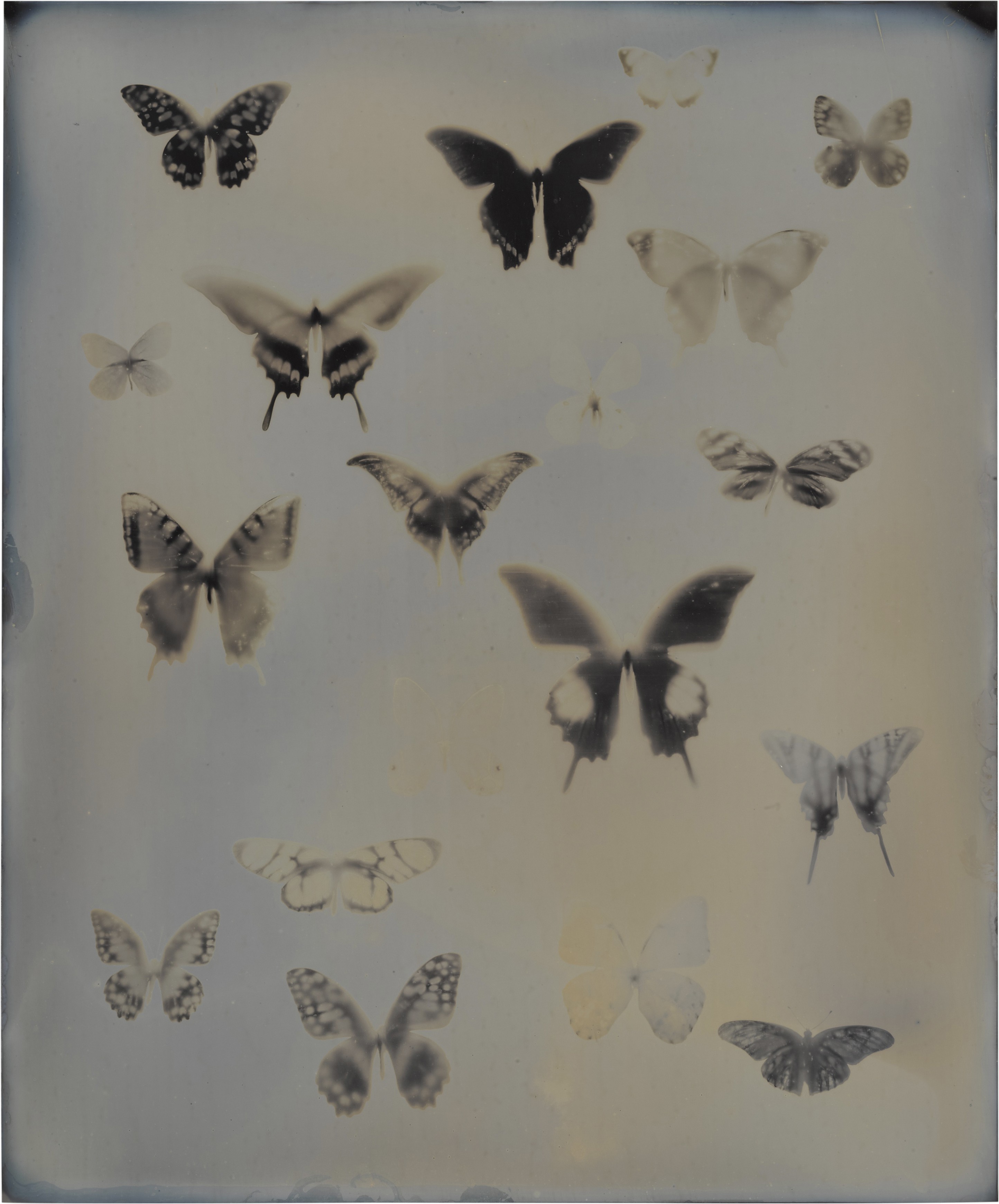
Adam Fuss
Untitled (from My Ghost)
Fuss absorbed all of this history and then moved through it and beyond it, arriving at a practice that is unmistakably his own. Where his predecessors often favored found objects and geometric arrangements, Fuss reached for the animate and the elemental: living snakes, the bodies of infants, the surface of disturbed water, smoke, feathers, and flower petals. The results are images of almost unbearable tenderness and strangeness. His breakthrough series, including the remarkable works grouped under the title My Ghost, established the aesthetic and philosophical coordinates of his practice in ways that continue to resonate.
The My Ghost works, produced as unique cibachrome and gelatin silver photograms, confront the viewer with ghostly silhouettes and luminous traces that suggest the presence of a life force barely contained by the paper on which it has been impressed. The series takes its title from the Shaker tradition, which held that the ghost or spirit could be photographed, and the works carry that belief in the image as a container for something beyond mere appearance. Works such as For Allegra from the series My Ghost are deeply personal and at the same time universally resonant, evoking birth, memory, loss, and the thin membrane that separates presence from absence. The technical ambition of Fuss's practice is inseparable from its emotional depth.
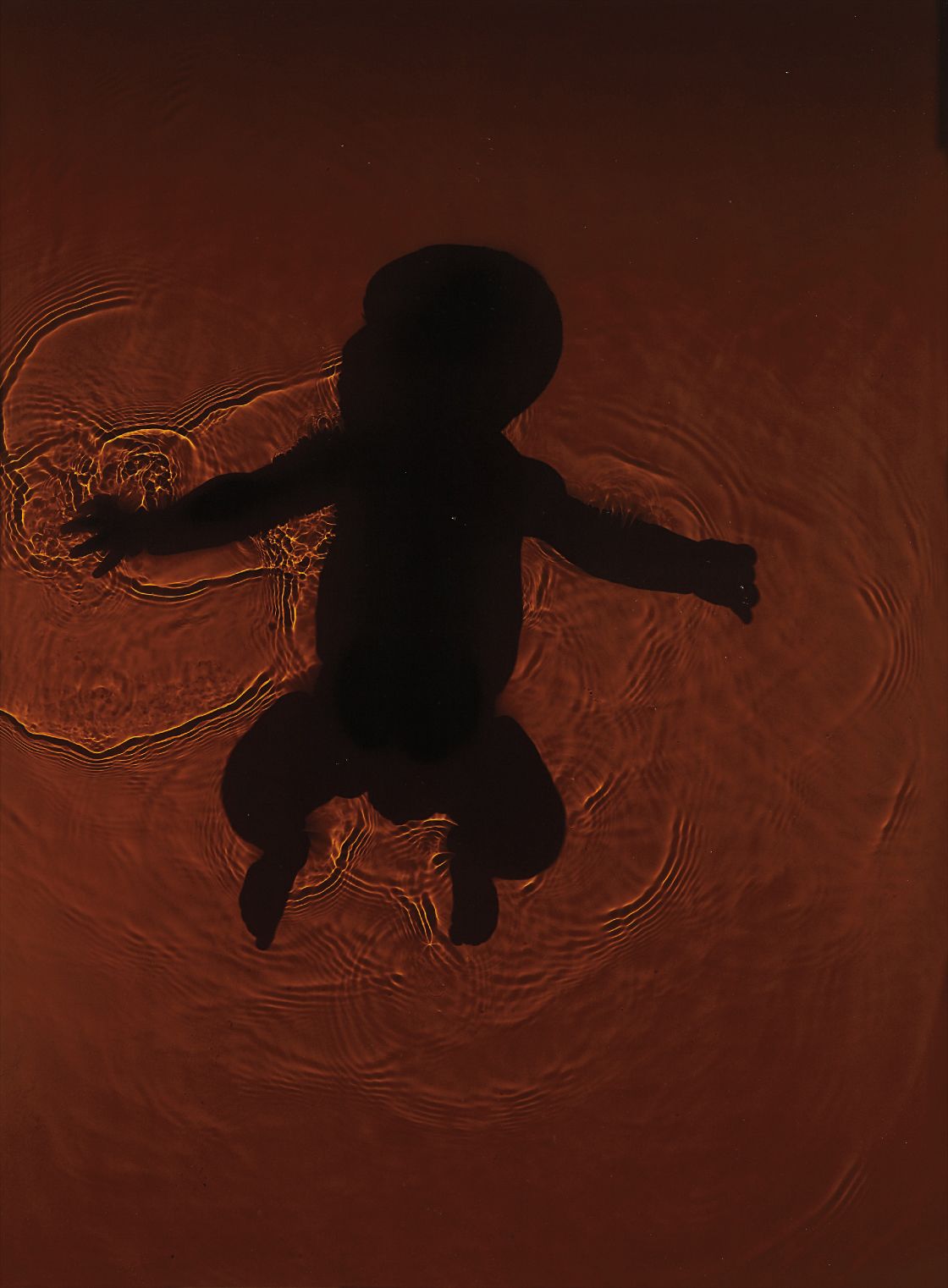
Adam Fuss
Journey
Creating photograms at the scale and chromatic richness that he achieves requires extraordinary craft and a willingness to work in conditions of near total darkness, responding to material and light in real time, without the ability to preview or adjust the image before it is fixed. Each work is therefore genuinely unique, a singular event produced at the intersection of intention and chance. This irreproducibility is not incidental but central to the meaning of the work. Fuss is deeply interested in the idea of the unique object in an age of mechanical and now digital reproduction, and his practice constitutes a sustained argument for the continued power of the singular, handmade image.
The dye destruction photogram Journey, for example, is a work of intense chromatic beauty and physical presence that no reproduction quite captures. For collectors, the work of Adam Fuss represents a rare convergence of historical significance, aesthetic beauty, and genuine rarity. Because each photogram is unique or exists in extremely limited numbers, the supply of works is naturally constrained, and institutional demand has grown steadily over the decades. Major collections including those housed at the Metropolitan Museum of Art in New York, the Victoria and Albert Museum in London, and the Art Institute of Chicago include examples of his work, a fact that speaks to the breadth of his critical recognition across both the fine art and photography collecting worlds.
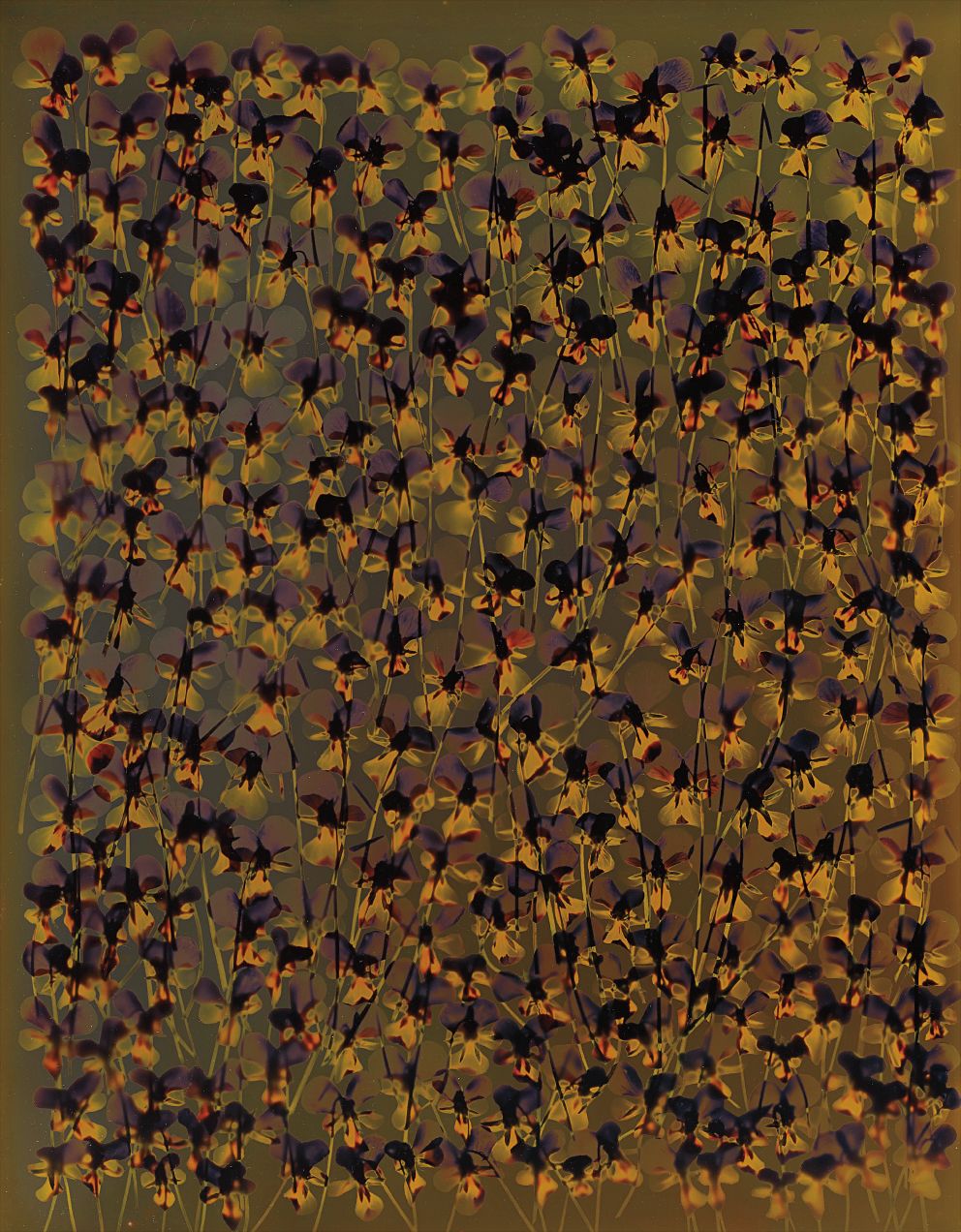
Adam Fuss
unique cibachrome photogram
At auction, his works have attracted serious attention, and the market for his cibachrome and gelatin silver photograms has matured into one of reliable and sustained appreciation. Collectors drawn to photography as a medium often find in Fuss a bridge between the historical avant garde and living practice, between the intimacy of the unique object and the ambition of major art. Within the broader context of contemporary art history, Fuss occupies a position that is easier to feel than to categorize. He shares with Hiroshi Sugimoto a commitment to photography as a medium of philosophical inquiry and a patience that borders on the meditative.
Like Wolfgang Tillmans, he takes seriously the physical and material properties of photographic paper as an expressive surface in its own right. And like Vik Muniz, he is drawn to the uncanny gap between what a photographic image shows and what it means. But Fuss is finally his own phenomenon, a British artist who found in New York and in the oldest possible photographic technology a language adequate to the largest possible questions. More than four decades into a practice that has never sought the approval of prevailing trends, Adam Fuss continues to make images of astonishing beauty and quiet intellectual force.
His commitment to the photogram is not nostalgia or novelty but a genuine belief that the direct impression of the world onto a light sensitive surface is one of the most honest and moving things a human being can make. The collectors who have brought his works into their lives understand this intuitively. They are not merely acquiring beautiful objects, though the objects are undeniably beautiful. They are participating in one of the most sustained and serious conversations in contemporary art about what photography is, what it can hold, and why it continues to matter.
Explore books about Adam Fuss