
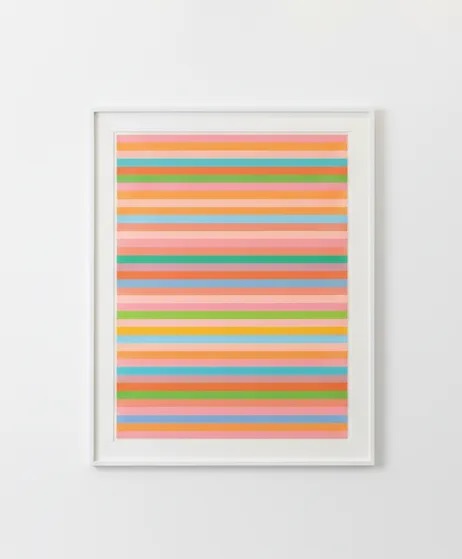
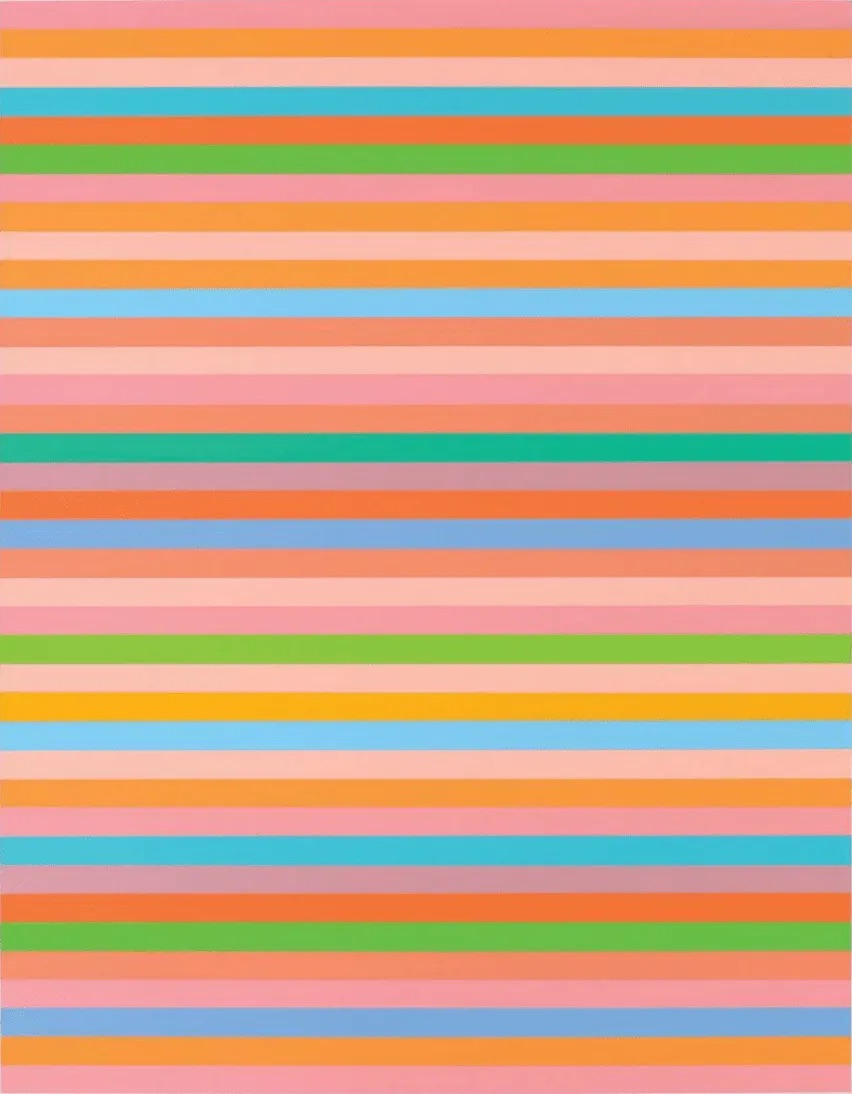
Rose Rose
2011
Bridget Riley's "Rose Rose" (2011) exemplifies the renowned Op Art master's mature exploration of chromatic relationships through rhythmic horizontal bands of varying widths and saturated hues. This sophisticated screen print demonstrates Riley's extraordinary command of color theory, creating optical vibrations and spatial ambiguity as warm peachy tones, cool blues, and vibrant pinks interact across the composition's surface. The work represents an important phase in Riley's career when she moved beyond her iconic black-and-white work to embrace pure color as her primary medium. A highly collectible piece from one of Britain's most significant living artists, this print offers accessible entry into Riley's oeuvre while maintaining the visual complexity and meditative quality that have made her work central to museum collections worldwide.
- Medium
- Screen print
- Dimensions
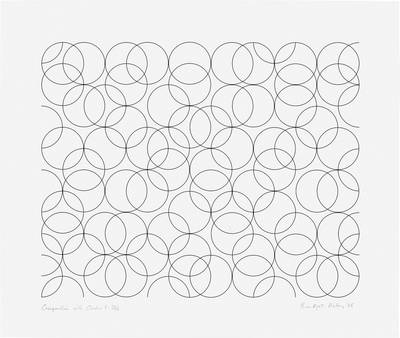
Spotted works by Bridget Riley
Artists in conversation

Victor Vasarely
Hungarian-French · b. 1906
Vasarely is widely regarded as the father of Op Art and shared Riley's dedication to geometric abstraction and optical illusion through precise color interaction and rhythmic repetition. His systematic exploration of chromatic vibration and spatial ambiguity in flat printed compositions mirrors the visual energy found in Rose Rose.
Kenneth Noland
American · b. 1924
Noland's Color Field paintings and prints featuring horizontal stripe compositions with saturated, carefully sequenced hues are remarkably aligned with Riley's approach in Rose Rose. His focus on how adjacent bands of warm and cool color create optical movement and chromatic tension closely parallels Riley's mature stripe works.

Ellsworth Kelly
American · b. 1923
Kelly's bold use of flat saturated color in rhythmic geometric sequences shares the same formal economy and chromatic intensity visible in Rose Rose. His screenprints and color panel works demonstrate a similarly rigorous investigation of how pure hues interact optically when placed in close horizontal or sequential proximity.
Start the Discussion
Request access to join the discussion