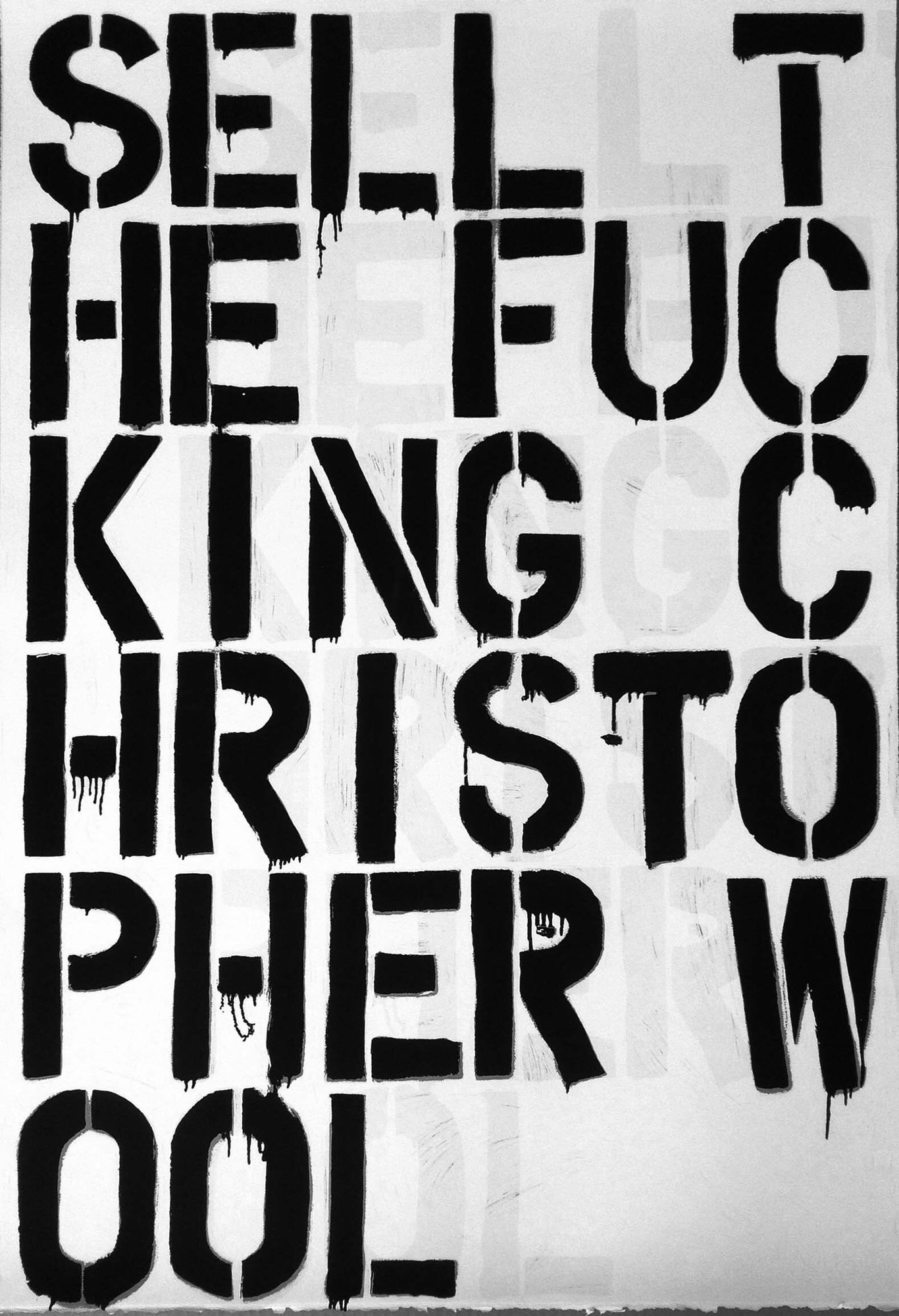
There is a particular kind of New York energy that lives in the work of Jim Kempner, an artist and gallerist who has spent decades turning the noise of American life into something you cannot stop reading. His 2014 work "Apocryphal Now" stands as a crystalline example of his practice at its most assured: a piece that borrows its authority from the language of legend and rumor, folding found imagery and charged text into a single visual field that manages to be both funny and quietly unsettling. For collectors encountering Kempner for the first time, that work functions as a kind of welcome letter, an invitation into a sensibility that is sharp without being cold, and playful without being lightweight. Kempner emerged from the American cultural landscape at a moment when pop art's original provocations had become institutionalized, and a new generation of artists was asking what it meant to work in that tradition with fresh urgency. He absorbed the lessons of the New York art world with both eyes open, understanding that the gallery space and the studio were not separate territories but parts of a single conversation. His dual identity as artist and gallerist, through Jim Kempner Fine Art on West 25th Street in Chelsea, has given him an unusually textured perspective on how art moves through the world, who it reaches, and what it demands of the people who encounter it. The founding of Jim Kempner Fine Art was itself a statement of intent. The gallery became known for championing contemporary works that carried a sense of purpose, pieces that asked something of their audience rather than simply decorating a wall. Running a gallery while maintaining an active studio practice is a demanding balancing act, and Kempner has navigated it with the fluency of someone who understands that both roles feed the same hunger: a desire to put meaningful work in front of people who are ready to be changed by it. The Chelsea location placed him at the center of one of the world's most competitive art markets, and he has held his ground there with quiet confidence. At the core of Kempner's artistic identity is his command of text as a visual and conceptual instrument. His works incorporate language not as caption or explanation but as raw material, words and phrases that carry their own weight and cast their own shadows across found imagery. This approach places him in a lineage that includes Barbara Kruger and Ed Ruscha, artists who recognized that the letters on a surface could carry as much charge as any brushstroke. What distinguishes Kempner is his particular relationship to American vernacular, the slang, the advertising copy, the political shorthand, the tabloid headline, all of it feeding into works that feel both deeply of their moment and strangely timeless. His engagement with consumer culture is never simply satirical. There is genuine affection woven into the critique, an acknowledgment that these images and phrases shaped him too, that none of us stand entirely outside the culture we examine. This complexity is part of what makes his work so rewarding to live with. A Kempner piece in a collection does not deliver its meaning all at once. It tends to open up slowly, offering new readings as the news cycle turns and the cultural weather shifts, which is precisely the quality that serious collectors prize most in text based work. "Apocryphal Now" exemplifies this quality beautifully. The title itself does considerable conceptual work, rhyming with Francis Ford Coppola's landmark film while invoking the idea of stories that circulate beyond verification, truths that feel true regardless of their factual status. In the context of the media environment of the 2010s, and perhaps even more so now, the piece reads as a meditation on how narratives are constructed, who gets to construct them, and what happens when the official version of events and the lived experience of ordinary people refuse to align. It is the kind of work that art historians will return to when they write the cultural history of this particular American moment. From a collecting perspective, Kempner represents an opportunity that experienced advisors recognize immediately. He is an artist with a fully formed and coherent vision, a documented exhibition history, and a practice that sits at the intersection of several robust collecting categories: pop art, text based work, social commentary, and American contemporary art. Works at this intersection tend to hold their value and find enthusiastic institutional interest over time, particularly as museums continue to build collections that reflect the complexity of life in the late twentieth and early twenty first centuries. For collectors building around similar artists such as Ruscha, Kruger, or Jonathan Monk, a Kempner is a natural and intellectually coherent addition. The art historical context for Kempner's work is rich and genuinely illuminating. Pop art opened the door to a frank engagement with mass culture, but it was the generation that followed, the appropriation artists and the text based practitioners of the 1980s and beyond, that brought a more analytical edge to that engagement. Kempner belongs to a tradition that takes popular imagery seriously as a site of ideological meaning, treating the surface of American life not as something to be transcended but as something to be read with extraordinary care. That tradition is now firmly part of the canon, and Kempner's place within it grows clearer with each passing year. What ultimately distinguishes Jim Kempner is the sense that his work is made by someone with a genuine stake in the conversation. He is not an ironist working at arm's length from the culture he depicts. He is a New Yorker, an American, someone who has watched this country's contradictions and glories play out across decades of gallery openings and studio mornings, and who has found in art the only language equal to the complexity of that experience. For those fortunate enough to collect his work, that commitment comes through in every piece, a voice that is unmistakably his own, speaking directly to anyone willing to read what is on the wall.