Sans titre
1974
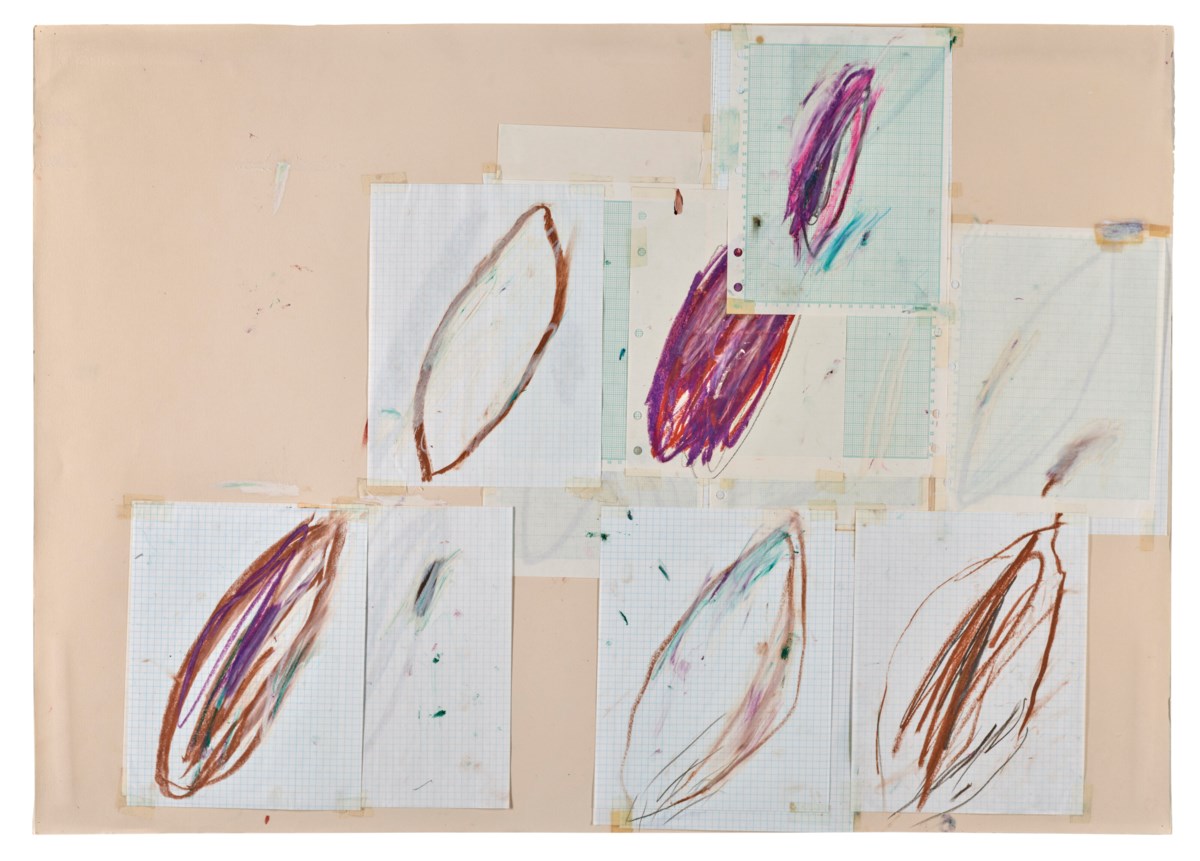
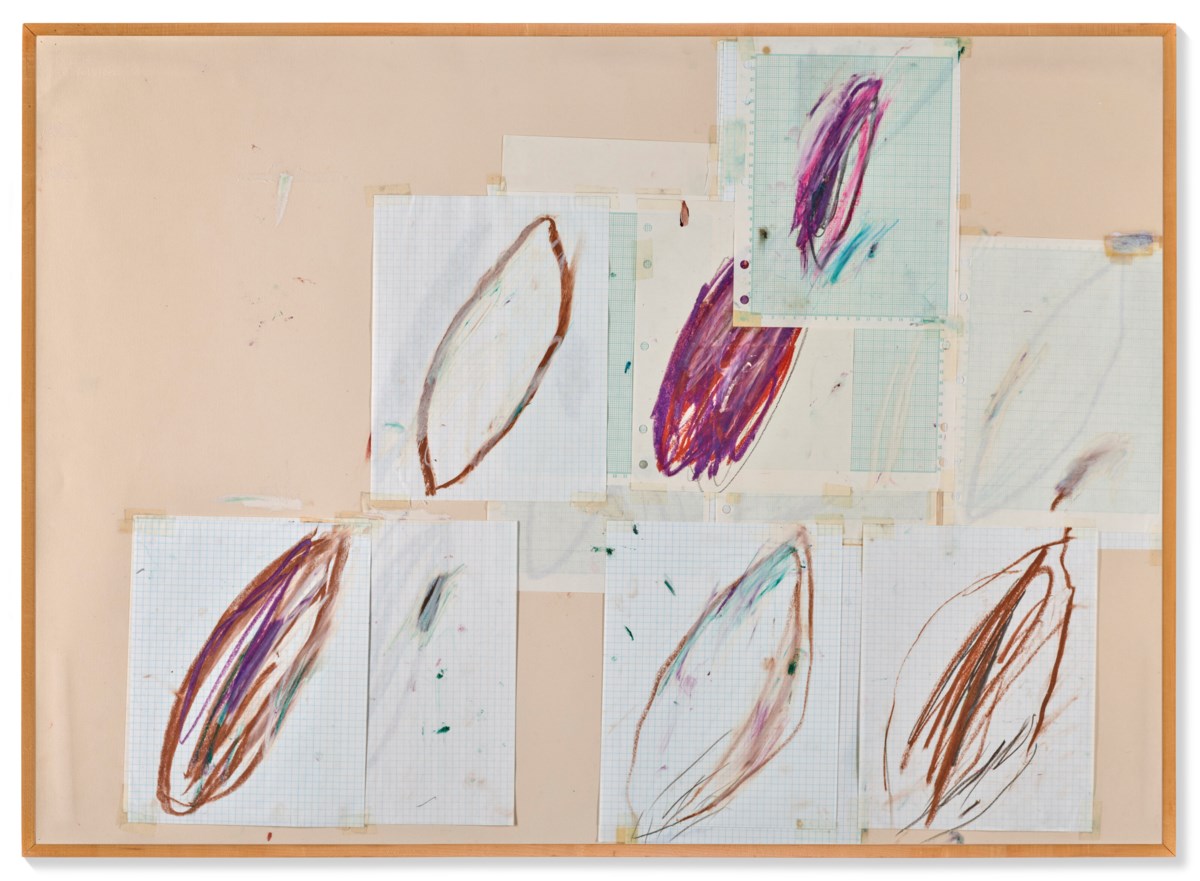
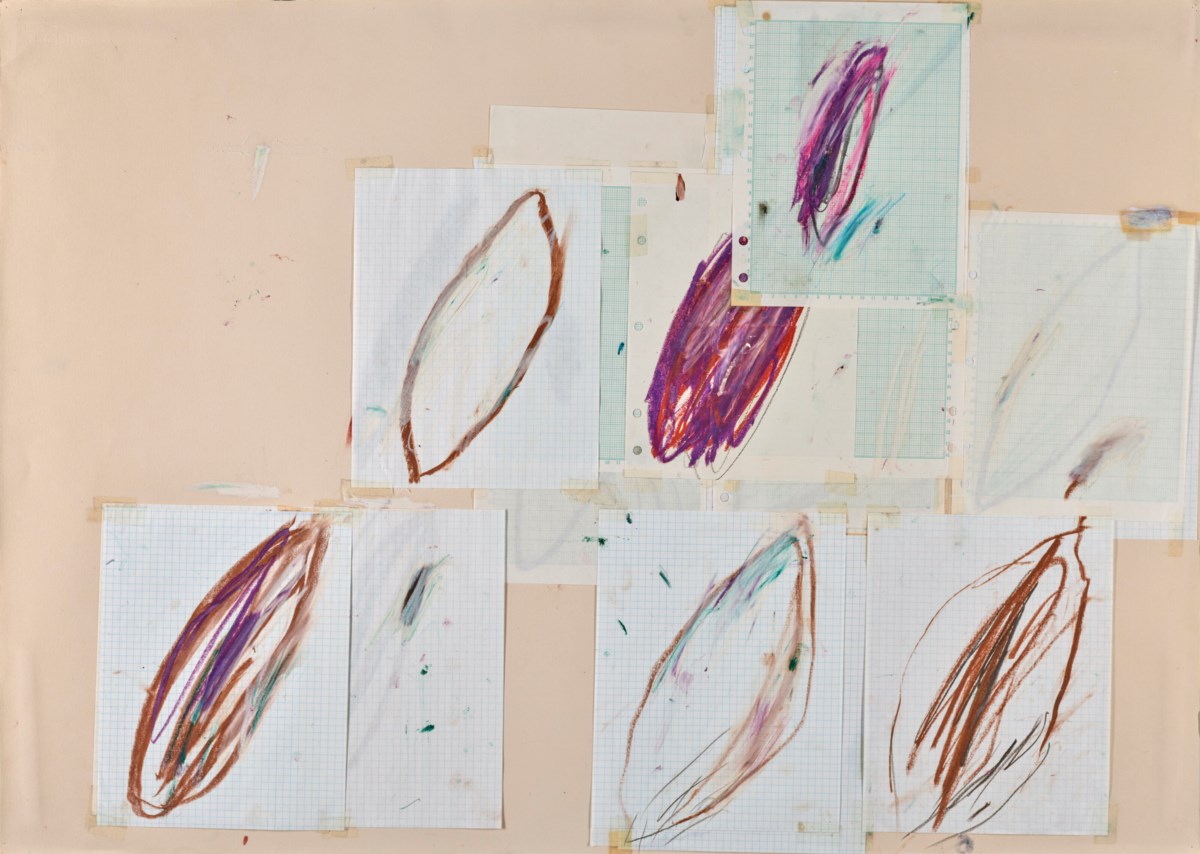
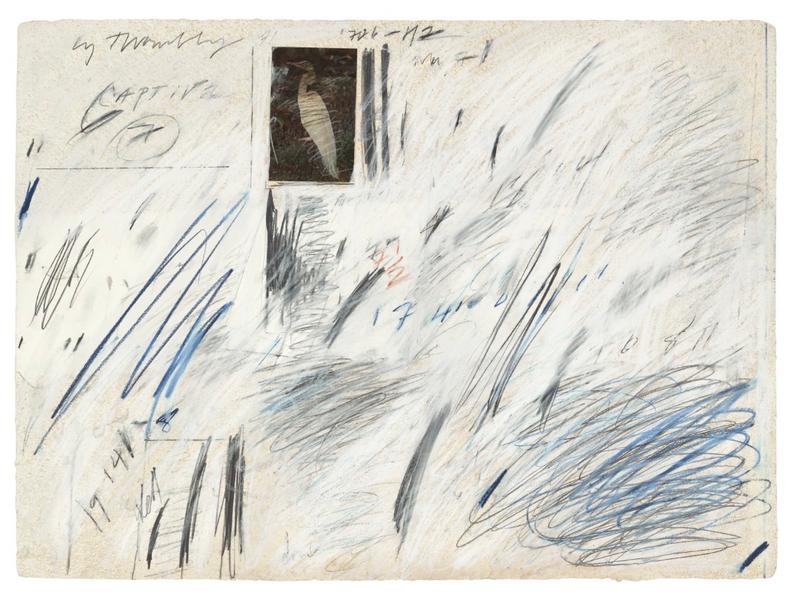
A dynamic interplay of gestural marks, numerical notations, and expressive color washes animates this mixed-media work, as Twombly layers gouache and pastel over collaged papers and graph paper. The grid of the millimeter paper asserts a quiet, measured structure beneath the artist's spontaneous, lyrical marks, creating a tension between order and chaos. Twombly's signature fusion of drawing, painting, and writing transforms the surface into a poetic field that hovers between abstraction and ancient memory.
- Medium
- gouache et pastel sur collage de papiers et papiers millimétrés sur papier
- Dimensions
- Signed
- Yes
- Spotted At
- Auction House · Christie's
Notes
LITERATURE Y. Lambert, Cy Twombly Catalogue raisonné des œuvres sur papier, Vol. VI, 1973-1976, Milan, 1979, No. 110 (illustré p. 115). N. Del Roscio, Cy Twombly Drawings, Catalogue Raisonné, Vol. 6 1972-1979, 2016, Munich, No. 114 (illustré en couleurs p. 108). EXHIBITED Paris, Galerie Yvon Lambert, Cy Twombly, avril-mai 1974. Seattle, Richard Hines Gallery, Cy Twombly: Paintings and Drawings, juillet-août 1980. Conditions of sale Brought to you by Elisabetta Vitullo Junior Specialist, Head of Day Sale EVITULLO@CHRISTIES.COM +33 (0)1 40 76 85 68 LOT ESSAY Skip to main content FRANÇAIS ENGLISH Dès que je mettais les pieds à Captiva, je me sentais habité par une magie à la puissance inexplicable. Robert Rauschenberg Cette œuvre datée de mars 1974 s’inscrit dans une suite de vingt-huit collages que Cy Twombly réalise lors d’un séjour à Captiva Island, chez son ami proche Robert Rauschenberg. Rendu au crayon de cire et à la mine de plomb sur des feuilles superposées de papier ligné et millimétré, le motif en forme d’amande devenu emblématique de la série y apparaît dans toute sa singulière expressivité. Entre 1968 et 1976, Twombly multiplie les séjours à la nouvelle résidence de Rauschenberg, au large de la côte ouest de la Floride. Durant cette période, il s’éloigne de la peinture au profit du dessin : une parenthèse particulièrement féconde, consacrée en 1973 par une importante rétrospective d’œuvres sur papier au Kunstmuseum Basel. Évocatrices de feuilles d’arbre, les formes organiques qui animent ici la composition témoignent de l’intérêt croissant pour le monde naturel que l’artiste cultive tout au long des années 1970. D’autres œuvres issues de cette série sont aujourd’hui conservées au musée d'Art contemporain de Téhéran, à la Cy Twombly Foundation de New York ainsi qu’au musée de Peinture et de Sculpture de Grenoble. Robert Rauschenberg and Cy Twombly. Carton d'invitation du vernissage de leur exposition conjointe à la Leo Castelli Gallery à New York, 4 mai 1974. Photo © Bob Petersen. C’est en 1950, dans l’effervescence de l’Art Students League of New York, que Twombly et Rauschenberg se rencontrent pour la première fois. Leur amitié se scelle l’année suivante sur les bancs du très révolutionnaire Black Mountain College, avant qu’une bourse de voyage ne les entraîne, en 1952, sur les routes de l’Europe, où Twombly s’éprend durablement de l’Italie. De retour à New York, il partage quelque temps l’atelier de Rauschenberg, où il signe, entre 1953 et 1954, certaines de ses œuvres de jeunesse les plus marquantes. Les deux artistes quittent Manhattan peu de temps après : Twombly s’installe à Rome en 1957, tandis que Rauschenberg prend la direction de Captiva Island, petite île-barrière nichée entre le détroit de Pine Island et le Golfe du Mexique. Il y acquiert une propriété en 1968 et s’y établit définitivement en 1970, pour ne plus quitter ce lieu où il se sent habité, écrira-t-il, d’« une magie à la puissance inexplicable » (lettre à P. Bishop, 1970). Les séjours à Captiva Island voient naître bon nombre d’œuvres de Twombly, parmi lesquelles une suite de collages inspirés de dessins de Léonard de Vinci, ainsi qu’un ensemble de lithographies réalisées dans l’atelier d’impression fondé par Rauschenberg, Untitled Press. Plusieurs œuvres de la présente série sont révélées à la galerie Leo Castelli en 1974, lors d’une exposition conjointe mettant en lumière le dialogue entre les pratiques de Twombly et Rauschenberg. Dans son article consacré à l’exposition, la critique américaine Hayden Herrera rapproche ces œuvres des dessins tardifs d’Arshile Gorky, ainsi que du célèbre tableau du XIIIe siècle Six kakis du moine bouddhiste chinois Muqi. « Le trait de Twombly se déploie sur la surface du papier avec un infaillible sens de la composition. […] Imprévisibles, désinvoltes, comme livrés au hasard, mais finalement brillamment ordonnés, [ses] dessins sont autant d’invitations au voyage, nous plongeant dans une liberté absolue de la matière et de l’esprit » (H. Herrera, ‘Reviews: Cy Twombly, Robert Rauschenberg’, in ARTnews, Vol. 73 No. 8, octobre 1974, pp. 110-111). Muqi, Six Persimmons, XIIIe siècle, Dynastie Song (Chine). Daitokuji, Kyoto, Japon. Photo © Public domain / Wikimedia Commons. [Twombly] dispose avec parcimonie des ellipses au crayon, comme pour traduire l’idée d’un vide habité, proche de celui de la célèbre toile Six kakis de la dynastie Song. Hayden Herrera Au cours des années 1970, Cy Twombly se détourne progressivement des élans mythologiques qui avaient nourri son œuvre durant la décennie précédente pour se tourner vers des sujets pastoraux et botaniques. En 1973, il séjourne à Tonnicoda, petit village des Abruzzes, au cœur des vastes forêts de l’Italie centrale. Les années suivantes voient émerger deux séries intitulées Natural History (« histoire naturelle »), la première consacrée aux champignons, la seconde à diverses formes de feuillage. Comme le souligne Richard Leeman, le motif en forme d’amande, apparu dans le répertoire de Twombly dès les années 1960, « avait été associé jusqu’alors au laurier d’Apollon ». La présence du terme « ficus » (« figuier ») dans une autre œuvre de la série suggère pourtant, poursuit-il, une autre source d’inspiration possible : les figuiers de Floride, dont de nombreuses variétés présentent des feuilles aux silhouettes comparables (R. Leeman, Cy Twombly: A Monograph, Londres, 2005, p. 214). D’autres œuvres de la série donnent d’ailleurs à voir des structures évoquant des ouvertures, signalées par la lettre « w » (pour window, peut-être) — comme autant de fenêtres ouvertes sur le monde, depuis l’atelier floridien. Every time I reached Captiva I felt a magic that was unexplainable in its power Robert Rauschenberg Executed in March 1974, the present work belongs to a suite of twenty-eight collages that Cy Twombly made while staying with his friend Robert Rauschenberg on Captiva Island. It captures the distinctive almond-shaped motif that came to define the series, rendered in wax crayon and pencil upon layered sheets of lined and graph paper. Between 1968 and 1976 Twombly made several trips to visit Rauschenberg at his new island home off the west coast of Florida. During this period he temporarily sidelined painting in favour of drawing, giving rise to a major retrospective of works on paper at the Kunstmuseum Basel in 1973. The present work’s leaf-life forms, meanwhile, bear witness to his increased fascination with the natural world throughout the 1970s. Other examples from the series reside in the Tehran Museum of Contemporary Art, the Cy Twombly Foundation and the Musée de Peinture et de Sculpture, Grenoble. Robert Rauschenberg and Cy Twombly. Carton d'invitation du vernissage de leur exposition conjointe à la Leo Castelli Gallery à New York, 4 mai 1974. Photo © Bob Petersen. Twombly and Rauschenberg had first met in 1950 at the Art Students League in New York. Their friendship blossomed during their time at the revolutionary Black Mountain College the following year. In 1952, funded by a travel scholarship, the two embarked upon a journey through Europe, where Twombly fell in love with Italy. Back in New York, he temporarily shared Rauschenberg’s studio, beginning some of his most important early works between 1953 and 1954. Both artists would eventually leave Manhattan, with Twombly moving to Rome in 1957. Rauschenberg, however, chose Captiva: a small barrier island dividing the Pine Island Sound and the Gulf of Mexico. After buying a property there in 1968, he took up permanent residence in 1970. He remained there until his death, declaring that he ‘felt a magic that was inexplainable in its power’ (letter to P. Bishop, 1970). Twombly made a number of works on his visits to Captiva over the years, including a suite of collages based on Leonardo da Vinci’s drawings and a series of lithographs at Rauschenberg’s newly-established print workshop Untitled Press. Works from the present series were unveiled in a joint exhibition with Rauschenberg at Leo Castelli Gallery in 1974, capturing the dialogue between the two artists’ practices. In his review of the show, the critic Hayden Herrara also compared Twombly’s works to Arshile Gorky’s late drawings, as well as the thirteenth-century Song dynasty painting Six Persimmons by the Chinese Buddhist monk Muqi. ‘Twombly’s marks are distributed over the paper’s surface with an unerring sense of placement,’ he writes. ‘… Unpredictable, insouciant and haphazard, yet finally exquisitely ordered, [his] drawings invite us to a voyage of untethered physical freedom and fantasy unmoored’ (H. Herrera, ‘Reviews: Cy Twombly, Robert Rauschenberg’, in ARTnews, Vol. 73 No. 8, October 1974, pp. 110-111). Muqi, Six Persimmons, XIIIe siècle, Dynastie Song (Chine). Daitokuji, Kyoto, Japon. Photo © Public domain / Wikimedia Commons. [Twombly] disperses crayoned ellipses to evoke a sense of charged void akin to that in the famous Song dynasty painting Six Persimmons Hayden Herrera During the 1970s Twombly began to move away from the mythological fantasies that had fascinated him throughout the previous decade, turning his attention instead to pastoral and botanical themes. In 1973 he had spent time in Tonnicoda: a small village in the Abruzzo region of central Italy, surrounded by vast forests. Over the following years he made two series of works entitled Natural History, the first of which featured mushrooms and the second of which focused on various leaf shapes. Richard Leeman notes that the present work’s almond-shaped motif, which had first appeared in Twombly’s work in the 1960s, ‘‘had been associated until now with the leaf of Apollo’s laurel.’’ The presence of the word ‘ficus’ (‘fig’) on another work in the series, he writes, suggests another potential source: the fig trees of Florida, several varieties of which feature almond-shaped leaves (R. Leeman, Cy Twombly: A Monograph, London 2005, p. 214). Other works in the series feature window-like structures, designated by the letter ‘w’, as if suggesting a view from the studio. READ MORE OF THE LOT ESSAY
🔨 Auction Lot
Art Contemporain
Lot 216
Collectors of Cy Twombly

Start the Discussion
Request access to join the discussion