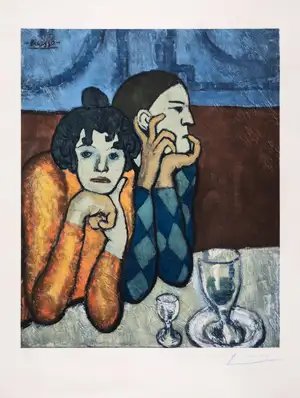
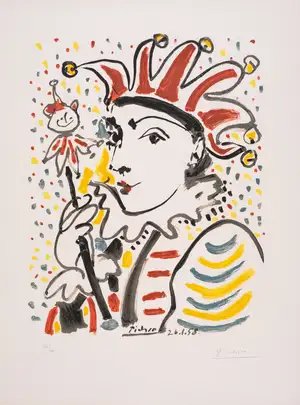
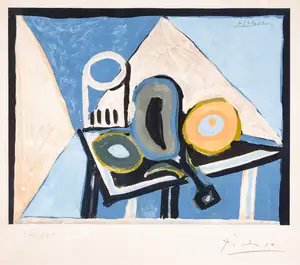
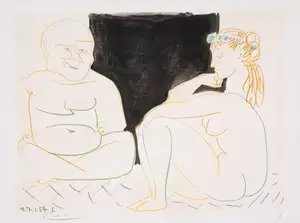
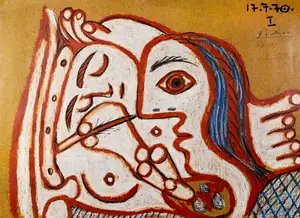
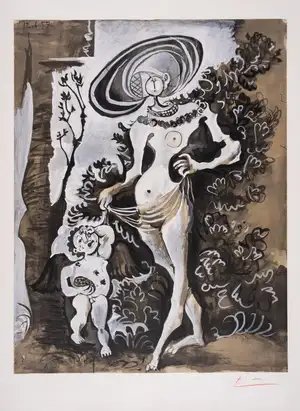
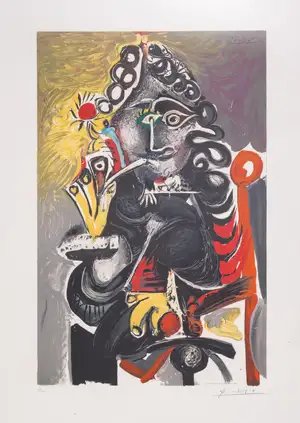
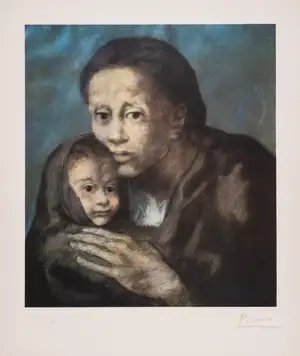
Few artists in the history of Western art command the room quite like Pablo Picasso. In 2023, the fifty year anniversary of his death prompted a wave of global reflection, with major institutions from the Musée National Picasso in Paris to the Museum of Modern Art in New York mounting exhibitions and programmes that reaffirmed his singular position in the canon. The art market, never far behind cultural sentiment, responded in kind. Works bearing his hand, his signature, and his unmistakable visual vocabulary continue to set benchmarks at auction, drawing seasoned collectors and first time buyers alike into a conversation that shows no sign of quieting. Pablo Ruiz Picasso was born on 25 October 1881 in Málaga, in the Andalusian south of Spain, to José Ruiz Blasco, a painter and art professor, and María Picasso López. His prodigious talent announced itself almost embarrassingly early. By the age of thirteen he had already surpassed the technical accomplishments his father could teach him, and José reportedly handed his son his own palette and brushes in an act of formal artistic surrender. Picasso studied at the School of Fine Arts in Barcelona and later at the Royal Academy of Fine Arts of San Fernando in Madrid, though the institutions could barely contain him. The streets of Barcelona, the cabarets, the bohemian energy of El Quatre Gats cafe where he held his first exhibition in 1900, these were his true classrooms. The artistic development that followed remains one of the most staggering in recorded history. His Blue Period, roughly 1901 to 1904, produced works of aching melancholy, painted in cool monochromatic tones and populated by the marginalised figures he observed in Barcelona and Paris. This gave way to the warmer, more tender Rose Period, and then, in 1907, everything changed. Les Demoiselles d'Avignon, now held at MoMA in New York, shattered pictorial convention with its fractured planes and confrontational gaze. In close dialogue with Georges Braque, Picasso forged Cubism, one of the most consequential movements in the history of art, dismantling perspective and rebuilding it on entirely new terms. What followed across the next six decades was a restless, shape shifting body of work that defied any single categorisation. His Neoclassical period of the early 1920s showed a deep tenderness for form and mythology. His engagement with Surrealism in the late 1920s and 1930s produced images of extraordinary psychological force. Guernica, painted in 1937 in response to the bombing of the Basque town of the same name, stands as one of the most politically charged works ever created. And still he kept moving. His late works, the musketeer series, the reinterpretations of Velázquez and Delacroix, were for years dismissed and are now understood as prescient and boldly expressive, decades ahead of their reassessment. The works available to collectors through platforms such as The Collection offer a particular and genuinely rewarding window into Picasso's practice. The prints and lithographs he produced across the middle decades of the twentieth century represent not a secondary activity but a medium he pursued with total seriousness and considerable invention. Works such as Tête de Femme (Marie Thérèse), a colour lithograph from 1958 printed by the celebrated Mourlot workshop in Paris, capture the tenderness and formal daring of his mature years. Marie Thérèse Walter, whom he met in 1927, was one of the most recurring and emotionally charged subjects of his career, and lithographs bearing her image carry real art historical weight. Similarly, Venus et l'amour voleur de miel, a colour lithograph from around 1957, demonstrates his lifelong engagement with the traditions of European painting, here reworking a composition after Lucas Cranach the Elder with characteristic wit and proprietary confidence. Le Cavalier (Mousquetaire à la Pipe) from 1968, printed by Mourlot and published in a numbered edition, exemplifies the late period bravura that now commands serious critical and market attention. For collectors, prints and works on paper offer an accessible yet genuinely significant point of entry into the Picasso universe. Editions published by Mourlot in Paris, where Picasso worked intimately with the printers and often revised stones and plates through multiple states, carry particular esteem among specialists. Signed and numbered impressions from limited editions, especially those on Arches paper with full margins and strong provenance, represent the kind of works that hold their integrity over time. Collectors would do well to consider condition, edition size, and the quality of the impression carefully, and to seek works accompanied by clear documentation of their publication history. Signed impressions from small editions, such as the colour lithograph Nature morte à l'aubergine from 1953, published by the Musée de Lyon and printed by Mourlot, with provenance tracing through the Redfern Gallery in London, exemplify the kind of layered history that gives a work lasting resonance. To understand Picasso fully is to understand him in relation to those around him. His friendship and rivalry with Georges Braque shaped the entire trajectory of modern art. His connections to Juan Gris, to Fernand Léger, to Joan Miró, whose work appears alongside Picasso's in collections of this period, reveal a Parisian artistic ecosystem of extraordinary fertility. Henri Matisse, though never a collaborator in the formal sense, was the great counterpoint to Picasso's career, and the two were acutely aware of each other across five decades. Collectors drawn to Picasso often find themselves building broader collections that encompass this generation, adding works by Miró, Chagall, and Cocteau as part of a coherent and deeply satisfying art historical narrative. The legacy of Pablo Picasso is not simply a matter of art historical precedent. It is a living presence in the way contemporary artists think about representation, about the body, about the relationship between image and object. His willingness to transform himself repeatedly, to court difficulty and court beauty in equal measure, remains an instruction to anyone who takes creativity seriously. He died on 8 April 1973 in Mougins, France, leaving behind a body of work estimated at over twenty thousand objects. The conversation around that work continues to deepen and surprise. For collectors, to hold a piece of that conversation is to hold something genuinely rare.