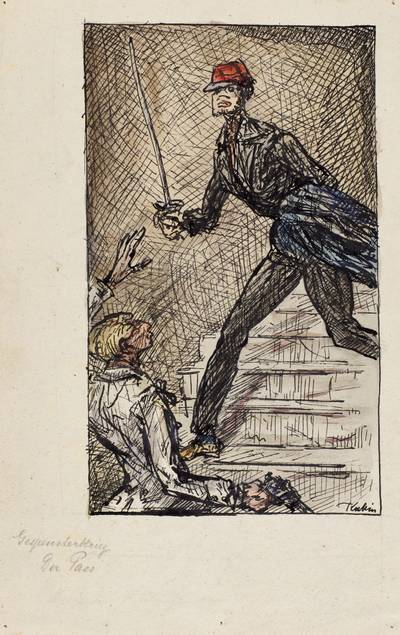
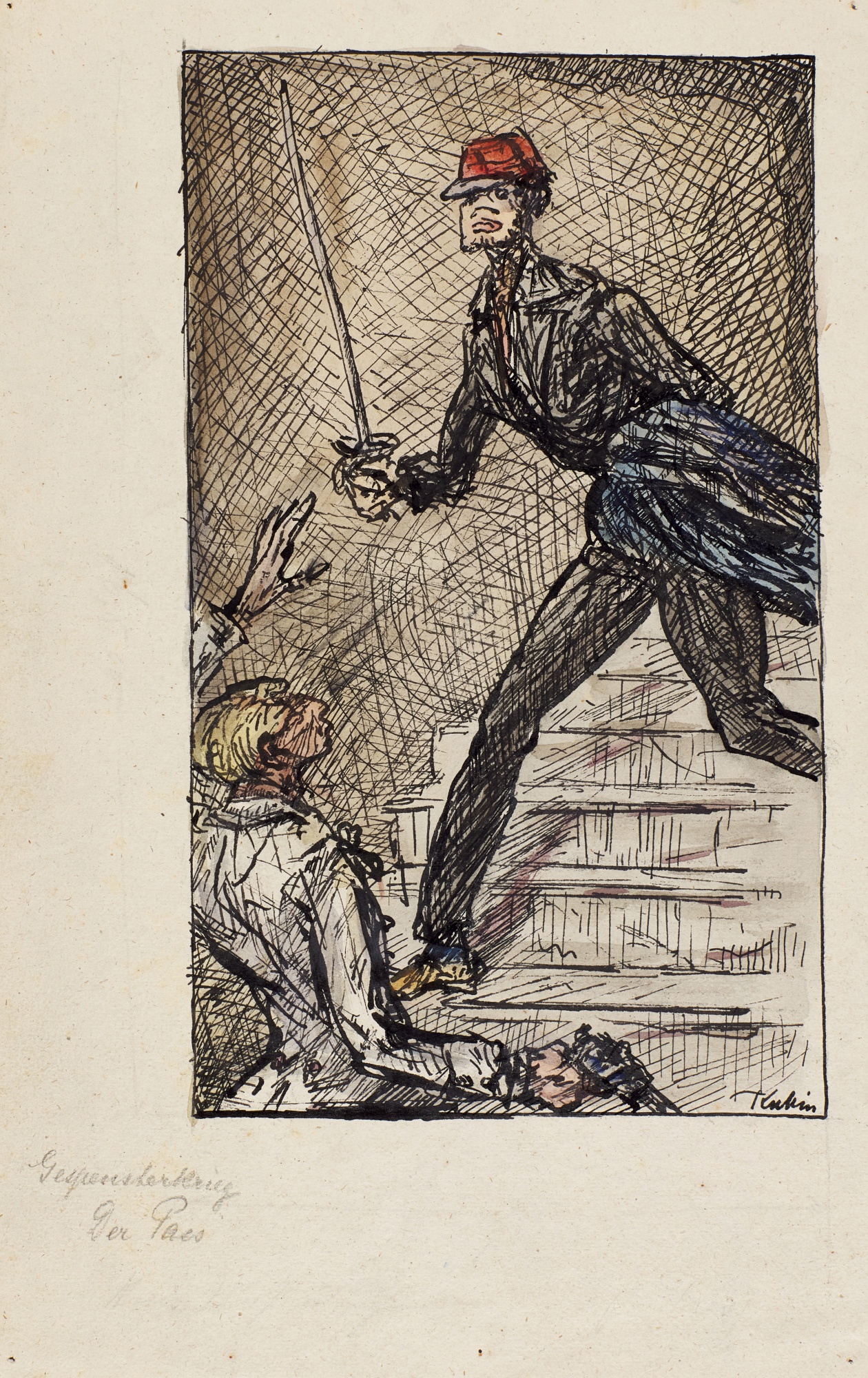
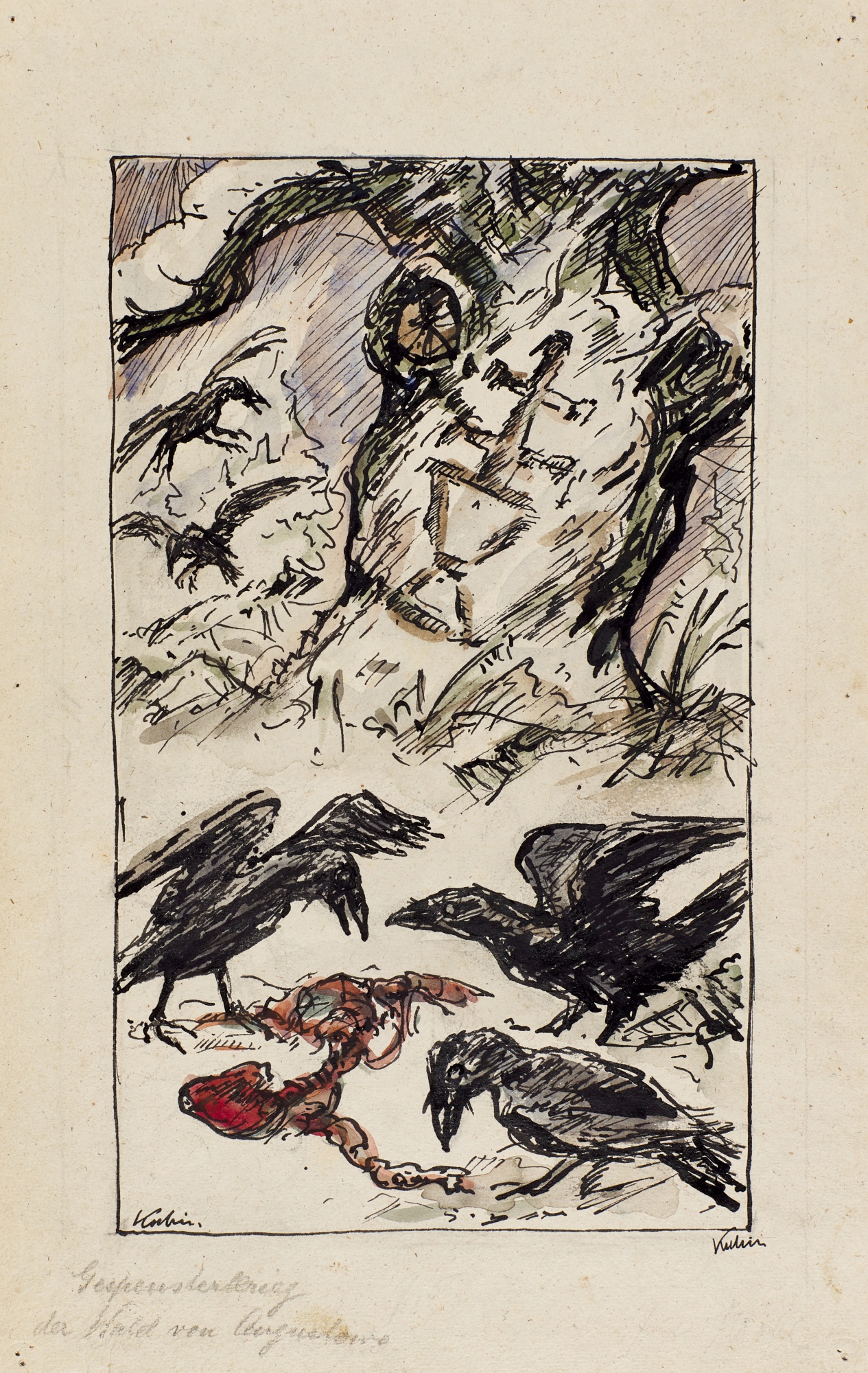
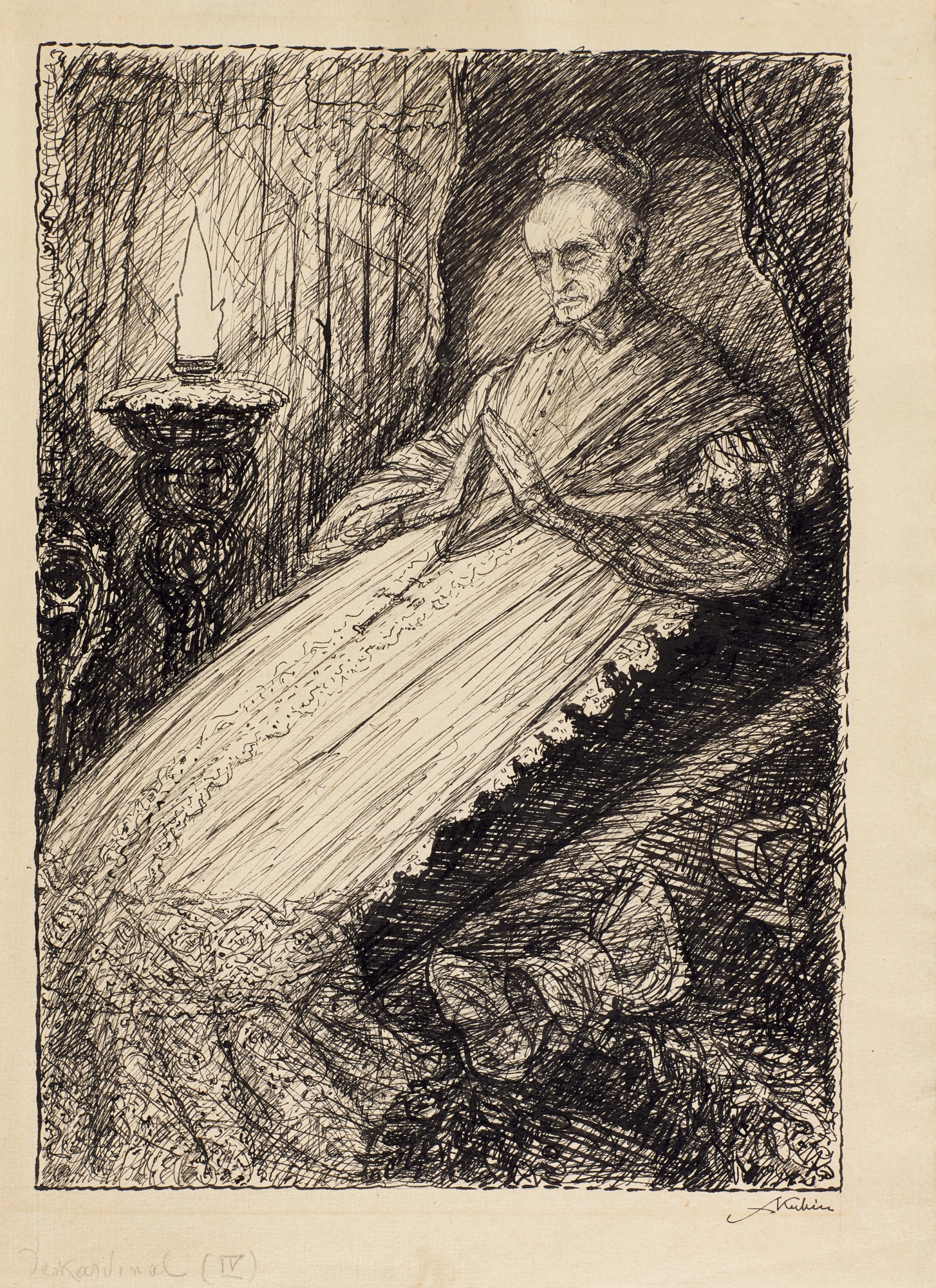
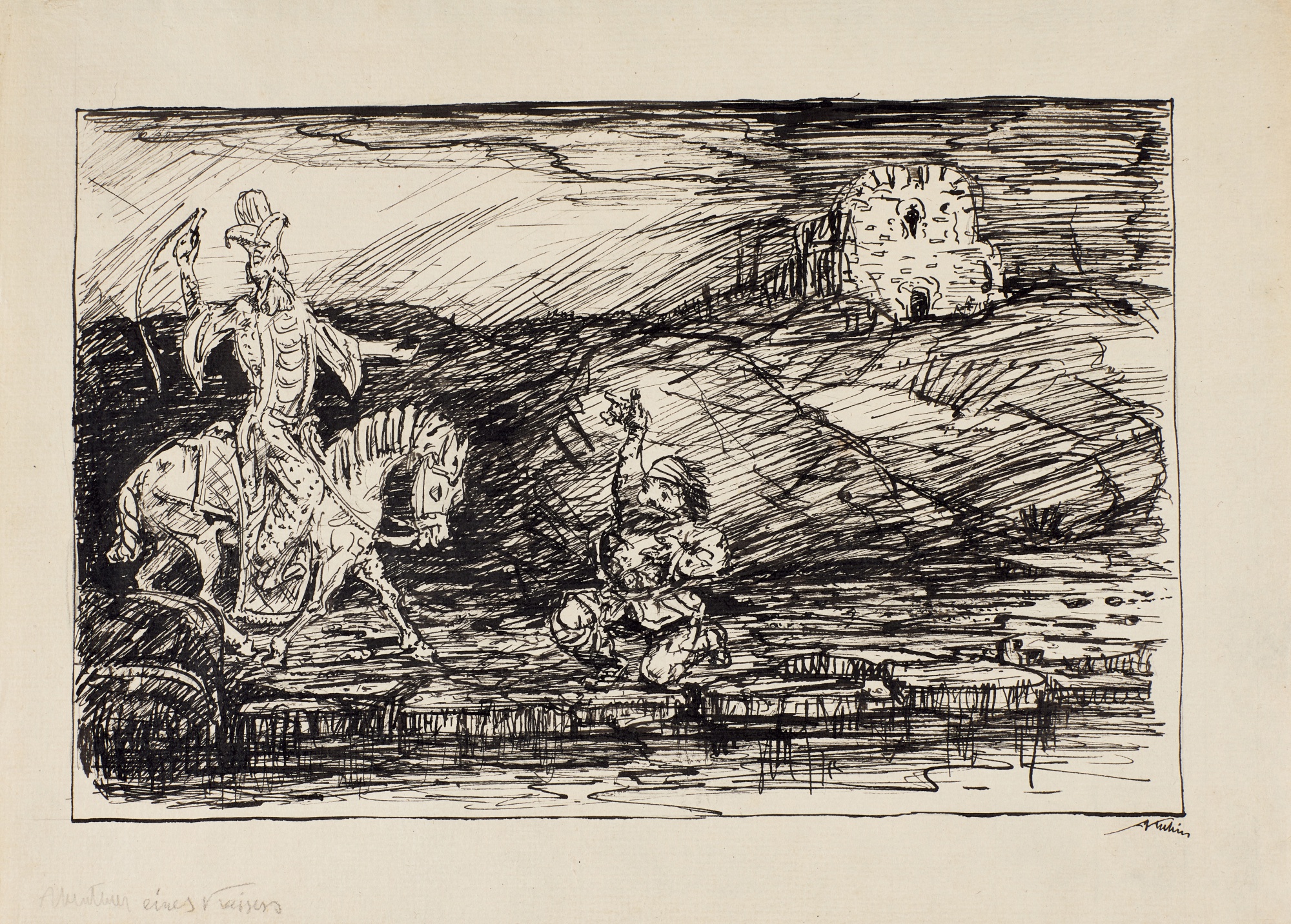
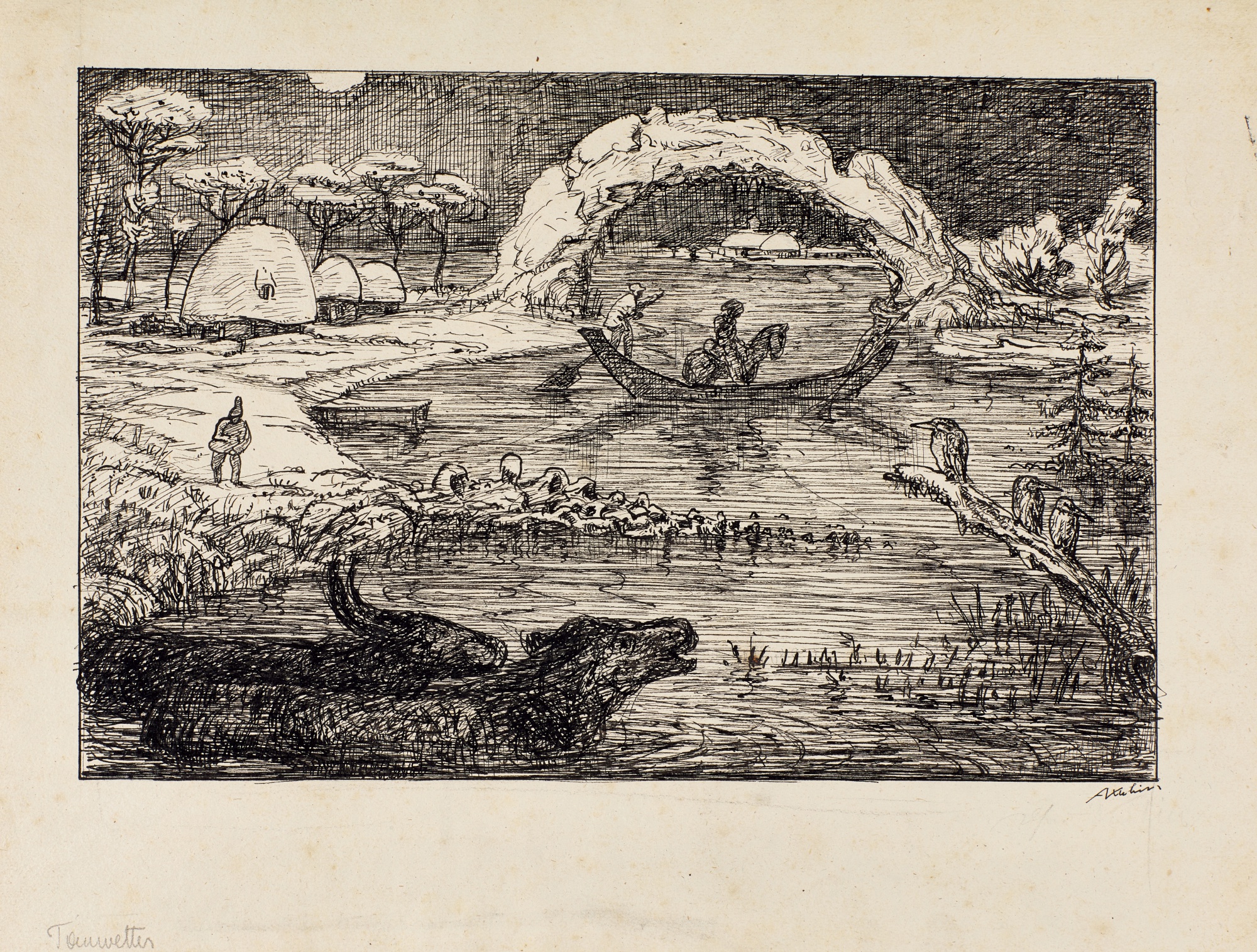
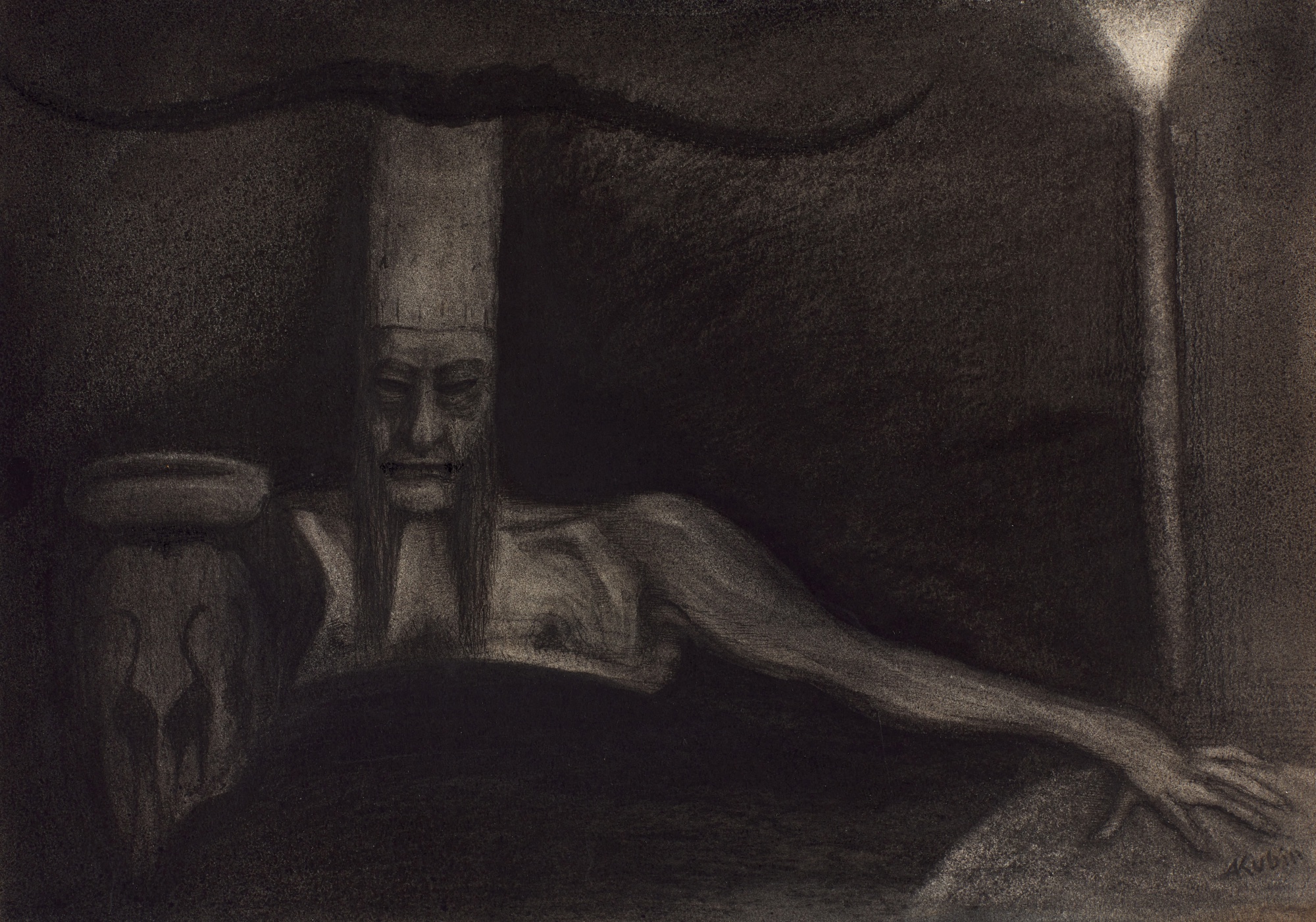
There are artists who depict the world as it is, and there are artists who reach into the place where sleep and waking blur, where reason loosens its grip and something stranger takes hold. Alfred Kubin belonged emphatically to the second category. To stand before one of his drawings is to feel the uncanny proximity of another realm, one that is neither quite nightmare nor quite dream, but something altogether more unsettling and more alive. That quality has ensured his reputation endures not as a curiosity of early modernism but as a genuinely necessary voice, one whose influence ripples forward through Surrealism, outsider art, and the darkly imaginative traditions that continue to shape contemporary practice. Kubin was born in 1877 in Leitmeritz, a town in the Bohemian region then part of the Austro Hungarian Empire and today known as Litoměřice in the Czech Republic. His early life was marked by profound loss and psychological turbulence. His mother died when he was ten years old, and the years that followed were shaped by instability, a difficult relationship with his father, and his own fragile mental state. He trained briefly as a photographer's apprentice before pursuing formal art education in Munich, enrolling at the Academy of Fine Arts there around 1898. Munich at the turn of the century was a crucible of symbolist and Jugendstil tendencies, and the young Kubin absorbed its atmosphere while finding his way toward something far more personal and extreme. A near breakdown in 1896, following a period of obsessive grief and a failed attempt to take his own life at his mother's grave, became in retrospect a kind of terrible threshold. On the other side of it, his art began to emerge in its true form. In Munich, Kubin encountered the work of Max Klinger, Odilon Redon, and Francisco Goya, three figures whose engagement with fantasy, melancholy, and the grotesque confirmed for him that printmaking and drawing could carry the full weight of an imaginative vision. He also looked closely at James Ensor and Félicien Rops. By the early 1900s, Kubin was producing drawings of extraordinary originality: figures emerging from shadows, skeletal presences presiding over human folly, landscapes where architecture and anatomy seemed to merge. His first major exhibition came in 1902 at the Cassirer Gallery in Berlin, and the response was immediate recognition from significant quarters. Wassily Kandinsky invited him to participate in the first exhibition of Der Blaue Reiter in Munich in 1911, a landmark moment that placed Kubin firmly within the vanguard of European modernism, even as his sensibility remained distinctly his own. The works available through The Collection offer an exceptional window into Kubin at the height of his powers. Der Reichste (The Richest Man) from 1902, rendered in charcoal, ink wash, and pen and ink, belongs to his earliest mature period and demonstrates the mordant social intelligence that ran beneath his fantastical surfaces. The rich man is not celebrated but rendered with the grotesque weight of accumulation, a figure bowed under what he possesses. The two works from the Gespensterkrieg series, both dated 1914 and executed in watercolour and pen and ink, represent a remarkable response to the outbreak of the First World War. Der Pass (The Pass) and Der Wald von Augustowo (The Forest of Augustowo) transform the geography of actual conflict into spectral theater, where the landscape itself seems to breathe with menace. That Kubin could find, even in the horror of contemporary events, a correspondence with his inner world of phantoms and thresholds speaks to the depth and consistency of his vision. The 1910 works present a different facet of his practice. Der Kardinal IV (The Cardinal IV) and Tauwetter (Thaw) are both executed in pen and ink, a medium Kubin wielded with extraordinary dexterity. The Cardinal series returns repeatedly to institutional power as a subject, the robed figure rendered neither with reverence nor simple satire but with something closer to existential curiosity, as if the costume of authority were itself a kind of haunting. Tauwetter, with its suggestion of seasonal change and yielding surfaces, shows the more lyrical dimension of Kubin's imagination, the way dissolution could be beautiful as well as threatening. Abenteuer eines Kaisers (Adventure of an Emperor), also from 1910, combines pen and ink with brush and ink to produce a work of theatrical complexity, a narrative implied but never resolved, which is perhaps the most characteristic of all Kubin's strategies. For collectors, works on paper by Kubin present a compelling proposition. His output was substantial but his finest drawings carry genuine rarity, particularly those from the key periods of 1900 to 1914 and the years surrounding the publication of his novel The Other Side in 1909. That novel, a surrealist fantasy about a dream kingdom presided over by a reclusive ruler, was written in a single concentrated burst and remains one of the most extraordinary literary productions of the early twentieth century, but it also functions as an extended key to understanding his visual work. Collectors who engage with both the drawings and the novel find that each illuminates the other in ways that make the experience of ownership unusually rich. At auction, Kubin's works on paper have historically attracted serious attention from European collectors with a focus on early modernism, Expressionism, and the broader symbolist tradition. His place within institutional collections, including the Albertina in Vienna and the Städtische Galerie im Lenbachhaus in Munich, provides strong curatorial validation. Kubin sits within a constellation of artists who shared his commitment to the inner life as subject matter and to drawing as a primary language. His relationship with the Blaue Reiter circle connected him to Kandinsky, Franz Marc, and Paul Klee, though his work remained resolutely figurative where theirs moved toward abstraction. The Belgian symbolist tradition, particularly Ensor and Rops, is a necessary reference point, as are the Spanish masters of the grotesque, above all Goya. Later, the Surrealists would recognize in Kubin an ancestor, and his influence can be traced in the work of Max Ernst and Hans Bellmer. More recently, artists working in the traditions of dark fantasy and visionary figuration, including figures like Kiki Smith and Neo Rauch, have acknowledged the territory Kubin helped to map. What makes Kubin matter today is precisely what made him difficult to categorize in his own time. He refused the comforts of either pure formalism or pure narrative, insisting instead on an art that lived in the space between. His drawings do not illustrate fears so much as they give fears a habitation and a form, which is an altogether more demanding and more rewarding thing to do. In a cultural moment that increasingly values the imaginative, the psychological, and the handmade, his work arrives with fresh authority. To collect Kubin is to bring into one's life an artist who understood that the most significant things are often the least visible, and who spent eighty two years finding ways to draw them into the light.