Blue And White
![Katsushika Hokusai — Kanagawa oki nami ura (Under the well of the Great Wave off Kanagawa) [“Great Wave”]](https://rtwaymdozgnhgluydsys.supabase.co/storage/v1/object/public/artwork-images/auction-lots/japanese-and-korean-art-24346-nyr-lot84.jpg)
Katsushika Hokusai
Kanagawa oki nami ura (Under the well of the Great Wave off Kanagawa) [“Great Wave”]





The Colour Combination That Conquered the World
There are very few visual languages in the history of art that have crossed every conceivable border, cultural, geographic, economic, and temporal, with the ease and authority of blue and white. From the kilns of Jingdezhen to the studios of contemporary artists working today, the pairing of cobalt against a pale ground has functioned simultaneously as a technical achievement, a trading commodity, a symbol of status, and a living artistic tradition. It is one of those rare aesthetic propositions that somehow becomes more interesting the longer you look at it, not less. The story begins, as so many great art historical stories do, in China.
By the early Tang dynasty, Chinese potters had already begun experimenting with cobalt oxide, imported from Persia, as a colorant for ceramic glazes. But it was during the Yuan dynasty, in the fourteenth century, that blue and white porcelain as we understand it truly crystallised into a coherent visual form. The imperial kilns at Jingdezhen produced vessels of startling sophistication: dragon dishes, phoenix vases, and lotus forms painted with a freedom and confidence that belied the technical complexity involved in their making. The cobalt had to be applied to the unfired clay before glazing, meaning the painter worked blind, trusting muscle memory and experience, with no possibility of correction.
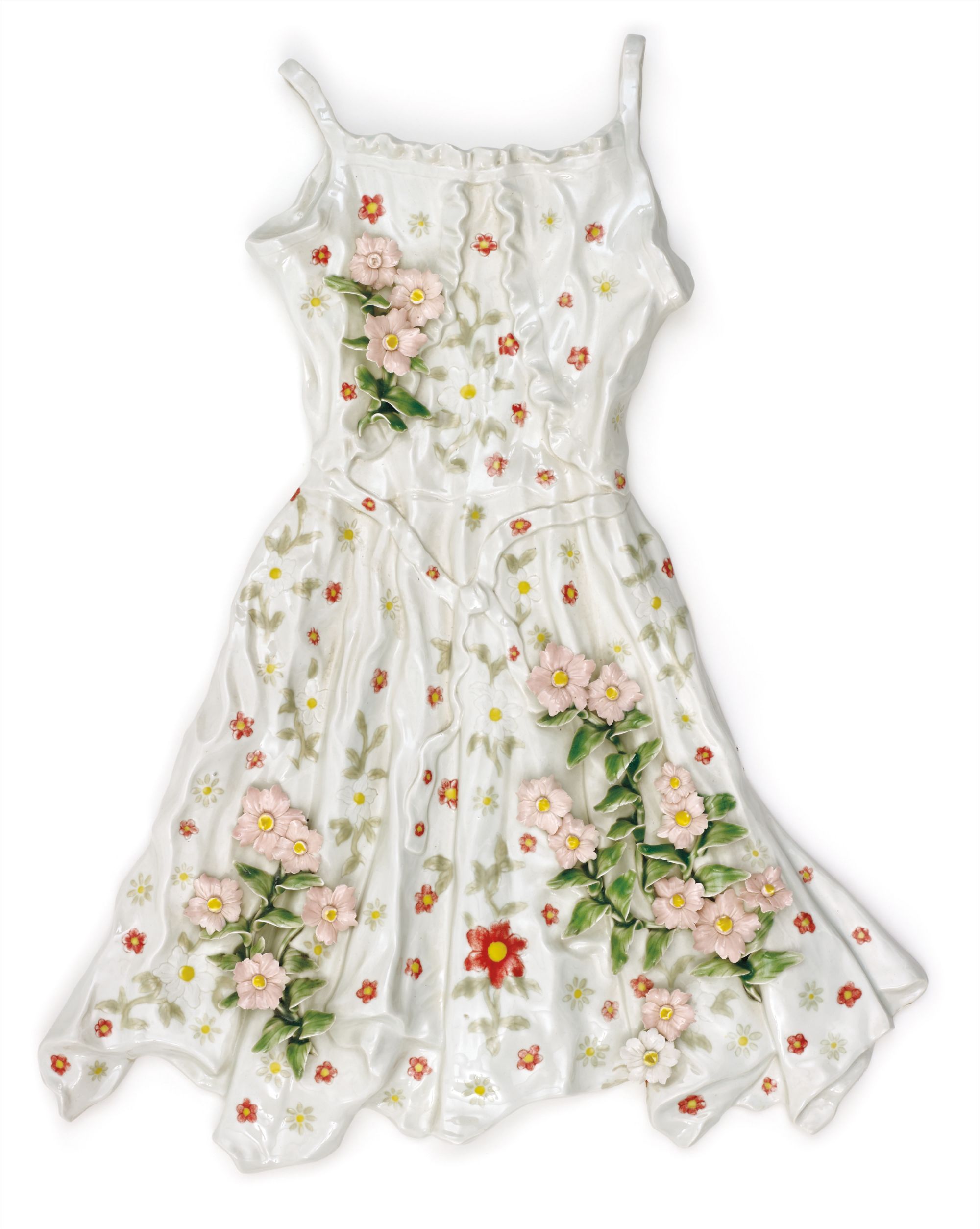
Ai Weiwei
Dress with Flowers (No.5)
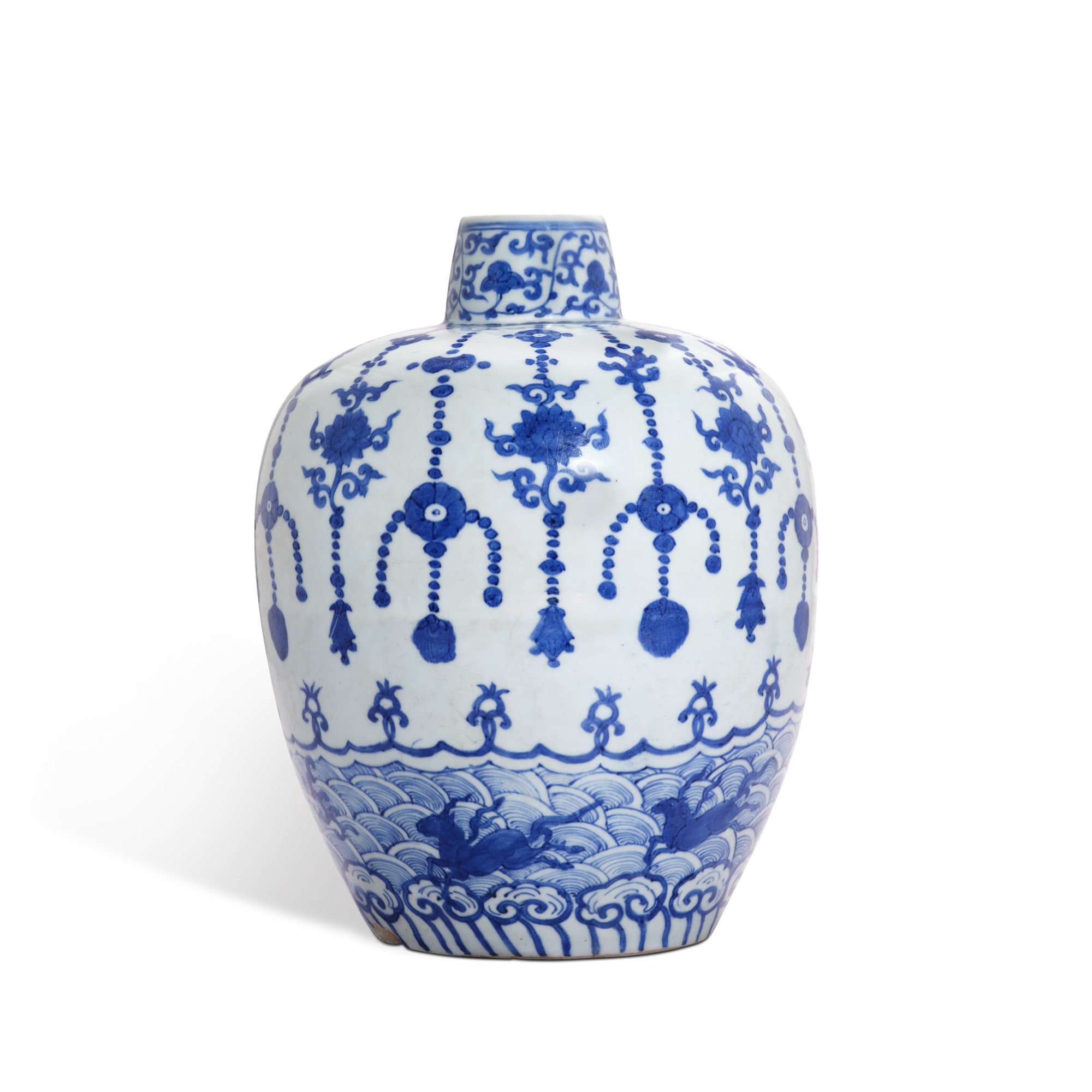
The results, fired at temperatures exceeding 1300 degrees Celsius, were permanent and luminous. The works from this period that appear across The Collection give a vivid sense of the range and ambition that defined the tradition. Large dragon dishes from the Ming and Qing dynasties, pieces in which the cobalt brushwork coils and spirals with an almost calligraphic energy, sit alongside more intimate objects: a small Qingbai lobed jar and cover, a dated blue and white phoenix garlic mouth vase, a blue and white moulded mountain dish whose surface reads almost like a landscape painting compressed into ceramic form. These are not merely decorative objects.
They are records of an extraordinarily refined culture, and they carry the evidence of hands and minds working at the very edge of what their medium allowed. The reach of Chinese blue and white porcelain across global trade routes fundamentally altered the visual culture of Europe. By the seventeenth century, Dutch Delftware potters were producing their own interpretations of the Chinese forms, feeding a market hunger that the East India companies had stoked but could never quite satisfy. The influence moved in both directions.
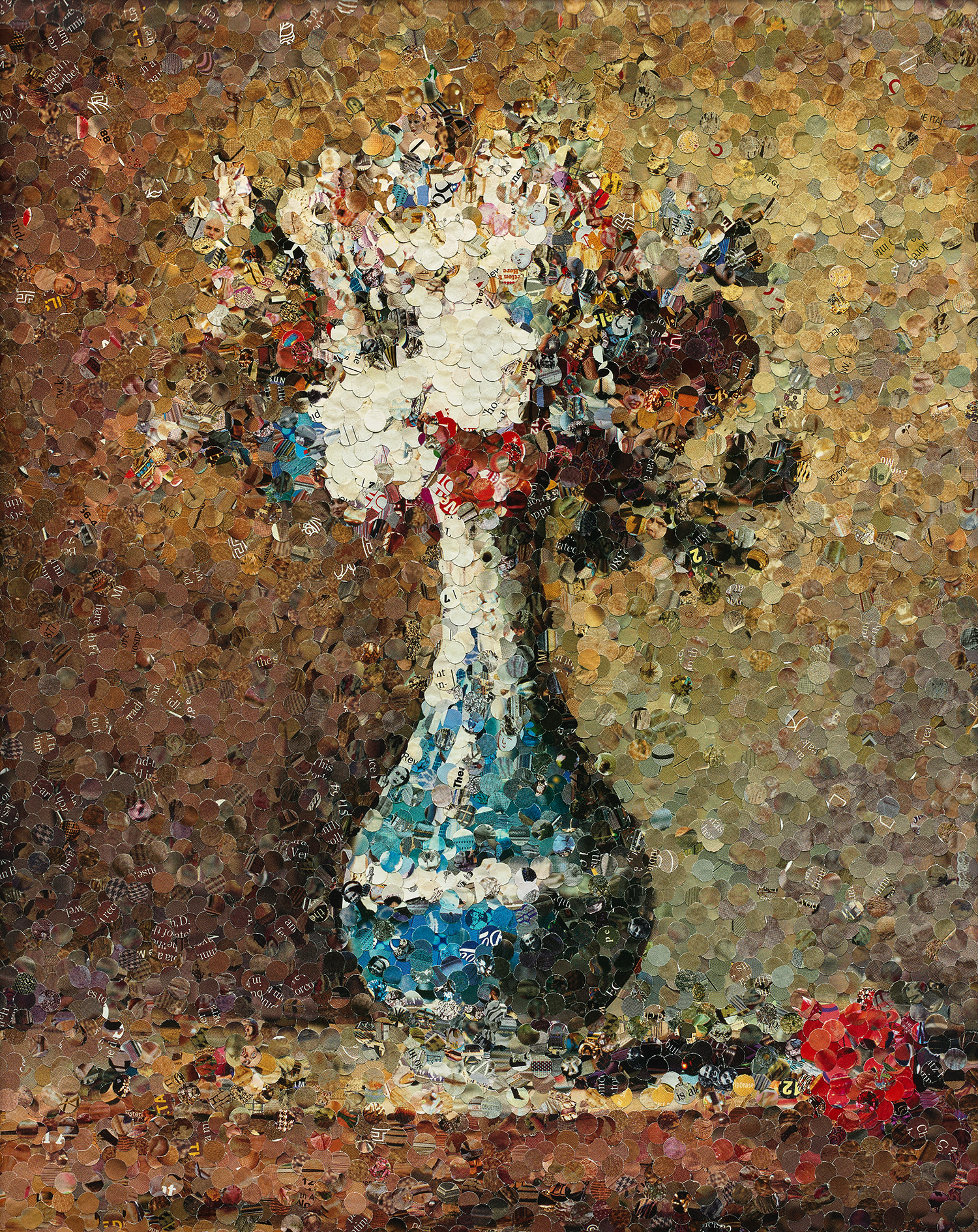
Vik Muniz
Flowers in a Blue and White Vase, After Chardin from Pictures of Magazines, 2024
European demand shaped what Chinese kilns produced for export, and Chinese forms reshaped what European potters considered beautiful. Ai Weiwei, one of the most significant artists of the past several decades, has returned repeatedly to this entangled history in his own work with blue and white porcelain, using the forms and iconography of the tradition to interrogate questions of cultural ownership, national identity, and the politics of heritage. His engagement with blue and white is never nostalgic. It is confrontational and precise.
The tradition also attracted artists working primarily in print and on paper who were captivated by the aesthetic possibilities of the blue and white palette. Félix Bracquemond, the French printmaker who was central to the nineteenth century japonisme movement in Paris, was among the first European artists to study Japanese blue and white ceramics with real seriousness. His etched work from the 1860s and 1870s shows the influence of Japanese decorative arts, including the flat planes, asymmetrical compositions, and restrained colour ranges that would go on to transform European modernism. Katsushika Hokusai and Utagawa Hiroshige, both well represented on The Collection, were working in a visual culture where blue and white was not a category or a style but simply a given condition of artistic life.
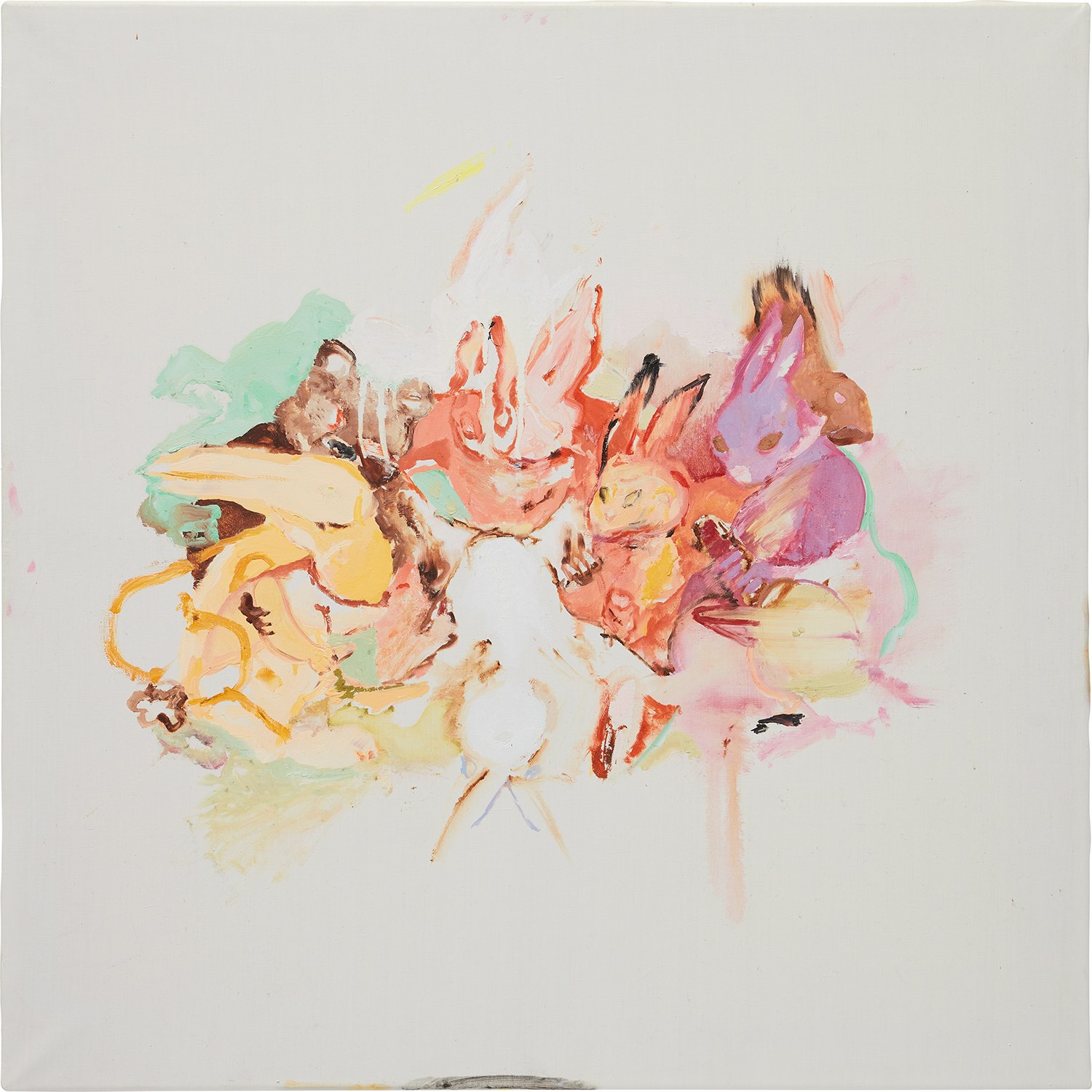
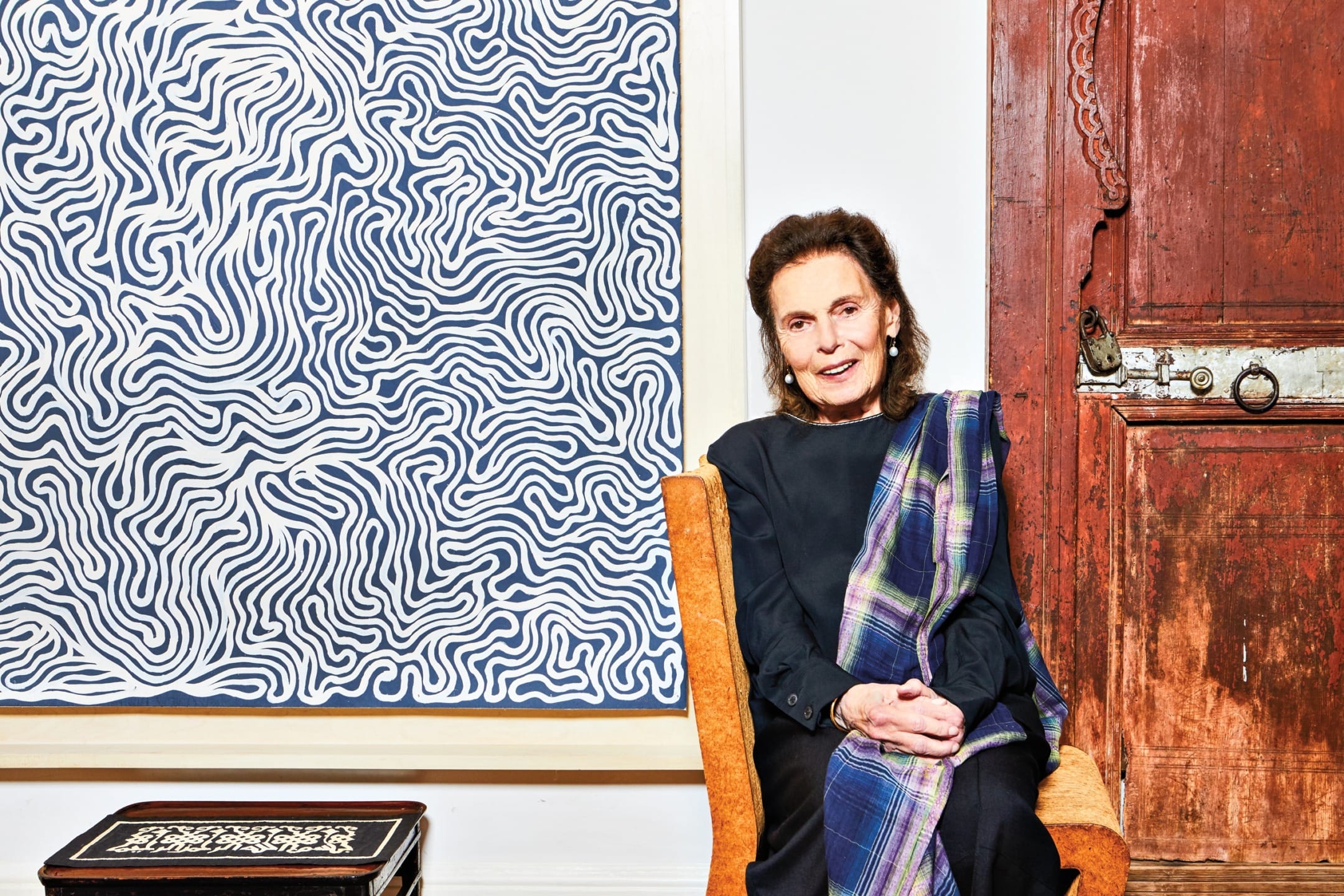
Pat Steir
Small Waterfall, 2014
The Prussian blue that Hokusai used in his celebrated wave prints was a relatively new pigment in Japan when he adopted it, imported from Europe, and yet it reads now as quintessentially Japanese, which tells you something important about how colours acquire cultural meaning over time. In the twentieth century, artists brought entirely new frameworks to the blue and white question. Pat Steir, whose work occupies a fascinating position between gesture and structure, has used the full spectrum of blue in paintings that are simultaneously about process, chance, and the history of mark making. Pablo Picasso, who spent the first years of the century in his so called Blue Period, understood blue as emotionally weighted in a way that no other colour quite matched.
The monochromaticism he practiced in those years was not an absence of colour but a concentration of feeling. Sterling Ruby has approached ceramic tradition from a position of deliberate tension, making work that acknowledges the history of vessel forms while refusing to be contained by it. What makes blue and white so enduringly compelling as a subject for collectors is precisely this layering of meanings. A Qing dynasty blue and white baluster vase and a contemporary work on paper that uses the same palette are not simply connected by colour.
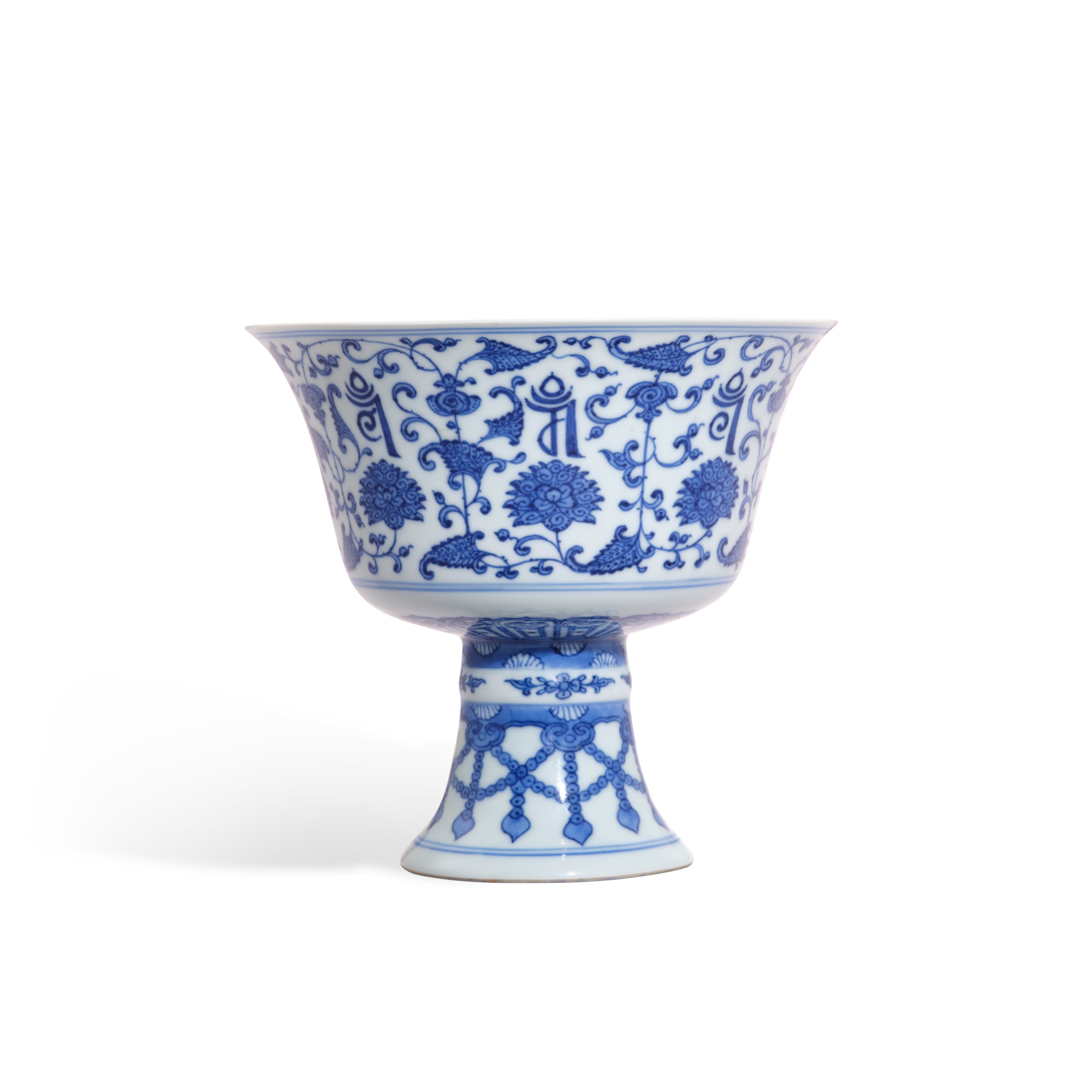
A blue and white 'lança' stem cup
清乾隆 青花梵紋纏枝番蓮紋高足盌 《大清乾隆年製》款
They are connected by a shared set of questions about how we communicate across time, how we signal refinement and learning, and how a visual language can survive radical changes in context and still retain its power. The works on The Collection that fall under this category span centuries and continents, and yet moving through them there is a coherence, a conversation happening across the centuries, that feels genuinely illuminating. The staying power of blue and white in contemporary practice suggests that we are nowhere near exhausting its possibilities. Collectors who engage with this tradition find themselves drawn into one of art history's longest and most democratic stories: a colour combination that has belonged, at various moments, to emperors and to market traders, to Japanese woodblock printers and to French printmakers, to revolutionary Chinese artists and to abstract painters working in New York lofts.
To collect in this space is to participate in something genuinely ongoing. The conversation is still very much alive.