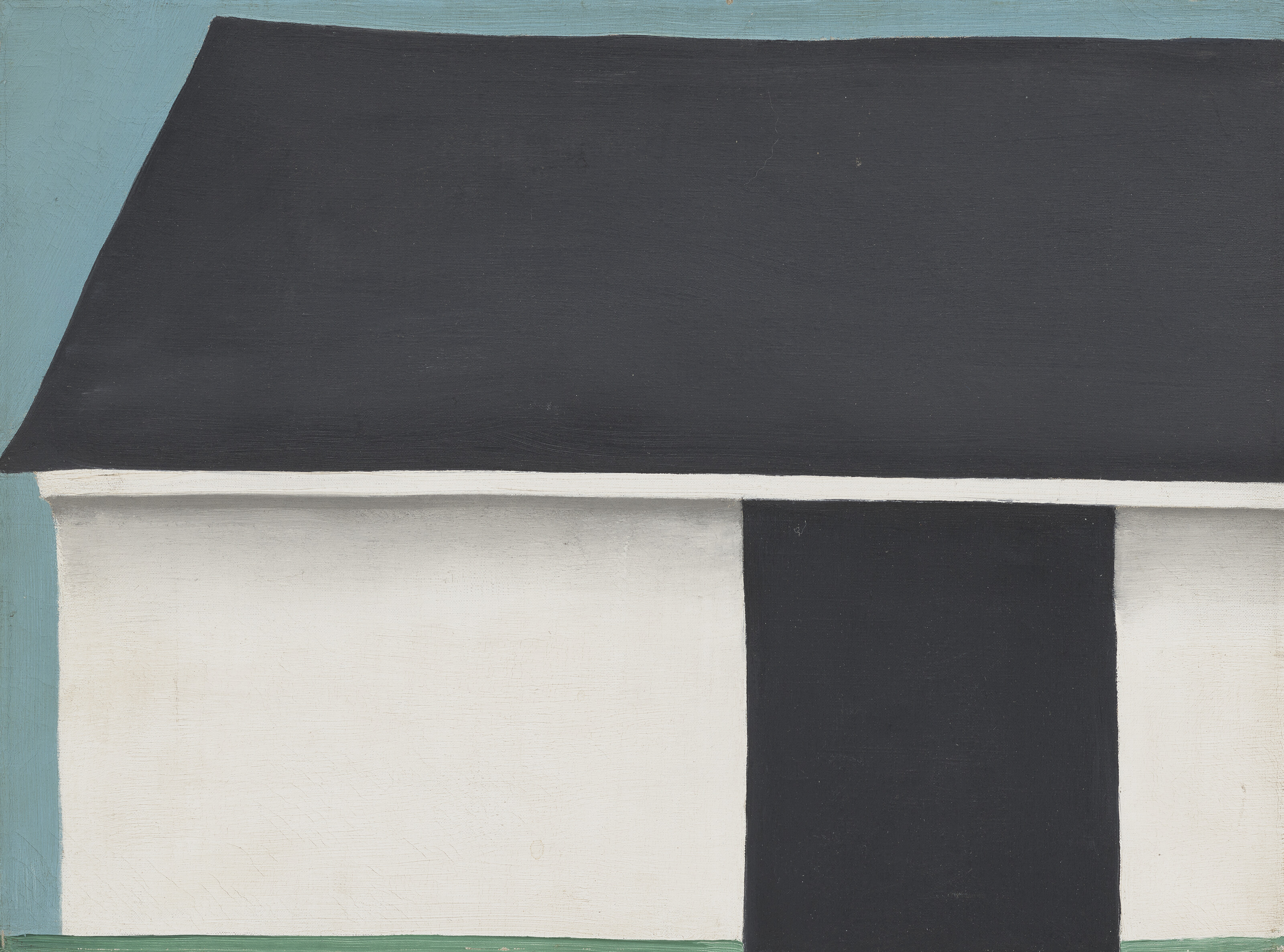
Canadian Barn
"Canadian Barn" by Georgia O'Keeffe presents a stark and simplified vision of rural architecture, stripping the structure down to its most essential forms and lines. With her characteristic ability to transform ordinary subjects into bold, almost abstract compositions, O'Keeffe renders the barn with a quiet intensity that balances geometric precision with organic warmth. The work reflects her enduring fascination with the American landscape and her talent for finding profound beauty in humble, everyday subjects.
- Signed
- Yes
- Spotted At
- Auction House · Christie's
Notes
LITERATURE B.B. Lynes, Georgia O’Keeffe: Catalogue Raisonné, vol. I, New Haven, Connecticut, 1999, p. 499, no. 810, illustrated. EXHIBITED (Probably) New York, An American Place, Arthur G. Dove, John Marin, Georgia O'Keeffe, Pablo Picasso, Alfred Stieglitz, October 17-November 27, 1941, n.p., no. 13. Conditions of sale Brought to you by Quincie Dixon Associate Specialist, Head of Sale Check the condition report or get in touch for additional information about this QDIXON@CHRISTIES.COM +1 212 636 2141 VIEW CONDITION REPORT LOT ESSAY The barn is a very healthy part of me—There should be more of it—It is something that I know too—it is my childhood… Sarah Whitaker Peters Georgia O’Keeffe, White Canadian Barn II, 1932, Metropolitan Museum of Art, New York. Born and raised on a Wisconsin farm, Georgia O’Keeffe absorbed the beauty to be found in the form and function of rural barns from an early age, integrating them into the very fabric of her artistic identity. In the early 20th century, American artists—including photographers such as Charles Sheeler and O’Keeffe’s husband, Alfred Stieglitz—embraced barns as subjects that celebrated vernacular architecture and symbolism of the heartland. For O’Keeffe, however, the barn carried an even deeper resonance: it stood not only as “a building of individuality and practicality,” but also as a “symbol of shelter and abundance,” making it an innately personal theme (S.W. Peters, Becoming O'Keeffe: The Early Years, New York, 1991, p. 281). This connection surfaces vividly in Canadian Barn of 1932, one of seven works inspired by the low white barns she encountered on the Gaspé Peninsula including examples in the Metropolitan Museum of Art, New York and the Detroit Institute of Arts, Michigan. Throughout her career, O’Keeffe found her greatest inspirations by discovering unexpected treasures within her surroundings, whether fragments of nature like her famous flowers and bones or the archetypical architecture of a Southwestern adobe house. Charles C. Eldredge expounds, “A farm child in the Midwest at the turn of the century would naturally have absorbed the rhythms of the seasons, the patterns of growth and decay, the cycles of planting and harvest…O’Keeffe showed how enduring were such lessons from her childhood…Many of O’Keeffe’s most familiar motifs—trees and leaves, flowers and fruit, barns, bones, and landscapes—were the products of an American tradition, of a life in the country close to nature.” (Georgia O’Keeffe: American and Modern, Fort Worth, Texas, 1993, p. 192) The influence of architecture on O’Keeffe’s artwork was evident from the early years of her career when she spent part of each year from 1918 to 1934 at the Stieglitz family estate at Lake George in Upstate New York. In addition to painting striking abstracted landscapes and some of her first magnified flowers, among her most strikingly modern and emotionally resonant works from this period are her architectural paintings of the estate’s farm buildings. Distilling their forms into essential geometric shapes, O’Keeffe produced fourteen works based on the barns at Lake George, including examples at the Georgia O’Keeffe Museum, Santa Fe; Museum of Fine Arts, Boston; and the Walker Art Center in Minneapolis. Left: Alfred Stieglitz, Barn—Lake George, 1922, Art Institute of Chicago, Chicago, Illinois. Right: Georgia O’Keeffe, The Barns, Lake George, 1926, Georgia O’Keeffe Museum, Santa Fe, New Mexico. O’Keeffe also painted barns on a return trip to her Wisconsin childhood home in 1928, painting the distinct red barns of the Midwest in works including an example in the Georgia O’Keeffe Museum. The artist explicitly linked the importance of her barn subjects to her early life in a 1929 letter, writing, “The barn is a very healthy part of me—There should be more of it—It is something that I know too—it is my childhood” (quoted in Modern Nature: Georgia O’Keeffe and Lake George, Glen Falls, New York, 2013, pp. 47–48). In 1932, O’Keeffe’s traveled through the Canadian Gaspé Peninsula, and the environs once again reminded her of home. She later recalled, “That was a wonderful trip...The soil there was a marvelous deep black after it had been turned over, and there were beautiful blossoming potato flowers—very lush” (Roxana Robinson, Georgia O'Keeffe: A Life, New York, 1989, p. 375). The paintings from this trip share a markedly bright palette of blues, greens, and stark whites that convey a sense of clarity, renewal and spiritual uplift. Although she had traveled to Canada partly to escape the strain of her deteriorating marriage, these austere, sun‑drenched works reflect the optimism and emotional refreshment that can accompany a change of scenery. In contrast to the moodier tones of her earlier Lake George barn paintings or the sharp reds of the Wisconsin barns, the Canadian Barn series reveals a shift in feeling most vividly through its luminous, expressive use of pure, clear color. Left: Charles Demuth, My Egypt, 1927, Whitney Museum of American Art, New York. Right: Charles Sheeler, Bucks County Barn, c. 1917, gelatin-silver print, The Lane Collection. © Estate of Charles Sheeler. Reveling in the barn’s structural simplicity, O’Keeffe’s Canadian Barn emphasizes the structure’s essential lines and forms. The extreme cropping and strict attention to shadow evoke a Precisionist sensibility reminiscent of contemporaries such as Charles Demuth and the photography of Charles Sheeler. Yet O’Keeffe’s approach remains distinctly her own. The barn may be reduced to a few emphatic rectangles such as the black roof, the white wall, the dark central opening, but subtle modulations of tone, softened edges, and the quiet drag of the brush animate the otherwise austere composition. By monumentalizing the protective roof, staging the central opening as a store of interior depth, and reducing the building to a vernacular archetype, O’Keeffe’s formal choices anchor the barn’s American associations of home and memory into the language of modernist abstraction. READ MORE OF THE LOT ESSAY
🔨 Auction Lot
Modern American Art
April 16, 2026
Estimate: $500,000 – $700,000
Lot 8
More by Georgia O'keeffe
Start the Discussion
Request access to join the discussion