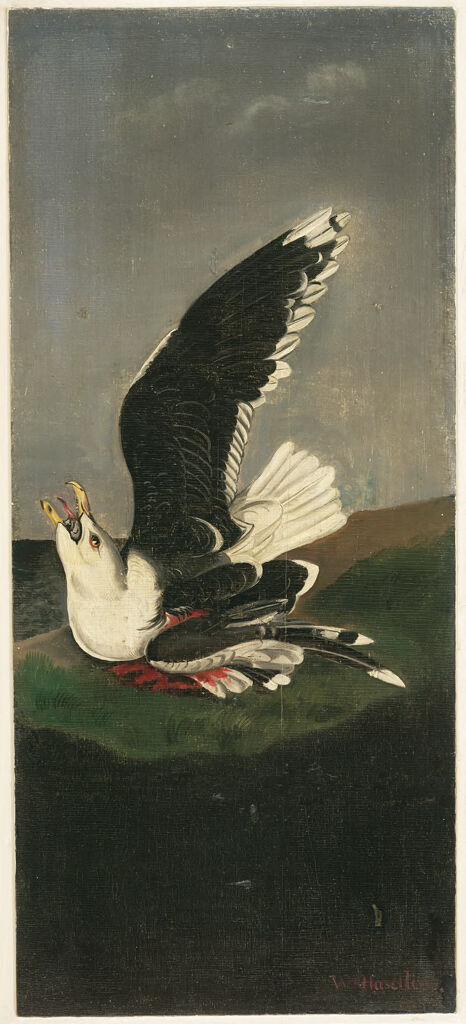
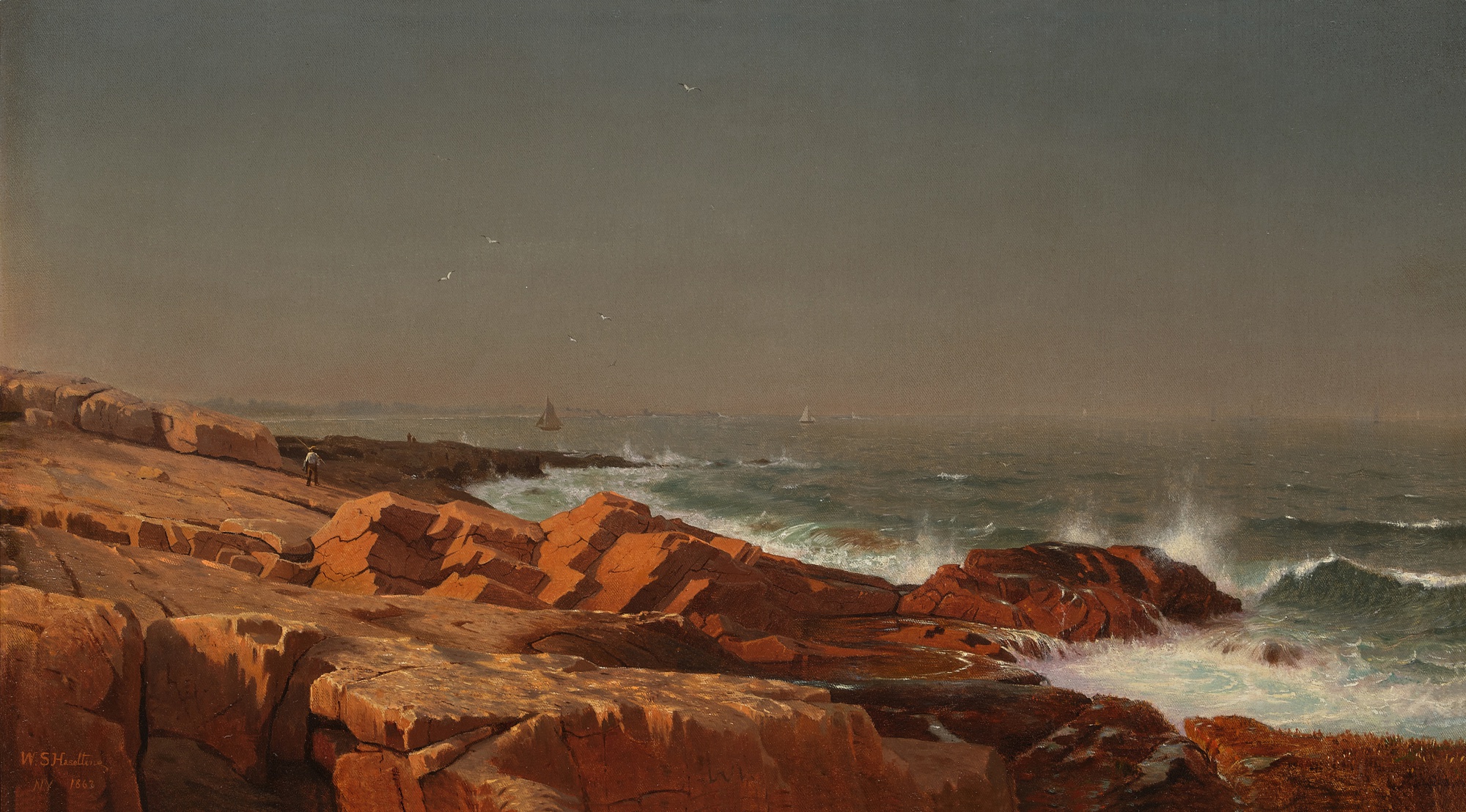
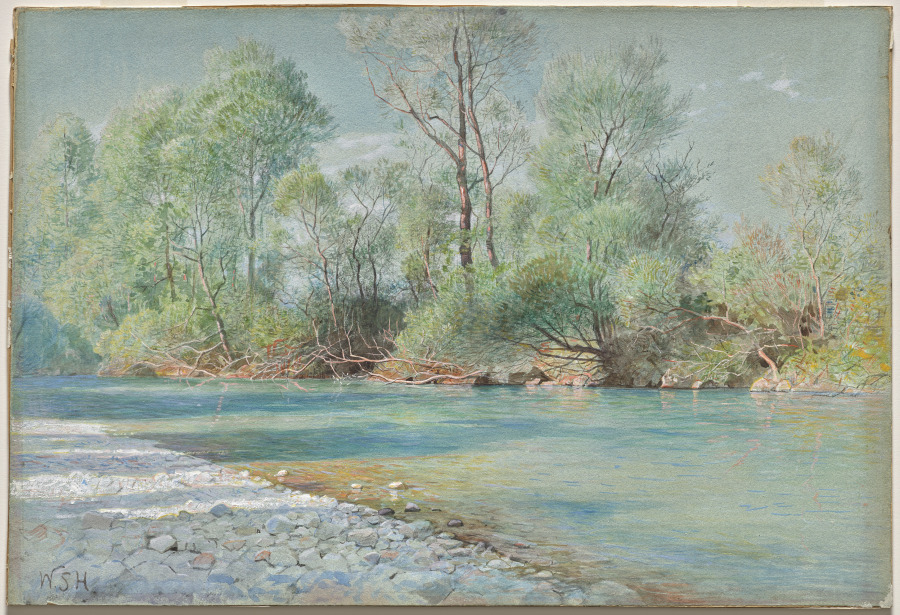
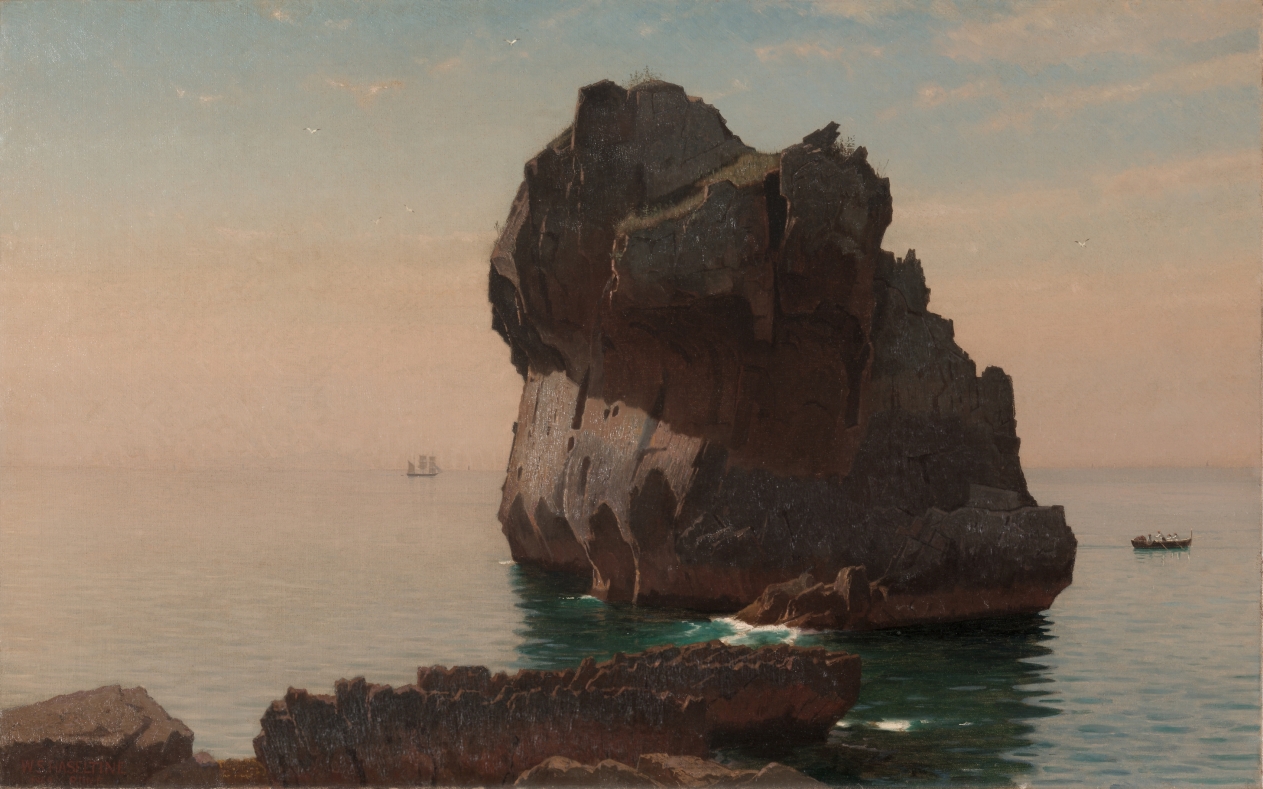
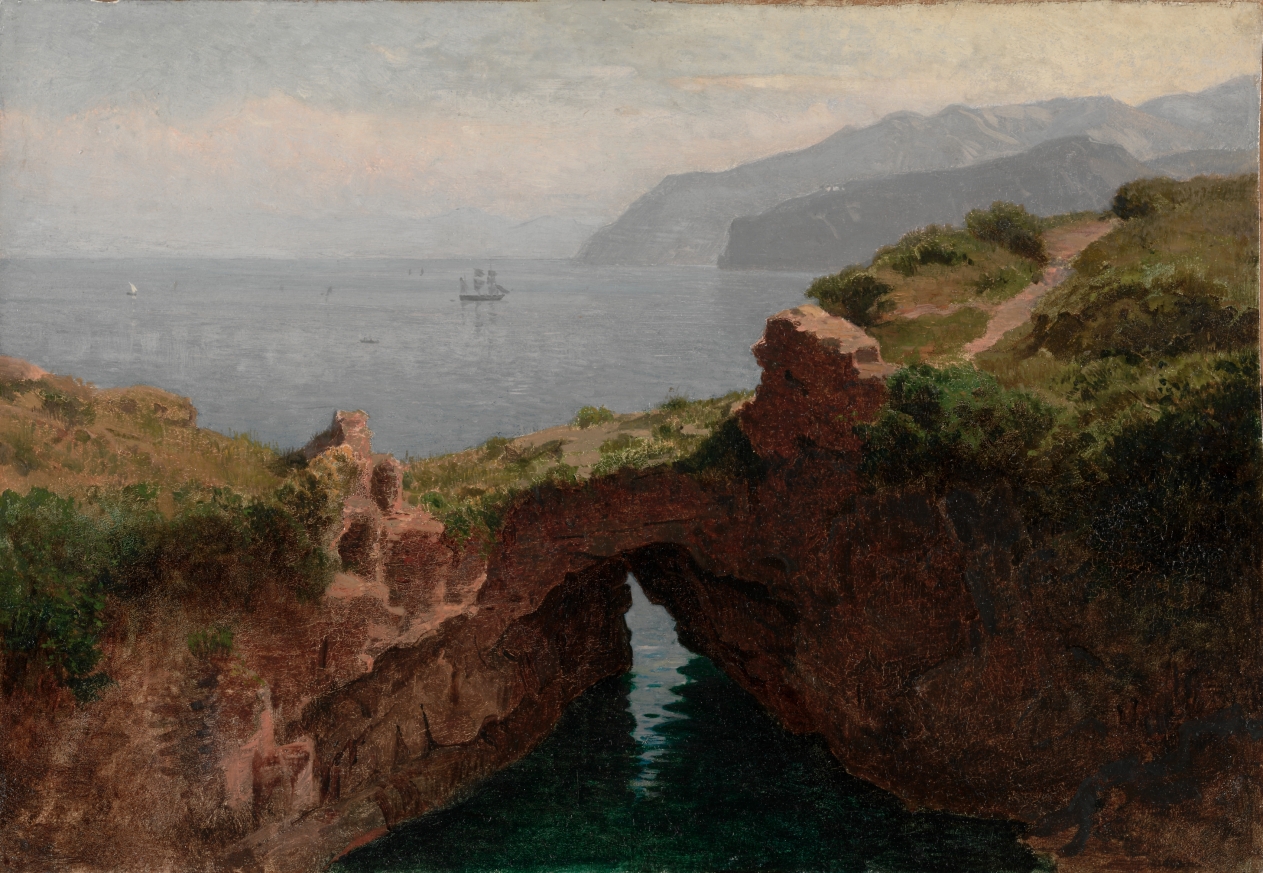
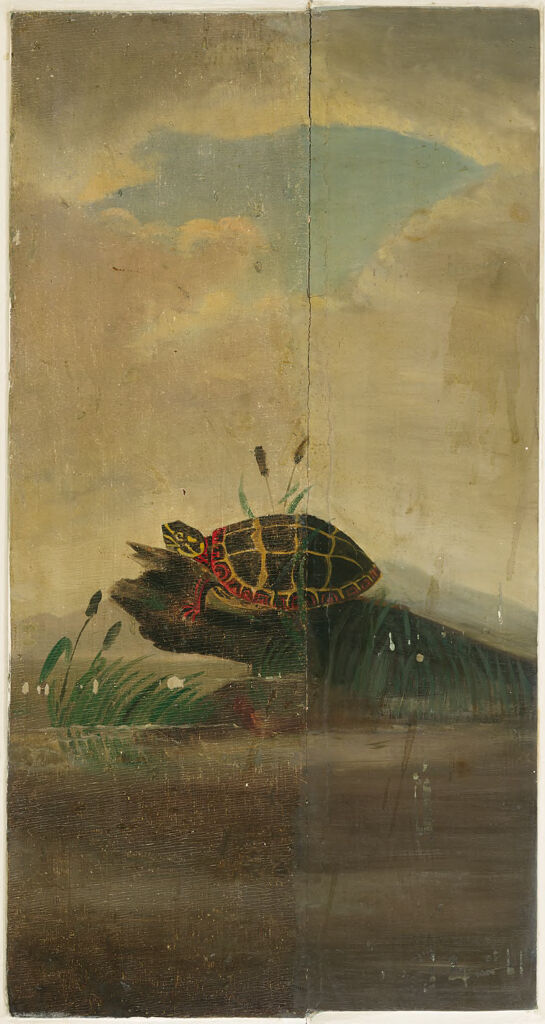
Stand before William Stanley Haseltine's "Rocks at Halibut Point, Cape Ann, Massachusetts" and something immediate happens. The granite slabs push forward from the canvas with an almost physical weight, their surfaces catching salt light in a way that feels less like painting and more like geology made radiant. It is a reminder that Haseltine was not merely a landscape painter but something closer to a natural philosopher with a brush, a man who understood that rock and water and atmosphere were not separate subjects but one continuous argument about the nature of the visible world. More than a century after his death in 1900, that argument still compels. William Stanley Haseltine was born in Philadelphia in 1835 into a family of culture and means. His father was a successful merchant with a genuine appreciation for art, and the household gave the young Haseltine early exposure to the kind of refined visual thinking that would later define his practice. He studied at Harvard in the early 1850s, where he came under the influence of Lefevre James Cranstone and began sketching with serious purpose. What followed was the formative journey that shaped a generation of American painters: he crossed the Atlantic to study in Düsseldorf, arriving around 1854 and entering the orbit of that city's celebrated academy, where a rigorous approach to draftsmanship, tonal discipline, and the close observation of nature was instilled with almost monastic intensity. The Düsseldorf school left its mark on Haseltine in ways both obvious and subtle. The precision that would become his trademark, that almost scientific fidelity to the specific texture of a cliff face or the way lichen colonizes a tidal shelf, owes much to the German tradition of meticulous preparation and careful study. But Haseltine was also absorbing the influence of the Hudson River School, whose leading figures, including Frederic Edwin Church and John Frederick Kensett, were transforming American landscape painting into a vehicle for spiritual and national feeling. Haseltine synthesized these two streams, European rigor and American romanticism, into something distinctly his own. By the late 1850s he had returned to the United States and was painting the coastlines of New England with a concentration that set him apart from his contemporaries. The Cape Ann paintings, made along the rocky Massachusetts shore during the late 1850s and into the 1860s, represent the great American chapter of his career. Works like "Rocks at Halibut Point" demonstrate what made Haseltine singular: where other luminists dissolved form into atmosphere, Haseltine held both simultaneously. His rocks are specific. They have grain and fissure and mineral character. Yet the light that falls across them is transcendent, that particular northern coastal light that seems to arrive from everywhere at once. He painted in oils with a controlled, almost architectural touch, building surfaces that reward close looking. These canvases circulated among collectors in New York and Boston, and Haseltine earned a reputation as one of the most technically gifted landscape painters of his generation. In 1866 Haseltine moved to Rome, a decision that opened the second and equally rich chapter of his artistic life. The expatriate community in Rome during the latter half of the nineteenth century was remarkable, drawing writers, sculptors, and painters from across America and northern Europe into a shared conversation about antiquity, beauty, and the purpose of art. Haseltine became a celebrated figure in this world, eventually settling with his family in the Palazzo Altieri, where his home and studio became a salon of genuine distinction. The Italian landscape offered him new material: the volcanic coastline of Capri, the sea caves and natural arches of Sorrento, the warm southern light that behaved so differently from the crystalline clarity of Cape Ann. His 1869 canvas "Capri" and the earlier "Natural Bridge, Sorrento" from 1856 show how fluidly he adapted his practice to Mediterranean conditions, retaining the geological precision while allowing color to open and warm. These Italian works are luminous in a different register, full of ochre and cerulean and the particular haze that rises off the Tyrrhenian Sea in summer. Haseltine was also a gifted draughtsman and watercolorist, and the works on paper in his output deserve particular attention from collectors. "Traunstein River on the Road to Empfig, Bavaria" from 1893, executed in watercolor and gouache on blue paper, reveals a side of his practice that is more intimate and experimental than the large exhibition oils. The blue paper ground creates a unifying cool tone that the gouache highlights push against with confident economy. These works on paper were often made during travels and served as both studies and finished objects in their own right. They offer a more spontaneous encounter with Haseltine's eye and hand, and they represent an accessible point of entry for collectors building a relationship with his work. Among the most intriguing objects in Haseltine's surviving output are two early panels from 1853: "Great Black backed Gull, after Audubon" and "Tortoise Resting on a Log," both painted in oil on wooden door panels. These works, made when Haseltine was just eighteen years old, speak to an almost obsessive observational instinct that preceded any formal training in Europe. The Audubon reference is significant, placing the young Haseltine in direct conversation with America's great tradition of natural history illustration and scientific looking. These panels are curiosities in the best sense, objects that illuminate how a major artistic sensibility begins to form. For collectors, Haseltine occupies an interesting position in the market for nineteenth century American landscape painting. He is firmly canonical, included in major museum collections including the Metropolitan Museum of Art in New York and the Smithsonian American Art Museum in Washington, and his work appears regularly at the major American auction houses. The Cape Ann oils command the strongest prices, reflecting both their quality and their central place in the narrative of American luminism. Italian subject works in oil are also actively sought, particularly those with strong coastal architecture or the dramatic natural formations, sea arches and sculpted cliffs, that Haseltine rendered with such authority. Works on paper offer a more varied market, with the finest watercolors and gouaches attracting serious attention from collectors who appreciate the directness and spontaneity they reveal. Haseltine belongs to a lineage that includes Kensett, Church, and Martin Johnson Heade among his American contemporaries, and his European formation connects him to the broader tradition of landscape realism that runs from the Düsseldorf school through the later plein air movements of France and Italy. He anticipates in certain ways the geological romanticism of later painters drawn to the American coast, and his influence, though quiet, has been acknowledged by artists and scholars working to recover the full depth of the Hudson River School tradition. His legacy is one of patient, luminous intelligence: a painter who looked at the world with extraordinary care and returned from each looking with something true.