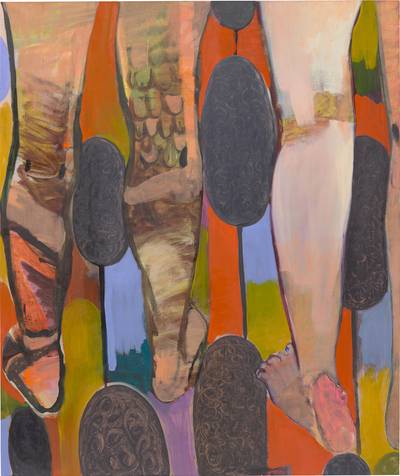
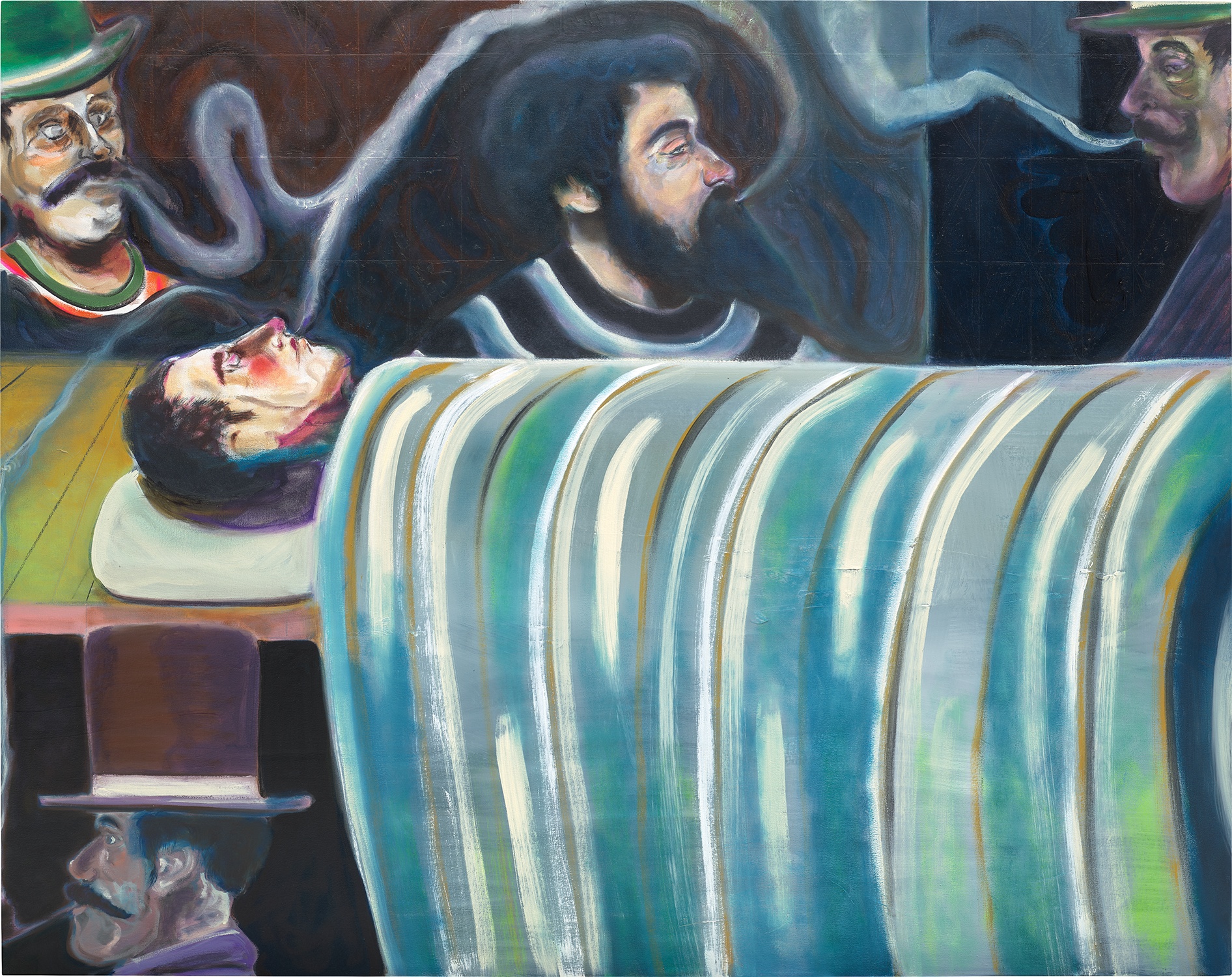
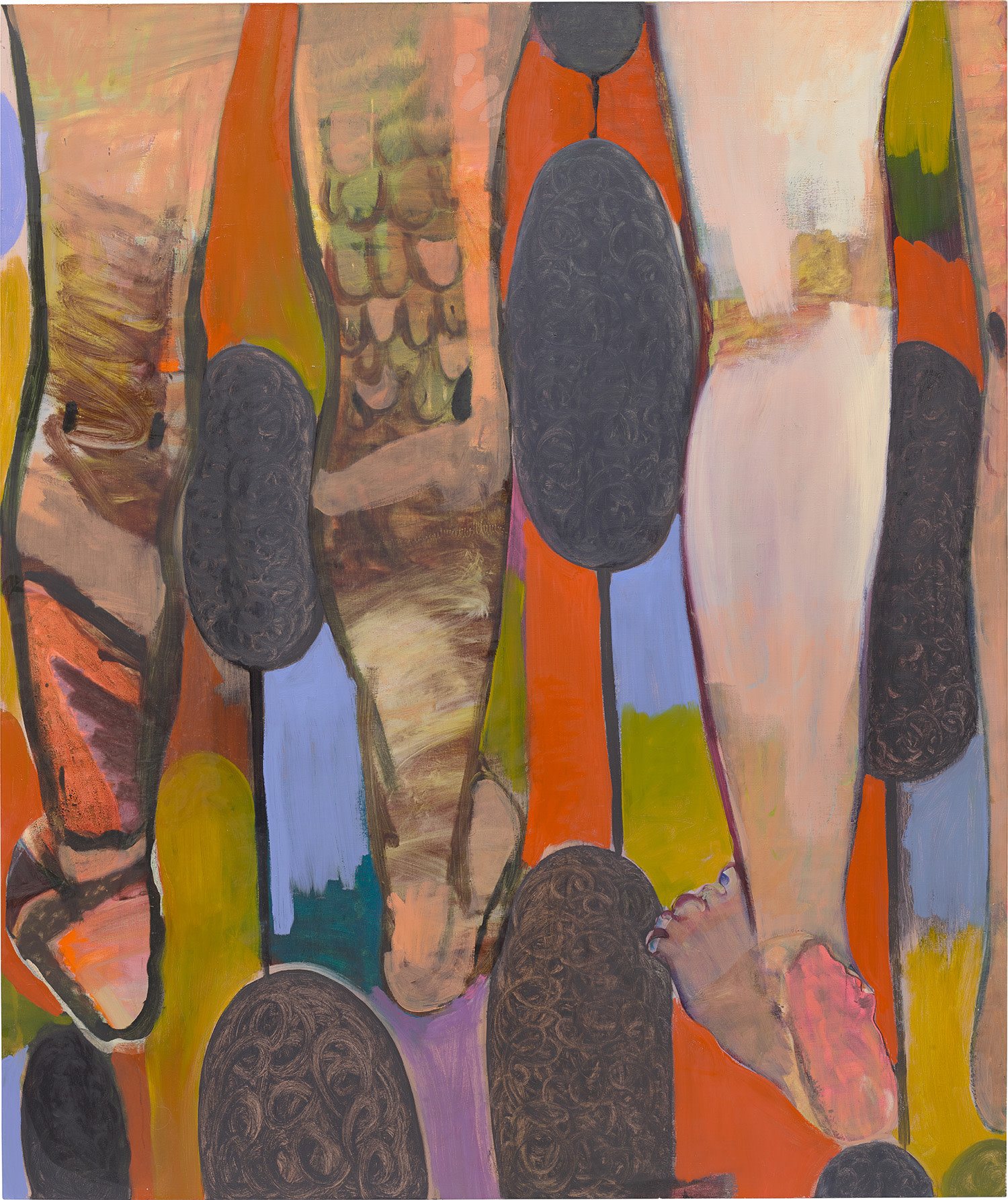
Something quietly remarkable has been unfolding in contemporary British painting, and Ryan Mosley sits at its most compelling edge. Over the past several years, Mosley has built a body of work that feels genuinely unlike anything else being made today, a sustained act of imaginative courage that rewards collectors who take the time to look closely. His ongoing relationship with Alison Jacques Gallery in London has brought his paintings to an increasingly international audience, and institutional interest in his work continues to grow as curators and critics recognise the depth and ambition behind what might first appear, deceptively, as pure visual pleasure. Mosley was born in 1980 and grew up in Britain during a period when figurative painting was both unfashionable and, for precisely that reason, quietly radical. The generation that shaped him had watched abstraction dominate critical conversation for decades, and yet there remained a stubborn, vital tradition of painterly figuration running through British art, from the grand eccentricities of the Royal Academy to the rawer energies of the London School. Mosley absorbed all of this and added something of his own, a genuine fascination with the older European traditions of carnival, theatrical spectacle, and folkloric imagery that stretches back centuries before the modern era ever arrived. His training and early development gave him a rigorous foundation in the craft of painting, and this shows in every canvas he makes. What distinguishes Mosley from many of his contemporaries is the seriousness with which he engages with art history as a living resource rather than a museum relic. The Old Masters, particularly the great Flemish and Northern European painters, inform the way he builds light, constructs a figure, and allows shadow to do meaningful work within a composition. Yet he never allows this historical consciousness to become pastiche or nostalgic costuming. His paintings feel rooted in the past and utterly alive in the present moment simultaneously. The figures that populate his canvases are among the most original inventions in contemporary painting. Jesters, masked revellers, enigmatic wanderers, and theatrical characters inhabit his compositions with a sense of ritualised purpose that suggests both comedy and melancholy without tipping entirely into either. These are not illustrations of a story but rather presences, beings caught in some perpetual interlude between performance and revelation. His gestural, expressionistic handling of paint gives these figures a physical urgency that pulls the viewer into the canvas, while the compositional intelligence ensures there is always more to discover the longer one spends with the work. The paint itself becomes a kind of performance, bold and searching at the surface while building quietly complex depths beneath. Among his most celebrated works, Studio Legs from 2009, executed in oil on linen, represents an early statement of his ambitions and his confidence. The work demonstrates the ease with which Mosley inhabits his own visual language, using the studio setting as a site of psychological and painterly inquiry rather than mere documentation. A decade later, Nocturnal Spirit from 2019, oil on canvas, shows the full maturity of that language. The nocturnal paintings represent some of his most searching work, canvases in which darkness becomes generative rather than simply atmospheric, giving his figures a spectral luminosity that feels earned rather than affected. Between these two works one can trace the arc of an artist deepening and expanding a practice with admirable consistency of purpose. From a collecting perspective, Mosley represents something genuinely valuable in the current landscape: an artist of proven quality and institutional credibility whose work remains accessible to a range of collectors while demonstrating clear long term significance. Collectors who have followed his career since his early exhibitions understand that his paintings reward sustained attention and improve in the company of other serious works. There is a sociability to Mosley's paintings, in the best sense, they animate a room, they invite conversation, they change as the light shifts and as the viewer's own mood shifts. These are qualities that distinguish genuinely great paintings from merely accomplished ones, and they are qualities Mosley possesses in abundance. Mosley's work sits in fascinating dialogue with a wider tradition of British and European figurative expressionism. One thinks of the psychological intensity of Frank Auerbach and Leon Kossoff, artists who understood paint as a form of thought rather than simply a medium for recording appearances. One also thinks of earlier European figures such as James Ensor, whose carnival masks and grotesque festivities share something of Mosley's theatrical imagination, and of Paula Rego, whose narrative figuration similarly draws on folklore and theatre as sources of psychological truth. Mosley is not derivative of any of these predecessors but he belongs to the same serious tradition, artists who believe that painting, in its most ambitious form, can hold the full complexity of human experience. What makes Ryan Mosley matter today, in a cultural moment saturated with images and often dismissive of the slow, considered pleasures of painting, is precisely his refusal to simplify or accelerate. His canvases demand and reward patience. They operate according to their own internal logic, a logic drawn from centuries of painterly thinking and from a genuinely original vision of what human figures, caught in their strange costumes and rituals, can tell us about the world we actually inhabit. For collectors building serious collections of contemporary British painting, Mosley is not a peripheral figure or an interesting footnote. He is one of the central and most rewarding voices of his generation, and the work he continues to make confirms that the best may still be ahead.