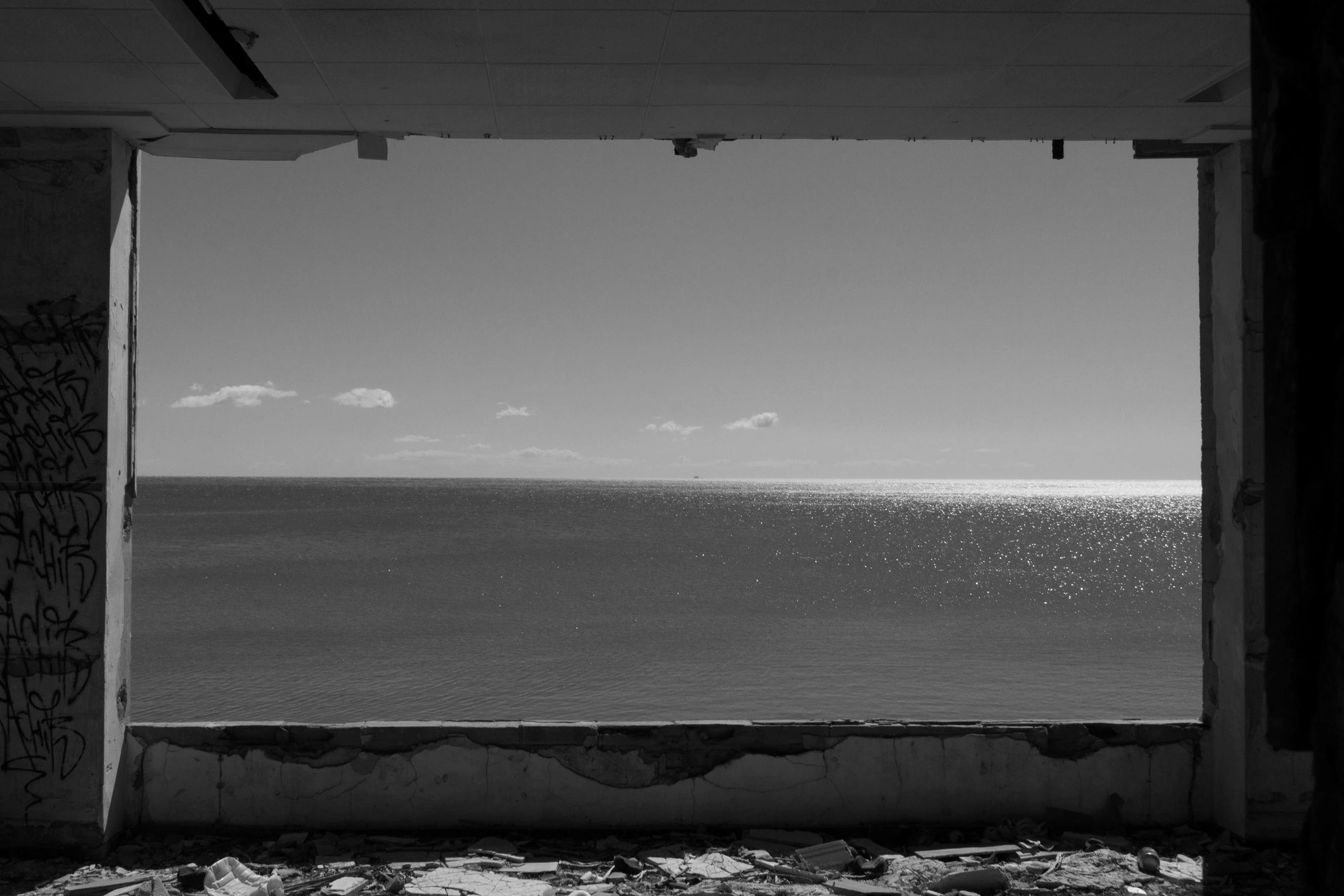
There are artists who document the world as it is, and then there are artists who reveal the world as it feels. Ruben Tomas belongs firmly to the second category. His work has been quietly earning the attention of discerning collectors who recognize something rare in his images: a capacity to hold two opposing forces in perfect, trembling balance. Whether encountered in a gallery setting or through the intimate experience of living with a print on a wall, his photographs ask the viewer to slow down, to breathe, and to look again at the elemental boundaries where the natural world meets itself. The conversation around Tomas centers on his ability to transform landscape photography into something that transcends the documentary impulse. He is not simply recording a place. He is capturing the emotional frequency of a threshold, the charged and uncertain space where ocean meets land, where light negotiates with shadow, where the familiar becomes genuinely mysterious. This is not a minor achievement. The history of landscape photography is littered with technically accomplished images that ultimately say very little. Tomas says a great deal, and he does so with an economy and restraint that feels deeply considered. While the full arc of Tomas's biographical formation remains closely held, his work speaks to an artist shaped by proximity to coastlines and an understanding of how bodies of water hold memory. There is in his practice a sensibility that suggests long hours spent observing tidal rhythms, an intimate familiarity with the way morning light behaves differently over salt water than it does over fresh, and a genuine reverence for geological time as experienced through erosion and accumulation. These are not qualities that can be manufactured or borrowed. They arise from sustained attention paid over years. The development of Tomas's artistic practice reflects a commitment to the fine art print as a complete and finished object, not merely a reproduction of a photographic file. His choice to work with Hahnemuhle Photo Matte paper signals a particular seriousness about the relationship between image and substrate. Hahnemuhle has been synonymous with archival quality and fine art reproduction since the late sixteenth century, and photographers who choose it understand that the surface of a print is itself a statement about permanence, about the intention to endure. The matte finish eliminates glare and invites the eye into the image rather than bouncing it back, creating a contemplative encounter that is fundamentally different from the experience of a glossy or metallic surface. Among the works available through The Collection, "Ocean Land" stands as a compelling entry point into Tomas's vision. Presented as a print on Fine Art Hahnemuhle Photo Matte paper and housed in a black wood frame with plexi, the work demonstrates how thoughtfully considered presentation can elevate a photographic image into a fully realized art object. The framing choice is not incidental. The black wood grounds the composition without competing with it, while the plexi creates a subtle layering effect, a slight sense of depth between viewer and image, that mirrors the thematic content of the work itself. You are looking at distance. You are looking at depth. And the physical object reminds you of that at every level. For collectors, the appeal of Tomas's work resides in several converging qualities. First, there is the visual intelligence of the images themselves, the way they reward extended looking and reveal new tonal relationships and spatial tensions upon return visits. Second, there is the material integrity of the editions, produced with archival standards that ensure longevity and stability over time. Third, and perhaps most importantly for those building a serious collection, there is the sense that one is acquiring work at a meaningful moment in an artist's trajectory, before institutional recognition catches up to what the most attentive eyes already understand. The collectors who recognized Wolfgang Tillmans in the early 1990s, or who followed Rinko Kawauchi's work from her earliest Japanese publications in the early 2000s, will understand this particular pleasure. In terms of artistic context, Tomas occupies a space that resonates with a broader lineage of artists committed to the poetics of the natural world rendered through the photographic lens. His attention to coastal landscape invites comparisons with the long tradition of artists drawn to the edge of the sea as a site of philosophical inquiry, from the nineteenth century Romanticism of Caspar David Friedrich to the cooler, more structural investigations of contemporary photographers like Hiroshi Sugimoto, whose ocean series has defined a benchmark for meditative seascape work. Where Sugimoto pursues a kind of radical reduction, Tomas appears more interested in the complexity of what accumulates at the shoreline, the geology, the light, the sense of ongoing negotiation between elements that are never quite at rest. The legacy that Tomas is building, work by work and print by print, is one rooted in attentiveness. In an era of overproduction and visual saturation, the decision to make images that ask for stillness and sustained looking feels almost countercultural. It is a legacy that aligns him with artists who understood that the most powerful images are often the quietest ones, that restraint is itself a form of generosity toward the viewer. To collect Tomas now is to participate in the early chapters of a story that has every indication of unfolding beautifully, and to own a piece of that ongoing conversation between the human eye and the endlessly patient natural world.